
This topic uses the AIM Learning Cycle to help MBBS students understand the structural and developmental organization of the oral cavity and tongue by integrating Anatomy, Embryology and Histology.
1. Curriculum Coverage
Anatomy
• Musculature of tongue
• Nerve supply of tongue
Embryology
• Developmental events of tongue
• Anomalies of tongue development
Histology
• Microscopic structure of lips
• Histological structure of tooth (longitudinal & transverse section)
• Histology of tongue
• Differences between anterior 2/3 and posterior 1/3 of tongue
ENT / Clinical
• Causes of oral ulcerations
• Aphthous ulcers and treatment
📚Standard Reference Framework
Primary Anatomy Reference
BD Chaurasia — Standard Undergraduate Depth
Concept Support:
Gray’s Anatomy for Students
Spatial Atlas:
Netter Atlas
Physiology:
Guyton & Hall
Histology:
DiFiore Atlas
Biochemistry:
Lippincott Illustrated Reviews
🎯Depth Policy
All content is restricted to Undergraduate MBBS Level.
Depth will not exceed BD Chaurasia standard.
2. Learning Material
1️⃣ INTRODUCTION
The oral cavity and tongue form the beginning of the digestive tract and play a critical role in mastication, speech, taste, and swallowing. The tongue is a muscular organ located in the floor of the mouth, while the lips and teeth form the entrance and functional framework of the oral cavity.
Understanding this topic is essential because many clinical conditions such as oral ulcers, tongue paralysis, and developmental anomalies arise from defects in structure or nerve supply. The histology of lips, tongue, and teeth explains how these organs withstand mechanical stress and infection.
This topic integrates Anatomy, Embryology, Histology, and Clinical Medicine, making it highly relevant for both examinations and clinical understanding.
2️⃣ FOUNDATION BASICS
Key Definitions
• Oral cavity → First part of digestive tract bounded by lips, cheeks, palate, tongue, and teeth
• Tongue → Muscular organ involved in taste, speech, swallowing, and food manipulation
• Papillae → Surface projections on tongue responsible for taste and friction
• Intrinsic muscles → Muscles that change shape of tongue
• Extrinsic muscles → Muscles that move tongue position
• Lingual nerve → Nerve supplying general sensation to anterior tongue
• Aphthous ulcer → Painful superficial ulcer of oral mucosa
3️⃣ CORE LEARNING — CURRICULUM COVERAGE
ANATOMY
Musculature of Tongue
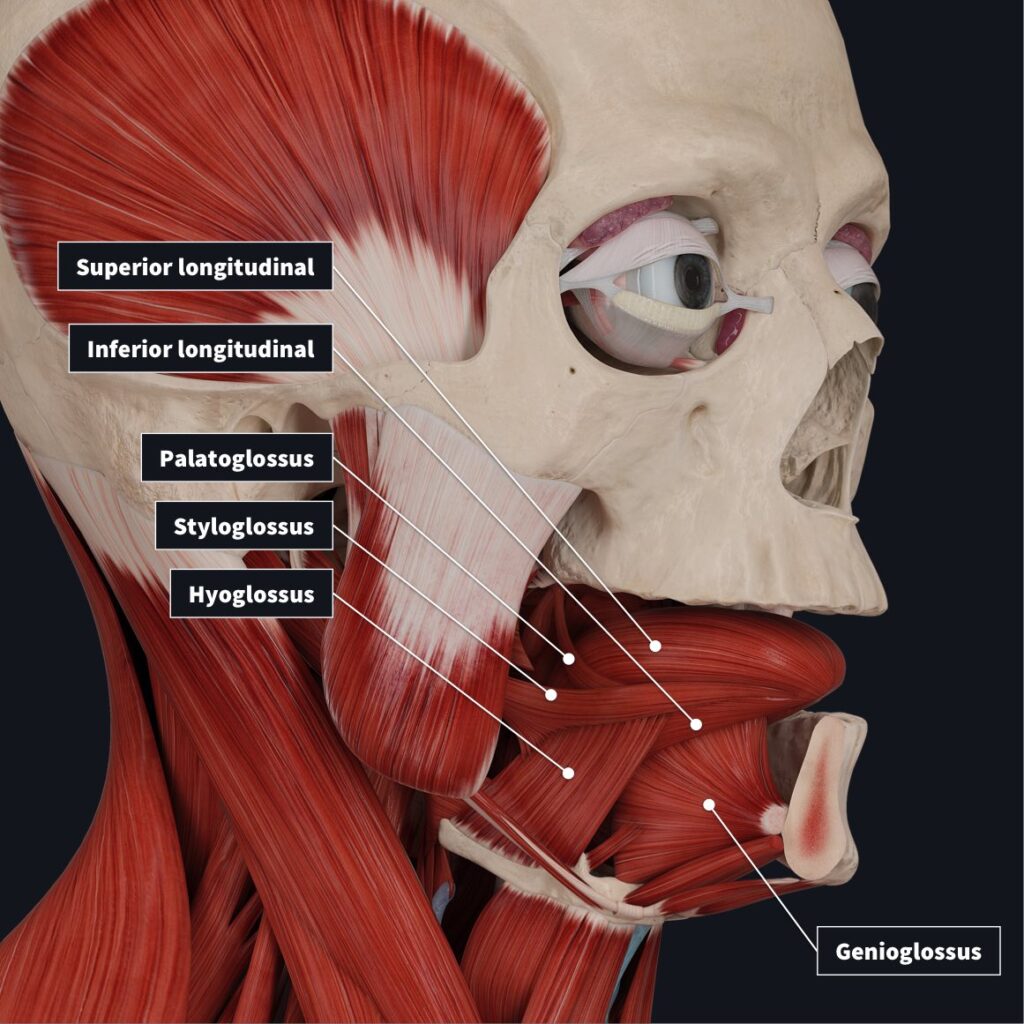
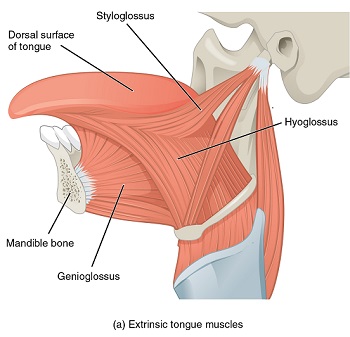
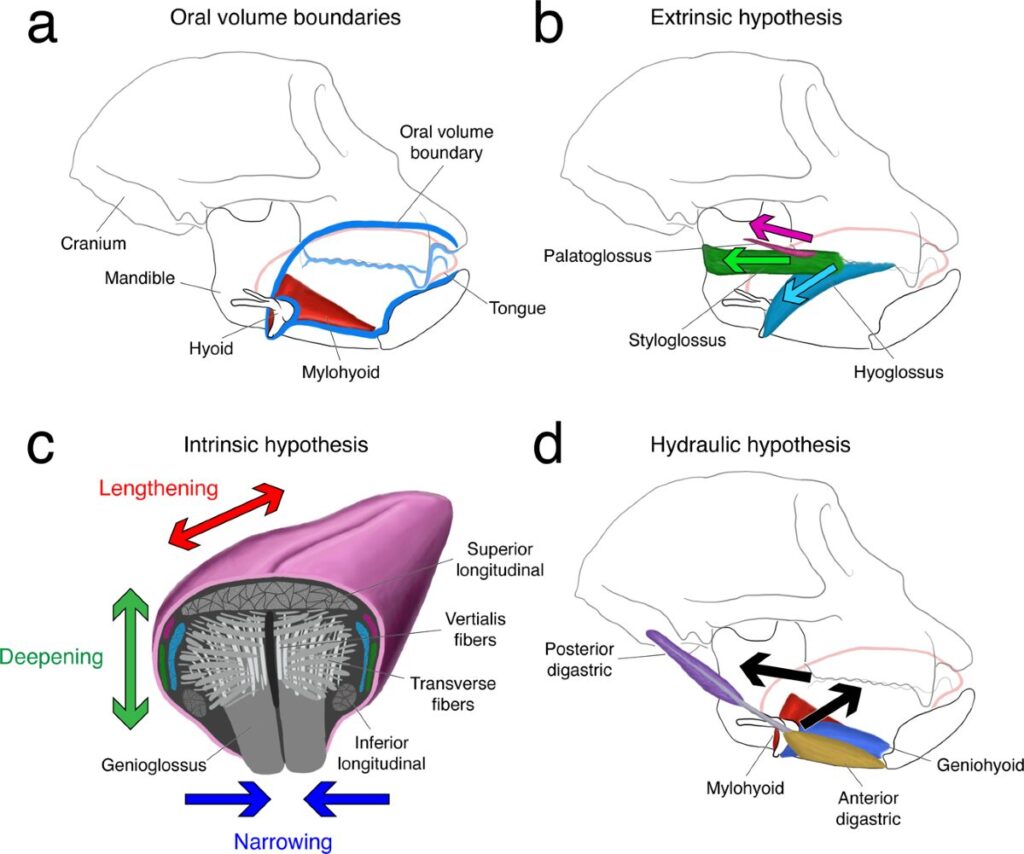
🧠 CORE
Definition:
Muscles of the tongue are skeletal muscles responsible for movement and shape control.
Major Components:
Intrinsic Muscles (Shape change)
• Superior longitudinal
• Inferior longitudinal
• Transverse
• Vertical
Extrinsic Muscles (Position change)
• Genioglossus
• Hyoglossus
• Styloglossus
• Palatoglossus
Primary Function:
• Speech articulation
• Food manipulation
• Swallowing
• Maintaining airway patency
🔬 CONCEPT EXPLAINED
Superior Longitudinal
Functional Role → Curls tip upward
Structure → Function:
Because fibers run in multiple directions, the tongue can change shape precisely, enabling speech articulation.
Location → Near dorsal surface
Fiber Direction → Anterior ↔ Posterior
Action → Shortens tongue
Inferior Longitudinal
- Location → Near ventral surface
- Fiber Direction → Anterior ↔ Posterior
- Action → Shortens tongue
- Functional Role → Curls tip downward
- Transverse
- Location → From median septum → lateral sides
- Fiber Direction → Medial ↔ Lateral
- Action → Narrows tongue
- Functional Role → Makes tongue long and narrow
- Vertical
- Location → Dorsal → Ventral surfaces
- Fiber Direction → Superior ↔ Inferior
- Action → Flattens tongue
- Functional Role → Broadens tongue
Extrinsic Muscles — Position Control
These muscles originate outside the tongue and insert into it.
Genioglossus
Origin → Superior mental spine of mandible
Insertion → Entire tongue
Action → Protrudes tongue
Functional Role → Prevents airway obstruction during sleep
Hyoglossus
Origin → Hyoid bone
Insertion → Side of tongue
Action → Depresses tongue
Styloglossus
Origin → Styloid process
Insertion → Side of tongue
Action → Retracts tongue
Palatoglossus
Origin → Soft palate
Insertion → Tongue
Action → Elevates posterior tongue
Structure → Function:
Extrinsic muscles allow movement in all directions, necessary for swallowing and speech.
⚠️ IF DAMAGED
Cause → Effect
Hypoglossal nerve injury → Tongue paralysis →
Tongue deviates toward injured side → Speech difficulty → Swallowing difficulty
Nerve Supply of Tongue
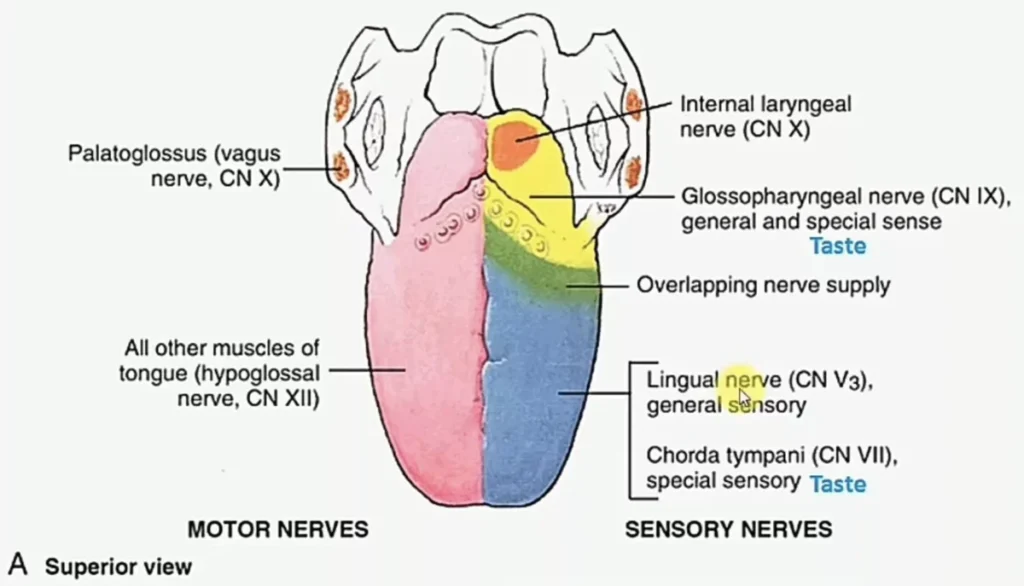
🧠 CORE
Major Nerves:
Motor Supply:
• Hypoglossal nerve (CN XII) → All tongue muscles
• Palatoglossus → Vagus nerve (CN X)
Sensory Supply:
Anterior 2/3:
• General sensation → Lingual nerve (CN V3)
• Taste → Chorda tympani (CN VII)
Posterior 1/3:
• General sensation → Glossopharyngeal nerve (CN IX)
• Taste → Glossopharyngeal nerve (CN IX)
Posterior-most part:
• Vagus nerve (CN X)
🔬 CONCEPT EXPLAINED
Nerve → Muscle → Movement → Function
Example:
Hypoglossal nerve → Tongue muscles → Tongue protrusion → Speech & swallowing
Taste fibers from facial nerve travel through chorda tympani to detect taste from anterior tongue.
Structure → Function:
Multiple nerve supply ensures precise sensory and motor control, essential for taste and articulation.
⚠️ IF DAMAGED
Lingual nerve injury → Loss of sensation →
Food injury unnoticed → Tongue biting
Chorda tympani damage → Loss of taste →
Reduced appetite
Blood Supply of Tongue
🧠 CORE
Primary Arterial Supply:
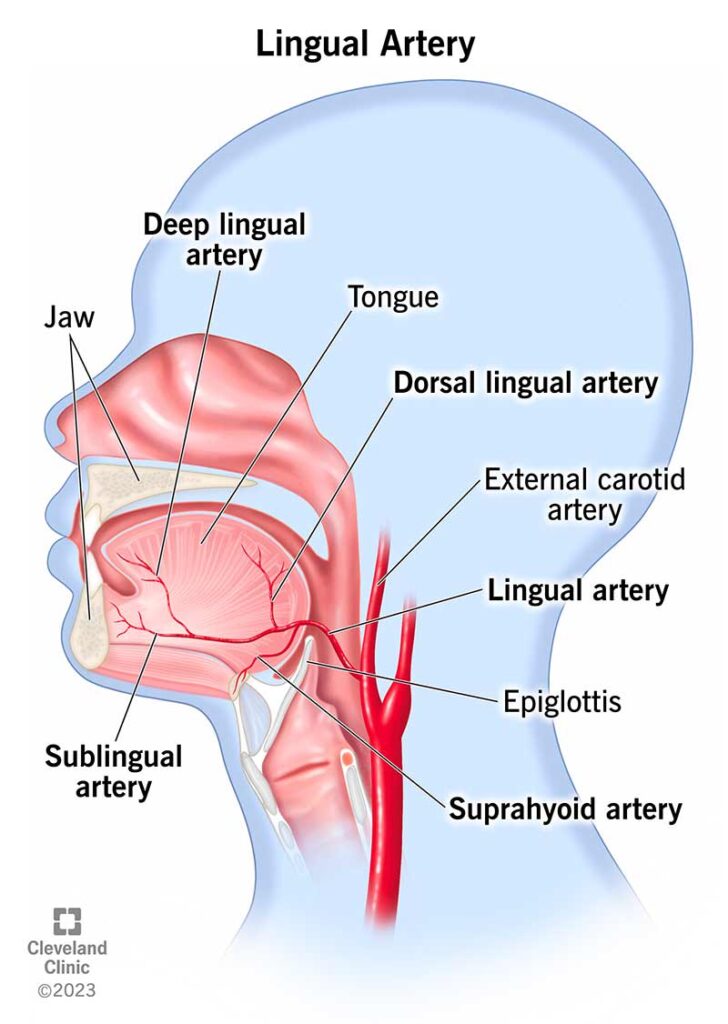
• Lingual artery
Parent Artery:
• External carotid artery
Major Branches of Lingual Artery:
- Dorsal lingual arteries
- Deep lingual artery
- Sublingual artery
Venous Drainage:
• Lingual vein → Internal jugular vein
Primary Function:
• Supplies oxygen and nutrients to tongue muscles and mucosa
• Supports rapid healing
🔬 CONCEPT EXPLAINED
Lingual Artery Course
Stepwise:
- Arises from external carotid artery
- Passes deep to hyoglossus muscle
- Divides into branches supplying tongue
Major Branch Functions
Dorsal lingual arteries
Supply:
• Posterior tongue
• Tonsillar region
Deep lingual artery
Supply:
• Anterior tongue
• Tip of tongue
Sublingual artery
Supply:
EMBRYOLOGY
Development of Tongue
🧠 CORE
Origin:
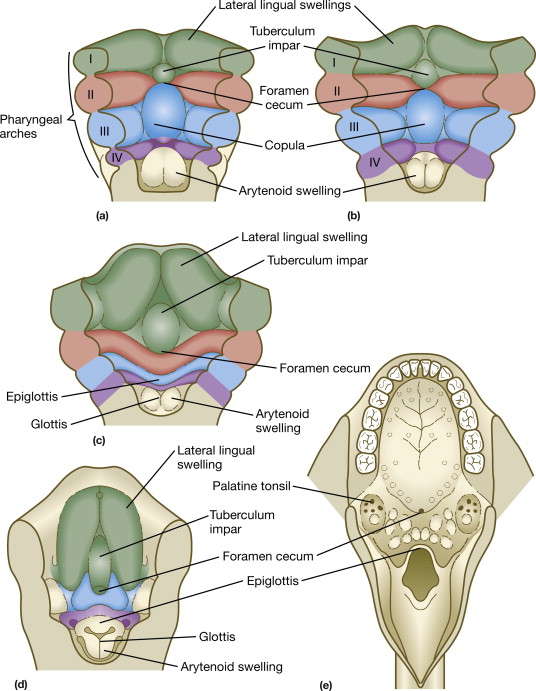
• First pharyngeal arch → Anterior 2/3
• Third pharyngeal arch → Posterior 1/3
• Fourth arch → Posterior-most part
Major Steps:
- Formation of lateral lingual swellings
- Fusion with tuberculum impar
- Growth of hypobranchial eminence
- Muscles migrate from occipital somites
Timeline:
Begins → 4th week
Completed → 8th week
🔬 CONCEPT EXPLAINED
Stepwise Development:
- Two lateral lingual swellings appear
- They fuse forming anterior tongue
- Posterior tongue forms from hypobranchial eminence
- Muscles migrate from occipital somites
Development → Adult Link:
Different embryological origins explain different nerve supply in anterior and posterior tongue.
⚠️ IF DAMAGED
Failure of fusion → Bifid tongue
Incomplete descent → Macroglossia
Short lingual frenulum → Ankyloglossia (tongue-tie)
Anomalies of Tongue Development
🧠 CORE
Common anomalies:
• Ankyloglossia
• Macroglossia
• Bifid tongue
• Microglossia
Primary Effects:
• Speech difficulty
• Feeding difficulty
• Swallowing impairment
🔬 CONCEPT EXPLAINED
Ankyloglossia:
Short frenulum restricts tongue movement.
Structure → Function:
Limited movement → Difficulty in articulation of sounds.
⚠️ IF DAMAGED
Restricted tongue →
Speech defect → Feeding problems in infants
HISTOLOGY
Microscopic Structure of Lips
🧠 CORE
Layers:
- Skin layer
- Vermilion zone
- Oral mucosa
Cells:
• Stratified squamous epithelium
• Skeletal muscle
• Sebaceous glands
Function:
• Protect oral opening
• Maintain flexibility
🔬 CONCEPT EXPLAINED
The vermilion zone contains rich blood supply, giving lips their red color.
Structure → Function:
Thick epithelium protects against mechanical stress.
⚠️ IF DAMAGED
Lip injury → Bleeding → Infection risk
Histological Structure of Tooth
(Longitudinal & Transverse Section)
🧠 CORE
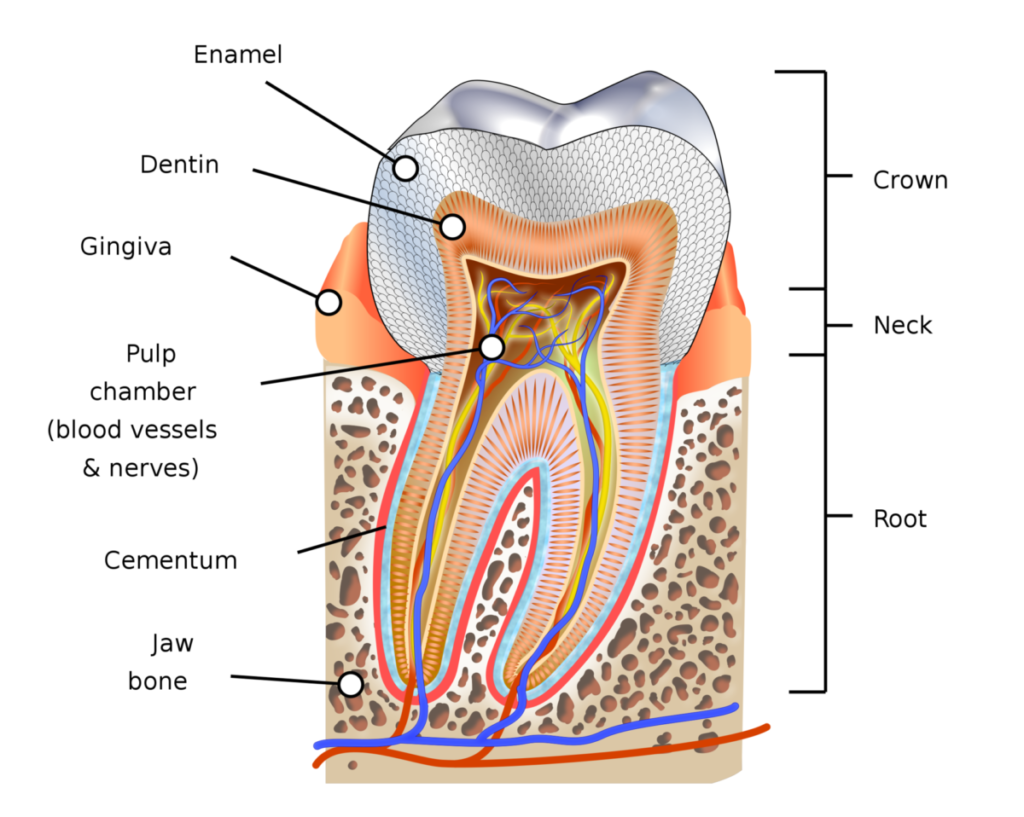
Major Components:
• Enamel
• Dentin
• Pulp
• Cementum
Functions:
• Enamel → Hard protection
• Dentin → Support
• Pulp → Nutrition
• Cementum → Anchoring
🔬 CONCEPT EXPLAINED
Enamel:
• Hardest substance in body
• Protects tooth from wear
Dentin:
• Contains tubules
• Transmits sensation
Structure → Function:
Hard outer enamel allows chewing forces.
⚠️ IF DAMAGED
Enamel loss → Dentin exposure → Tooth sensitivity
Histology of Tongue
🧠 CORE
Papillae Types:
• Filiform
• Fungiform
• Circumvallate
• Foliate
Cells:
• Taste buds
• Stratified squamous epithelium
• Skeletal muscle
🔬 CONCEPT EXPLAINED
Taste buds contain gustatory cells detecting taste.
Structure → Function:
Papillae increase surface area for taste sensation.
⚠️ IF DAMAGED
Taste bud damage → Loss of taste
Differences Between Anterior 2/3 and Posterior 1/3
🧠 CORE
Anterior 2/3:
• From 1st arch
• Lingual nerve
• Taste via facial nerve
Posterior 1/3:
• From 3rd arch
• Glossopharyngeal nerve
🔬 CONCEPT EXPLAINED
Different origins explain different sensory nerve supply.
ENT / CLINICAL
Causes of Oral Ulcerations
🧠 CORE
Common Causes:
• Trauma
• Infection
• Vitamin deficiency
• Autoimmune disease
• Stress
🔬 CONCEPT EXPLAINED
Deficiency of Vitamin B12 or Iron leads to mucosal breakdown.
⚠️ IF DAMAGED
Persistent ulcer → Possible malignancy risk
Aphthous Ulcers and Treatment
🧠 CORE
Definition:
Small painful ulcers in oral mucosa.
Treatment:
• Topical steroids
• Vitamin supplementation
• Pain relief gels
🔬 CONCEPT EXPLAINED
Immune response causes localized tissue damage, forming ulcers.
4️⃣ MECHANISM FLOW
Taste Perception
- Food dissolves in saliva
- Taste molecules bind receptors
- Sensory impulse generated
- Signals travel via cranial nerves
- Brain interprets taste
5️⃣ FUNCTIONAL INTEGRATION
Structure → Function → Outcome
Tongue muscles → Movement → Speech clarity
Papillae → Taste detection → Food selection
Teeth → Mechanical breakdown → Digestion efficiency
6️⃣ CLINICAL CORRELATION
Common Conditions:
• Aphthous ulcers
• Tongue paralysis
• Ankyloglossia
• Glossitis
⭐ 7️⃣ POINTS TO REMEMBER
- Hypoglossal nerve supplies all tongue muscles except palatoglossus
- Anterior tongue → Facial nerve taste
- Posterior tongue → Glossopharyngeal nerve
- Tongue develops from pharyngeal arches
- Enamel is hardest body tissue
- Filiform papillae are most numerous
- Ankyloglossia causes speech difficulty
- Aphthous ulcers are painful but benign
- Papillae increase taste surface area
- Tongue deviation indicates hypoglossal nerve injury
MASTER CONCEPT MAP
                 ORAL CAVITY & TONGUE
                          │
 ─────────────────────────┼────────────────────────
                          │
                    STRUCTURE
                          │
        ┌─────────────────┼─────────────────┐
        │                 │                 │
     MUSCLES           NERVES         BLOOD SUPPLY
        │                 │                 │
 Intrinsic         Sensory Supply      Lingual Artery
 Extrinsic         Motor Supply        (Ext. Carotid)
        │                 │                 │
        └─────────────── FUNCTION ────────────────┘
                          │
                Speech • Swallowing • Taste
                          │
 ─────────────────────────┼────────────────────────
                          │
                    DEVELOPMENT
                          │
        Pharyngeal Arches (1st & 3rd)
                          │
                Adult Tongue Regions
                          │
 ─────────────────────────┼────────────────────────
                          │
                     HISTOLOGY
                          │
     Lips • Tooth • Tongue Papillae
                          │
 ─────────────────────────┼────────────────────────
                          │
                     CLINICAL
                          │
     Ulcers • Aphthous Ulcers • Anomalies
SUBMAP 1: Tongue Muscles & Nerve Supply
                     TONGUE MOVEMENT
                           │
        ┌──────────────────┼──────────────────┐
        │                                     │
   INTRINSIC                          EXTRINSIC
 (Shape Change)                   (Position Change)
        │                                     │
 ┌──────┼──────┐                     ┌────────┼────────┐
 │      │      │                     │        │        │
Sup   Inf    Trans               Genioglossus Hyoglossus Styloglossus
Long  Long                        │           │           │
 │      │      │                  │           │           │
Curl  Curl  Narrow              Protrude   Depress     Retract
Up    Down                        │           │           │
        └───────────────┬───────────────┘
                        │
                 MOTOR SUPPLY
                        │
                 Hypoglossal Nerve
                        │
                  Functional Output
                        │
              Speech • Swallowing
SUBMAP 2: Development of Tongue
                   DEVELOPMENT OF TONGUE
                            │
               PHARYNGEAL ARCH ORIGIN
                            │
        ┌───────────────────┼───────────────────┐
        │                                       │
     1st Arch                              3rd Arch
        │                                       │
   Anterior 2/3                        Posterior 1/3
        │                                       │
     Lingual Nerve                    Glossopharyngeal
        │                                       │
                Adult Tongue Regions
                            │
                   Development Errors
                            │
        ┌────────────┬────────────┬────────────┐
        │            │            │
   Ankyloglossia  Bifid Tongue  Macroglossia
SUBMAP 3: Histology of Oral Structures
                     ORAL HISTOLOGY
                           │
      ┌────────────────────┼────────────────────┐
      │                    │                    │
     LIPS                TOOTH                TONGUE
      │                    │                    │
  Vermilion Zone       Enamel              Papillae
  Skeletal Muscle      Dentin               │
                       Pulp         ┌────────┼────────┐
                       Cementum     │        │        │
                                  Filiform Fungiform Circumvallate
                                     │        │        │
                                No Taste    Taste     Taste
                                  Buds      Buds      Buds
Recommended Video
3. PRE-TEST MCQs
Results


#1. Which muscle is primarily responsible for protrusion of the tongue?
#2. The intrinsic muscles of the tongue mainly function to:
#3. Motor supply to most muscles of the tongue is provided by:
#4. General sensation from the anterior two-thirds of the tongue is carried by:
#5. Taste sensation from the anterior two-thirds of the tongue is transmitted through:
#6. The posterior one-third of the tongue develops mainly from:
#7. Failure of fusion of lateral lingual swellings may result in:
#8. Which papillae are most numerous on the dorsal surface of the tongue?
#9. Taste buds are mainly associated with which papillae?
#10. The vermilion border of the lip appears red primarily due to:
#11. The hardest substance in the human body is:
#12. Which structure of the tooth contains blood vessels and nerves?
#13. The sulcus terminalis separates which two parts of the tongue?
#14. Which muscle depresses the tongue?
#15. Ankyloglossia is characterized by:
#16. The main artery supplying the tongue arises from:
#17. Which branch of the lingual artery supplies the anterior part of the tongue?
#18. Aphthous ulcers most commonly affect:
#19. Which tissue forms the bulk of the tongue?
#20. Loss of taste sensation from the posterior one-third of the tongue suggests involvement of:
4. Diagnostic Feedback
Your score in this pre-test reflects your current level of understanding of the topic.
Score 0–7 → Foundational Level
You may not yet be familiar with the basic concepts of connective tissue structure and biochemistry.
Focus on understanding the components of extracellular matrix, collagen structure, glycosaminoglycans, and proteoglycans before attempting more advanced questions.
Score 8–14 → Developing Understanding
You have a partial understanding of connective tissue components and their functions.
Review the relationships between collagen fibers, extracellular matrix proteins, and ground substance, and how these components contribute to tissue strength and elasticity.
Score 15–20 → Strong Conceptual Base
You already have a solid understanding of connective tissue biochemistry and structure.
As you proceed through the learning material, focus on integrating histological structure with biochemical mechanisms and physiological functions.
5. Guided Reasoning
Ask AIM Tutor
I answered this MCQ incorrectly in my MBBS learning module.

Please help me understand:

1. What concept is being tested in this question?
2. Why is the correct option correct?
3. Why are the other options incorrect?
4. What is the key concept I should remember for exams?

Here is the MCQ:
6. Concept Integration
Whole Topic Core Flow
Tongue Development (Pharyngeal Arches)
↓
Formation of Muscles + Nerve Supply
↓
Normal Structure of Tongue & Oral Cavity
(Muscles + Papillae + Teeth + Lips)
↓
Functional Activities
Speech • Taste • Mastication • Swallowing
↓
Histological Integrity
(Stratified epithelium + Taste buds + Enamel)
↓
If Structure Damaged →
Functional Failure Occurs
↓
Clinical Disorders Develop:
- Ankyloglossia
- Oral Ulcers
- Taste Loss
- Tooth Sensitivity
↓
Drug / Treatment Action: - Topical Steroids → Reduce inflammation
- Vitamin Therapy → Restore mucosal healing
- Surgical Correction → Restore mobility
↓
Restored Function:
Normal Speech • Feeding • Oral Health
3️⃣ CORE MECHANISM INTEGRATION
Functional Breakdown Mechanism — Oral Ulcer Formation
Trigger Factor
(Trauma / Vitamin Deficiency / Infection)
↓
Damage to Oral Epithelium
(Stratified Squamous Layer)
↓
Loss of Protective Barrier
↓
Exposure of Underlying Tissue
↓
Inflammatory Response Activated
↓
Pain + Ulcer Formation
↓
Functional Consequences:
Pain → Difficulty Eating → Reduced Nutrition
Integrated Subjects
Histology → epithelial damage
Biochemistry → vitamin deficiency
Clinical → ulcer formation
Pharmacology → anti-inflammatory therapy
4️⃣ CLINICAL INTEGRATION SNAPSHOT
Clinical Flow 1 — Hypoglossal Nerve Injury
Hypoglossal Nerve Damage
↓
Loss of Motor Supply to Tongue Muscles
↓
Tongue Deviation Toward Affected Side
↓
Speech Difficulty + Swallowing Problems
↓
Management:
Treat underlying nerve injury
Speech therapy if required
Clinical Flow 2 — Aphthous Ulcer
Immune / Nutritional Trigger
(Vitamin B12 / Iron Deficiency)
↓
Breakdown of Oral Mucosal Integrity
↓
Local Inflammation
↓
Painful Oral Ulcer Formation
↓
Clinical Symptoms:
Pain during Eating & Speaking
↓
Treatment:
Topical Steroids + Vitamin Supplementation
Clinical Flow 3 — Ankyloglossia (Tongue-Tie)
Short Lingual Frenulum
(Developmental Defect)
↓
Restricted Tongue Movement
↓
Impaired Speech Articulation
↓
Feeding Difficulty in Infants
↓
Treatment:
Surgical Frenotomy
↓
Improved Tongue Mobility
5️⃣ ULTRA–HIGH–YIELD MASTER SUMMARY
Last-Day Revision Integration Model
NORMAL SYSTEM:
Tongue Muscles + Nerve Supply
↓
Coordinated Movement
↓
Speech • Taste • Swallowing
DISEASE MECHANISM:
Developmental Defect /
Mucosal Injury /
Nerve Damage
↓
Structural Disruption
↓
Functional Loss
DRUG ACTION:
Topical Steroids → Reduce inflammation
Vitamin Therapy → Promote mucosal repair
Surgical Correction → Restore movement
TREATMENT EFFECT:
Restored Structure
↓
Recovered Function
↓
Normal Oral Activity
7. KMU Past Papers
MCQ 1
Question:
Deviation of the protruded tongue toward one side most directly indicates dysfunction of which functional component?
Options:
A. Sensory fibers supplying taste to anterior region
B. Motor fibers controlling intrinsic musculature
C. Sensory fibers from posterior region
D. Parasympathetic fibers supplying salivary glands
E. Fibers supplying circumvallate papillae
Correct Answer:
B. Motor fibers controlling intrinsic musculature
Explanation:
Hypoglossal nerve injury affects motor control of intrinsic muscles, causing deviation toward affected side.
MCQ 2
Question:
A developmental disturbance affecting migration of occipital somites would most directly impair which structural feature?
Options:
A. Sensory innervation of anterior region
B. Formation of lingual papillae
C. Muscular component of tongue
D. Formation of dental enamel
E. Development of vermilion zone
Correct Answer:
C. Muscular component of tongue
Explanation:
Tongue muscles originate from occipital somites; migration failure disrupts muscle formation.
MCQ 3
Question:
A histological section showing heavily keratinized projections without taste buds most likely represents which functional adaptation?
Options:
A. Enhancement of taste perception
B. Facilitation of mechanical handling of food
C. Reduction of salivary secretion
D. Maintenance of mucosal immunity
E. Promotion of thermal sensitivity
Correct Answer:
B. Facilitation of mechanical handling of food
Explanation:
Filiform papillae are keratinized and function mainly in mechanical food handling.
MCQ 4
Question:
Failure of fusion between lateral lingual swellings during early embryonic development results in which anatomical abnormality?
Options:
A. Enlargement of tongue volume
B. Reduction of muscular content
C. Presence of midline cleft
D. Absence of posterior region
E. Shortening of lingual frenulum
Correct Answer:
C. Presence of midline cleft
Explanation:
Incomplete fusion leads to bifid tongue formation.
MCQ 5
Question:
A microscopic slide shows a highly vascular connective tissue zone between external skin and oral mucosa. This feature contributes primarily to which visible characteristic?
Options:
A. Increased keratinization
B. Enhanced immune response
C. Red coloration of lip margin
D. Reduced mechanical stress
E. Increased salivary flow
Correct Answer:
C. Red coloration of lip margin
Explanation:
The vermilion zone appears red due to abundant capillaries.
MCQ 6
Question:
Damage to nerve fibers transmitting taste sensation from the posterior region of the tongue would most likely impair detection of stimuli from which structural location?
Options:
A. Apex of tongue
B. Lateral margin of anterior region
C. Central dorsal surface anteriorly
D. Area behind sulcus terminalis
E. Ventral surface near frenulum
Correct Answer:
D. Area behind sulcus terminalis
Explanation:
Posterior third of tongue receives taste via glossopharyngeal nerve.
MCQ 7
Question:
Exposure of dentin following loss of enamel leads to increased sensitivity primarily because dentin contains which structural component?
Options:
A. Keratin bundles
B. Elastic fibers
C. Neural canals
D. Tubular channels
E. Lymphatic sinusoids
Correct Answer:
D. Tubular channels
Explanation:
Dentin tubules transmit stimuli to pulp, causing sensitivity.
MCQ 8
Question:
Restriction of tongue movement in infants leading to feeding difficulty is most likely caused by abnormal development of which structure?
Options:
A. Palatine process
B. Lingual frenulum
C. Hypobranchial eminence
D. Dental lamina
E. Median palatal raphe
Correct Answer:
B. Lingual frenulum
Explanation:
Short lingual frenulum results in ankyloglossia.
MCQ 9
Question:
A lesion affecting sensory fibers responsible for tactile perception in the anterior region of the tongue would most likely involve which neural pathway?
Options:
A. Fibers associated with facial nerve
B. Fibers associated with glossopharyngeal nerve
C. Fibers associated with trigeminal nerve
D. Fibers associated with vagus nerve
E. Fibers associated with hypoglossal nerve
Correct Answer:
C. Fibers associated with trigeminal nerve
Explanation:
General sensation from anterior two-thirds travels via lingual nerve (V3).
MCQ 10
Question:
A histological specimen demonstrating tall circumferential trenches surrounding papillae indicates specialization primarily for which function?
Options:
A. Protection from mechanical trauma
B. Enhancement of tactile sensitivity
C. Amplification of gustatory stimulus exposure
D. Facilitation of thermal regulation
E. Maintenance of structural rigidity
Correct Answer:
C. Amplification of gustatory stimulus exposure
Explanation:
Circumvallate papillae trenches allow exposure to dissolved tastants.
MCQ 11
Question:
During surgical removal of a lesion from the floor of the mouth, a vessel running deep to the hyoglossus muscle is accidentally damaged. Which functional region would most directly suffer from reduced blood supply?
Options:
A. Posterior tonsillar region
B. Anterior region of tongue
C. Hard palate mucosa
D. Gingival mucosa of molars
E. Soft palate musculature
Correct Answer:
B. Anterior region of tongue
Explanation:
The lingual artery runs deep to hyoglossus and its deep lingual branch supplies the anterior tongue.
MCQ 12
Question:
Loss of general sensation from the anterior region of the tongue without loss of taste most likely indicates injury to which neural component?
Options:
A. Facial nerve fibers
B. Glossopharyngeal fibers
C. Trigeminal nerve fibers
D. Vagus nerve fibers
E. Hypoglossal nerve fibers
Correct Answer:
C. Trigeminal nerve fibers
Explanation:
General sensation from anterior tongue is via lingual nerve (V3), while taste remains via chorda tympani.
MCQ 13
Question:
A histological section of oral mucosa demonstrates non-keratinized stratified squamous epithelium with underlying skeletal muscle bundles. This combination is most characteristic of which structure?
Options:
A. Vermilion region of lip
B. Gingival margin
C. Dorsal surface of tongue
D. Ventral surface of tongue
E. Palatal mucosa
Correct Answer:
D. Ventral surface of tongue
Explanation:
The ventral surface contains non-keratinized epithelium with underlying skeletal muscle bundles.
MCQ 14
Question:
Failure in formation of the hypobranchial eminence during embryonic development would most directly affect which structural region?
Options:
A. Anterior region of tongue
B. Apex of tongue
C. Posterior region of tongue
D. Lateral margins of tongue
E. Lingual frenulum
Correct Answer:
C. Posterior region of tongue
Explanation:
Posterior one-third develops from the hypobranchial eminence.
MCQ 15
Question:
A patient presents with difficulty retracting the tongue during swallowing. Dysfunction of which muscle is most likely responsible?
Options:
A. Genioglossus muscle
B. Hyoglossus muscle
C. Styloglossus muscle
D. Vertical muscle
E. Transverse muscle
Correct Answer:
C. Styloglossus muscle
Explanation:
Styloglossus retracts the tongue, especially during swallowing.
MCQ 16
Question:
Which structural characteristic of enamel contributes most to its resistance against mechanical stress during mastication?
Options:
A. Presence of vascular channels
B. Arrangement of collagen bundles
C. Dense mineralized crystalline matrix
D. Abundance of elastic fibers
E. Presence of neural endings
Correct Answer:
C. Dense mineralized crystalline matrix
Explanation:
Enamel consists of highly mineralized hydroxyapatite crystals, providing hardness.
MCQ 17
Question:
Increased susceptibility to recurrent oral ulcers in nutritional deficiency is most directly related to impairment of which histological function?
Options:
A. Keratin production in epithelial cells
B. Cell turnover in mucosal epithelium
C. Mineral deposition in enamel
D. Saliva secretion by glands
E. Neural transmission in taste buds
Correct Answer:
B. Cell turnover in mucosal epithelium
Explanation:
Vitamin deficiency impairs epithelial regeneration, leading to ulcer formation.
MCQ 18
Question:
A lesion involving the posterior region of the tongue results in loss of both taste and general sensation. Which anatomical feature explains this combined loss?
Options:
A. Dual nerve supply from facial nerve
B. Presence of mixed motor fibers
C. Single nerve carrying both modalities
D. Overlapping supply from trigeminal nerve
E. Lack of sensory receptors
Correct Answer:
C. Single nerve carrying both modalities
Explanation:
Glossopharyngeal nerve provides both general and taste sensation to posterior tongue.
MCQ 19
Question:
Which histological feature allows circumvallate papillae to effectively expose taste receptors to dissolved substances?
Options:
A. Presence of thick keratin layers
B. Arrangement within deep surrounding trenches
C. Lack of connective tissue support
D. Reduced epithelial thickness
E. Absence of salivary ducts
Correct Answer:
B. Arrangement within deep surrounding trenches
Explanation:
Circumvallate papillae are surrounded by trenches allowing tastants to contact taste buds.
MCQ 20
Question:
During early development, fusion of lateral lingual swellings contributes primarily to formation of which adult structure?
Options:
A. Posterior region of tongue
B. Lingual tonsil
C. Apex and body of tongue
D. Epiglottic region
E. Palatoglossal arch
Correct Answer:
C. Apex and body of tongue
Explanation:
Anterior two-thirds (body and apex) develops from fused lateral lingual swellings.
8. Post-Test
Post Test MCQs
9. Explanation of Incorrect Answers
Incorrect answers are valuable learning opportunities. When reviewing MCQs, focus on understanding the concept behind the question, not just memorizing the correct option.
If you answered a question incorrectly:
• Identify the concept being tested.
• Determine why the correct option is correct.
• Understand why the other options are incorrect.
You can paste the MCQ into the AIM Tutor and ask for a step-by-step explanation. This helps strengthen conceptual understanding and improves reasoning for future questions.
Learning Tip
If your Post-Test score is below 80%, review the key concepts and attempt the Post-Test again to reinforce your understanding.
10. Student Memory Support
1️⃣High-Yield Flashcards
Flashcard 1
Q: Which muscle is responsible for protrusion of the tongue?
A: Genioglossus muscle
Flashcard 2
Q: Which nerve supplies motor function to most tongue muscles?
A: Hypoglossal nerve
Flashcard 3
Q: General sensation from anterior 2/3 of tongue is carried by which nerve?
A: Lingual nerve
Flashcard 4
Q: Taste from anterior 2/3 of tongue is supplied by which nerve?
A: Chorda tympani
Flashcard 5
Q: Posterior 1/3 of tongue develops from which pharyngeal arch?
A: Third pharyngeal arch
Flashcard 6
Q: Which papillae are most numerous on the tongue?
A: Filiform papillae
Flashcard 7
Q: What is the hardest substance in the human body?
A: Enamel
Flashcard 8
Q: What causes ankyloglossia?
A: Short lingual frenulum
Flashcard 9
Q: Which artery supplies the tongue?
A: Lingual artery
Flashcard 10
Q: What is the main function of intrinsic tongue muscles?
A: Change shape of tongue
Flashcard 11
Q: What gives the vermilion border its red color?
A: Rich capillary supply
Flashcard 12
Q: What structure transmits sensation in dentin?
A: Dentinal tubules
2️⃣Mnemonics
Mnemonic Title: Extrinsic Muscles of Tongue
Mnemonic Word:
“GHS-P”
Meaning:
G → Genioglossus
H → Hyoglossus
S → Styloglossus
P → Palatoglossus
Mnemonic Title: Intrinsic Muscle Actions
Mnemonic Word:
“SUN-V”
Meaning:
S → Superior longitudinal (curls up)
U → Under (Inferior longitudinal curls down)
N → Narrows (Transverse)
V → Vertical flattens
Mnemonic Title: Nerve Supply of Tongue
Mnemonic Word:
“LCT-G”
Meaning:
L → Lingual nerve (General sensation anterior)
C → Chorda tympani (Taste anterior)
T → Glossopharyngeal (Taste posterior)
G → Hypoglossal (Motor)
3️⃣Memory Tables
Table 1 — Intrinsic vs Extrinsic Tongue Muscles
| Feature | Intrinsic Muscles | Extrinsic Muscles |
| Location | Within tongue | Outside tongue |
| Function | Change shape | Change position |
| Origin | Inside tongue | Bone structures |
| Examples | Superior longitudinal | Genioglossus |
Table 2 — Anterior vs Posterior Tongue
| Feature | Anterior 2/3 | Posterior 1/3 |
| Development | First arch | Third arch |
| General sensation | Lingual nerve | Glossopharyngeal |
| Taste | Chorda tympani | Glossopharyngeal |
| Surface | Papillae present | Lingual tonsil present |
4️⃣Rapid Revision Points
Must Remember
• Genioglossus protrudes tongue
• Hypoglossal nerve supplies tongue muscles
• Lingual nerve → general sensation anterior
• Chorda tympani → taste anterior
• Glossopharyngeal → posterior sensation & taste
• Filiform papillae have no taste buds
• Circumvallate papillae contain many taste buds
• Enamel is hardest body tissue
• Lingual artery supplies tongue
• Ankyloglossia causes speech difficulty
• Aphthous ulcers are painful mucosal lesions
5️⃣Clinical Memory Hooks
Clinical Hook 1:
Hypoglossal nerve injury → Tongue deviates toward affected side
Clinical Hook 2:
Short lingual frenulum → Feeding difficulty in infants
Clinical Hook 3:
Loss of enamel → Tooth sensitivity due to dentin exposure
Clinical Hook 4:
Vitamin deficiency → Recurrent oral ulcers
Clinical Hook 5:
Inflamed mucosa → Pain during eating and speaking
✔ Topic Completion
📊 Your Performance
Pre-Test: Not Attempted
Post-Test: Not Attempted
Improvement: --