
AIM OSCE / CLINICAL SKILLS • FINAL YEAR MBBS
OSCE STATION 5. Leukocytosis / Suspected Leukemia — Focused Clinical Assessment
Blood and Immunology • Focused assessment and clinical reasoning • Adult or pediatric variant
Candidate Instructions
Use the case card provided by the examiner. Take a focused history, describe a relevant examination, interpret the blood results, and explain your diagnostic approach and initial management priorities. In the pediatric variant, also explain the findings and next steps to the parent.
Clinical Setting and Station Requirements
This is one station with interchangeable variants. Use either the adult or pediatric card, its matching investigation sheet, and a simulated patient or parent.
- Pediatric card: A parent brings a 7-year-old child with fatigue, recurrent fever and new bruises.
- Adult card: A 48-year-old patient presents with fatigue, weight loss and increasing fullness in the left upper abdomen.
Station Findings and Investigation Sheets
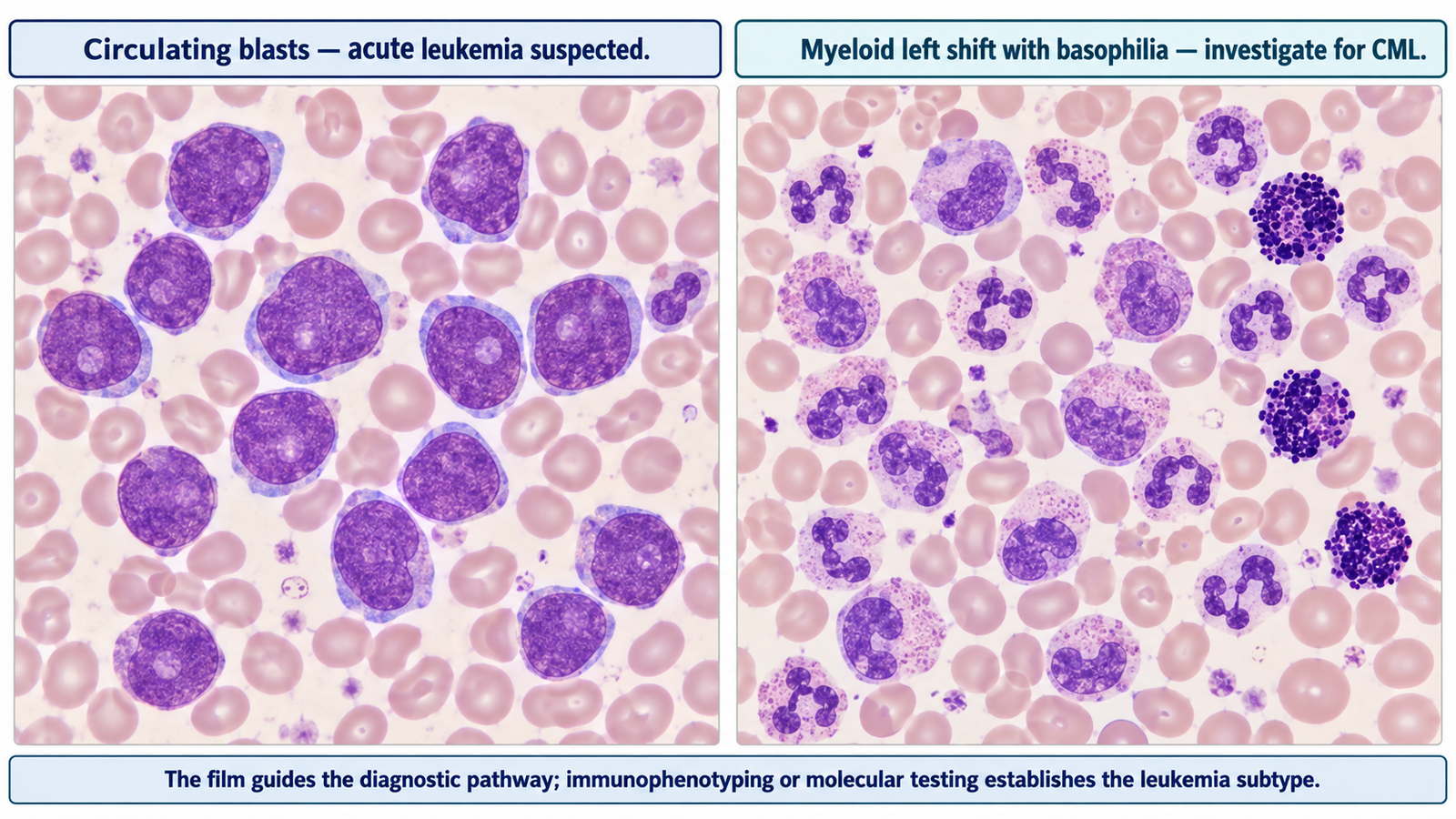
Pediatric variant: Pallor, scattered bruises, cervical lymphadenopathy and mild hepatosplenomegaly. Hemoglobin 7.8 g/dL; white-cell count 42 × 109/L; platelets 36 × 109/L. Peripheral film reports numerous circulating blast cells. The blast lineage has not yet been confirmed.
Adult variant: Pallor and an enlarged spleen, without active bleeding. Hemoglobin 10.2 g/dL; white-cell count 95 × 109/L; platelets 460 × 109/L. Peripheral film reports granulocytes at different stages of maturation and basophilia, with few blasts. BCR::ABL1 testing has not yet been performed.
Expected Student Performance
- Assess immediate safety: check for fever with illness, active bleeding, breathlessness, altered consciousness or other signs of deterioration. Escalate promptly if present.
- Take a focused history: ask about symptom onset, fever or recurrent infections, bruising or bleeding, fatigue, bone pain, weight loss and night sweats. In the child, ask the parent about reduced activity and school attendance; in the adult, ask about abdominal fullness. Review medicines, previous blood counts and relevant exposures.
- Examine respectfully: record vital signs; assess pallor, petechiae or bruising, lymph nodes, liver and spleen. Look for signs of infection and examine additional systems according to symptoms.
- Interpret all three cell lines: confirm leukocytosis and assess hemoglobin and platelets. Review the film for blasts versus a spectrum of maturing myeloid cells; do not infer the leukemia subtype from the white-cell count alone.
- Investigate suspected leukemia: request urgent hematology review, repeat the blood count and film as appropriate, and arrange marrow examination with immunophenotyping for suspected acute leukemia. Use cytogenetic or molecular testing to establish the subtype; specifically request BCR::ABL1 testing when the adult pattern suggests CML.
- Explain the treatment direction: acute leukemia requires specialist-led supportive care and subtype-specific treatment, usually including induction therapy followed by further treatment. Confirmed chronic-phase CML is generally treated with a BCR::ABL1-targeted tyrosine kinase inhibitor and monitored; asymptomatic CLL may initially be observed, while progressive or symptomatic disease requires specialist treatment.
- Counsel in the pediatric variant: tell the parent that the result raises serious concern but the exact type requires confirmation. If ALL is confirmed, explain that a pediatric oncology team will plan staged treatment, infection and bleeding support, and follow-up; invite questions and check understanding.
Model Interpretation and Clinical Conclusion
Pediatric variant: “The combination of circulating blasts, anemia and thrombocytopenia is highly concerning for acute leukemia. ALL is a possibility, but the lineage must be confirmed by marrow assessment and immunophenotyping. I would arrange urgent pediatric hematology assessment, address any infection or bleeding immediately, and explain the uncertainty and next steps clearly to the parent.”
Adult variant: “Marked leukocytosis with a full range of maturing granulocytes, basophilia and splenomegaly suggests chronic myeloid leukemia. I would confirm this with BCR::ABL1 testing and arrange hematology review. Treatment and monitoring would then follow the confirmed diagnosis.”
Classification: The four main groups are acute lymphoblastic leukemia (ALL), acute myeloid leukemia (AML), chronic lymphocytic leukemia (CLL) and chronic myeloid leukemia (CML).
Critical Safety Points
A patient with suspected acute leukemia who has fever or significant bleeding needs immediate assessment and escalation. Do not reassure a parent that the child has a specific leukemia subtype—or begin subtype-specific treatment—solely on the peripheral-film appearance.
AIM ADMIN VISUAL PRODUCTION BOX
Examiner Viva
- How are the major leukemias classified?
By acute or chronic course and lymphoid or myeloid lineage: ALL, AML, CLL and CML. - What test helps distinguish ALL from AML in a child with blasts?
Flow-cytometric immunophenotyping, usually performed on a marrow sample, establishes lineage. - What is the broad treatment approach for childhood ALL?
Specialist-led, staged combination therapy with supportive care and monitoring for infection, bleeding and treatment complications. - What confirms suspected CML, and what is its usual treatment principle?
Demonstration of BCR::ABL1 confirms CML; chronic-phase disease is generally treated with a targeted tyrosine kinase inhibitor. - Does every patient with CLL need immediate treatment?
No. An asymptomatic patient may be observed; progressive or symptomatic disease is assessed for treatment by hematology.