
AIM OSCE / CLINICAL SKILLS • FINAL YEAR MBBS
OSCE STATION 8. Child With a Bleeding Disorder — History & Examination
Blood and Immunology • Focused pediatric history and physical examination
Candidate Instructions
Take a focused bleeding history from the parent and examine the child. Describe the skin findings, explain what the bleeding pattern suggests, and outline your initial diagnostic approach. State how your history and examination would change for an infant.
Clinical Setting and Station Requirements
A parent brings a 6-year-old child because of new skin spots and bruises. A simulated parent, pediatric patient or mannequin, examination couch and vital-sign observations are available.
Expected Student Performance
- Introduce and assess urgency: confirm the child’s identity, obtain parental consent and involve the child appropriately. Ask immediately about ongoing heavy bleeding, severe headache, head injury, fainting or a child who appears acutely unwell.
- Characterize the bleeding: establish onset, frequency, sites and duration. Ask about nosebleeds, gum bleeding, blood in urine or stool, bruising after minor injury, prolonged bleeding after procedures, and painful swollen joints or muscle bleeds.
- Seek the cause: ask about recent infection, medicines, previous bleeding episodes, family history and any known diagnosis. Clarify whether bruises followed an injury consistent with the child’s developmental abilities.
- Examine systematically: wash hands, check vital signs and general appearance, and look for pallor. Inspect the whole skin and visible mucosa with appropriate exposure and dignity; describe the size, distribution and character of lesions. Examine joints for swelling, tenderness or restricted movement, and assess for lymphadenopathy or hepatosplenomegaly when indicated.
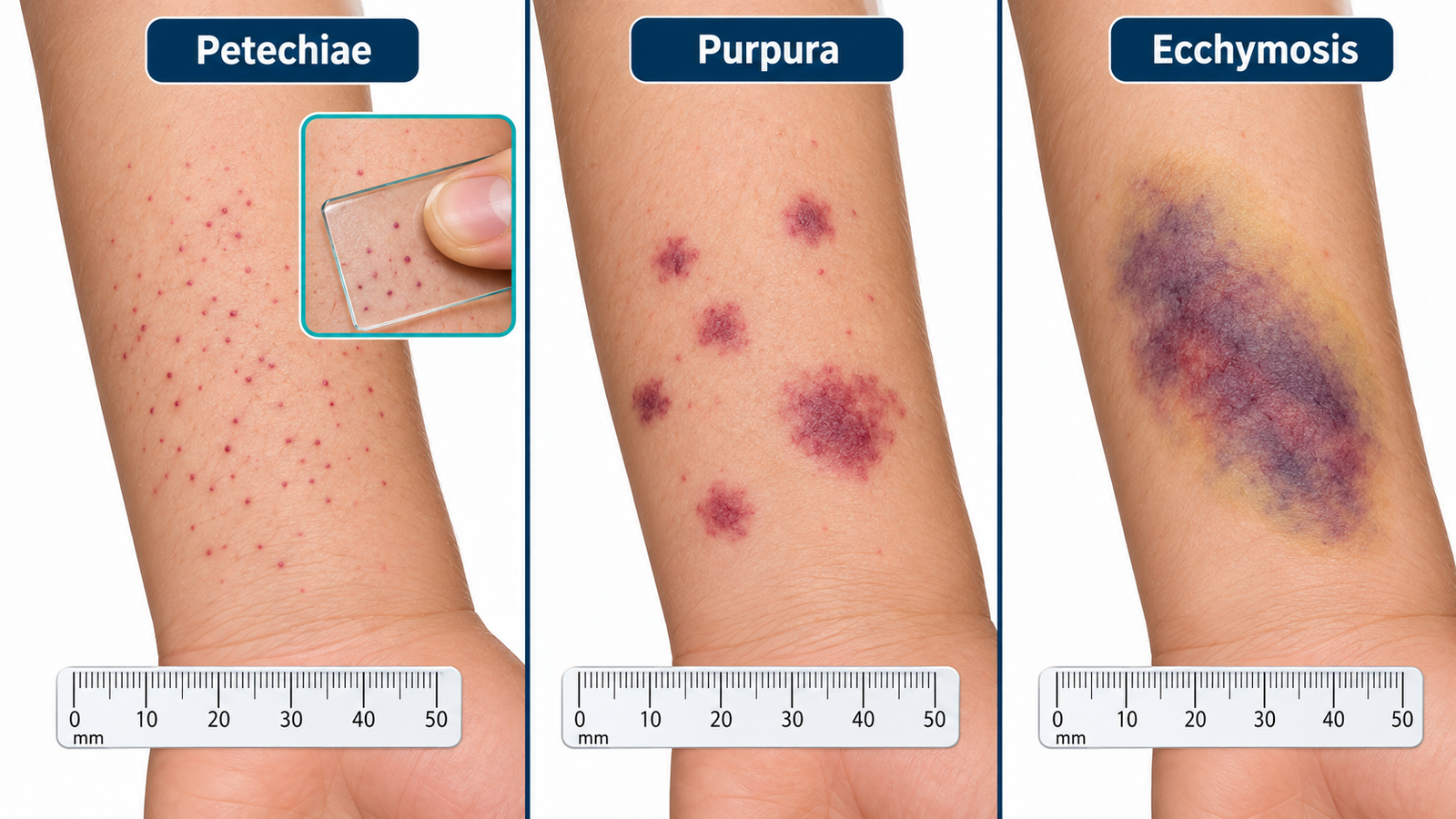
- Identify the lesions: petechiae are pinpoint, non-blanching areas of bleeding under the skin; purpura are larger non-blanching spots or patches; ecchymoses are broader areas of bruising. Record what is actually seen rather than assuming a diagnosis from the appearance alone.
- Interpret the pattern: petechiae and mucosal bleeding suggest a platelet or vascular problem; deep muscle bleeding or hemarthrosis suggests a coagulation-factor disorder. Mixed findings or an unwell child require broader assessment.
- Choose initial tests: request a complete blood count with platelet count and peripheral film, plus PT and aPTT. Select further platelet, von Willebrand factor or coagulation-factor tests according to the history, examination and initial results.
Infant adaptation: ask about bleeding after birth, heel prick or circumcision where applicable, feeding, family history and any prior treatment. Assess the infant’s mobility and the explanation for any bruise; unexplained bruising in a non-mobile infant needs prompt evaluation for both a bleeding disorder and possible injury.
Station Findings and Parent Responses
The parent reports small spots on both legs, several new bruises and one brief nosebleed over the past three days. The child had a mild respiratory illness one week ago. There has been no prolonged bleeding after previous minor injuries and no painful joint swelling. The child is alert, with scattered non-blanching pinpoint spots and a few larger bruises; there is no active bleeding.
Model Interpretation and Clinical Conclusion
“I can see petechiae and ecchymoses. With the nosebleed and no history of deep or joint bleeding, the pattern points toward a platelet-type bleeding problem, but it does not establish the cause. I would check the platelet count and blood film, assess PT and aPTT, and investigate further according to those results. I would reassess urgently if significant bleeding or concerning neurological symptoms develop.”
Critical Safety Points
Active severe bleeding, head injury with concerning symptoms, altered consciousness or circulatory instability requires immediate pediatric assessment. A bleeding disorder must not be assumed to explain an unexplained injury in a non-mobile infant.
AIM ADMIN VISUAL PRODUCTION BOX
VISUAL 1 — Recognizing Petechiae, Purpura and Ecchymoses
Examiner Viva
- What are petechiae?
Pinpoint, non-blanching spots caused by bleeding into the skin. - How do purpura and ecchymoses differ from petechiae?
Purpura are larger non-blanching spots or patches; ecchymoses are broader areas of bruising. - Which history suggests a coagulation-factor disorder?
Recurrent deep muscle bleeding or painful joint swelling, especially with prolonged bleeding after injury or procedures. - Which initial tests help assess a child with unexplained bleeding?
A complete blood count and platelet count, peripheral blood film, PT and aPTT. - Why does bruising in a non-mobile infant require particular care?
It may indicate a bleeding disorder or an injury that needs assessment; both possibilities must be evaluated..