
AIM OSCE / OSPE • FINAL YEAR MBBS
Station 04 — Acute Liver Failure & Hepatic Encephalopathy: Emergency Assessment
GIT Module • Final Year MBBS • Medicine
Rapid Revision • Clinical Skills • Practical Skills • Viva
🎯 Candidate Task
A patient presents with acute jaundice and altered consciousness. Assess the patient, demonstrate the examination for asterixis, interpret the supplied clinical and laboratory findings, grade the neurological impairment and outline your immediate management priorities, including important precipitating factors.
⚡ Model Station Answer
Recognition: Acute liver failure is suspected with acute liver injury, coagulopathy (INR ≥1.5) and encephalopathy in a patient without pre-existing cirrhosis.
Assessment: Assess ABCDE, GCS, orientation, behavior and asterixis; grade hepatic encephalopathy using West Haven criteria.
Investigations: Interpret INR/PT, bilirubin, AST/ALT, glucose, electrolytes and renal function; investigate the underlying cause.
Immediate priority: Urgently involve senior/critical-care and liver-transplant services, protect the airway when indicated, correct hypoglycemia and treat the underlying cause.
Precipitants: In patients with cirrhosis, assess for infection, gastrointestinal bleeding, constipation, dehydration, electrolyte disturbance and sedative medications.
🔎 How to Perform / Approach
- Recognize and escalate: Identify altered consciousness with acute liver dysfunction. Call for urgent senior assistance and begin ABCDE assessment.
- Assess immediate threats: Check airway protection, respiratory status, circulation, vital signs, GCS and bedside glucose. Treat hypoglycemia promptly.
- Perform focused neurological examination: Assess orientation, attention, behavior, speech, level of consciousness, pupils and focal neurological signs.
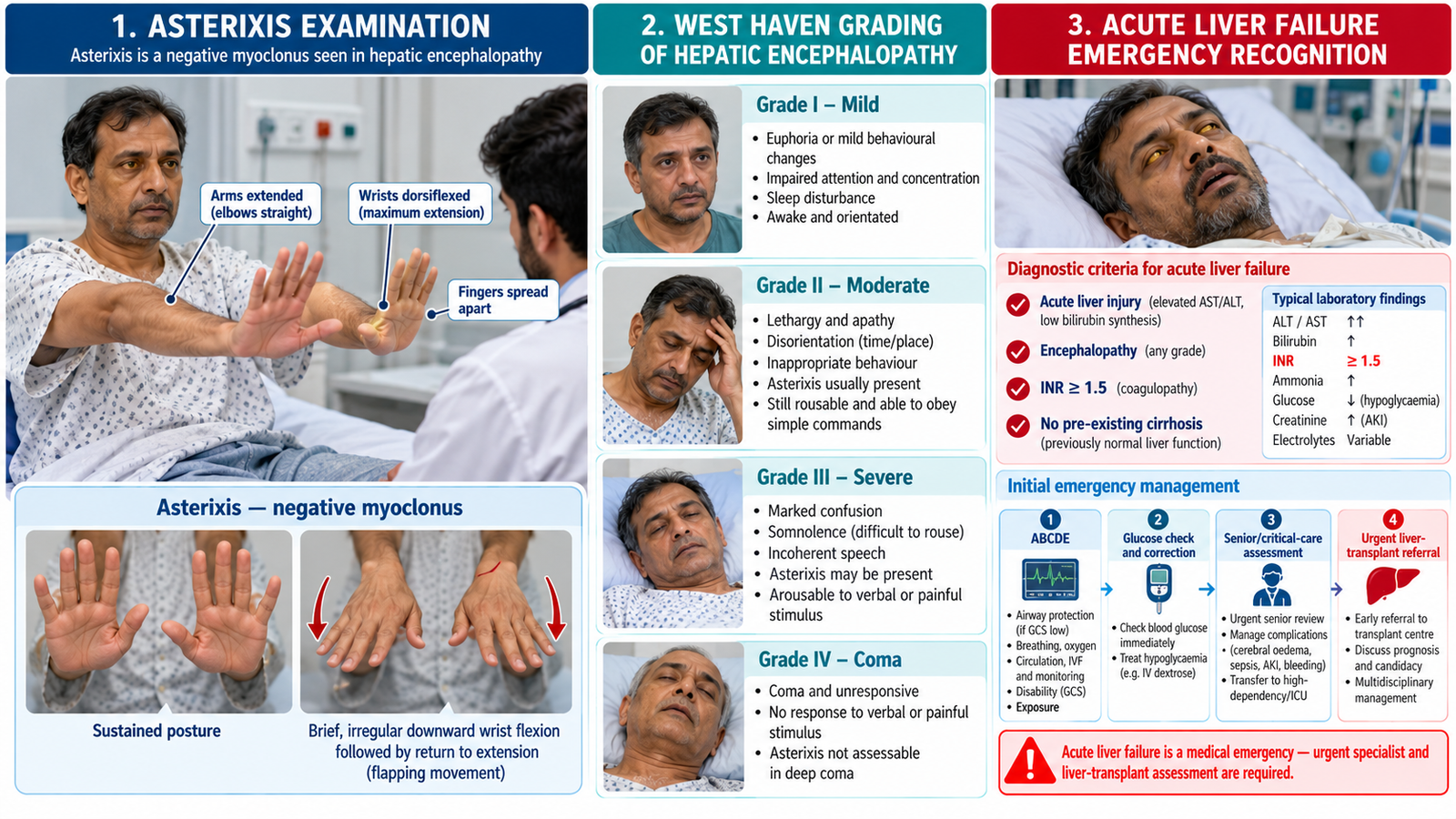
- Demonstrate asterixis: Ask the conscious, cooperative patient to extend both arms, dorsiflex the wrists and spread the fingers. Observe for brief, irregular lapses of posture producing flapping movements.
- Interpret and grade: Review INR/PT, liver tests, glucose, electrolytes and renal function. Apply West Haven grading: I—subtle cognitive change; II—lethargy/disorientation with possible asterixis; III—marked confusion/somnolence; IV—coma.
- Identify cause and contributing factors: Review medication/toxin exposure, particularly paracetamol, viral hepatitis and other causes of acute liver injury. In cirrhosis, seek infection, bleeding, constipation, dehydration, hypokalemia and sedatives.
- Initiate management and reassess: Arrange urgent specialist assessment, frequent neurological/glucose monitoring and correction of reversible abnormalities. Give cause-specific treatment where indicated; treat precipitants of cirrhosis-related encephalopathy, including lactulose when appropriate.
🖼️ Visual Learning
Asterixis Examination, Encephalopathy Grading & Acute Liver Failure Recognition
📝 Important Viva Questions
1. What defines acute liver failure?
Answer: Acute liver injury with INR ≥1.5 and hepatic encephalopathy developing within 26 weeks in a patient without pre-existing cirrhosis.
2. How do you demonstrate asterixis?
Answer: Ask the patient to extend both arms, dorsiflex the wrists and spread the fingers. Observe for irregular brief downward flapping movements.
3. How is hepatic encephalopathy graded?
Answer: West Haven grades I–IV range from subtle cognitive disturbance to lethargy/disorientation, marked somnolence/confusion and finally coma.
4. Name four common precipitants of hepatic encephalopathy in cirrhosis.
Answer: Gastrointestinal bleeding, infection, constipation and dehydration; electrolyte abnormalities and sedatives are also important.
5. What is the immediate management priority in acute liver failure with altered consciousness?
Answer: Stabilize airway and circulation, check and correct glucose, monitor neurological status and urgently involve critical-care and liver-transplant services while investigating and treating the cause.