
AIM OSCE / OSPE • FINAL YEAR MBBS
Station 8 — Hypospadias Recognition & Clinical Management
Renal Module • Pediatric Surgery
Rapid Revision • Clinical Skills • Practical Skills • Viva
🎯 Candidate Task
You are shown a clinical illustration of a child with an abnormal urethral opening. Identify the congenital anomaly, classify its anatomical type, recognize important associated features and complications, and outline the appropriate management.
⚡ Model Station Answer
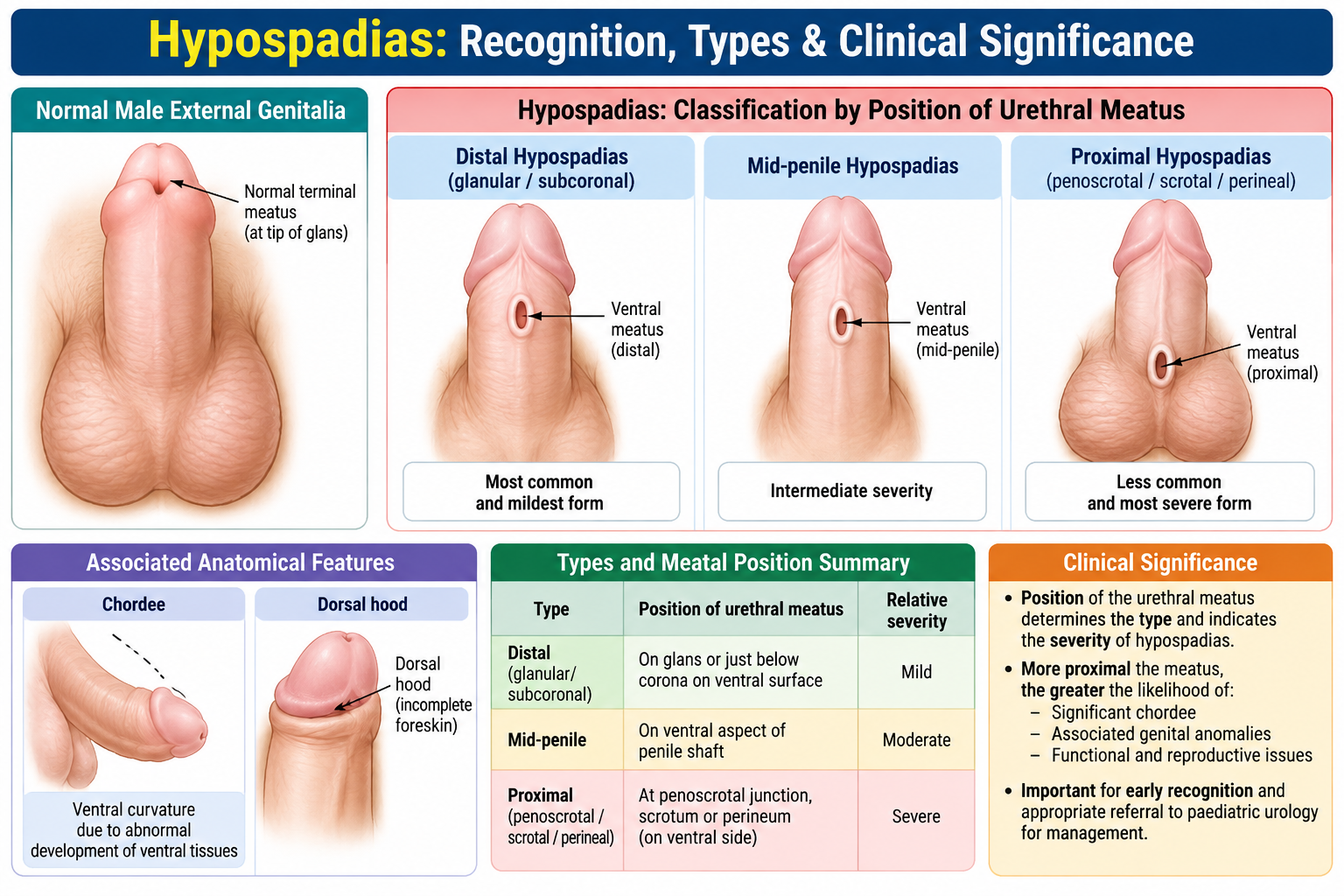
Identification: Hypospadias is a congenital anomaly in which the urethral opening lies on the ventral surface of the penis rather than at the tip.
Classification: It is classified as distal, midshaft or proximal according to the position of the urethral meatus.
Associated features: Dorsal hooded foreskin, ventral penile curvature (chordee) and an abnormal urinary stream may occur.
Complications: Abnormal urinary direction, difficulty with standing urination and, in severe cases, later sexual or reproductive functional problems.
Management: Avoid circumcision, assess both testes and refer to pediatric urology/surgery. Surgical repair is commonly planned at 6–18 months of age.
🔎 How to Perform / Approach
- Identify the abnormal urethral meatus:
Examine the supplied illustration and locate the external urethral opening on the ventral penile surface rather than at the glans tip. - Classify the anatomical type:
Distal hypospadias involves a glanular, coronal or subcoronal meatus; midshaft hypospadias involves the penile shaft; proximal hypospadias includes penoscrotal, scrotal or perineal openings. - Recognize associated abnormalities:
Look for dorsal hooding of the foreskin, deficient ventral foreskin, downward penile curvature (chordee), abnormal glans configuration and undescended testes. - Identify important functional complications:
Abnormal direction or spraying of urine, difficulty urinating while standing, and significant curvature causing later sexual dysfunction. Severe proximal defects may affect reproductive function. - Assess the need for further evaluation:
An isolated distal hypospadias usually needs no routine renal imaging. Proximal hypospadias with undescended testes or atypical genital appearance requires specialist assessment for a possible difference of sex development. - Outline surgical management:
Refer to pediatric surgery/urology. Surgical repair aims to straighten the penis when necessary, reconstruct the urethra and position the opening near the glans tip. Repair is commonly performed between 6 and 18 months. - Explain essential precautions and follow-up:
Do not circumcise before specialist evaluation, because foreskin tissue may be needed for reconstruction. Recognize postoperative urethrocutaneous fistula, meatal stenosis, urethral stricture and recurrent curvature as possible complications requiring follow-up.
🖼️ Visual Learning
Hypospadias — Anatomical Types, Associated Features & Surgical Management Principles
📝 Important Viva Questions
Q1. What is hypospadias?
Answer: A congenital anomaly in which the external urethral meatus opens on the ventral surface of the penis rather than at the normal glans tip.
Q2. How is hypospadias classified anatomically?
Answer: Distal (glanular, coronal or subcoronal), midshaft (penile shaft) and proximal (penoscrotal, scrotal or perineal), according to meatal position.
Q3. Why should circumcision be avoided in a child with hypospadias?
Answer: The foreskin may be required for urethral reconstruction during surgical repair, so it should be preserved until specialist evaluation.
Q4. What complications can occur with severe hypospadias?
Answer: Abnormal urinary stream, difficulty with standing urination and significant penile curvature that may cause later sexual dysfunction. Reconstructive surgery can also be complicated by fistula or meatal stenosis.
Q5. What is the recommended management and usual timing of surgical repair?
Answer: Refer to pediatric urology/surgery for individualized assessment and correction of curvature and urethral position. Repair is commonly performed between 6 and 18 months of age.