
AIM OSCE / OSPE • FINAL YEAR MBBS
Station 9 — Male Infertility Investigation Interpretation
Renal Module • Urology
Rapid Revision • Clinical Skills • Practical Skills • Viva
🎯 Candidate Task
A 32-year-old man presents with his partner after 18 months of regular unprotected intercourse without conception. His semen analysis shows the following:
Semen volume: 2.0 mL
Sperm concentration: 8 million/mL
Total motility: 30%
Normal morphology: 3%
Interpret the investigation, outline your diagnostic approach and explain the available management options to the examiner.
⚡ Model Station Answer
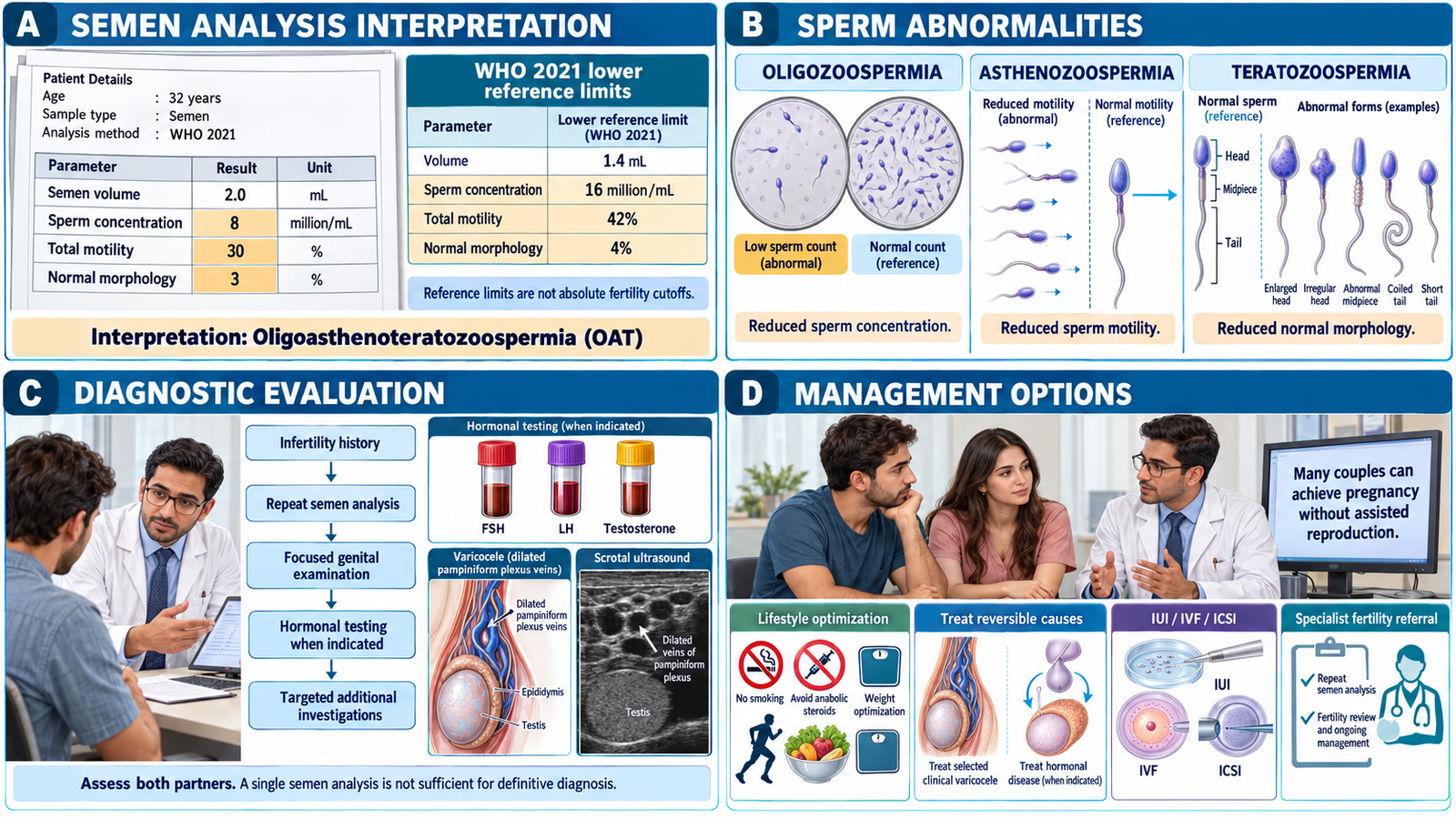
Interpretation: Reduced sperm concentration, motility and normal morphology indicate oligoasthenoteratozoospermia (OAT).
Confirmation: Repeat semen analysis under appropriate collection conditions because semen parameters vary.
Assessment: Evaluate both partners. Ask about sexual history, previous infections, surgery, medications and lifestyle; examine testicular size and possible varicocele.
Investigations: Consider FSH, LH and testosterone, with scrotal ultrasound or genetic testing when indicated.
Management: Treat reversible causes, optimize lifestyle and refer for fertility care, including assisted reproductive techniques where appropriate.
🔎 How to Perform / Approach
- Confirm the infertility history:
Establish duration of unsuccessful conception, frequency and timing of intercourse, erectile or ejaculatory difficulties, previous pregnancies and whether the female partner has undergone assessment. - Interpret semen analysis:
Compare volume, sperm concentration, motility and morphology with WHO 2021 lower reference limits: volume 1.4 mL, concentration 16 million/mL, total motility 42% and normal morphology 4%. Identify the abnormal parameters. - Confirm abnormal findings:
Repeat semen analysis, generally after an appropriate interval, using 2–7 days of abstinence and correct sample collection. One abnormal result alone does not establish the underlying cause. - Take relevant history:
Ask about cryptorchidism, mumps orchitis, genital infection, testicular trauma, previous pelvic or inguinal surgery, chemotherapy, smoking, anabolic steroids, testosterone use and occupational heat exposure. - Perform focused examination:
Assess secondary sexual characteristics, testicular position and size, epididymis, vas deferens and palpable varicocele. Identify features of hormonal deficiency or genital tract abnormalities. - Select further investigations:
Check FSH and morning testosterone, adding LH, prolactin or other hormonal studies as appropriate. Scrotal ultrasound is indicated for selected examination findings; genetic testing is reserved for relevant severe sperm abnormalities or suspected genetic causes. - Outline management options:
Address reversible causes, discontinue gonadotoxic exposures when clinically appropriate, treat selected clinical varicoceles and manage hormonal disorders. Discuss assisted reproduction such as IUI, IVF or ICSI according to semen quality and both partners’ fertility assessment.
🖼️ Visual Learning
Male Infertility — Semen Analysis Interpretation & Diagnostic Approach
📝 Important Viva Questions
Q1. What is the clinical definition of infertility?
Answer: Failure to achieve pregnancy after 12 months or more of regular unprotected sexual intercourse.
Q2. What are the WHO 2021 lower reference limits for sperm concentration, total motility and normal morphology?
Answer: Sperm concentration 16 million/mL, total motility 42% and normal morphology 4%. These are reference limits, not absolute fertility thresholds.
Q3. What is oligoasthenoteratozoospermia?
Answer: A combination of reduced sperm concentration (oligozoospermia), reduced sperm motility (asthenozoospermia) and reduced normal sperm morphology (teratozoospermia).
Q4. Which hormonal investigations are useful in male infertility?
Answer: Serum FSH and morning testosterone are useful initially when indicated; LH and prolactin are added according to the clinical and hormonal findings.
Q5. What are the main management options for male infertility?
Answer: Lifestyle optimization, treatment of reversible causes, selected surgical or hormonal treatment and assisted reproductive techniques such as IUI, IVF or ICSI when appropriate.