
Course Content
OSCE Station 1 — Urine Specimen Collection, Physical Examination and Microscopy
KMU clinical activity: Urine collection methods, physical examination of urine specimen and microscopic examination of centrifuged urine Learning Objectives The student should be able to: • Demonstrate the correct procedure for urine specimen collection. • Assess the volume, colour, appearance and pH of a urine specimen. • Recognize an abnormal urine specimen showing pyuria and hematuria. • Prepare an appropriate report from the physical examination of urine. • Identify important urinary microscopic constituents including pus cells, RBCs, epithelial cells, crystals and casts. • Prepare urinary sediment for microscopic examination. • Examine a prepared urinary-sediment slide under the microscope. • Detect relevant abnormalities in the urinary sediment. • Interpret the findings of physical and microscopic urine examination.
0/1
OSCE Station 2 — Chemical Examination of Urine: Protein and Reducing Substances
KMU clinical activity: Chemical examination of non-centrifuged urine specimen Learning Objectives The student should be able to: • Identify substances commonly assessed during chemical examination of urine. • Describe different procedures used for detection of protein in urine. • Explain the principle of protein detection by the heat method. • Perform the heat and acetic acid test for urinary protein. • Demonstrate or interpret the test for Bence Jones protein. • Explain the principle of testing urine for reducing substances. • Explain the principle of Benedict's test. • Perform Benedict's test correctly. • Interpret the results of urinary protein and reducing-substance testing.
0/1
OSCE Station 3 — Urinary Tract Infection: Staining, Culture, Sensitivity and Prescription
KMU clinical activity: Urine staining and culture; prescriptions for acute and chronic UTI Learning Objectives The student should be able to: • Describe the staining methods used for urine specimens in acute and chronic urinary tract infection. • Explain the basic principles underlying these staining methods. • Identify common uropathogens demonstrated on a prepared slide. • Demonstrate appropriate sterile methods for collection of urine for culture and sensitivity. • Describe or demonstrate culture of a urinary pathogen. • Perform or interpret antimicrobial susceptibility testing by the disc-diffusion method. • Relate culture and sensitivity findings to appropriate antimicrobial selection. • Formulate an appropriate prescription for acute UTI. • Formulate an appropriate prescription for chronic UTI.
0/1
OSCE Station 4 — Waste Disposal and Incinerator Model
KMU clinical activity: Incinerator / waste-disposal models Learning Objectives The student should be able to: • Identify an incinerator or waste-disposal model. • Recognize the purpose of the demonstrated waste-disposal system. • Explain the steps of waste disposal represented by the model. • Describe the sequence of waste handling demonstrated in the model.
0/1
OSCE Station 5 — Water Sources and Sand Filtration
KMU clinical activity: Water-source models and sand filters Learning Objectives The student should be able to: • Identify a model representing a source of water. • Recognize the type of water source demonstrated. • Identify a sand-filter model. • Identify the different layers of the sand filter. • Explain the role of the different layers in water purification. • Explain the mechanism of purification by sand filtration.
0/1
OSCE Station 6 — Water Disinfection and Water-Quality Assessment
KMU clinical activity: Bleaching-powder calculation; physical assessment of water; presumptive coliform test Learning Objectives The student should be able to: • Calculate the required dose of bleaching powder for disinfection of water in a domestic tank. • Assess a water sample according to relevant physical parameters. • Assess the colour of a water sample. • Assess turbidity and suspended particles. • Assess temperature and pH. • Interpret the bacteriological quality of water using the presumptive coliform test. • Integrate physical and bacteriological findings when assessing water quality.
0/1
OSCE Station 7 — Ethics and Legal Aspects of Organ Transplantation
KMU clinical activity: Ethics of Organ Transplantation Learning Objectives The student should be able to: • Describe important ethical principles related to organ transplantation. • Discuss ethical considerations surrounding organ donation and transplantation. • Describe the relevant provisions of the Human Organ Transplant Act (HOTA) as required by the KMU curriculum. • Apply transplantation ethics to a relevant clinical or forensic scenario. • Identify important loopholes in the existing system of human organ transplantation as stated in the KMU learning objectives
0/1
AIM OSPE/OSCE Lab — Renal & Urology Module | 4th Year MBBS
AIM OSCE / OSPE • MBBS

Station 3 — Urinary Tract Infection: Staining, Culture, Sensitivity and Prescription

4th Year • Rapid Revision • Practical Skills • Viva

🎯 Candidate Task

Demonstrate or describe the laboratory processing of a urine specimen for suspected urinary tract infection, identify the organism from the provided preparation, and interpret the culture and antimicrobial susceptibility findings. Using the information provided, formulate an appropriate antimicrobial prescription.

⚡ Model Station Answer

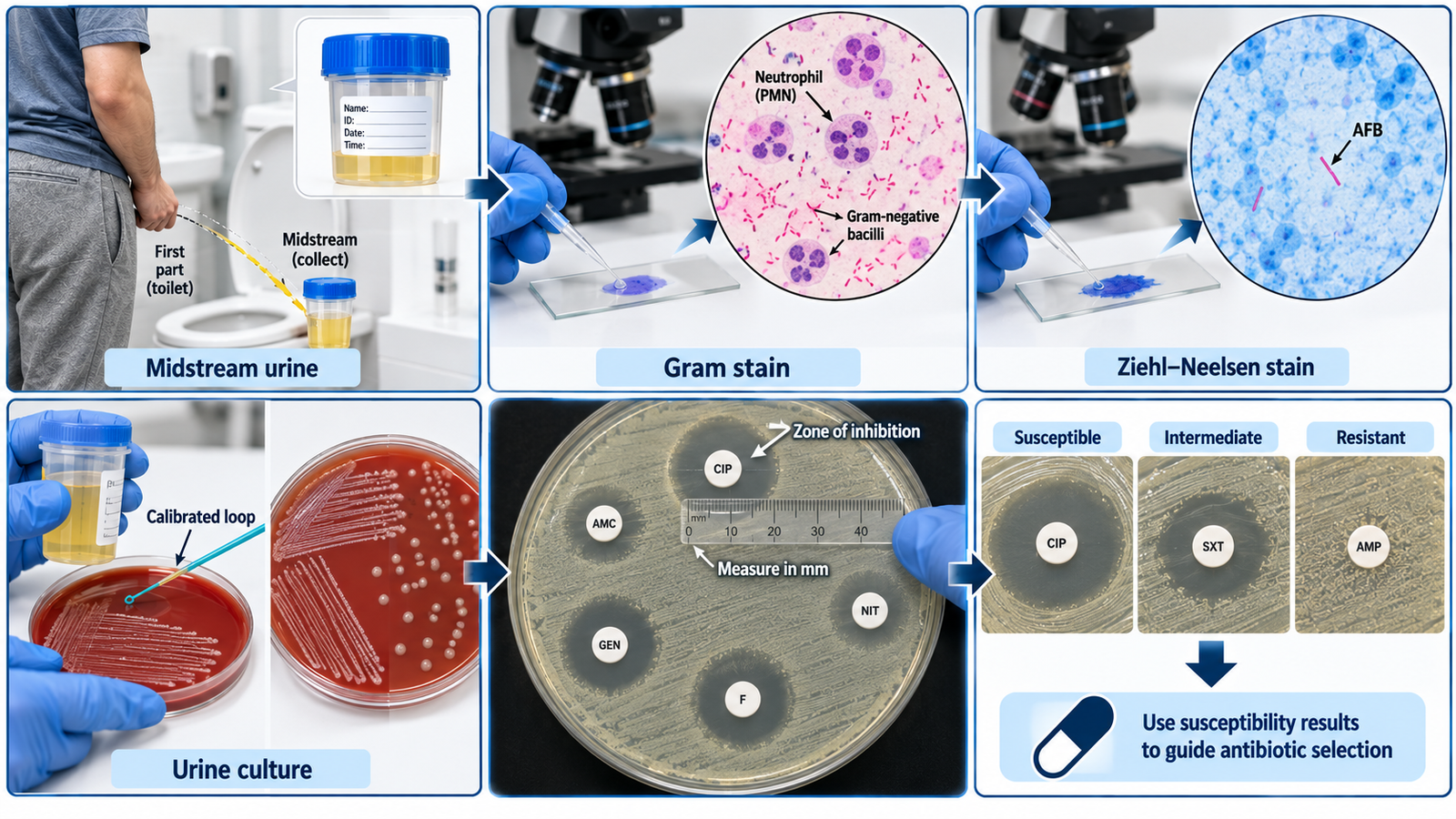
Staining: I would use Gram staining for routine bacterial examination; where chronic UTI due to mycobacterial infection is suspected, acid-fast staining such as Ziehl–Neelsen may be relevant.

Culture: A properly collected sterile midstream urine specimen is inoculated onto appropriate culture medium using aseptic technique and incubated for bacterial growth and identification.

Sensitivity: The isolated organism is tested against antimicrobial discs, zones of inhibition are measured and interpreted as susceptible, intermediate or resistant using the laboratory standard.

Prescription: I would select an antimicrobial according to the culture and susceptibility result while checking allergy status, pregnancy where relevant, renal function, dose, route, frequency and duration.

Chronic/recurrent infection: I would obtain culture before treatment and use culture-directed therapy rather than repeated empirical antimicrobial courses.

🔎 How to Perform / Approach

  1. Collect correctly: Obtain a labelled clean-catch midstream urine specimen in a sterile container without contaminating the inside of the container or lid.
  2. Examine the stained preparation: Perform or review Gram staining and identify bacterial morphology and Gram reaction; consider acid-fast staining when the supplied chronic-infection scenario specifically requires it.
  3. Culture aseptically: Mix the urine specimen appropriately and inoculate a measured sample onto the provided culture medium using a sterile calibrated loop and correct streaking technique.
  4. Assess growth: After incubation, inspect colony growth, correlate significant growth with the clinical specimen and identify the likely urinary pathogen using the provided laboratory findings.
  5. Perform susceptibility testing: Prepare a standardized bacterial inoculum, produce an even lawn on the susceptibility-testing plate and apply appropriate antimicrobial discs aseptically.
  6. Interpret the result: Measure zones of inhibition in millimetres and classify each antimicrobial as susceptible, intermediate or resistant according to the applicable laboratory standard.
  7. Write the prescription: Select an appropriate susceptible antimicrobial and write the drug name, strength, dose, route, frequency and duration; check patient factors and avoid an antimicrobial reported as resistant.

“`

Prescription format: Patient details → date → generic drug name → strength → dose/route → frequency → duration → relevant instructions → prescriber signature. In recurrent or chronic infection, base therapy on urine culture and susceptibility findings.

🖼️ Visual Learning

VISUAL 1

UTI Laboratory Work-Up: Staining, Culture and Antimicrobial Susceptibility
 

🎥 Practical Demonstration

Kirby–Bauer Disc-Diffusion Method

Focus on preparation of the inoculum, inoculation of the plate, application of antimicrobial discs, measurement of inhibition zones and final susceptibility interpretation.

Watch the practical antimicrobial susceptibility demonstration — Open University / EUCAST-based training

📝 Important Viva Questions

1. What is the purpose of Gram staining in a suspected bacterial UTI?

Answer: It demonstrates bacteria and their Gram reaction and morphology, helping provide an early indication of the likely bacterial group before culture identification.

2. When may Ziehl–Neelsen staining be relevant in urinary infection?

Answer: It may be used when genitourinary tuberculosis or another mycobacterial infection is suspected, particularly in an appropriate chronic urinary presentation.

3. Why should urine for culture be collected in a sterile container using a clean-catch midstream technique?

Answer: It minimizes contamination from periurethral and genital flora so that cultured organisms are more likely to represent organisms actually present in the urinary tract.

4. What does the zone of inhibition represent in a disc-diffusion susceptibility test?

Answer: It is the area around an antimicrobial disc where bacterial growth has been inhibited. Its measured diameter is compared with standardized breakpoints to determine susceptibility.

5. How should culture and sensitivity findings influence the prescription?

Answer: A suitable antimicrobial to which the organism is susceptible should be selected while considering patient-specific factors. An antimicrobial reported as resistant should generally not be chosen for targeted therapy.

Scroll to Top
💬 WhatsApp Support