
Course Content
OSCE Station 1 — Urine Specimen Collection, Physical Examination and Microscopy
KMU clinical activity: Urine collection methods, physical examination of urine specimen and microscopic examination of centrifuged urine Learning Objectives The student should be able to: • Demonstrate the correct procedure for urine specimen collection. • Assess the volume, colour, appearance and pH of a urine specimen. • Recognize an abnormal urine specimen showing pyuria and hematuria. • Prepare an appropriate report from the physical examination of urine. • Identify important urinary microscopic constituents including pus cells, RBCs, epithelial cells, crystals and casts. • Prepare urinary sediment for microscopic examination. • Examine a prepared urinary-sediment slide under the microscope. • Detect relevant abnormalities in the urinary sediment. • Interpret the findings of physical and microscopic urine examination.
0/1
OSCE Station 2 — Chemical Examination of Urine: Protein and Reducing Substances
KMU clinical activity: Chemical examination of non-centrifuged urine specimen Learning Objectives The student should be able to: • Identify substances commonly assessed during chemical examination of urine. • Describe different procedures used for detection of protein in urine. • Explain the principle of protein detection by the heat method. • Perform the heat and acetic acid test for urinary protein. • Demonstrate or interpret the test for Bence Jones protein. • Explain the principle of testing urine for reducing substances. • Explain the principle of Benedict's test. • Perform Benedict's test correctly. • Interpret the results of urinary protein and reducing-substance testing.
0/1
OSCE Station 3 — Urinary Tract Infection: Staining, Culture, Sensitivity and Prescription
KMU clinical activity: Urine staining and culture; prescriptions for acute and chronic UTI Learning Objectives The student should be able to: • Describe the staining methods used for urine specimens in acute and chronic urinary tract infection. • Explain the basic principles underlying these staining methods. • Identify common uropathogens demonstrated on a prepared slide. • Demonstrate appropriate sterile methods for collection of urine for culture and sensitivity. • Describe or demonstrate culture of a urinary pathogen. • Perform or interpret antimicrobial susceptibility testing by the disc-diffusion method. • Relate culture and sensitivity findings to appropriate antimicrobial selection. • Formulate an appropriate prescription for acute UTI. • Formulate an appropriate prescription for chronic UTI.
0/1
OSCE Station 4 — Waste Disposal and Incinerator Model
KMU clinical activity: Incinerator / waste-disposal models Learning Objectives The student should be able to: • Identify an incinerator or waste-disposal model. • Recognize the purpose of the demonstrated waste-disposal system. • Explain the steps of waste disposal represented by the model. • Describe the sequence of waste handling demonstrated in the model.
0/1
OSCE Station 5 — Water Sources and Sand Filtration
KMU clinical activity: Water-source models and sand filters Learning Objectives The student should be able to: • Identify a model representing a source of water. • Recognize the type of water source demonstrated. • Identify a sand-filter model. • Identify the different layers of the sand filter. • Explain the role of the different layers in water purification. • Explain the mechanism of purification by sand filtration.
0/1
OSCE Station 6 — Water Disinfection and Water-Quality Assessment
KMU clinical activity: Bleaching-powder calculation; physical assessment of water; presumptive coliform test Learning Objectives The student should be able to: • Calculate the required dose of bleaching powder for disinfection of water in a domestic tank. • Assess a water sample according to relevant physical parameters. • Assess the colour of a water sample. • Assess turbidity and suspended particles. • Assess temperature and pH. • Interpret the bacteriological quality of water using the presumptive coliform test. • Integrate physical and bacteriological findings when assessing water quality.
0/1
OSCE Station 7 — Ethics and Legal Aspects of Organ Transplantation
KMU clinical activity: Ethics of Organ Transplantation Learning Objectives The student should be able to: • Describe important ethical principles related to organ transplantation. • Discuss ethical considerations surrounding organ donation and transplantation. • Describe the relevant provisions of the Human Organ Transplant Act (HOTA) as required by the KMU curriculum. • Apply transplantation ethics to a relevant clinical or forensic scenario. • Identify important loopholes in the existing system of human organ transplantation as stated in the KMU learning objectives
0/1
AIM OSPE/OSCE Lab — Renal & Urology Module | 4th Year MBBS

AIM OSCE / OSPE • MBBS

Station 6 — Water Disinfection and Water-Quality Assessment

4th Year • Rapid Revision • Practical Skills • Viva

🎯 Candidate Task

Assess the supplied water sample for relevant physical characteristics and interpret the provided presumptive coliform-test result. Using the information supplied at the station, calculate the quantity of bleaching powder required to disinfect a domestic water tank.

⚡ Model Station Answer

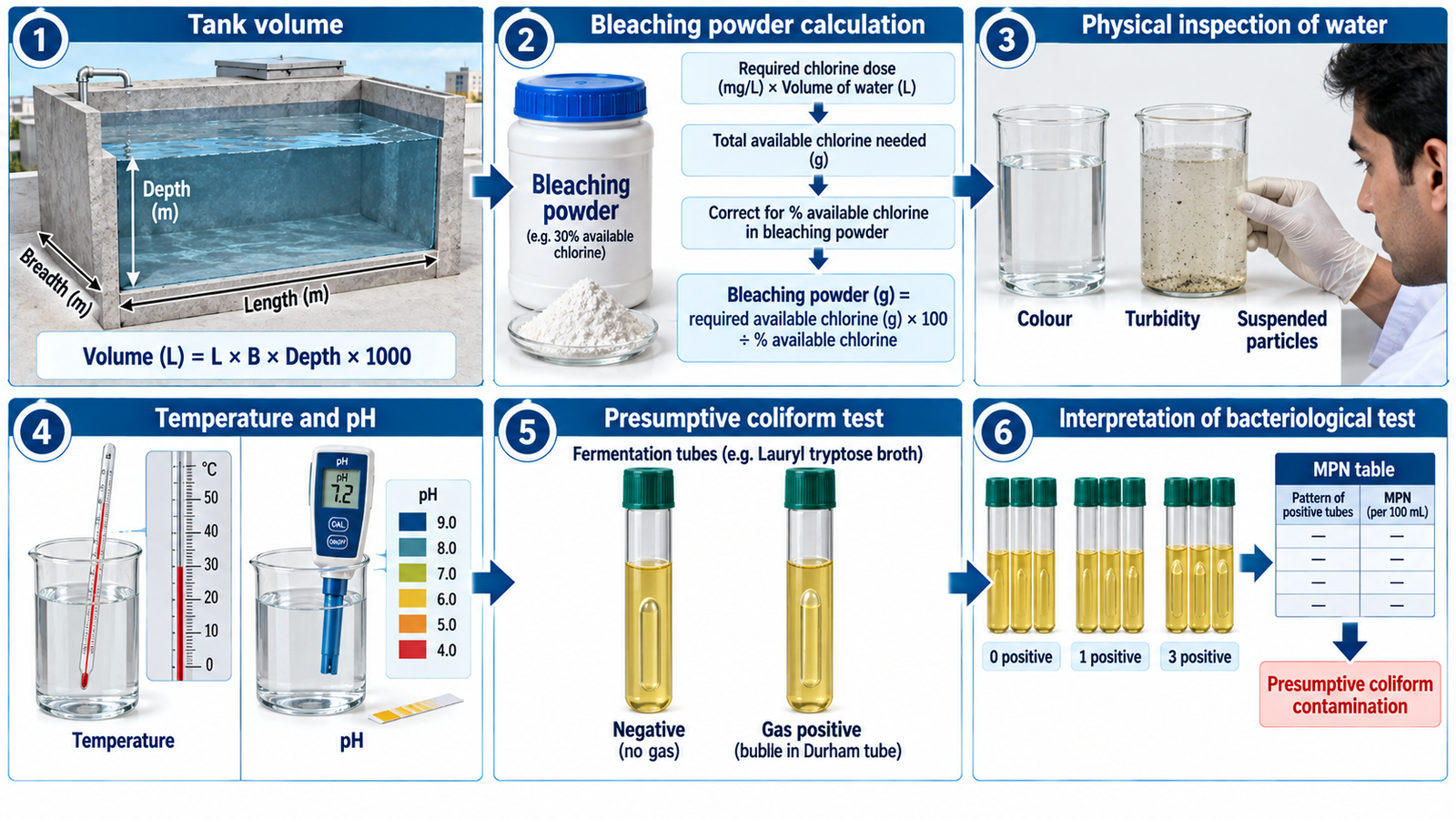
Physical assessment: I would assess colour, visible suspended particles/turbidity, temperature and pH.

Disinfection: I would first calculate the volume of water and then calculate the bleaching-powder requirement from the required chlorine dose and percentage of available chlorine stated in the station.

Bacteriological assessment: Gas production in the presumptive coliform test indicates presumptive coliform contamination; the pattern of positive tubes can be used to estimate the most probable number, or MPN.

Conclusion: Water quality should be interpreted by integrating both its physical characteristics and bacteriological findings.

🔎 How to Perform / Approach

  1. Step 1 — Calculate water volume.
    For a rectangular tank: length × breadth × water depth in metres × 1000 = volume in litres.
  2. Step 2 — Calculate chlorine requirement.
    Required available chlorine (g) = water volume (L) × required chlorine dose (mg/L) ÷ 1000.
  3. Step 3 — Convert to bleaching powder.
    Bleaching powder required (g) = required available chlorine (g) × 100 ÷ percentage of available chlorine in the bleaching powder.
  4. Step 4 — Inspect the water physically.
    Observe the sample against good illumination for abnormal colour, cloudiness, turbidity and visible suspended particles.
  5. Step 5 — Measure temperature and pH.
    Record temperature using an appropriate thermometer and assess pH using pH paper, indicator or a pH meter as provided.
  6. Step 6 — Interpret the presumptive coliform test.
    Examine inoculated fermentation tubes for gas in Durham tubes and associated fermentation changes. Record the number of positive tubes in each set and use the supplied MPN table when required.
  7. Step 7 — Integrate the findings.
    Comment on physical acceptability and bacteriological contamination separately before giving an overall assessment of the water sample.
Calculation shortcut: Always convert tank volume into litres first, then account for the percentage of available chlorine in the bleaching powder.

🖼️ Visual Learning

VISUAL 1

Water Disinfection, Physical Assessment and Presumptive Coliform Testing
 

📝 Important Viva Questions

1. How do you calculate the volume of water in a rectangular domestic tank?

Answer: Multiply length × breadth × water depth in metres to obtain cubic metres, then multiply by 1000 to convert the result into litres.

2. Why must the percentage of available chlorine be considered when calculating bleaching powder?

Answer: Bleaching powder is not pure chlorine. The quantity required therefore depends on how much available chlorine the preparation actually contains.

3. Which physical characteristics of water are assessed in this station?

Answer: Colour, turbidity or suspended particles, temperature and pH are assessed.

4. What indicates a positive presumptive coliform test?

Answer: Gas production in the fermentation tube after appropriate incubation indicates presumptive coliform activity and requires interpretation according to the test system used.

5. What does MPN mean in bacteriological examination of water?

Answer: MPN means Most Probable Number. It is a statistical estimate of coliform organisms based on the pattern of positive fermentation tubes.

Scroll to Top
💬 WhatsApp Support