High-Risk Pregnancy — Gestational Diabetes Mellitus
Related AIM Topic: High-Risk Pregnancy & Antenatal Complications
An integrated maternal and fetal assessment from antenatal diagnosis to delivery planning and postpartum prevention.
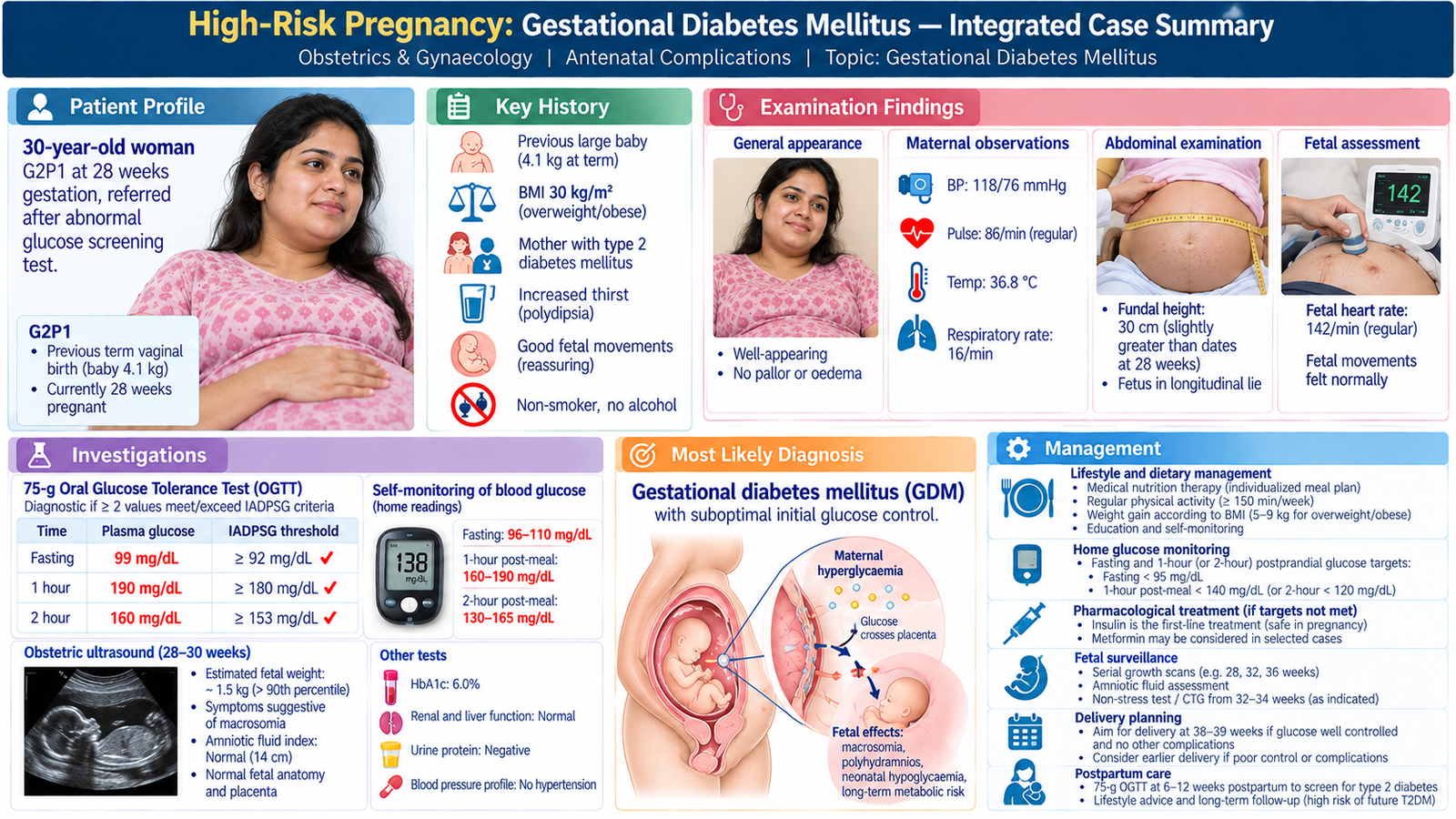
2. Patient Scenario
A 30-year-old woman, gravida 2 para 1, attends the antenatal clinic at 28 weeks of gestation after an abnormal routine glucose screening test. She feels generally well but reports increased thirst over the preceding few weeks. Her previous baby weighed 4.1 kg at birth. She is concerned about the effect of the test result on her baby and whether she will need insulin.
Opening task: Assess this pregnant woman systematically without assuming a diagnosis from the screening result alone.
3. Student Task
- Take focused obstetric and medical histories, including risk factors and symptoms of complications.
- Examine the mother and assess fetal growth and wellbeing.
- Interpret screening and diagnostic glucose results; identify the main clinical problem.
- Discuss differential diagnoses, further investigations, management and monitoring.
- Plan delivery and postpartum follow-up, and counsel the woman about future diabetes risk.
4. Relevant History
Current pregnancy and presenting concern
- Gestational age and dating: 28 weeks, confirmed by an early ultrasound — establishes when abnormal glucose regulation was identified and supports fetal-growth interpretation.
- Screening pathway: Ask which test was abnormal, whether it was a screening or diagnostic test, and whether a 75-g oral glucose tolerance test (OGTT) was performed — diagnosis must be based on valid diagnostic criteria.
- Symptoms: Increased thirst and nocturia, without vomiting, abdominal pain, marked weight loss or altered consciousness — hyperglycaemia can be asymptomatic; severe symptoms would require prompt assessment.
- Pregnancy symptoms: Normal perceived fetal movements, no vaginal bleeding, fluid leakage, contractions, severe headache or visual disturbance — screens for important obstetric problems.
Previous obstetric history
- Previous term birth: A 4.1-kg baby delivered vaginally, without documented shoulder dystocia — previous macrosomia raises suspicion of maternal glucose intolerance and informs delivery planning.
- Previous GDM, unexplained stillbirth, neonatal hypoglycaemia or birth injury: Specifically ask; none reported — these would change risk assessment and surveillance.
Medical, family and lifestyle history
- Pre-pregnancy BMI: Approximately 30 kg/m² — obesity increases the likelihood of insulin resistance and adverse pregnancy outcomes.
- Family history: Mother has type 2 diabetes — an important metabolic risk factor.
- Prior diabetes or abnormal glucose tests: No known diabetes before pregnancy — helps distinguish gestational from pre-existing diabetes, while not excluding previously unrecognized disease.
- Other illness and drugs: Ask about hypertension, previous pregnancy complications and glucose-raising medicines — may influence management and the differential.
- Diet, activity and access to care: Frequent sweetened drinks, limited physical activity and anxiety about home glucose checks — directly relevant to a feasible treatment plan.
5. Physical Examination
- General condition: Alert and comfortable; no dehydration or acute illness — currently clinically stable.
- Vital signs: BP 118/76 mmHg, pulse 84/min; no fever — no clinical evidence of hypertension or acute infection at this visit.
- Anthropometry: Document current weight and pre-pregnancy BMI; review gestational weight gain rather than using current BMI alone.
- General examination: Look for acanthosis nigricans, oedema and signs suggesting concurrent maternal complications; acanthosis may support insulin resistance but is not diagnostic.
- Obstetric abdominal examination: Uterus corresponds approximately to 29–30 weeks; longitudinal lie, fetal heart rate 142/min. Mildly increased fundal height requires ultrasound assessment, not an assumption of macrosomia.
- Relevant negatives: No tenderness, bleeding, signs of labour or reduced fetal movements.
6. Clinical Problem Representation
A stable 30-year-old G2P1 at 28 weeks, with obesity, a first-degree family history of type 2 diabetes and previous delivery of a 4.1-kg infant, presents after abnormal antenatal glucose screening. She has mild hyperglycaemic symptoms, normal blood pressure and reassuring clinical fetal activity, with fundal height slightly greater than dates.
Main clinical problem: Suspected hyperglycaemia first recognized during pregnancy, requiring diagnostic confirmation and joint maternal–fetal risk assessment.
7. Differential Diagnosis
- Gestational diabetes mellitus (GDM): Most likely because hyperglycaemia is detected during routine late-second-trimester testing with multiple risk factors; requires diagnostic confirmation.
- Previously unrecognized overt diabetes in pregnancy: Consider if glucose values meet non-pregnant diabetes thresholds or there is evidence of pre-existing disease; none is established from the screening history alone.
- Physiological urinary frequency and thirst of pregnancy: Symptoms can occur in normal pregnancy, but cannot explain an abnormal diagnostic OGTT.
- Transient or non-fasting screening abnormality: Screening can produce false positives; distinguish it through an appropriately performed diagnostic test.
8. Investigations & Interpretation
| Test | Why requested | Representative result and meaning |
|---|---|---|
| 75-g OGTT at 28 weeks | Confirm or exclude GDM after abnormal screening. | Fasting 99 mg/dL (5.5 mmol/L), 1-hour 190 mg/dL (10.5 mmol/L), 2-hour 160 mg/dL (8.9 mmol/L). These exceed the IADPSG/WHO one-step pregnancy thresholds (92/180/153 mg/dL); diagnostic of GDM under that pathway. |
| Fasting and post-meal capillary glucose profile | Assess current control and guide treatment. | First-week readings: fasting 98–108 mg/dL; 1-hour post-meal 145–168 mg/dL. Several values exceed commonly used targets of fasting <95 mg/dL and 1-hour <140 mg/dL. |
| HbA1c | May help identify marked or longer-standing hyperglycaemia; not a substitute for OGTT in routine GDM diagnosis. | 5.8% — does not independently establish or exclude GDM. |
| Urine dipstick, BP review | Screen for concurrent antenatal issues including proteinuria and hypertension. | Protein negative, BP normal — no current clinical suggestion of pre-eclampsia; continue routine assessment. |
| Growth ultrasound and amniotic fluid assessment | Evaluate possible accelerated fetal growth or polyhydramnios. | At 30 weeks, estimated fetal weight around 80th percentile, normal fluid — no confirmed macrosomia or polyhydramnios; trend growth rather than rely on one estimate. |
| Fetal wellbeing assessment | Determine whether additional surveillance is needed based on treatment and complications. | Normal movements and heart rate at this visit. Further surveillance is individualized; a normal heart rate alone does not replace indicated fetal testing. |
Interpretation note: GDM diagnostic thresholds and screening strategies differ between institutions (one-step versus two-step). Interpret results using the locally adopted protocol; the example above explicitly uses the 75-g one-step criteria.
9. Final Diagnosis
Gestational diabetes mellitus diagnosed at 28 weeks’ gestation, with fasting and postprandial glucose above usual treatment targets on initial monitoring, and no currently identified maternal hypertension or fetal growth complication.
10. Management
A. Initial priorities and coordinated care
Explain the diagnosis and maternal–fetal implications; arrange follow-up with the antenatal/obstetric team and diabetes educator or medical team where available. Check for symptoms of significant hyperglycaemia, dehydration or other obstetric problems; there is no indication for emergency treatment in this stable patient.
B. Nutrition and lifestyle
Offer individualized pregnancy-appropriate nutrition counselling: regular balanced meals, moderate portions of carbohydrates distributed through the day, high-fibre foods, adequate protein and avoidance of sugar-sweetened beverages. Encourage safe regular physical activity, such as walking after meals, unless obstetric contraindications exist. Avoid restrictive dieting or intentional weight loss in pregnancy.
C. Glucose monitoring and pharmacological treatment
Teach home glucose testing, typically fasting and after meals, alongside a record of food intake and readings. Common targets are fasting <95 mg/dL (5.3 mmol/L), 1-hour after meals <140 mg/dL (7.8 mmol/L), or 2-hour after meals <120 mg/dL (6.7 mmol/L), according to local protocol. Review logs promptly. Because this patient’s fasting and post-meal values remain repeatedly elevated, initiate or arrange pharmacological treatment without prolonged delay. Insulin is a well-established preferred option during pregnancy where medication is needed, with regimens individualized to glucose patterns. Metformin may be an option under selected local protocols after counselling on placental transfer and its limitations.
D. Maternal and fetal surveillance
At each relevant visit, review glucose logs, adherence, hypoglycaemia symptoms, BP, urine findings and gestational weight gain. Assess fetal growth and amniotic fluid by ultrasound as indicated. Plan antenatal fetal surveillance according to whether GDM is diet-controlled or medication-treated and whether other complications develop.
E. Delivery planning
Plan delivery collaboratively based on glycaemic control, fetal growth, maternal condition and obstetric factors. Well-controlled uncomplicated GDM does not automatically require Caesarean section or premature delivery. Medication requirement, poor control, suspected excessive fetal growth or coexisting complications may alter timing and mode. Discuss ultrasound weight-estimation uncertainty and assess any indication for Caesarean delivery individually.
F. Intrapartum, newborn and postpartum plan
Arrange appropriate maternal glucose monitoring during labour under the unit protocol. Inform the neonatal team of the GDM history; ensure early feeding and neonatal glucose monitoring as indicated because of hypoglycaemia risk. After birth, insulin or other glucose-lowering treatment used solely for GDM can often be discontinued under supervision, with reassessment for persisting diabetes. Encourage breastfeeding and arrange a 75-g OGTT at 4–12 weeks postpartum, followed by periodic lifelong diabetes screening.
11. Complications & Red Flags
Maternal complications: Pre-eclampsia, polyhydramnios, increased likelihood of operative delivery and later type 2 diabetes. Fetal/newborn complications: Excessive fetal growth, birth trauma including shoulder dystocia, neonatal hypoglycaemia and respiratory or adaptation difficulties. Risk is influenced by the degree of glycaemic control and other obstetric factors.
12. Patient Counselling & Follow-Up
- Explain clearly: Pregnancy-related insulin resistance can raise blood glucose; treatment reduces the likelihood of complications, and most women can have good maternal and neonatal outcomes.
- Address concerns: Insulin, if needed, is not a personal failure. Ask about access to glucose strips, injections, food choices, family support and emotional stress.
- Practical home care: Demonstrate glucose recording, explain agreed targets, review meals and activity, and provide a contact pathway for repeated high or low readings.
- Safety: Explain symptoms and management of hypoglycaemia if insulin is started, and emphasize prompt reporting of reduced fetal movements or pre-eclampsia symptoms.
- After pregnancy: Complete a 75-g OGTT at 4–12 weeks postpartum even if glucose normalizes. Repeat diabetes screening at least every 1–3 years, as locally recommended; maintain sustainable nutrition and activity changes.
- Future pregnancies: GDM can recur. Seek preconception assessment and early glucose screening in subsequent pregnancies.
13. Long Case Presentation to the Examiner
“I assessed a 30-year-old G2P1 at 28 weeks of gestation referred after abnormal antenatal glucose screening. Her major risk factors are a pre-pregnancy BMI of approximately 30 kg/m², a first-degree family history of diabetes and a previous 4.1-kg baby. She describes increased thirst but no severe hyperglycaemic or obstetric warning symptoms. She is clinically stable, normotensive and reports normal fetal movements, although her fundal height is slightly greater than dates.”
“A diagnostic 75-g OGTT has values above pregnancy thresholds, confirming gestational diabetes using the stated one-step criteria. Early home glucose readings remain above recommended targets. My plan is individualized dietary and physical activity support, structured glucose monitoring, timely pharmacological treatment if readings remain elevated, maternal and fetal surveillance, individualized delivery planning, and postpartum OGTT with long-term prevention counselling.”
14. Examiner Discussion / Viva Preparation
Q1. Why is 28 weeks a relevant time to identify GDM?
Insulin resistance increases in later pregnancy; routine screening commonly takes place at 24–28 weeks.
Q2. Which features increase this woman’s GDM risk?
Raised pre-pregnancy BMI, first-degree family history of type 2 diabetes and a previous macrosomic infant.
Q3. How do you distinguish screening from diagnosis?
A screening result identifies women needing further assessment; diagnosis depends on the locally adopted diagnostic glucose test and cutoffs. Her specified 75-g OGTT exceeds the one-step thresholds.
Q4. Why is an HbA1c of 5.8% insufficient to exclude GDM?
HbA1c can miss pregnancy-specific dysglycaemia and is not the routine substitute for a diagnostic OGTT.
Q5. What are your common home glucose targets?
Fasting <95 mg/dL; 1-hour post-meal <140 mg/dL or 2-hour post-meal <120 mg/dL, subject to local protocol.
Q6. When would you add medication?
When readings remain repeatedly above targets despite appropriate nutritional and lifestyle measures, or if significant hyperglycaemia warrants earlier intervention. Insulin is a standard preferred choice.
Q7. Does GDM alone mandate Caesarean delivery?
No. Timing and mode depend on glycaemic control, estimated fetal growth and usual obstetric indications.
Q8. Why is postpartum testing necessary?
Glucose may normalize after delivery, but women remain at high risk of persistent dysglycaemia and future type 2 diabetes; a 75-g OGTT at 4–12 weeks postpartum is recommended.
15. AIM Long Case — High-Yield Review
- GDM is often asymptomatic; do not rely on thirst or polyuria to make the diagnosis.
- Previous macrosomia, obesity and first-degree family history are high-yield risk clues.
- Identify the screening pathway before interpreting any abnormal glucose test.
- For a 75-g one-step OGTT, pregnancy thresholds are fasting 92, 1-hour 180 and 2-hour 153 mg/dL; one abnormal value is sufficient under this system.
- Check BP and urine findings as well as maternal glucose, because obstetric risk extends beyond blood sugar.
- Assess fetal growth and fluid when indicated; fundal height alone does not diagnose macrosomia.
- Use fasting and post-meal glucose logs to judge response to treatment.
- Begin individualized meal planning, safe activity and glucose-monitoring education promptly.
- Repeated values above targets merit timely medication review; insulin is a standard pregnancy option.
- Delivery route and timing are individualized; GDM by itself is not a Caesarean indication.
- Anticipate neonatal hypoglycaemia and coordinate newborn care.
- Never omit postpartum 75-g OGTT and long-term diabetes prevention counselling.