
Short Case 06 — Antenatal Examination: Pregnant Woman
Endocrine & Reproduction Module | Obstetrics & Gynaecology
Focused maternal observations, obstetric abdominal examination and interpretation of fetal findings.
1. Short Case Title
Short Case 06 — Antenatal Examination: Pregnant Woman
Related AIM Topics: Topic 5 — Antenatal Care, Maternal Assessment, Fetal Wellbeing & Prenatal Diagnosis; Topic 6 — High-Risk Pregnancy & Antenatal Complications.
2. Patient / Clinical Setting
A 26-year-old G2P1 woman at 32 weeks of gestation attends a routine antenatal visit. She reports normal fetal movements and no current bleeding, fluid leakage, headache or visual disturbance. Her antenatal record is available.
3. Student Task
“Take a brief focused antenatal history, perform a general and obstetric abdominal examination, assess maternal blood pressure and fetal wellbeing, and present and interpret your findings.”
4. Focused Examination Approach
- Preparation: Introduce yourself, obtain consent, ensure privacy and a chaperone where appropriate, perform hand hygiene and position the patient comfortably with a left lateral tilt if supine symptoms occur.
- Focused history: Confirm gestation and dating, parity, fetal movements, antenatal follow-up and previous obstetric complications; ask about bleeding, fluid leakage, abdominal pain, headache, visual symptoms, swelling and urinary symptoms.
- Maternal observations: Measure blood pressure with an appropriately sized cuff after rest; check pulse and general appearance. Assess pallor, oedema and other clinically relevant signs.
- Abdominal inspection: Inspect abdominal contour, scars, skin and visible fetal movements; look for tenderness or unusual distension.
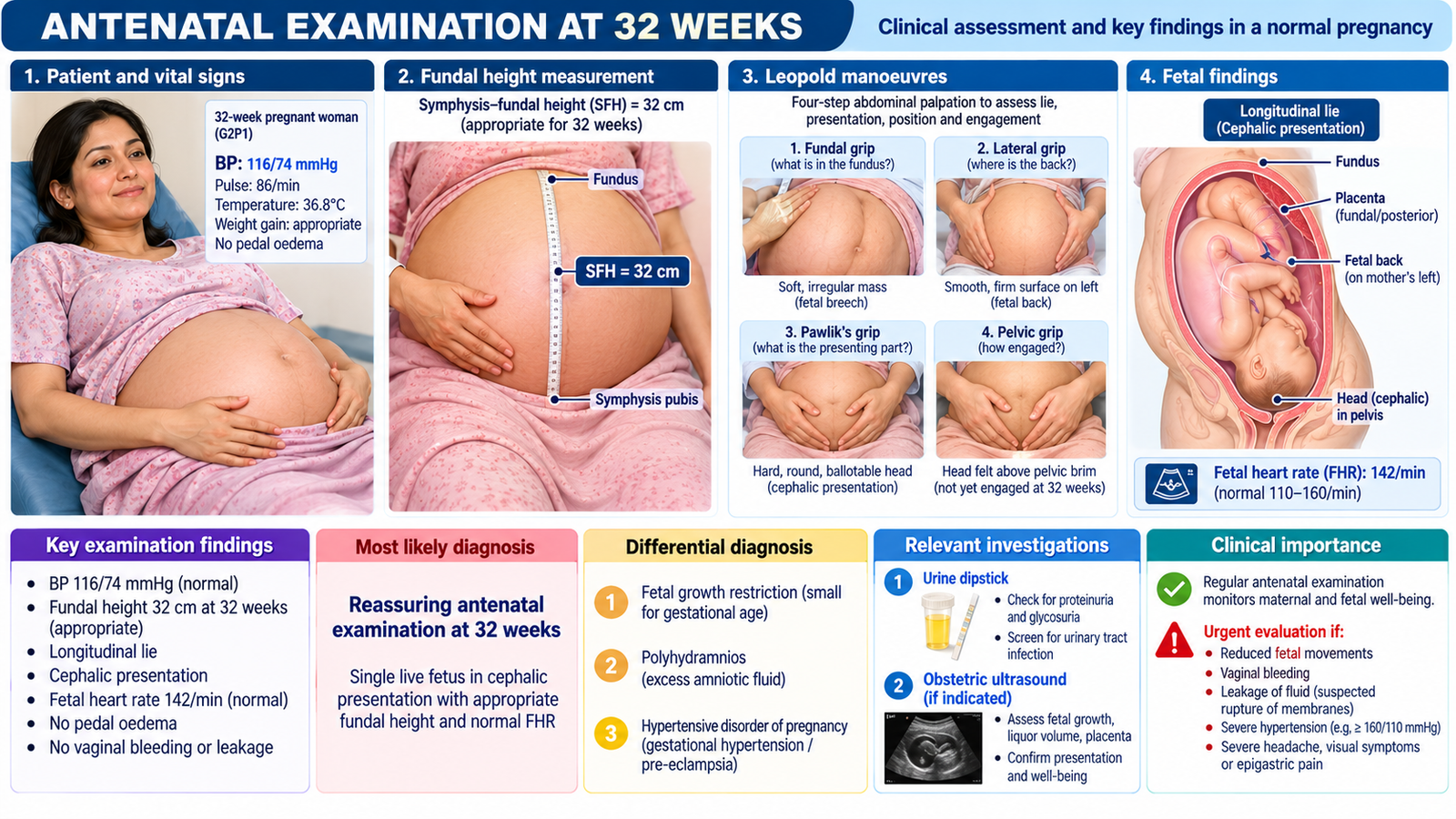
- Fundal height: Palpate the uterine fundus and measure symphysis–fundal height in centimetres with a non-stretch tape; compare with gestational age and the serial growth chart.
- Leopold manoeuvres: Use fundal, lateral and pelvic palpation to determine fetal lie, presenting part, position where possible and whether the presenting part is engaged; avoid forceful palpation.
- Fetal wellbeing: Ask about fetal movements and auscultate fetal heart rate using an appropriate Doppler; distinguish fetal rate from the maternal pulse. Review antenatal records and plot/document findings.
5. Important Clinical Findings
Expected positive / reassuring findings in this patient
- BP 116/74 mmHg: normotensive at this visit.
- Well appearing, no pallor or concerning oedema: no obvious general maternal abnormality on focused examination.
- Symphysis–fundal height 32 cm: broadly concordant with 32 weeks; a serial growth chart is more informative than one measurement.
- Longitudinal lie and cephalic presentation: head is the presenting part; presentation may still change at 32 weeks.
- Fetal heart rate 142/min, regular: within the usual baseline range of 110–160/min; a single auscultation does not establish complete fetal wellbeing.
Important relevant negative findings
- No vaginal bleeding, fluid leakage or significant abdominal tenderness.
- No severe headache, visual symptoms or right upper-quadrant/epigastric pain.
- No markedly discrepant fundal height or abnormal fetal heart rate during assessment.
6. Presentation of Findings
“I examined a 26-year-old G2P1 woman at 32 weeks. She is clinically well, with blood pressure 116/74 mmHg and no pallor or concerning oedema. Her symphysis–fundal height is 32 cm. The fetus is in longitudinal lie with cephalic presentation, and the fetal heart rate is regular at 142/min. There is no abdominal tenderness, and she reports normal fetal movements without maternal warning symptoms. These are reassuring antenatal findings today, subject to review of serial growth and routine antenatal investigations.”
7. Most Likely Diagnosis
Singleton ongoing pregnancy at 32 weeks with clinically reassuring maternal and fetal findings on this focused antenatal assessment.
This is an examination impression, not a guarantee that pregnancy is free from complications.
8. Differential Diagnosis
- Fetal growth restriction: consider if fundal height is small for gestation or serial growth is faltering; confirm growth by ultrasound.
- Polyhydramnios or multiple pregnancy: consider with unexpectedly large fundal height; ultrasound clarifies fluid volume and fetal number.
- Hypertensive disorder of pregnancy: consider with raised BP, proteinuria or suggestive symptoms; assess promptly even if the abdominal findings are unremarkable.
9. Relevant Investigations
- Urine dipstick: screen for protein in the setting of hypertension and identify findings suggesting glycosuria or urinary infection; confirm abnormalities appropriately.
- Haemoglobin / full blood count: detect maternal anaemia when due as part of antenatal screening or clinically indicated.
- Obstetric ultrasound: assess fetal biometry, growth, presentation and amniotic fluid when measurements or clinical findings are concerning.
- Fetal wellbeing assessment (e.g., CTG/NST when indicated): evaluate reduced fetal movements or other suspected fetal compromise, rather than treating one normal Doppler rate as definitive.
10. Management Discussion
- Continue routine antenatal care if maternal observations, serial growth and indicated screening results are reassuring.
- Document BP, fundal height, fetal lie/presentation, fetal heart rate and reported movements; compare with previous visits.
- Explain urgent return precautions for reduced movements, bleeding, fluid leakage or pre-eclampsia symptoms.
- Arrange appropriate obstetric assessment and targeted investigations if any maternal or fetal abnormality is detected.
11. Red Flags / Serious Complications
- BP ≥160 systolic or ≥110 diastolic mmHg, or severe headache, visual disturbance or epigastric pain.
- Reduced or absent fetal movements.
- Vaginal bleeding or suspected rupture of membranes.
- Persistent severe abdominal pain or abnormal fetal heart findings.
Any of these findings requires immediate obstetric assessment and escalation.
12. Examiner Viva Preparation
Q1. Why is the mother’s blood pressure measured at every antenatal visit?
Answer: To detect pregnancy-related hypertension and identify women requiring assessment for pre-eclampsia.
Q2. What does a symphysis–fundal height of 32 cm at 32 weeks suggest?
Answer: It is broadly consistent with dates; trends and ultrasound matter when discrepancy is suspected.
Q3. How do you determine fetal lie and presentation?
Answer: Use abdominal palpation: fundal and lateral grips assess lie, while the lower pole/pelvic grips identify the presenting part.
Q4. What is the usual fetal heart-rate baseline range?
Answer: Approximately 110–160 beats/min.
Q5. Does a normal fetal heart rate alone confirm fetal wellbeing?
Answer: No. Maternal report of movements, growth trend and indicated additional testing must also be considered.
Q6. What findings raise concern for pre-eclampsia?
Answer: New hypertension after 20 weeks with proteinuria or maternal organ dysfunction; headache, visual disturbance and epigastric pain are warning symptoms.
Q7. What is your next step if fundal height is persistently smaller than expected?
Answer: Review dating and the serial growth chart, and arrange obstetric ultrasound to evaluate fetal growth and fluid.
13. AIM Short Case High-Yield Review
- Confirm gestational age, parity, fetal movements and major maternal warning symptoms.
- Measure BP correctly and recognize severe hypertension.
- Inspect the mother, then examine the obstetric abdomen systematically.
- Measure and chart symphysis–fundal height; a single measurement is not a growth diagnosis.
- Identify fetal lie and presenting part with Leopold manoeuvres.
- Check fetal heart rate; normal baseline is usually 110–160/min.
- Consider growth restriction, excess fluid and hypertensive disease if findings are abnormal.
- Record both positive and relevant negative findings in a concise presentation.
- Never reassure solely on one normal fetal heart auscultation when fetal movements are reduced.