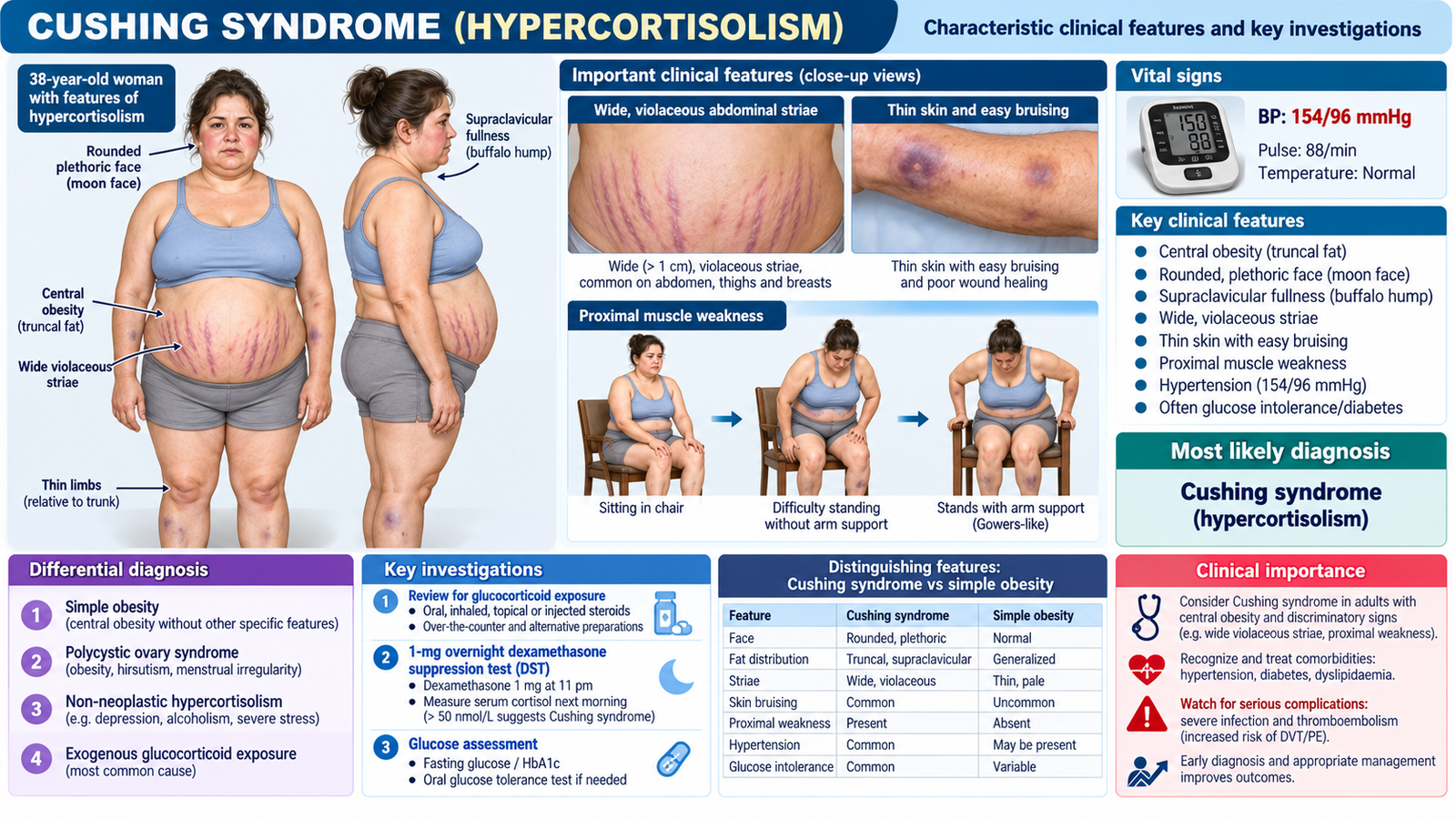
Cushing Syndrome — Clinical Signs
Endocrine & Reproduction Module | Medicine
Focused bedside recognition of hypercortisolism, characteristic physical signs and associated metabolic complications.
1. Short Case Title
Short Case 04 — Focused Examination of a Patient with Clinical Features of Cushing Syndrome
2. Patient / Clinical Setting
A 38-year-old woman attends the medical outpatient department with progressive weight gain and difficulty rising from a seated position. She has developed facial rounding and prominent stretch marks over the abdomen.
You are asked to perform a focused clinical examination and interpret the findings.
3. Student Task
Examine this patient for characteristic physical signs of hypercortisolism, identify associated complications, and present your findings with the most likely clinical diagnosis.
4. Focused Examination Approach
Introduce yourself, obtain consent, ensure privacy and appropriate exposure, and examine the patient respectfully.
A. General Appearance and Fat Distribution
- Observe central obesity with relatively thin extremities.
- Inspect for a rounded, full face (moon facies) and facial plethora.
- Look for supraclavicular fat pads and dorsocervical fat accumulation.
- Assess the general body habitus rather than relying on obesity alone.
B. Skin Examination
- Inspect the abdomen and proximal limbs for wide, violaceous striae.
- Look for thin skin, easy bruising and delayed wound healing.
- Observe for acne and excessive facial hair where relevant.
- Assess for skin infections or other signs of impaired tissue integrity.
C. Proximal Muscle Assessment
- Ask the patient to rise from a chair without using the arms, if safe.
- Assess resisted shoulder abduction and hip flexion.
- Look for symmetrical proximal muscle weakness and wasting.
- Distinguish weakness from limitation caused by joint pain or obesity.
D. Cardiovascular and Metabolic Assessment
- Measure blood pressure correctly and assess for hypertension.
- Record weight, height, BMI and waist circumference where appropriate.
- Look for clinical evidence of complications such as infection or impaired mobility.
- Ask briefly about diabetes symptoms, including polyuria and polydipsia.
Wide purple striae, easy bruising, thin skin and true proximal muscle weakness are more discriminatory for hypercortisolism than central obesity or facial rounding alone.
5. Important Clinical Findings
Positive Findings
| Clinical Finding | Clinical Interpretation |
|---|---|
| Central obesity and rounded face | Characteristic redistribution of body fat in hypercortisolism. |
| Wide, violaceous abdominal striae | Suggests cortisol-related thinning of skin and connective tissue. |
| Easy bruising and thin skin | Supports increased tissue fragility from glucocorticoid excess. |
| Proximal muscle weakness | Suggests glucocorticoid-associated myopathy. |
| Blood pressure 154/96 mmHg | Indicates an important associated cardiovascular complication. |
Important Relevant Negative Findings
- No peripheral edema or signs of acute cardiovascular decompensation.
- No focal neurological deficit.
- No obvious acute infection or non-healing ulcer.
The findings above represent this illustrative patient. Clinical features raise suspicion but do not establish biochemical hypercortisolism.
6. Presentation of Findings
“I examined a 38-year-old woman with central obesity, rounded plethoric facies, wide violaceous abdominal striae, thin skin with easy bruising and symmetrical proximal muscle weakness. Her blood pressure is elevated at 154/96 mmHg. These findings are highly suggestive of Cushing syndrome with associated hypertension. I would review her glucocorticoid exposure and arrange appropriate biochemical evaluation.”
7. Most Likely Diagnosis
Clinically suspected Cushing syndrome (hypercortisolism), with proximal myopathy and hypertension.
The cause may be exogenous glucocorticoid exposure or endogenous cortisol excess. Clinical examination alone cannot determine the etiology.
8. Differential Diagnosis
| Alternative Diagnosis | Distinguishing Features |
|---|---|
| Simple obesity | May cause central weight gain, but wide violaceous striae, thin skin, easy bruising and objective proximal weakness are less typical. |
| Polycystic ovary syndrome | May produce obesity, acne and hirsutism; catabolic skin changes and proximal myopathy favor Cushing syndrome. |
| Non-neoplastic hypercortisolism (pseudo-Cushing state) | Can occur with alcohol use disorder or severe depression; clinical overlap requires careful biochemical interpretation. |
9. Relevant Investigations
First, review prescribed, inhaled, topical, injected or other glucocorticoid exposure. Endogenous Cushing syndrome should not be screened for without considering exogenous steroid use.
| Investigation | Purpose / Expected Finding |
|---|---|
| 1-mg overnight dexamethasone suppression test | Screens for endogenous hypercortisolism; inadequate morning cortisol suppression is abnormal. |
| Late-night salivary cortisol or 24-hour urinary free cortisol | Alternative or confirmatory screening methods; appropriately collected repeated abnormal results support cortisol excess. |
| Fasting glucose or HbA1c | Identifies associated hyperglycemia or diabetes mellitus. |
| Serum electrolytes, especially potassium | Assesses metabolic complications; hypokalemia may occur, particularly in severe hypercortisolism. |
If endogenous hypercortisolism is confirmed, specialist evaluation determines the source. Random serum cortisol is not an appropriate standalone screening test.
10. Management Discussion
- Review glucocorticoid exposure and confirm the diagnosis biochemically before determining treatment.
- Manage associated hypertension, hyperglycemia and other clinically significant complications.
- Refer confirmed endogenous Cushing syndrome for endocrine evaluation and treatment directed at its cause.
- If the syndrome is medication-induced, adjust steroids only under medical supervision; abrupt cessation may cause adrenal insufficiency.
11. Red Flags / Serious Complications
- Severe hypertension with headache, chest pain or neurological symptoms.
- Marked hyperglycemia, dehydration or altered consciousness.
- Fever or serious infection with unexpectedly few inflammatory signs.
- Sudden dyspnea or unilateral leg swelling suggesting venous thromboembolism.
Any suspected hypertensive emergency, major infection, thromboembolism or acute metabolic decompensation requires urgent hospital assessment.
12. Examiner Viva Preparation
Q1. Which physical signs are particularly suggestive of Cushing syndrome?
Wide violaceous striae, easy bruising, thin skin, facial plethora and proximal muscle weakness.
Q2. How does the fat distribution typically change?
Central fat accumulation, rounded face, supraclavicular fullness and sometimes a dorsocervical fat pad, with relatively thin limbs.
Q3. How would you demonstrate proximal myopathy?
Observe the patient rising from a chair without arm support and test shoulder abduction and hip flexion against resistance.
Q4. How can you differentiate Cushing syndrome from simple obesity clinically?
Central obesity alone is nonspecific; thin skin, easy bruising, wide purple striae and true proximal myopathy strongly favor Cushing syndrome.
Q5. What is the first important cause to exclude?
Exogenous glucocorticoid exposure, including oral, injected, inhaled and topical preparations.
Q6. Name two appropriate screening tests for endogenous hypercortisolism.
The 1-mg overnight dexamethasone suppression test and late-night salivary cortisol; 24-hour urinary free cortisol is another option.
Q7. What important associated complications should you assess?
Hypertension, diabetes mellitus, infections, osteoporosis, proximal muscle weakness and venous thromboembolism.
13. AIM Short Case High-Yield Review
- Look: Central obesity, moon facies, facial plethora and abnormal fat distribution.
- Inspect the skin: Wide violaceous striae, thin skin and easy bruising.
- Test muscle power: Proximal weakness is a valuable discriminatory sign.
- Measure BP: Hypertension is an important associated complication.
- Differentiate: Obesity alone does not establish Cushing syndrome.
- Ask about steroids: Exogenous glucocorticoid use is an essential consideration.
- Investigate: Use an appropriate cortisol screening test, not random serum cortisol alone.
- Manage: Confirm the diagnosis, assess complications and treat the underlying cause.
- Recognize red flags: Severe hypertension, major infection, thromboembolism or metabolic decompensation.
Short Case Visual 04 — Cushing Syndrome: Characteristic Clinical Signs