
Course Content
OSCE Station 1 — Identification of Intestinal Helminth Ova: Ascaris, Enterobius and Ankylostoma
KMU clinical activity: Ascaris lumbricoides, Enterobius vermicularis and Ankylostoma duodenale — identification of morphological and staining characteristics of ova. Learning Objectives The student should be able to: Identify the important morphological and staining characteristics of Ascaris lumbricoides ova. Identify the important morphological and staining characteristics of Enterobius vermicularis ova. Identify the important morphological and staining characteristics of Ankylostoma duodenale ova. Differentiate the three ova when presented as specimens or images at the station.
0/1
OSCE Station 2 — Liver Function Tests: Interpretation in Clinical Scenarios
KMU clinical activity: Liver Function Tests. Learning Objectives The student should be able to: Interpret normal liver function test results. Identify abnormal liver function test results. Interpret abnormal liver function tests in the context of different clinical scenarios. Integrate the principal liver function test findings presented at the station.
0/1
OSCE Station 3 — Prescription Writing I: Peptic Ulcer Disease and Antiemetic Therapy
KMU clinical activity: Peptic ulcer disease; anti-emetics — prescription construction for Helicobacter-associated peptic ulcer disease and common clinical indications for antiemetic therapy. Learning Objectives The student should be able to: Construct a prescription for Helicobacter-associated peptic ulcer disease using triple therapy. Construct a prescription for Helicobacter-associated peptic ulcer disease using quadruple therapy. Construct an appropriate prescription for motion sickness. Construct an appropriate prescription for morning sickness. Construct an appropriate prescription for a post-operative patient requiring antiemetic therapy. Construct an appropriate prescription for cancer chemotherapy-induced vomiting.
0/1
OSCE Station 4 — Prescription Writing II: Amoebic Dysentery, Enteric Fever and Ascariasis
Learning Objectives The student should be able to: Construct a prescription for a patient suffering from amoebic dysentery. Construct a prescription for a patient suffering from enteric fever. Write a prescription for a patient suffering from ascariasis. Select and present the appropriate prescription according to the clinical scenario provided at the station.
0/1
OSCE Station 5 — Corrosive Poisons and Vitriolage
KMU clinical activity: Poisons/corrosives — identification of corrosives and case presentation of vitriolage. Learning Objectives The student should be able to: Identify corrosive substances/poisons presented at the station. Present a case of vitriolage in a structured manner. Relate the presented corrosive substance or scenario to the relevant forensic case.
0/1
OSCE Station 6 — Identification of Irritant, Metallic, Non-Metallic, Vegetable and Animal Poisons
KMU clinical activity: Irritants; metallic poisons; non-metallic poisons; vegetable poisons; animal poisons. Learning Objectives The student should be able to: Identify common irritant poisons. Identify common metallic poisons. Identify common non-metallic poisons. Identify common vegetable poisons. Identify common animal poisons. Differentiate the major poison categories when presented as specimens, models or spotters.
0/1
OSCE Station 7 — Nutrition Models: Protein-Calorie Malnutrition, Food Plate, Food Pyramid, Fortification and Adulteration
KMU clinical activity: Protein-calorie malnutrition; My Food Plate/The Pyramid; food fortification and food adulteration. Learning Objectives The student should be able to: Identify a protein-calorie malnutrition model presented at the station. Differentiate between the clinical features of the two protein-calorie malnutrition models. Explain the public-health importance of protein-calorie malnutrition. Explain the concepts of food fortification and food adulteration. Identify the My Food Plate/Food Pyramid model. Describe the different components of the food plate/food pyramid model.
0/1
OSCE Station 8 — Health Education: Identification and Formulation of a Health Message
KMU clinical activity: Health education — identification and formulation of a health-education message from a provided problem or scenario. Learning Objectives The student should be able to: Identify an appropriate health-education message for the problem or scenario provided. Formulate an appropriate health-education message for the problem or scenario provided. Present the message clearly and appropriately according to the scenario.
0/1
OSCE Station 9 — Vector Identification and Control: Housefly/Arthropods and Aedes aegypti
KMU clinical activity: Housefly/arthropods and Aedes aegypti — model identification, associated disease and vector control. Learning Objectives The student should be able to: Identify a housefly/arthropod model presented at the station. Explain the disease associated with the vector and its control. Identify an Aedes aegypti model presented at the station. Explain the disease associated with this vector and its control. Differentiate the two vectors when presented as models or specimens.
0/1
OSCE Station 10 — Autoclave and Instrument Sterilization
KMU clinical activity: Autoclave — model identification, items suitable for autoclaving and steps of instrument sterilization. Learning Objectives The student should be able to: Identify the autoclave model. Explain the types of items for which autoclaves are used. Explain the steps of instrument sterilization. Integrate the relevant sterilization steps when presented with an autoclave-based practical scenario.
0/1
AIM OSPE/OSCE Lab — GIT & Hepatobiliary-II Module | 4th Year MBBS
AIM OSCE / OSPE • MBBS

Station 1 — Identification of Intestinal Helminth Ova: Ascaris, Enterobius and Ankylostoma

4th Year • GIT / Hepatobiliary • Rapid Revision • Practical Skills • Viva

🎯 Candidate Task

Examine the three provided ova specimens or images. Identify each helminth ovum and state the important morphological and staining features that distinguish it from the others.

⚡ Model Station Answer

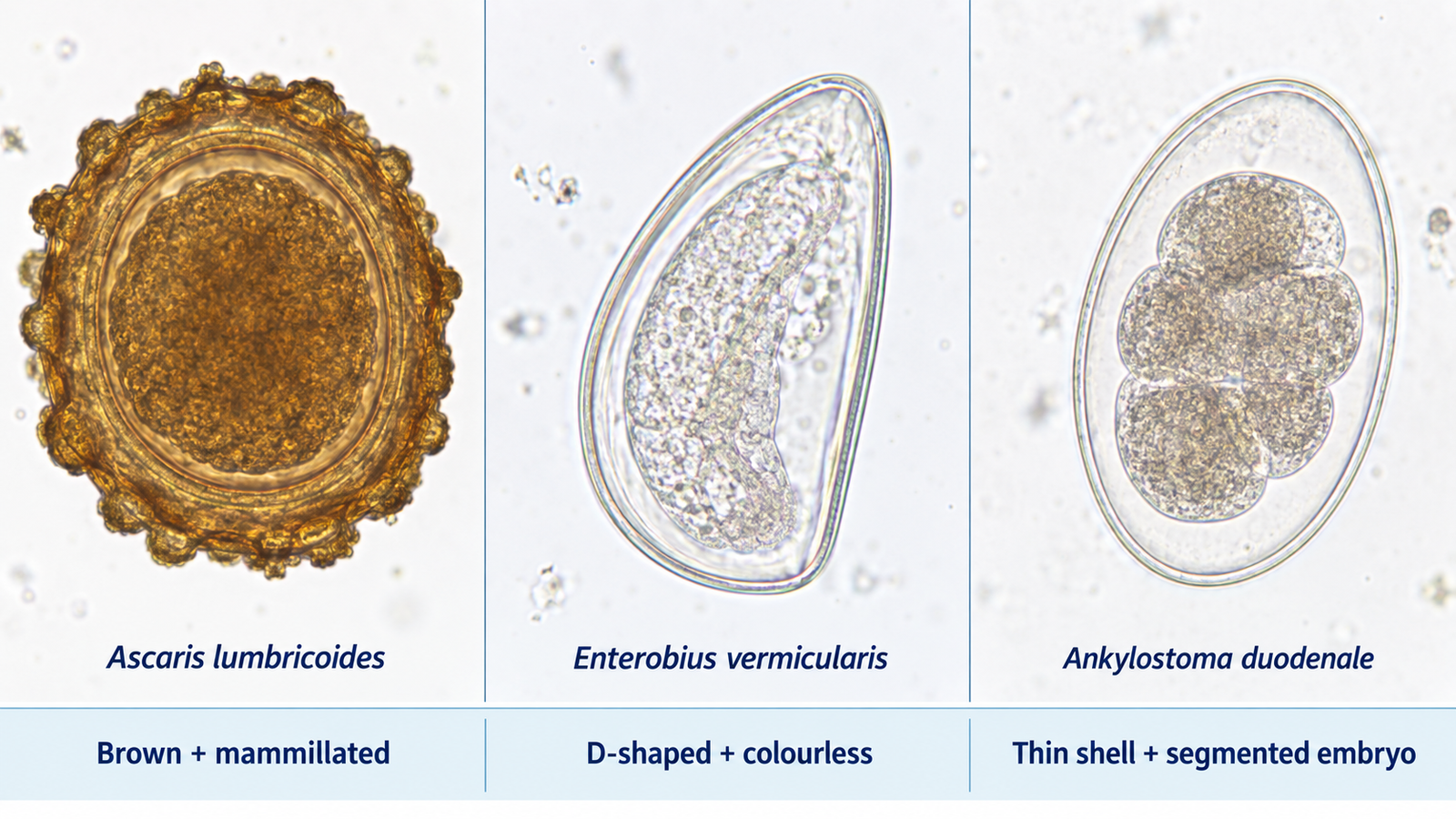
Ascaris lumbricoides: Typically a round-to-oval, bile-stained brown ovum with a thick shell and characteristic mammillated outer coat.

Enterobius vermicularis: A colourless, asymmetrical planoconvex or D-shaped ovum with one side flattened and a thin, smooth shell.

Ankylostoma duodenale: A colourless, oval or elliptical ovum with a thin transparent shell, usually containing a segmented embryo with a clear space between the embryo and shell.

Key differentiation: Thick brown mammillated shell suggests Ascaris; flattened-sided D shape suggests Enterobius; thin-shelled oval ovum containing blastomeres suggests Ankylostoma.

🔎 How to Perform / Approach

  1. Step 1 — Observe overall shape: Decide whether the ovum is round/oval, asymmetrical D-shaped, or uniformly elliptical.
  2. Step 2 — Examine the shell: Look for a thick mammillated coat, a smooth flattened-sided shell, or a thin transparent shell.
  3. Step 3 — Assess colour: Determine whether the ovum is bile-stained brown or essentially colourless.
  4. Step 4 — Examine internal contents: Look for an ovum containing a developing larva or a segmented embryo with blastomeres.
  5. Step 5 — Identify the distinguishing feature: Match the dominant morphology to Ascaris, Enterobius or Ankylostoma.
  6. Step 6 — State the identification: Name the parasite clearly and mention the feature that most strongly supports your answer.

🖼️ Visual Learning

VISUAL 1

Comparison of Ascaris, Enterobius and Ankylostoma Ova
 

📝 Important Viva Questions

1. What is the most characteristic feature of a typical fertilized Ascaris lumbricoides ovum?

Answer: It has a thick shell with a characteristic mammillated outer coat and is usually bile-stained brown.

2. How do you recognize an Enterobius vermicularis ovum?

Answer: It is colourless and characteristically asymmetrical or D-shaped, with one side flattened and the other convex.

3. What are the important identifying features of an Ankylostoma duodenale ovum?

Answer: It is colourless, oval and thin-shelled, usually containing a segmented embryo with several blastomeres and a clear space around it.

4. Which of these three ova is typically bile-stained?

Answer: Ascaris lumbricoides ova are typically bile-stained brown, whereas Enterobius and Ankylostoma ova are generally colourless.

5. How would you rapidly differentiate the three ova in an OSPE spotter?

Answer: Look for a thick brown mammillated shell in Ascaris, a flattened-sided D shape in Enterobius, and a thin transparent oval shell containing segmented blastomeres in Ankylostoma.

Scroll to Top
💬 WhatsApp Support