
Course Content
OSCE Station 1 — Identification of Intestinal Helminth Ova: Ascaris, Enterobius and Ankylostoma
KMU clinical activity: Ascaris lumbricoides, Enterobius vermicularis and Ankylostoma duodenale — identification of morphological and staining characteristics of ova. Learning Objectives The student should be able to: Identify the important morphological and staining characteristics of Ascaris lumbricoides ova. Identify the important morphological and staining characteristics of Enterobius vermicularis ova. Identify the important morphological and staining characteristics of Ankylostoma duodenale ova. Differentiate the three ova when presented as specimens or images at the station.
0/1
OSCE Station 2 — Liver Function Tests: Interpretation in Clinical Scenarios
KMU clinical activity: Liver Function Tests. Learning Objectives The student should be able to: Interpret normal liver function test results. Identify abnormal liver function test results. Interpret abnormal liver function tests in the context of different clinical scenarios. Integrate the principal liver function test findings presented at the station.
0/1
OSCE Station 3 — Prescription Writing I: Peptic Ulcer Disease and Antiemetic Therapy
KMU clinical activity: Peptic ulcer disease; anti-emetics — prescription construction for Helicobacter-associated peptic ulcer disease and common clinical indications for antiemetic therapy. Learning Objectives The student should be able to: Construct a prescription for Helicobacter-associated peptic ulcer disease using triple therapy. Construct a prescription for Helicobacter-associated peptic ulcer disease using quadruple therapy. Construct an appropriate prescription for motion sickness. Construct an appropriate prescription for morning sickness. Construct an appropriate prescription for a post-operative patient requiring antiemetic therapy. Construct an appropriate prescription for cancer chemotherapy-induced vomiting.
0/1
OSCE Station 4 — Prescription Writing II: Amoebic Dysentery, Enteric Fever and Ascariasis
Learning Objectives The student should be able to: Construct a prescription for a patient suffering from amoebic dysentery. Construct a prescription for a patient suffering from enteric fever. Write a prescription for a patient suffering from ascariasis. Select and present the appropriate prescription according to the clinical scenario provided at the station.
0/1
OSCE Station 5 — Corrosive Poisons and Vitriolage
KMU clinical activity: Poisons/corrosives — identification of corrosives and case presentation of vitriolage. Learning Objectives The student should be able to: Identify corrosive substances/poisons presented at the station. Present a case of vitriolage in a structured manner. Relate the presented corrosive substance or scenario to the relevant forensic case.
0/1
OSCE Station 6 — Identification of Irritant, Metallic, Non-Metallic, Vegetable and Animal Poisons
KMU clinical activity: Irritants; metallic poisons; non-metallic poisons; vegetable poisons; animal poisons. Learning Objectives The student should be able to: Identify common irritant poisons. Identify common metallic poisons. Identify common non-metallic poisons. Identify common vegetable poisons. Identify common animal poisons. Differentiate the major poison categories when presented as specimens, models or spotters.
0/1
OSCE Station 7 — Nutrition Models: Protein-Calorie Malnutrition, Food Plate, Food Pyramid, Fortification and Adulteration
KMU clinical activity: Protein-calorie malnutrition; My Food Plate/The Pyramid; food fortification and food adulteration. Learning Objectives The student should be able to: Identify a protein-calorie malnutrition model presented at the station. Differentiate between the clinical features of the two protein-calorie malnutrition models. Explain the public-health importance of protein-calorie malnutrition. Explain the concepts of food fortification and food adulteration. Identify the My Food Plate/Food Pyramid model. Describe the different components of the food plate/food pyramid model.
0/1
OSCE Station 8 — Health Education: Identification and Formulation of a Health Message
KMU clinical activity: Health education — identification and formulation of a health-education message from a provided problem or scenario. Learning Objectives The student should be able to: Identify an appropriate health-education message for the problem or scenario provided. Formulate an appropriate health-education message for the problem or scenario provided. Present the message clearly and appropriately according to the scenario.
0/1
OSCE Station 9 — Vector Identification and Control: Housefly/Arthropods and Aedes aegypti
KMU clinical activity: Housefly/arthropods and Aedes aegypti — model identification, associated disease and vector control. Learning Objectives The student should be able to: Identify a housefly/arthropod model presented at the station. Explain the disease associated with the vector and its control. Identify an Aedes aegypti model presented at the station. Explain the disease associated with this vector and its control. Differentiate the two vectors when presented as models or specimens.
0/1
OSCE Station 10 — Autoclave and Instrument Sterilization
KMU clinical activity: Autoclave — model identification, items suitable for autoclaving and steps of instrument sterilization. Learning Objectives The student should be able to: Identify the autoclave model. Explain the types of items for which autoclaves are used. Explain the steps of instrument sterilization. Integrate the relevant sterilization steps when presented with an autoclave-based practical scenario.
0/1
AIM OSPE/OSCE Lab — GIT & Hepatobiliary-II Module | 4th Year MBBS
AIM OSCE / OSPE • MBBS

Station 3 — Prescription Writing I: Peptic Ulcer Disease and Antiemetic Therapy

4th Year • GIT / Hepatobiliary • Rapid Revision • Practical Skills • Viva

🎯 Candidate Task

Write complete, legible prescriptions for the clinical situations provided, including appropriate drug, dose, route, frequency and duration. Ensure that each prescription is checked for important contraindications, interactions and prescribing errors.

⚡ Model Station Answer

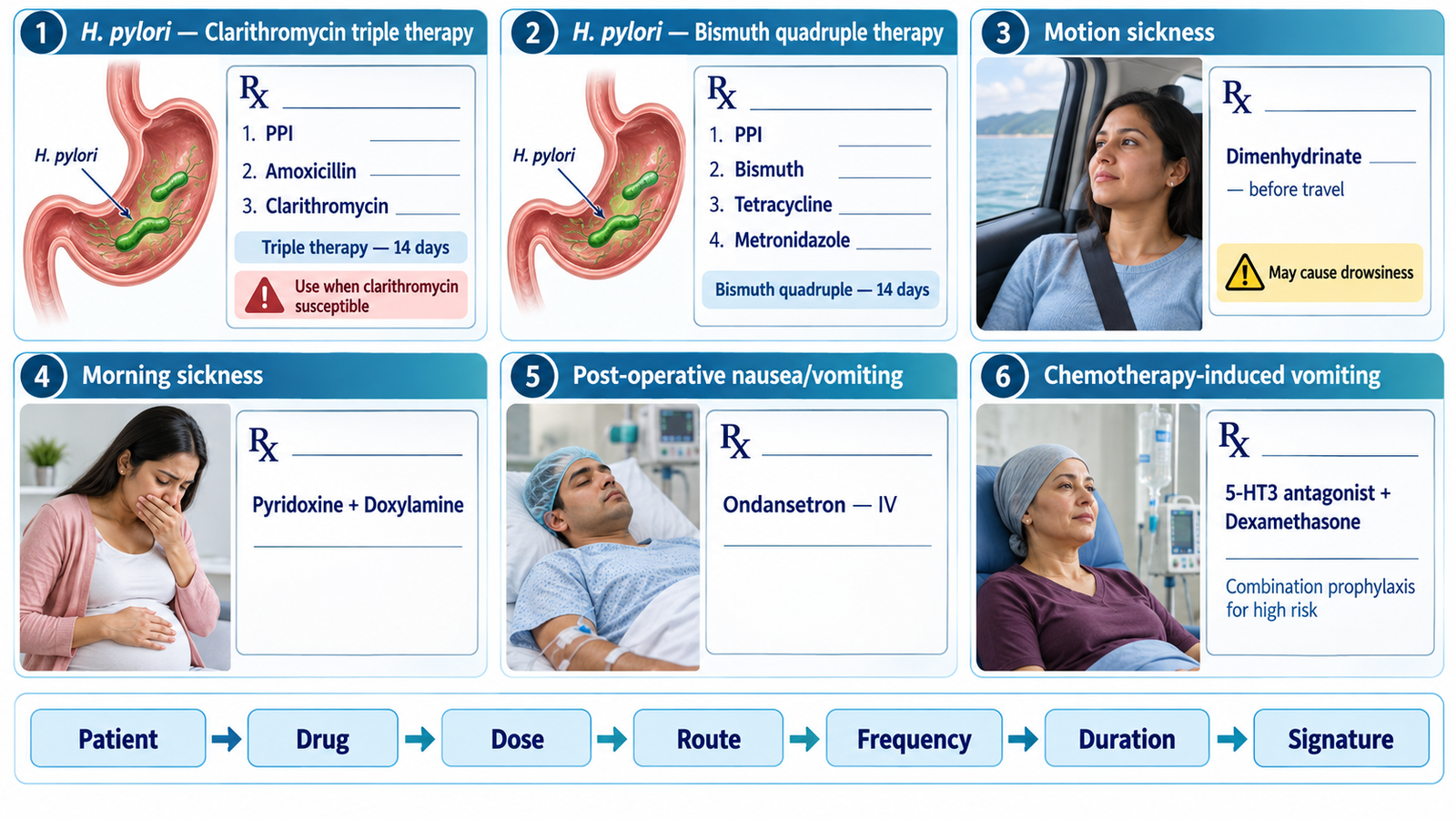
H. pylori triple therapy: PPI + amoxicillin + clarithromycin for 14 days when clarithromycin susceptibility is established.

H. pylori quadruple therapy: PPI + bismuth + tetracycline + metronidazole for 14 days.

Motion sickness: A centrally acting H1-antihistamine such as dimenhydrinate before travel.

Morning sickness: Pyridoxine with doxylamine is an appropriate first-line pharmacological option.

Post-operative / chemotherapy-associated vomiting: Select antiemetic therapy according to the clinical setting and emetic risk; 5-HT3 antagonists such as ondansetron are commonly used, while chemotherapy may require combination prophylaxis.

🔎 How to Perform / Approach

  1. Step 1 — Review the scenario: Identify the indication, patient factors, allergies, pregnancy status and relevant previous medication.
  2. Step 2 — Write patient details: Include name, age and date where supplied in the station.
  3. Step 3 — Choose the correct regimen: Select drugs appropriate for the indication rather than writing an isolated antiemetic without considering the clinical setting.
  4. Step 4 — Write each medicine completely: State generic name, strength, dose, route, frequency and duration.
  5. Step 5 — Add essential instructions: Include timing before travel, chemotherapy or meals where relevant.
  6. Step 6 — Check safety: Review allergies, contraindications, interactions, pregnancy considerations and duplicate therapy.
  7. Step 7 — Authenticate: Finish with date and prescriber signature/details as required by the station.

Exam note: The examples below are standard undergraduate prescription constructions. In clinical practice, antimicrobial resistance, previous antibiotic exposure, chemotherapy emetogenicity and local formulary guidance must be considered.

💊 Prescription Examples

1. H. pylori — Clarithromycin Triple Therapy

Rx

  • Tab. Omeprazole 20 mg orally twice daily × 14 days
  • Tab. Amoxicillin 1 g orally twice daily × 14 days
  • Tab. Clarithromycin 500 mg orally twice daily × 14 days

Important: Use clarithromycin-containing triple therapy when clarithromycin susceptibility is established; empirical use is discouraged where resistance is unknown or significant.

2. H. pylori — Bismuth Quadruple Therapy

Rx

  • Tab. Omeprazole 20 mg orally twice daily × 14 days
  • Tab. Bismuth subcitrate 120–300 mg orally four times daily × 14 days
  • Cap. Tetracycline 500 mg orally four times daily × 14 days
  • Tab. Metronidazole 500 mg orally three times daily × 14 days

3. Motion Sickness

Rx

  • Tab. Dimenhydrinate 50 mg orally 1–2 hours before travel.
  • May repeat 50 mg every 4–6 hours if required; do not exceed the recommended daily maximum.

Counsel: May cause drowsiness; avoid driving or operating machinery if affected.

4. Morning Sickness

Rx

  • Tab. Doxylamine succinate 10 mg + pyridoxine hydrochloride 10 mg delayed-release: 2 tablets orally at bedtime.
  • If symptoms remain uncontrolled, the dose may be titrated according to the preparation up to a maximum of 4 tablets daily.

5. Post-operative Nausea and Vomiting

Example Rx

  • Inj. Ondansetron 4 mg IV slowly, once, if a 5-HT3 antagonist has not already been given.

Important: If vomiting occurs despite prior prophylaxis, rescue treatment should generally use an antiemetic from a different pharmacological class rather than simply repeating the same agent immediately.

6. Chemotherapy-induced Nausea and Vomiting

Example — moderately emetogenic chemotherapy

  • Tab./Inj. Ondansetron 8 mg orally/IV before chemotherapy
  • Tab./Inj. Dexamethasone 8 mg orally/IV before chemotherapy

High-emetic-risk chemotherapy: Current prophylaxis commonly requires combination therapy with an NK1 antagonist + 5-HT3 antagonist + dexamethasone + olanzapine rather than ondansetron alone.

🖼️ Visual Learning

VISUAL 1

Rapid Prescription-Writing Framework for PUD and Antiemetic Therapy
 

📝 Important Viva Questions

1. What drugs constitute classic clarithromycin-based triple therapy for H. pylori?

Answer: A proton-pump inhibitor, amoxicillin and clarithromycin. Clarithromycin-based therapy should be used when susceptibility is established rather than prescribed empirically where resistance is unknown.

2. What are the four components of bismuth quadruple therapy?

Answer: A PPI, bismuth, tetracycline and metronidazole, typically given for 14 days.

3. Why is ondansetron not a good drug for motion sickness?

Answer: Motion sickness is predominantly mediated through central vestibular pathways; centrally acting H1 antihistamines or antimuscarinic drugs are more effective than 5-HT3 antagonists.

4. What is a first-line pharmacological option for nausea and vomiting of pregnancy?

Answer: Pyridoxine, with doxylamine added when required, is an established first-line option.

5. Why does chemotherapy-induced vomiting often require more than one antiemetic?

Answer: Highly emetogenic chemotherapy activates multiple emetic pathways, so drugs from different classes are combined to improve control of acute and delayed nausea and vomiting.

Scroll to Top
💬 WhatsApp Support