
Station 5 — Corrosive Poisons and Vitriolage
🎯 Candidate Task
Examine the corrosive substance or scenario provided, identify the corrosive where possible, and present the associated forensic case in a structured manner. If a prescription scenario is provided, select and write an appropriate prescription for that clinical situation.
⚡ Model Station Answer
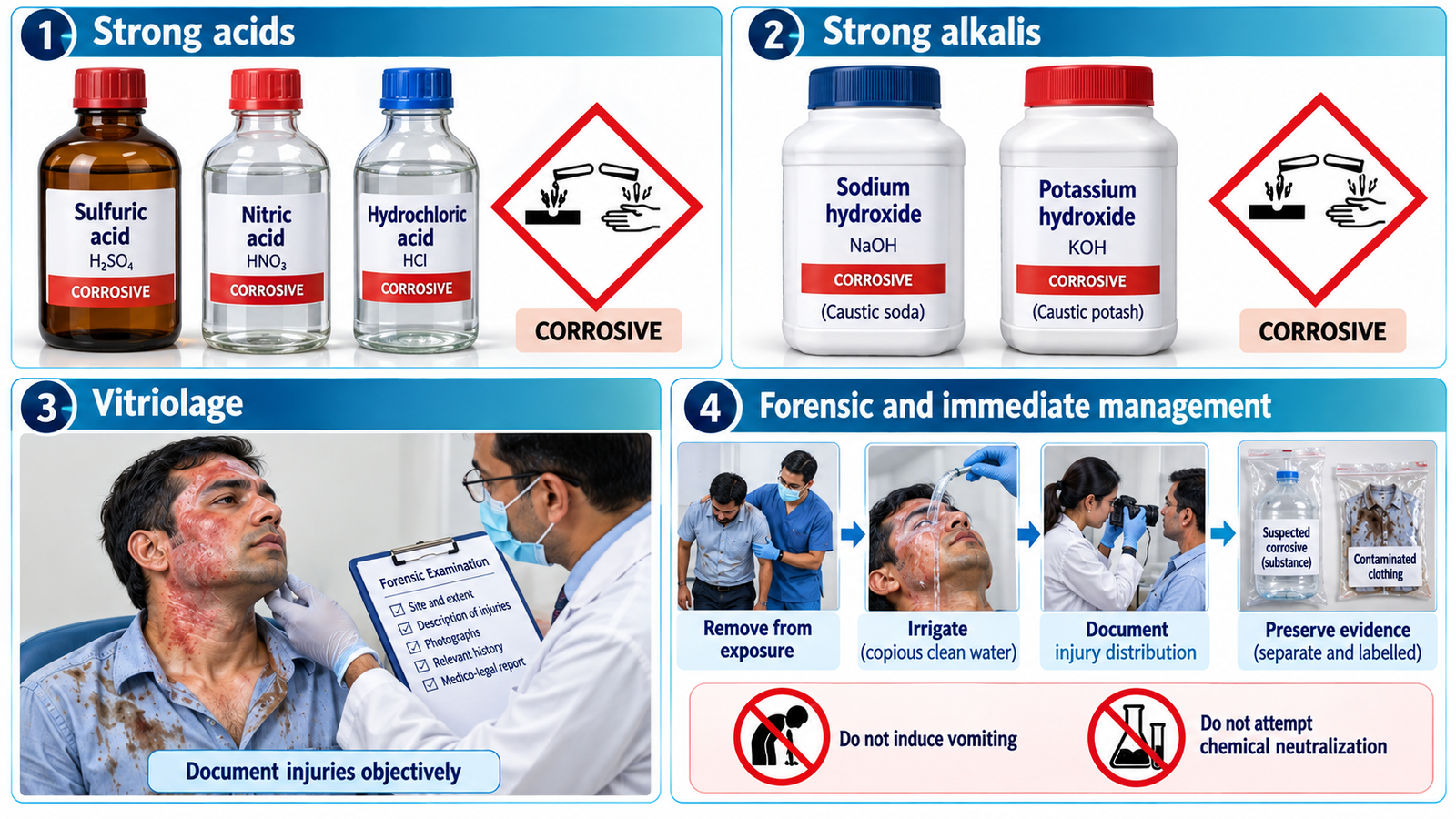
Identification: Corrosive poisons include strong acids such as sulfuric, nitric and hydrochloric acids, and strong alkalis such as sodium or potassium hydroxide.
Vitriolage: Vitriolage refers to an assault in which a corrosive substance, classically an acid, is deliberately thrown on a person causing chemical burns.
Case presentation: I would state the circumstances of exposure, suspected corrosive, sites and extent of injury, important clinical findings, treatment already given and relevant documentation.
Forensic relevance: The substance/container, clothing and other relevant material should be preserved appropriately and the injuries documented objectively without speculation.
Prescription: Any prescription must be based on the exact clinical scenario supplied; I would write the generic drug, dose, route, frequency and duration and check it before signing.
🔎 How to Perform / Approach
- Step 1 — Observe safely: Inspect the labelled specimen, container, photograph or scenario without directly handling an unknown corrosive.
- Step 2 — Identify the corrosive: State whether it represents a strong acid or alkali and name it if sufficient information is provided.
- Step 3 — Establish the exposure: Clarify whether the case involves ingestion, accidental contact or deliberate throwing of a corrosive substance.
- Step 4 — Present vitriolage systematically: State circumstances, suspected agent, exposed body sites, visible injuries and important clinical findings.
- Step 5 — Relate it to forensic practice: Document findings objectively and preserve relevant containers, clothing or other material according to medicolegal procedure.
- Step 6 — Address immediate clinical needs: Prioritize removal from exposure and copious water irrigation of affected skin or eyes; do not attempt chemical neutralization.
- Step 7 — Complete prescription if asked: Choose treatment appropriate to the supplied clinical scenario and write drug, dose, route, frequency, duration, date and signature.
Safety: Do not smell, taste or directly touch an unidentified corrosive. In corrosive ingestion, do not induce vomiting or attempt acid–alkali neutralization.
🖼️ Visual Learning
Corrosive Poison Identification and Vitriolage Case Presentation
📝 Important Viva Questions
1. What is meant by a corrosive poison?
Answer: A corrosive is a substance capable of producing chemical destruction of tissues on contact, commonly a strong acid or strong alkali.
2. What is vitriolage?
Answer: Vitriolage is the deliberate throwing of a corrosive substance, classically acid, onto another person with resulting chemical injury.
3. Name three common strong acids encountered as corrosives.
Answer: Sulfuric acid, nitric acid and hydrochloric acid.
4. What should you avoid after corrosive ingestion?
Answer: Do not induce vomiting and do not attempt to neutralize an acid with an alkali or an alkali with an acid.
5. What are the important forensic steps in a suspected vitriolage case?
Answer: Document the history and injuries objectively and preserve relevant material such as the suspected corrosive container and contaminated clothing according to medicolegal procedure.