
Station 8 — Health Education: Identification and Formulation of a Health Message
🎯 Candidate Task
Review the health problem or scenario provided. Identify the most appropriate health-education message and present it clearly to the individual or community described in the station.
⚡ Model Station Answer
Identification: I would first identify the main health problem and the specific behaviour or action that needs to change.
Message: I would formulate one clear, accurate and practical health message directly related to that problem.
Communication: I would use simple language, avoid unnecessary medical terminology and state exactly what the person should do.
Conclusion: The message should be brief, understandable, relevant and actionable for the intended audience.
🔎 How to Perform / Approach
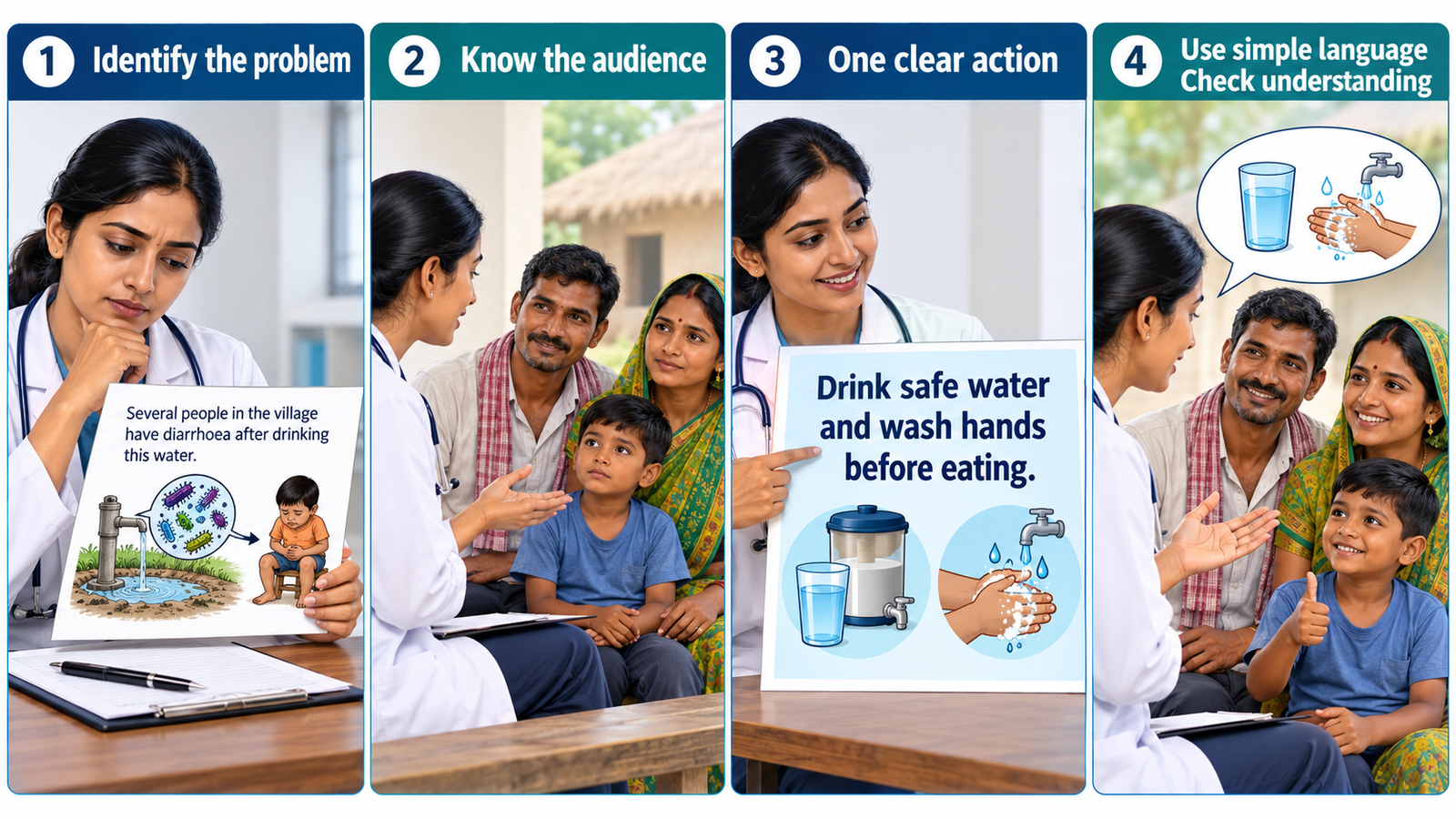
- Step 1 — Identify the problem: Determine the main health issue presented in the scenario.
- Step 2 — Identify the audience: Decide whether the message is intended for an individual, family or community group.
- Step 3 — Decide the key action: Select the single most important behaviour, preventive measure or health action the audience should follow.
- Step 4 — Formulate the message: Convert the key action into one short, accurate and easy-to-understand statement.
- Step 5 — Keep it audience-appropriate: Use simple language and avoid technical jargon, unnecessary detail or frightening wording.
- Step 6 — Present clearly: State the message confidently and explain the required action briefly if needed.
- Step 7 — Check understanding: Confirm that the listener has understood the message correctly.
🖼️ Visual Learning
Formulating an Effective Health-Education Message
📝 Important Viva Questions
1. What is the first step in formulating a health-education message?
Answer: First identify the specific health problem and the behaviour or action that needs to be addressed.
2. What are the main characteristics of a good health message?
Answer: It should be clear, brief, accurate, relevant to the audience and practical enough to act upon.
3. Why should medical jargon be avoided in health education?
Answer: Technical language may reduce understanding; the message should use words appropriate to the audience.
4. Why is identification of the target audience important?
Answer: The language, content and method of communication should be appropriate to the people receiving the message.
5. How can you check whether a health message has been understood?
Answer: Ask the listener to explain the main message or intended action back in their own words.