
Course Content
OSCE Station 1 — Identification of Intestinal Helminth Ova: Ascaris, Enterobius and Ankylostoma
KMU clinical activity: Ascaris lumbricoides, Enterobius vermicularis and Ankylostoma duodenale — identification of morphological and staining characteristics of ova. Learning Objectives The student should be able to: Identify the important morphological and staining characteristics of Ascaris lumbricoides ova. Identify the important morphological and staining characteristics of Enterobius vermicularis ova. Identify the important morphological and staining characteristics of Ankylostoma duodenale ova. Differentiate the three ova when presented as specimens or images at the station.
0/1
OSCE Station 2 — Liver Function Tests: Interpretation in Clinical Scenarios
KMU clinical activity: Liver Function Tests. Learning Objectives The student should be able to: Interpret normal liver function test results. Identify abnormal liver function test results. Interpret abnormal liver function tests in the context of different clinical scenarios. Integrate the principal liver function test findings presented at the station.
0/1
OSCE Station 3 — Prescription Writing I: Peptic Ulcer Disease and Antiemetic Therapy
KMU clinical activity: Peptic ulcer disease; anti-emetics — prescription construction for Helicobacter-associated peptic ulcer disease and common clinical indications for antiemetic therapy. Learning Objectives The student should be able to: Construct a prescription for Helicobacter-associated peptic ulcer disease using triple therapy. Construct a prescription for Helicobacter-associated peptic ulcer disease using quadruple therapy. Construct an appropriate prescription for motion sickness. Construct an appropriate prescription for morning sickness. Construct an appropriate prescription for a post-operative patient requiring antiemetic therapy. Construct an appropriate prescription for cancer chemotherapy-induced vomiting.
0/1
OSCE Station 4 — Prescription Writing II: Amoebic Dysentery, Enteric Fever and Ascariasis
Learning Objectives The student should be able to: Construct a prescription for a patient suffering from amoebic dysentery. Construct a prescription for a patient suffering from enteric fever. Write a prescription for a patient suffering from ascariasis. Select and present the appropriate prescription according to the clinical scenario provided at the station.
0/1
OSCE Station 5 — Corrosive Poisons and Vitriolage
KMU clinical activity: Poisons/corrosives — identification of corrosives and case presentation of vitriolage. Learning Objectives The student should be able to: Identify corrosive substances/poisons presented at the station. Present a case of vitriolage in a structured manner. Relate the presented corrosive substance or scenario to the relevant forensic case.
0/1
OSCE Station 6 — Identification of Irritant, Metallic, Non-Metallic, Vegetable and Animal Poisons
KMU clinical activity: Irritants; metallic poisons; non-metallic poisons; vegetable poisons; animal poisons. Learning Objectives The student should be able to: Identify common irritant poisons. Identify common metallic poisons. Identify common non-metallic poisons. Identify common vegetable poisons. Identify common animal poisons. Differentiate the major poison categories when presented as specimens, models or spotters.
0/1
OSCE Station 7 — Nutrition Models: Protein-Calorie Malnutrition, Food Plate, Food Pyramid, Fortification and Adulteration
KMU clinical activity: Protein-calorie malnutrition; My Food Plate/The Pyramid; food fortification and food adulteration. Learning Objectives The student should be able to: Identify a protein-calorie malnutrition model presented at the station. Differentiate between the clinical features of the two protein-calorie malnutrition models. Explain the public-health importance of protein-calorie malnutrition. Explain the concepts of food fortification and food adulteration. Identify the My Food Plate/Food Pyramid model. Describe the different components of the food plate/food pyramid model.
0/1
OSCE Station 8 — Health Education: Identification and Formulation of a Health Message
KMU clinical activity: Health education — identification and formulation of a health-education message from a provided problem or scenario. Learning Objectives The student should be able to: Identify an appropriate health-education message for the problem or scenario provided. Formulate an appropriate health-education message for the problem or scenario provided. Present the message clearly and appropriately according to the scenario.
0/1
OSCE Station 9 — Vector Identification and Control: Housefly/Arthropods and Aedes aegypti
KMU clinical activity: Housefly/arthropods and Aedes aegypti — model identification, associated disease and vector control. Learning Objectives The student should be able to: Identify a housefly/arthropod model presented at the station. Explain the disease associated with the vector and its control. Identify an Aedes aegypti model presented at the station. Explain the disease associated with this vector and its control. Differentiate the two vectors when presented as models or specimens.
0/1
OSCE Station 10 — Autoclave and Instrument Sterilization
KMU clinical activity: Autoclave — model identification, items suitable for autoclaving and steps of instrument sterilization. Learning Objectives The student should be able to: Identify the autoclave model. Explain the types of items for which autoclaves are used. Explain the steps of instrument sterilization. Integrate the relevant sterilization steps when presented with an autoclave-based practical scenario.
0/1
AIM OSPE/OSCE Lab — GIT & Hepatobiliary-II Module | 4th Year MBBS
AIM OSCE / OSPE • MBBS

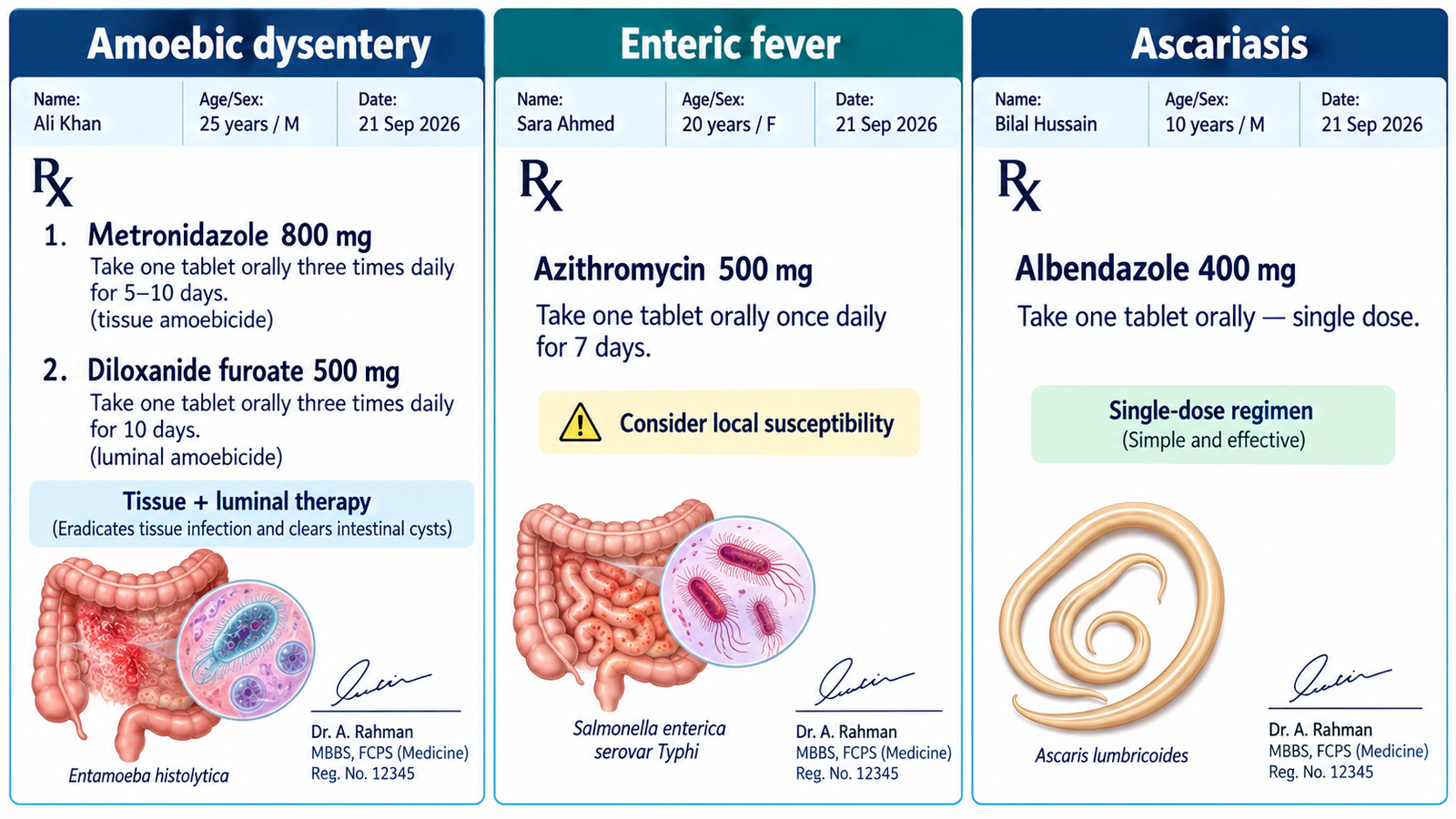
Station 4 — Prescription Writing II: Amoebic Dysentery, Enteric Fever and Ascariasis

4th Year • GIT / Hepatobiliary • Rapid Revision • Prescription Writing • Viva

🎯 Candidate Task

Review the clinical scenario provided and write a complete, safe and legible prescription for the diagnosed condition. Select the appropriate prescription for amoebic dysentery, enteric fever or ascariasis as indicated by the station.

⚡ Model Station Answer

Amoebic dysentery: Prescribe a tissue amoebicide such as metronidazole 800 mg orally three times daily for 5–10 days, followed by a luminal amoebicide such as diloxanide furoate 500 mg orally three times daily for 10 days.

Enteric fever: In an uncomplicated adult case suitable for oral treatment, prescribe an appropriate antibiotic such as azithromycin 500 mg orally once daily for 7 days, while considering local antimicrobial susceptibility and the clinical scenario.

Ascariasis: Prescribe albendazole 400 mg orally as a single dose.

Prescription completion: Write the patient’s details, date, drug name, strength, route, frequency, duration and instructions clearly, then sign the prescription.

🔎 How to Perform / Approach

  1. Step 1 — Read the scenario: Identify which of the three conditions is being tested and note relevant age, allergy, pregnancy or other safety information supplied.
  2. Step 2 — Start correctly: Write the patient’s identifying details and date, followed by the prescription symbol or medication orders.
  3. Step 3 — Select the appropriate drug: Choose treatment suitable for amoebic dysentery, enteric fever or ascariasis according to the scenario.
  4. Step 4 — Write the complete drug order: State the generic drug name, strength, dose, route, frequency and duration.
  5. Step 5 — Add essential instructions: Include clear directions to the patient where relevant and avoid unnecessary medicines.
  6. Step 6 — Check safety: Recheck dose, route, frequency, duration, allergies and any contraindication mentioned in the station.
  7. Step 7 — Authenticate: Complete the prescription with the prescriber’s signature and required identifying details.
Exam tip: For enteric fever, antibiotic choice may depend on local resistance and susceptibility patterns. Follow the clinical information supplied in the station rather than automatically writing the same antibiotic in every scenario.

🖼️ Visual Learning

VISUAL 1

Correct Prescription Format for Three Common GIT Infections
 

📝 Important Viva Questions

1. Why is a luminal amoebicide required after metronidazole in amoebic dysentery?

Answer: Metronidazole treats invasive trophozoites effectively, while a luminal amoebicide helps eradicate organisms remaining within the intestinal lumen.

2. What important factor should be considered when selecting an antibiotic for enteric fever?

Answer: Local antimicrobial resistance and culture-susceptibility results should be considered whenever available.

3. What is a commonly used albendazole regimen for uncomplicated ascariasis?

Answer: Albendazole 400 mg orally as a single dose is a commonly used regimen.

4. What essential information should accompany a drug name on a prescription?

Answer: The prescription should clearly state the strength, dose, route, frequency and duration or quantity as appropriate.

5. Why should generic drug names preferably be used in prescription writing?

Answer: Generic names reduce ambiguity, improve clarity and avoid unnecessary dependence on particular brand names.

Scroll to Top
💬 WhatsApp Support