
Acute Appendicitis — Focused Abdominal Examination
Focused bedside examination, interpretation of right iliac fossa signs, and clinical decision-making.
1. Short Case Title
Short Case 03 — Acute Appendicitis: Focused Abdominal Examination
2. Patient / Clinical Setting
A 15-year-old boy presents with approximately 18 hours of abdominal pain, now mainly in the right iliac fossa, with reduced appetite and nausea. He is alert and able to cooperate with examination.
3. Student Task
“Perform a focused abdominal examination for suspected acute appendicitis, identify the significant findings, and present your clinical impression.”
4. Focused Examination Approach
- Prepare: introduce yourself, obtain consent, ask about pain, ensure privacy, position the patient supine with knees relaxed, and expose the abdomen appropriately. Avoid unnecessary painful maneuvers.
- Initial observation: note whether the patient lies still, appears distressed, or avoids movement; check temperature, pulse, blood pressure and general hydration.
- Inspection: look for abdominal distension, scars, visible masses and reduced abdominal movement with respiration.
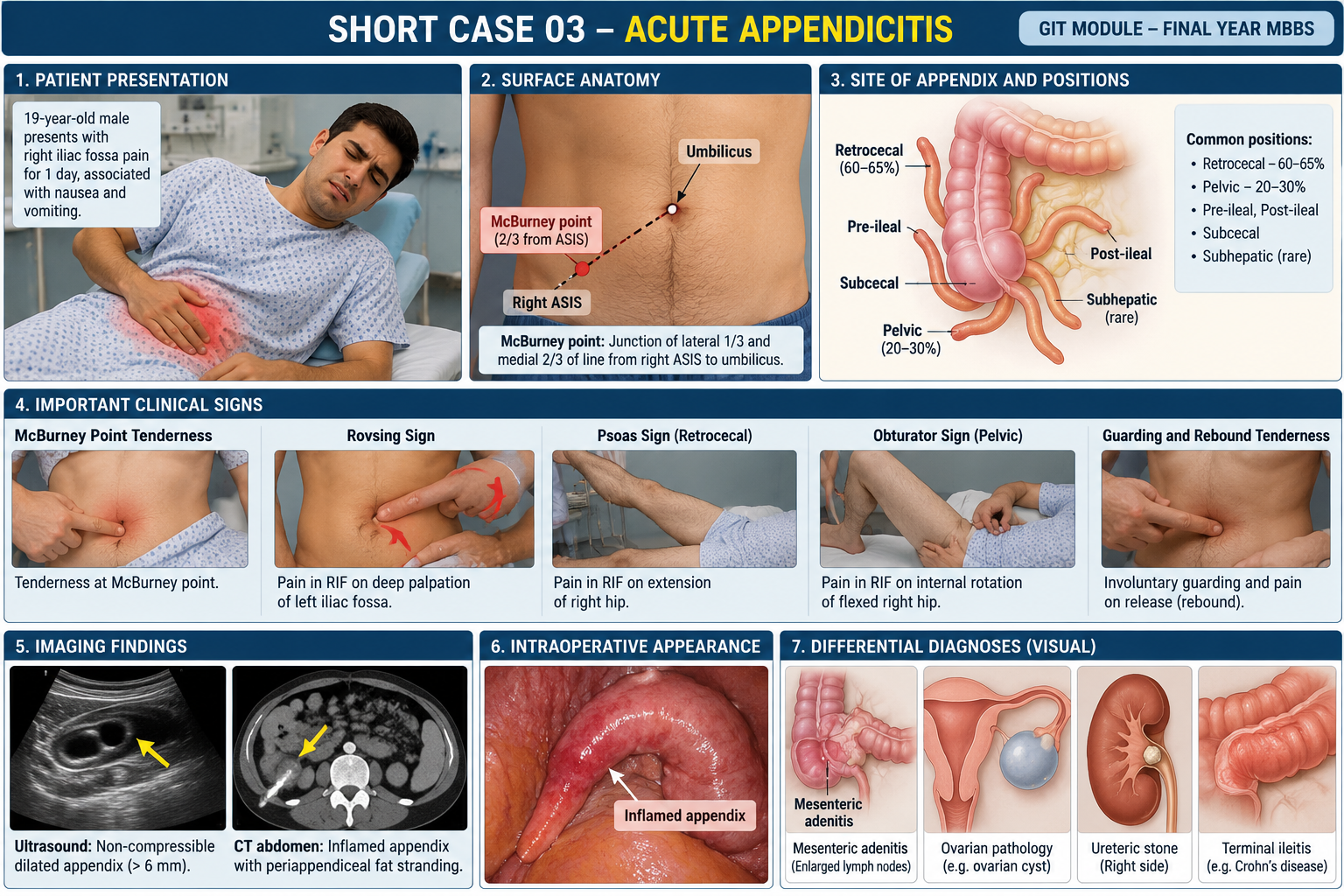
- Palpation: start away from the painful area, assess light then deeper tenderness, and localize maximal tenderness to the right iliac fossa (near McBurney’s point). Assess voluntary guarding versus involuntary rigidity; test rebound tenderness only if necessary and gently.
- Helpful associated signs: assess cough/percussion tenderness; Rovsing’s sign (right iliac fossa pain on left-sided palpation); psoas sign (pain on right hip extension, often with a retrocaecal appendix); and obturator sign (pain with flexed-right-hip internal rotation, sometimes with a pelvic appendix). Negative signs do not exclude appendicitis.
- Complete focused assessment: listen for bowel sounds if indicated; consider right flank/renal angle and hernial or testicular examination when clinically indicated, with permission and an appropriate chaperone.
5. Important Clinical Findings
Expected positive findings
- Localized right iliac fossa tenderness: supports an inflamed appendix, particularly when maximal near McBurney’s point.
- Localized guarding and pain on coughing or percussion: suggest localized peritoneal irritation.
- Low-grade fever and mild tachycardia: support an inflammatory process but are not specific.
- Possible positive Rovsing’s, psoas or obturator sign: supportive clues; their absence does not rule out the disease.
Important relevant negative findings
- No generalized rigidity or diffuse peritonism: makes generalized peritonitis less likely at this examination.
- No marked distension or persistent bilious vomiting: does not suggest overt bowel obstruction.
- No significant scrotal abnormality when appropriately examined: reduces concern for a testicular source of lower abdominal pain.
6. Presentation of Findings
“This is a 15-year-old boy who is alert and mildly uncomfortable. He has localized tenderness in the right iliac fossa, greatest near McBurney’s point, with mild localized guarding and pain on coughing. There is no generalized abdominal rigidity or marked distension. These findings are clinically suggestive of acute appendicitis without obvious generalized peritonitis; I would correlate them with vital signs, laboratory tests and surgical assessment.”
7. Most Likely Diagnosis
Acute appendicitis with localized right iliac fossa peritoneal irritation. Clinical examination alone cannot reliably determine whether perforation is absent.
8. Differential Diagnosis
- Mesenteric adenitis: may follow a viral illness and cause right iliac fossa tenderness, often with less localized peritoneal irritation.
- Acute gastroenteritis: diffuse abdominal cramps and prominent diarrhea or vomiting are more typical.
- Right ureteric colic / urinary tract pathology: flank-to-groin pain, urinary symptoms or hematuria may help distinguish it.
9. Relevant Investigations
- Complete blood count: leukocytosis with neutrophilia may support inflammation but a normal count does not exclude appendicitis.
- C-reactive protein: may rise with inflammation; interpret alongside symptoms and examination.
- Urinalysis: helps assess urinary tract causes; mild urinary abnormalities can still occur with appendicitis.
- Abdominal ultrasonography: useful first-line imaging in children where needed; may show a noncompressible enlarged appendix. If nondiagnostic and suspicion remains, seek surgical review and consider further imaging according to local practice.
10. Management Discussion
- Urgent surgical assessment for suspected appendicitis; reassess pain, vital signs and abdominal signs.
- Keep nil by mouth pending a procedural decision; obtain intravenous access and provide fluids if dehydrated.
- Give appropriate analgesia and antiemetics; pain relief should not be withheld to preserve examination signs.
- Antibiotics and appendicectomy decisions should follow surgical assessment and local guidance.
- Explain the concern and need for prompt evaluation to the child and parent or guardian.
11. Red Flags / Serious Complications
- Generalized rigidity or diffuse rebound/percussion tenderness: possible perforation with peritonitis.
- Persistent tachycardia, hypotension or altered consciousness: possible sepsis or shock.
- High fever with escalating abdominal pain: possible complicated infection.
- Palpable tender right iliac fossa mass: possible appendicular phlegmon or abscess.
Escalate immediately to the emergency and surgical team if any of these findings are present.
12. Examiner Viva Preparation
Q1. Where is tenderness usually maximal in acute appendicitis?
Q2. What does localized involuntary guarding signify?
Q3. How is Rovsing’s sign elicited?
Q4. What may a positive psoas sign suggest?
Q5. Does a negative obturator or psoas sign rule out appendicitis?
Q6. Which imaging modality is commonly preferred initially in a child when imaging is needed?
Q7. Which examination findings require immediate escalation?
13. AIM Short Case High-Yield Review
- Begin with overall appearance, vital signs and permission-based abdominal examination.
- Right iliac fossa tenderness near McBurney’s point is a key bedside clue.
- Guarding and cough/percussion tenderness indicate local peritoneal irritation.
- Rovsing’s, psoas and obturator signs can support, but cannot exclude, appendicitis.
- Present both positive findings and absence of generalized peritonism.
- Consider mesenteric adenitis, gastroenteritis and urinary pathology.
- CBC, CRP, urinalysis and ultrasound are focused investigations.
- Arrange prompt surgical assessment with fluids and analgesia as appropriate.
- Generalized rigidity, shock or worsening systemic illness require urgent escalation.
- Common examination mistake: repeatedly provoking rebound tenderness instead of using a gentle, systematic examination.