Acute Poisoning — Clinical Assessment & Emergency Management
MS Module — Final Year MBBS | Medicine
An integrated clinical approach to suspected poisoning, emergency stabilization, toxidrome recognition, investigation interpretation, antidote selection, complication prevention and patient counselling.
1. Long Case Title
Long Case 02 — Acute Poisoning: Clinical Assessment & Emergency Management
Representative clinical presentation: Acute organophosphorus insecticide poisoning following suspected pesticide ingestion.
This representative case provides an integrated approach to the assessment and treatment of acute poisoning. The clinical reasoning principles are also relevant when differentiating other common toxic exposures.
2. Patient Scenario
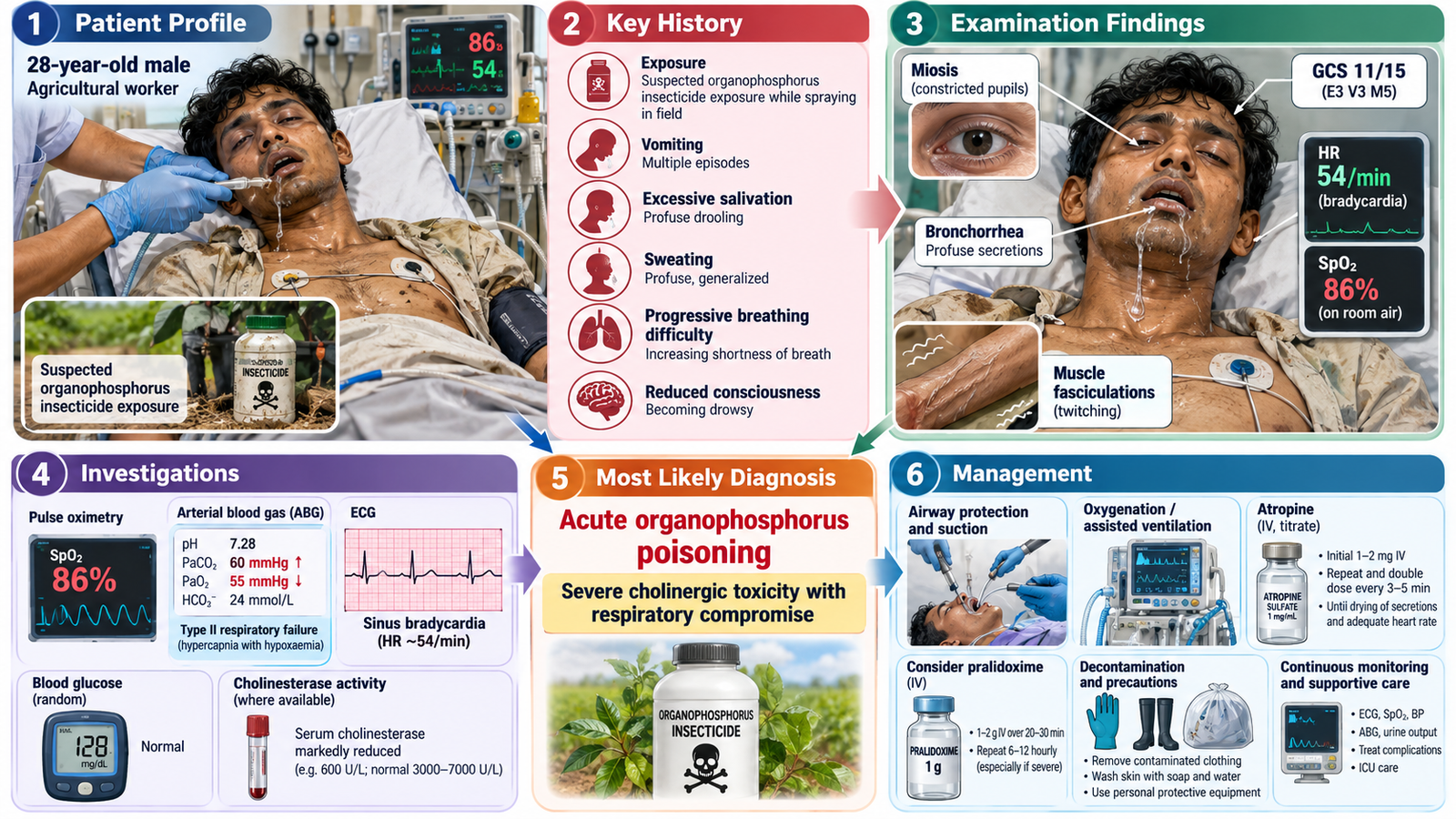
A 28-year-old male agricultural worker is brought to the emergency department by his brother with repeated vomiting, excessive sweating, difficulty breathing and progressive drowsiness for approximately one hour.
His brother reports that the patient had been working near agricultural insecticides earlier that day. A partially empty pesticide container was subsequently found nearby, but the exact substance, route and circumstances of exposure are initially uncertain.
The patient is restless, sweating profusely and unable to provide a complete history.
3. Student Task
The student should be able to:
- Obtain a comprehensive history of suspected poisoning, including the probable substance, route, timing and circumstances of exposure.
- Perform an emergency assessment of airway, breathing, circulation and consciousness.
- Recognize the characteristic toxidrome and identify life-threatening complications.
- Formulate appropriate differential diagnoses.
- Select and interpret relevant bedside, laboratory and toxicological investigations.
- Explain appropriate supportive management and antidote selection.
- Discuss monitoring, complication prevention, patient safety and appropriate referral.
- Communicate with the patient and family regarding treatment, prevention and follow-up.
4. Relevant History
A. History of presenting illness
The patient developed nausea, repeated vomiting, abdominal cramps and excessive salivation shortly after the suspected exposure. These symptoms were followed by sweating, difficulty breathing, generalized weakness and increasing drowsiness.
Clinical significance: Rapid onset of gastrointestinal, secretory, respiratory and neurological manifestations after possible pesticide exposure strongly raises suspicion of a cholinergic toxidrome.
B. Identification of the toxic substance
Collateral history from the brother reveals that the container was labeled as an agricultural organophosphorus insecticide. The name and concentration are not yet confirmed.
Important questions include:
- What substance was involved? Is the original container or label available?
- Was exposure through ingestion, inhalation or skin contact?
- Approximately when did the exposure occur?
- What quantity may have been involved?
- Were any additional drugs, alcohol or chemicals involved?
- Was the exposure accidental, occupational or potentially intentional?
Clinical significance: Product identification helps anticipate toxicity, select an antidote and estimate the period of required monitoring. The patient’s immediate treatment must not be delayed while awaiting complete identification.
C. Progression and severity
The brother reports increasing secretions, coughing and worsening breathing difficulty during transport. The patient was initially conscious but became increasingly drowsy.
Clinical significance: Progressive respiratory symptoms and altered consciousness suggest potentially severe poisoning with risk of airway compromise and respiratory failure.
D. Relevant associated symptoms
- Excessive salivation and lacrimation: Suggest muscarinic cholinergic effects.
- Vomiting, diarrhea and abdominal cramps: Indicate gastrointestinal muscarinic stimulation.
- Sweating and urinary urgency: Support cholinergic excess.
- Muscle twitching and weakness: Suggest nicotinic neuromuscular involvement.
- Confusion, seizures or coma: Suggest significant central nervous system involvement.
- Breathing difficulty: May result from bronchorrhea, bronchospasm, respiratory muscle weakness or aspiration.
E. Previous medical and medication history
Ask about previous poisoning, respiratory illness, neurological disorders and previous hospital admissions. Determine whether the patient uses sedatives, opioids, antidepressants or other medications that may alter consciousness or interact with treatment.
In this case, the brother reports no known previous poisoning or chronic medical illness.
F. Occupational and environmental history
The patient regularly handles insecticides at work. Protective gloves and masks are inconsistently used, and pesticide containers are sometimes stored near household supplies.
Clinical significance: Occupational exposure, inadequate personal protection and unsafe storage are important preventable poisoning risks.
G. Circumstances and psychosocial history
Assess whether the exposure may have been accidental, deliberate or related to workplace conditions. Ask about recent emotional distress and possible self-harm when the patient is medically stable and able to participate.
Use a supportive, non-judgmental approach. Do not assume intentional poisoning solely because the substance may have been ingested.
5. Physical Examination
The initial examination focuses on identifying immediate threats to life. Detailed examination follows stabilization.
A. General examination and vital signs
| Parameter | Finding | Clinical significance |
|---|---|---|
| Pulse | 54/min | Bradycardia, consistent with muscarinic activity |
| Blood pressure | 95/60 mmHg | Borderline hypotension |
| Respiratory rate | 30/min | Respiratory distress |
| SpO₂ | 86% on room air | Significant hypoxemia |
| Temperature | 36.5°C | No significant temperature abnormality |
| GCS | 11/15 (E3 V3 M5) | Impaired consciousness and aspiration risk |
B. Airway and breathing
- Copious oral secretions and poor handling of saliva.
- Coarse bilateral chest sounds with widespread wheezing.
- Increased work of breathing and hypoxemia.
- Weak cough and possible respiratory muscle weakness.
Interpretation: Bronchorrhea, bronchospasm, weakness and impaired consciousness place the patient at high risk of respiratory failure and aspiration.
C. Cardiovascular examination
Bradycardia is present, with borderline blood pressure. Peripheral perfusion is assessed, and continuous cardiac monitoring is initiated.
Interpretation: Cholinergic poisoning may produce clinically significant heart-rate and blood-pressure abnormalities.
D. Pupils, skin and secretions
- Bilateral pinpoint pupils reactive to light.
- Excessive lacrimation and salivation.
- Profuse sweating and moist skin.
- No dry flushed skin or markedly dilated pupils.
Interpretation: Miosis with profuse wet secretions supports a muscarinic cholinergic toxidrome rather than a typical anticholinergic toxidrome.
E. Neurological and neuromuscular assessment
The patient is drowsy but responds to commands. Fasciculations are visible in the calf muscles, with generalized weakness. No focal neurological deficit is identified during the limited initial assessment.
Interpretation: Muscle fasciculations and weakness suggest nicotinic receptor involvement. Drowsiness indicates central nervous system toxicity, hypoxemia or both.
6. Clinical Problem Representation
A 28-year-old agricultural worker presents within approximately one hour of suspected insecticide exposure with acute vomiting, salivation, sweating, miosis, bradycardia, bronchorrhea, respiratory distress, muscle fasciculations and impaired consciousness.
He is hypoxemic, with oxygen saturation of 86% on room air and GCS 11/15.
Main clinical problem: Acute cholinergic poisoning, most likely organophosphorus insecticide toxicity, complicated by significant respiratory compromise and altered consciousness.
7. Differential Diagnosis
The differential should prioritize clinically plausible causes of altered consciousness and autonomic manifestations following suspected toxic exposure.
- Organophosphorus insecticide poisoning — most likely: Supported by pesticide exposure, miosis, profuse secretions, bradycardia, bronchorrhea and fasciculations.
- Carbamate insecticide poisoning: Can produce a very similar cholinergic presentation. The exact product and exposure history help distinguish the two; cholinesterase testing alone may not reliably identify which compound was involved.
- Opioid poisoning: May cause miosis and reduced consciousness but usually produces prominent respiratory depression without the characteristic combination of profuse secretions, diarrhea and fasciculations.
- Sedative or benzodiazepine poisoning: May cause drowsiness and impaired consciousness but does not typically produce marked cholinergic secretions or neuromuscular fasciculations.
- Other toxicological or metabolic causes of altered consciousness: Hypoglycemia, mixed-drug exposure and selected chemical poisonings should be assessed when the clinical presentation or collateral history is uncertain.
8. Investigations and Interpretation
Acute poisoning is initially diagnosed through clinical assessment, toxidrome recognition and exposure history. Investigations evaluate physiological compromise, support the suspected diagnosis and identify complications.
| Investigation | Reason / representative finding | Interpretation |
|---|---|---|
| Bedside blood glucose | Random glucose 112 mg/dL | Hypoglycemia is not responsible for the altered consciousness at this assessment. |
| Pulse oximetry | SpO₂ 86% on room air | Significant hypoxemia requiring immediate respiratory intervention. |
| Arterial blood gas | pH 7.28, PaCO₂ 52 mmHg, PaO₂ 58 mmHg on room air | Respiratory acidosis with hypoxemia, consistent with inadequate ventilation and respiratory compromise. |
| ECG | Sinus bradycardia | Supports autonomic toxicity and provides a baseline for arrhythmia monitoring. |
| Serum electrolytes and renal function | Evaluate sodium, potassium, bicarbonate, urea and creatinine | Identifies electrolyte or renal complications associated with vomiting, fluid disturbance or systemic toxicity. |
| Plasma butyrylcholinesterase / erythrocyte acetylcholinesterase | Reduced activity, if testing is available | Supports organophosphorus or related cholinesterase-inhibitor exposure. Testing must not delay treatment. |
| Chest X-ray | Requested if aspiration or persistent respiratory compromise is suspected | Helps identify aspiration-related pulmonary complications; an early normal film does not exclude aspiration. |
| Targeted toxicology testing | Additional testing guided by suspected co-ingestion and clinical findings | May identify concurrent poisoning or alternative causes; routine broad toxicology screening has limitations. |
Clinical interpretation
The combined findings of pesticide exposure, characteristic cholinergic manifestations, hypoxemia and respiratory acidosis strongly support clinically significant organophosphorus poisoning with respiratory compromise.
Depressed cholinesterase activity can support the diagnosis, but the acute treatment decision is based on the clinical presentation, not on waiting for the laboratory result.
9. Final Diagnosis
Acute Organophosphorus Insecticide Poisoning with Severe Cholinergic Toxicity
Clinical manifestations: Muscarinic, nicotinic and central nervous system involvement.
Major complications at presentation: Acute respiratory compromise with hypoxemia and hypercapnia, excessive airway secretions, bradycardia and impaired consciousness.
Exposure circumstances: Suspected pesticide ingestion or other significant exposure; exact circumstances require confirmation after stabilization.
10. Management
Management follows a systematic emergency approach and should be initiated immediately in a monitored resuscitation setting. Early senior, emergency medicine and toxicology support should be obtained.
A. Immediate priorities — ABCDE stabilization
- Airway: Position the patient safely, suction excessive secretions and assess ability to protect the airway.
- Breathing: Administer supplemental oxygen, assess ventilation and prepare for assisted ventilation or endotracheal intubation if airway protection or adequate gas exchange cannot be maintained.
- Circulation: Obtain intravenous access, monitor heart rate, blood pressure and ECG, and treat clinically important circulatory compromise.
- Disability: Reassess GCS, pupils, seizures and bedside glucose.
- Exposure: Remove contaminated clothing, prevent secondary contamination and inspect for additional toxic exposure or injuries.
B. Decontamination and staff protection
Ensure appropriate personal protective equipment, remove contaminated clothing and wash exposed skin thoroughly with water and soap where appropriate. Contaminated clothing should be handled safely to prevent secondary exposure.
Gastrointestinal decontamination is not routine. Activated charcoal may be considered only in carefully selected early ingestions after assessment of airway safety and the expected benefit.
C. Specific antidotal treatment
Atropine: The principal antidote for life-threatening muscarinic manifestations. It reduces bronchial secretions and improves bronchospasm and clinically significant muscarinic bradycardia.
In this patient, intravenous atropine is urgently indicated. Repeat and titrate treatment under the resuscitation protocol according to improvement in chest secretions, ventilation, oxygenation and cardiovascular status.
Pralidoxime: An acetylcholinesterase reactivator considered in significant organophosphorus poisoning, particularly when early treatment may help improve neuromuscular dysfunction. It is administered according to local toxicology guidance alongside supportive care and atropine, not as a substitute for atropine.
Important distinction: Atropine mainly reverses muscarinic manifestations; it does not directly reverse nicotinic muscle weakness. Pralidoxime may help restore acetylcholinesterase activity in susceptible organophosphorus exposure when administered appropriately.
Clinical response, rather than pupil dilatation alone, guides atropine titration. Improvement in airway secretions and respiratory function is particularly important.
D. Supportive management
- Maintain effective oxygenation and ventilation; provide mechanical ventilation if indicated.
- Continue suctioning and airway care as required.
- Treat seizures promptly with an appropriate benzodiazepine if they occur.
- Correct clinically significant fluid, electrolyte and acid-base abnormalities.
- Assess and treat suspected aspiration and other complications.
- Monitor urine output, respiratory status and neurological recovery.
E. Gastric lavage — clinical decision and safety
Gastric lavage is not routinely recommended in poisoning because its benefit is uncertain and it can cause serious complications, especially aspiration.
In this patient, reduced consciousness, vomiting, copious secretions and respiratory compromise make gastric lavage particularly hazardous. It should not be performed routinely.
In exceptional situations involving a potentially life-threatening recent ingestion, a specialist may consider it after weighing the risks and benefits and ensuring appropriate airway protection.
Undergraduate principle: A suspected poisoning history alone is not an indication for gastric lavage.
F. Monitoring and reassessment
Monitor:
- Respiratory effort, oxygen saturation, chest secretions and blood gases where indicated.
- Heart rate, blood pressure and ECG.
- Consciousness, muscle power and new respiratory weakness.
- Clinical response to atropine and the need for continued antidotal treatment.
- Electrolytes, renal function, fluid balance and complications as appropriate.
Repeated assessment is important because respiratory or neuromuscular deterioration may occur after initial improvement.
G. Prevention and recognition of complications
Prevent aspiration, detect respiratory fatigue early, avoid unnecessary invasive decontamination and maintain adequate monitoring. Patients with significant toxicity require observation for recurrent cholinergic manifestations and delayed neuromuscular weakness.
H. Referral and follow-up
This patient requires emergency or high-dependency care, with intensive care involvement if respiratory support is necessary. Before discharge, confirm clinical stability, adequate respiratory and neurological recovery and a safe disposition plan.
If deliberate poisoning is suspected or confirmed, arrange a compassionate psychosocial and mental health assessment once the patient is medically stable.
11. Complications and Red Flags
Important complications
- Acute respiratory failure: Caused by bronchorrhea, bronchospasm, central respiratory depression or respiratory muscle weakness.
- Aspiration pneumonitis: Associated with vomiting, impaired consciousness and loss of airway protective reflexes.
- Cardiovascular complications: Clinically significant bradycardia, hypotension and arrhythmias.
- Neurological complications: Seizures, coma and prolonged neurological impairment in severe cases.
- Intermediate syndrome: Delayed muscle weakness, often involving proximal, neck and respiratory muscles, developing after the initial cholinergic phase.
- Delayed peripheral neuropathy: May occur after exposure to certain organophosphorus compounds.
- Falling oxygen saturation or increasing breathing difficulty.
- Failure to protect the airway or progressive reduction in consciousness.
- Severe bronchorrhea with inability to clear secretions.
- Respiratory muscle weakness or impending ventilatory failure.
- Seizures or coma.
- Severe bradycardia, hypotension or clinically important arrhythmias.
- Recurrent symptoms after apparent initial recovery.
Clinical significance: The absence of obvious secretions after initial treatment does not exclude delayed neuromuscular weakness. Respiratory reassessment remains essential.
12. Patient Counselling and Follow-Up
When the patient is medically stable, explain the suspected poisoning, the treatment provided and the reasons for observation. Include the family with the patient’s consent.
A. Explanation of the condition
Explain that organophosphorus insecticides interfere with the enzyme responsible for breaking down acetylcholine, leading to excessive stimulation of nerves, glands and muscles.
Clarify that breathing difficulty may result from excess airway secretions, bronchospasm and respiratory muscle weakness.
B. Prevention of future exposure
- Use appropriate protective clothing and equipment when handling pesticides.
- Follow product handling and storage instructions.
- Keep pesticides in original labeled containers, away from food and drinking water.
- Avoid reusing chemical containers for household purposes.
- Ensure safe disposal of pesticide containers according to local regulations.
- Seek prompt medical attention following suspected significant exposure rather than attempting unsafe home remedies.
C. Psychological and family support
Explore the circumstances of exposure privately and respectfully. If intentional self-poisoning is suspected, arrange appropriate mental health assessment and safety planning after medical stabilization.
Avoid judgmental language or assuming the patient intended self-harm before an appropriate assessment.
D. Follow-up and warning symptoms
Advise reassessment for breathing difficulty, new weakness, swallowing difficulty, repeated vomiting, abnormal sweating or recurrent secretions. Arrange follow-up according to the severity of exposure, respiratory recovery and any persistent neuromuscular symptoms.
13. Long Case Presentation to the Examiner
“I assessed a 28-year-old male agricultural worker who presented approximately one hour after suspected insecticide exposure with acute vomiting, excessive salivation, sweating, difficulty breathing and progressive drowsiness. Examination revealed miosis, bradycardia, bronchorrhea, bilateral wheezing, muscle fasciculations and impaired consciousness. His oxygen saturation was 86% on room air, respiratory rate 30/min and GCS 11/15. The clinical findings are consistent with an acute cholinergic toxidrome, most likely organophosphorus insecticide poisoning.”
“My immediate priorities would be airway protection, suctioning secretions, oxygenation and ventilatory support if indicated, together with intravenous atropine and consideration of pralidoxime according to the poisoning protocol. I would monitor respiratory and cardiovascular function, evaluate for aspiration and delayed neuromuscular weakness, and arrange appropriate toxicology and intensive care support. I would also clarify the circumstances of exposure and provide prevention and psychosocial counselling following stabilization.”
14. Examiner Discussion / Viva Preparation
Q1. Which clinical features suggest a cholinergic toxidrome?
Excessive salivation, lacrimation, sweating, bronchorrhea, bronchospasm, vomiting, diarrhea, miosis and bradycardia, often accompanied by fasciculations, weakness and altered consciousness.
Q2. What is the mechanism of organophosphorus poisoning?
Organophosphorus compounds inhibit acetylcholinesterase, causing accumulation of acetylcholine at muscarinic, nicotinic and central nervous system receptors.
Q3. Why is respiratory failure a major cause of death?
Respiratory failure may result from excessive bronchial secretions, bronchospasm, weakness of respiratory muscles, central respiratory depression and aspiration.
Q4. How does atropine help, and what response is used to assess treatment?
Atropine blocks muscarinic effects of excess acetylcholine. Reduction in bronchial secretions, improvement in ventilation and oxygenation, and stabilization of circulation are the main clinical treatment endpoints.
Q5. Why might pralidoxime be considered?
Pralidoxime can reactivate inhibited acetylcholinesterase before irreversible aging of the enzyme–organophosphate complex. It may improve neuromuscular manifestations in appropriate organophosphorus poisoning cases, although its use should follow local toxicology recommendations.
Q6. Why should gastric lavage not be performed routinely?
It has uncertain benefit and may cause aspiration or procedural injury. In a patient with impaired consciousness, vomiting and airway secretions, the risks are particularly significant.
Q7. What is intermediate syndrome?
It is delayed neuromuscular weakness following the initial cholinergic phase of organophosphorus poisoning, typically affecting proximal muscles, neck flexors and sometimes respiratory muscles. It can lead to respiratory failure.
Q8. Which investigations should be performed without delaying emergency treatment?
Bedside glucose, pulse oximetry, ECG, blood gas analysis, electrolytes and renal function are selected according to clinical severity. Cholinesterase testing can support the diagnosis when available, but treatment is clinically guided.
15. AIM Long Case — High-Yield Review
- In every suspected poisoning, begin with stabilization of airway, breathing, circulation and consciousness.
- Identify the toxic substance, route, amount, timing and circumstances through targeted history and collateral information.
- Muscarinic features of organophosphorus poisoning include secretions, bronchospasm, gastrointestinal hyperactivity, bradycardia and miosis.
- Fasciculations and muscle weakness indicate nicotinic involvement.
- Altered consciousness and seizures may indicate central nervous system toxicity or secondary physiological compromise.
- Airway secretions, hypoxemia and respiratory muscle weakness are critical indicators of severity.
- Atropine treats muscarinic manifestations; improvement in chest secretions and ventilation is an important treatment endpoint.
- Pralidoxime may be appropriate in significant organophosphorus poisoning as part of supervised antidotal management.
- Cholinesterase testing can support the diagnosis, but emergency treatment must not wait for laboratory confirmation.
- Gastric lavage is not routine and may be dangerous, particularly in patients with an unprotected airway.
- Monitor for aspiration, recurrent cholinergic manifestations and delayed muscle weakness.
- Common examination mistake: Focusing on identifying the poison or correcting pupil size while failing to recognize and treat respiratory compromise.
AIM Integrated Long Case Visual