
Station 04 — Chest Trauma: ABC Assessment & Chest-Tube Decision
🎯 Candidate Task
A patient has sustained significant chest trauma and is breathless. Perform a structured initial ABC assessment, identify features of an immediately life-threatening thoracic injury, and explain when thoracostomy or chest-tube insertion would be required.
⚡ Model Station Answer
- Airway: I would assess whether the airway is patent while maintaining appropriate trauma precautions and call for urgent help if airway compromise is present.
- Breathing: I would assess respiratory rate, oxygenation, chest movement, tracheal position, percussion note, breath sounds and signs of respiratory distress, looking particularly for pneumothorax or hemothorax.
- Circulation: I would assess pulse, blood pressure, peripheral perfusion and evidence of shock or significant blood loss.
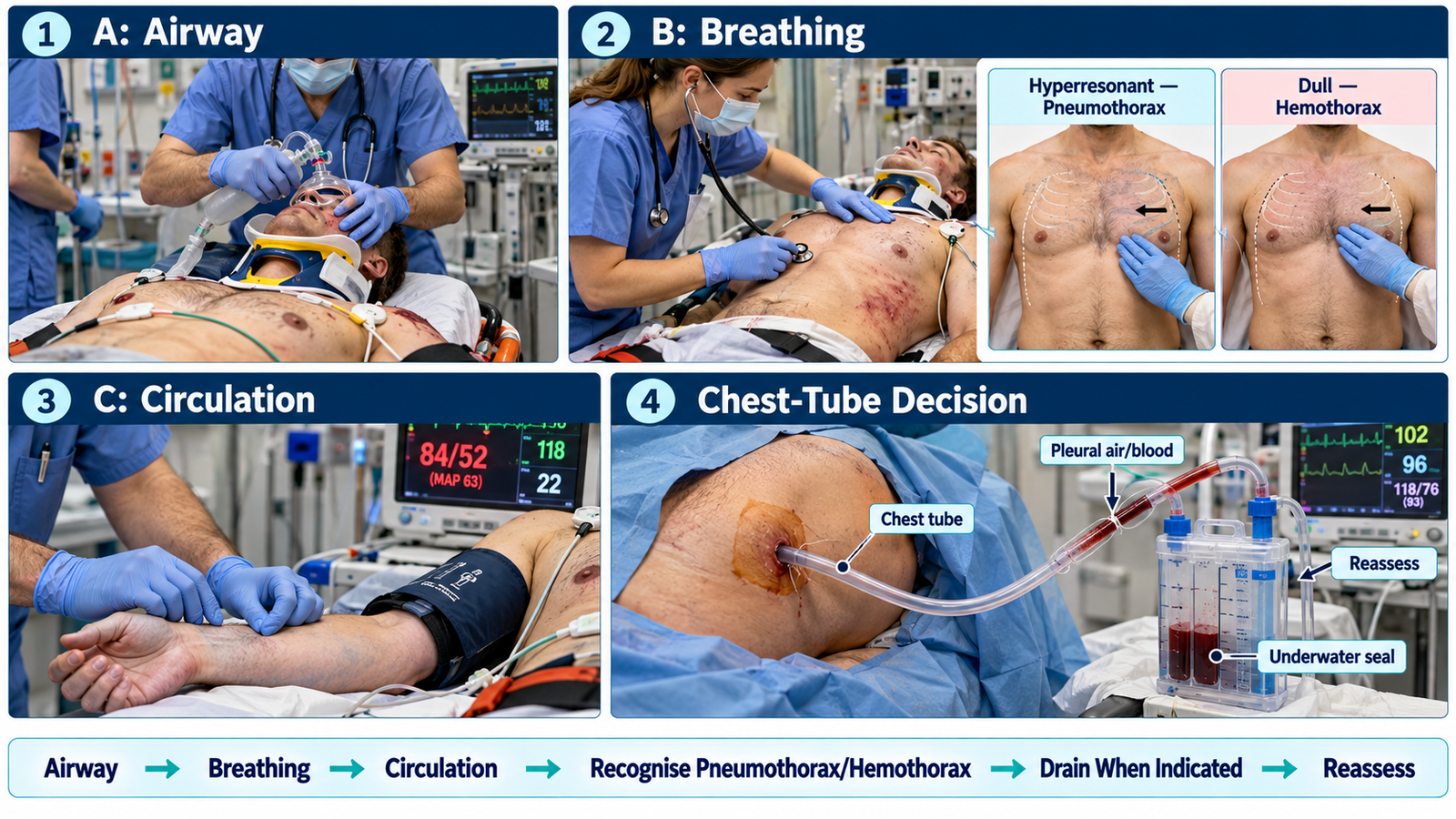
- Interpretation: Unilateral absent/reduced breath sounds with hyperresonance suggests pneumothorax, while reduced breath sounds with dullness suggests hemothorax; severe compromise requires immediate action.
- Chest-tube decision: Thoracostomy/chest intubation is indicated when clinically significant pleural air or blood requires drainage, followed by appropriate tube monitoring and ongoing reassessment.
🔎 How to Perform / Approach
- Recognize the emergency: Ensure scene/personal safety, introduce yourself where feasible, call for appropriate senior/emergency support and begin immediate assessment.
- Assess Airway: Confirm that the patient can speak or otherwise demonstrate airway patency. Identify obstruction promptly and maintain appropriate trauma precautions.
- Assess Breathing: Expose the chest appropriately and assess respiratory rate, oxygen saturation, chest expansion, symmetry and work of breathing. Look for penetrating injury, bruising or deformity.
- Examine for pleural injury: Assess tracheal position where relevant, palpate chest expansion, percuss both sides and auscultate bilaterally. Hyperresonance with reduced/absent breath sounds supports pneumothorax; dullness with reduced breath sounds supports hemothorax.
- Assess Circulation: Check pulse, blood pressure, capillary/peripheral perfusion and signs of shock. Consider significant intrathoracic bleeding when circulatory compromise accompanies chest trauma.
- Make the chest-tube decision: Identify whether significant pleural air or blood requires thoracostomy/chest intubation. In a clinically deteriorating patient, life-saving treatment should not be unnecessarily delayed.
- Reassess & manage the tube: Continue monitoring respiratory status and circulation, ensure appropriate chest-tube function and drainage, and escalate if deterioration or complications occur.
🖼️ Visual Learning
Chest Trauma ABC Assessment & Chest-Tube Decision
📝 Important Viva Questions
Reduced unilateral chest movement, hyperresonant percussion and reduced or absent breath sounds on the affected side suggest pneumothorax.
Reduced chest movement and breath sounds with a dull percussion note on the affected side suggest pleural blood accumulation.
It prioritizes immediately life-threatening airway, breathing and circulatory problems so urgent treatment is not delayed by less important assessment.
It drains air, blood or other pleural contents, allowing the lung to re-expand and helping restore normal intrapleural conditions.
Reassess respiratory status, oxygenation and circulation, and check that the drainage system is functioning appropriately while watching for continued deterioration or complications.