
Station 08 — Parent Counselling in Congenital Heart Disease
🎯 Candidate Task
You are speaking with the parent of a child in whom congenital heart disease is suspected. Counsel the parent regarding the suspected heart problem, the need for further investigations and general management, and explain important warning symptoms and follow-up.
⚡ Model Station Answer
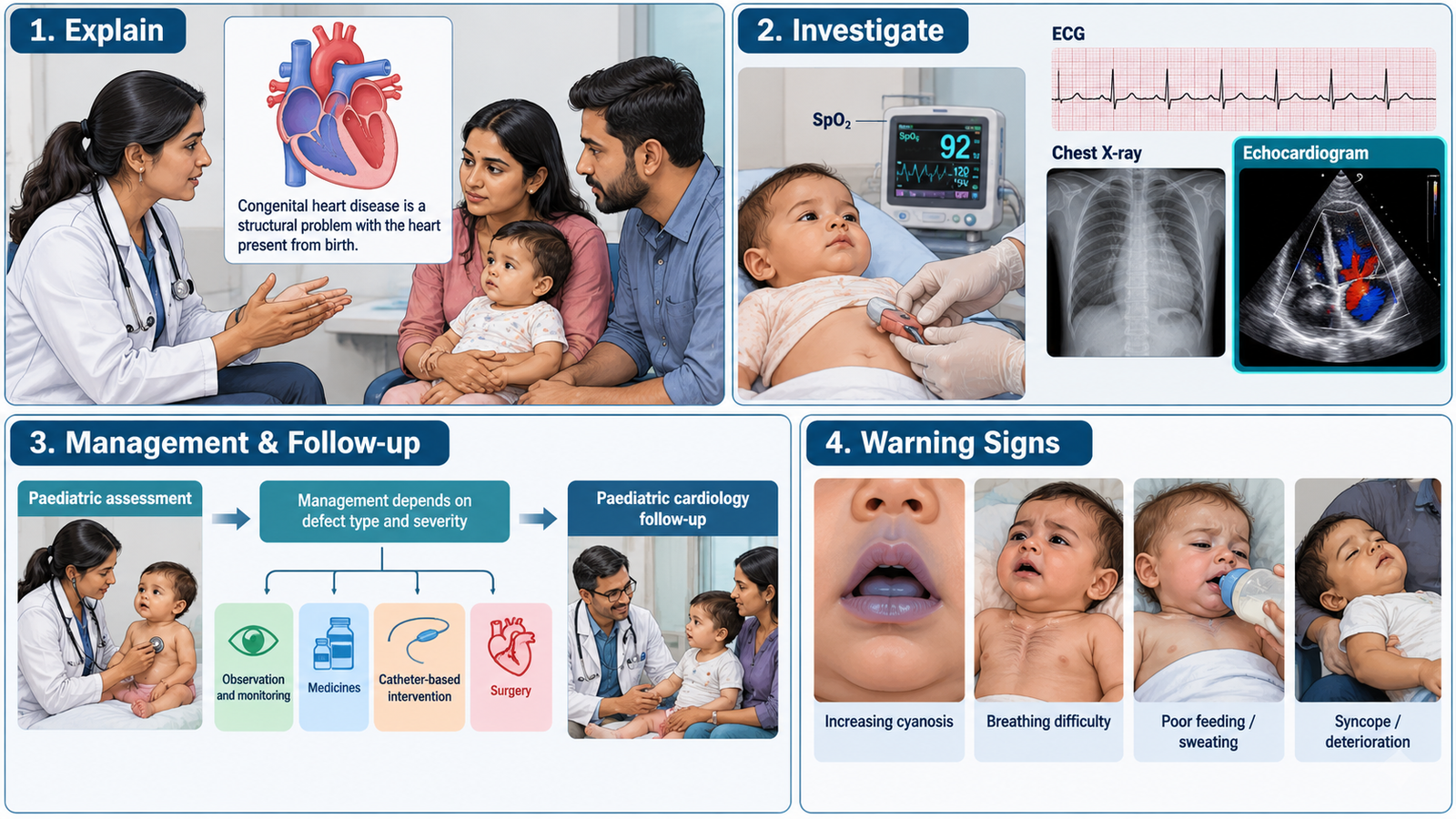
“I understand that hearing your child may have a heart problem can be worrying. Congenital heart disease means there may be a structural problem in the heart that has been present since birth; we need further tests to determine exactly what type it is and how significant it is.”
“We will assess your child carefully and may arrange tests such as oxygen-saturation measurement, an ECG, chest X-ray and particularly an echocardiogram. Management depends on the exact defect and its severity; some children only need observation and follow-up, while others may require medicines or a procedure/surgery by a pediatric cardiac team.”
“Please seek urgent medical attention if your child develops worsening blue discoloration, severe breathing difficulty, poor feeding, marked sweating or tiredness with feeds, fainting, or becomes unusually drowsy. Regular pediatric cardiology follow-up is important, and I will answer any questions or concerns you have.”
🔎 How to Perform / Approach
- Introduce and establish context: Introduce yourself, confirm the parent and child, ensure privacy, and establish what the parent already understands.
- Explain simply: Explain that congenital heart disease is a heart abnormality present from birth; avoid technical terminology and do not label a specific defect unless it has been established.
- Explain the suspected problem: Relate the concern to the child’s clinical findings while emphasizing that further assessment is needed to define the exact lesion and severity.
- Discuss investigations: Explain the purpose of clinical assessment, oxygen saturation, ECG and chest X-ray where appropriate, with echocardiography as the key test for defining cardiac anatomy and function.
- Discuss management: Explain that treatment depends on the type and severity of the defect and may range from observation to medicines, catheter-based intervention or surgery with specialist pediatric cardiac care.
- Safety-net: Explain important warning symptoms including worsening cyanosis, respiratory distress, poor feeding, excessive sweating/tiredness with feeds, syncope or significant deterioration.
- Close appropriately: Explain the need for regular follow-up and specialist referral, address parental concerns, check understanding and invite questions.
🖼️ Visual Learning
Parent Counselling in Congenital Heart Disease
🎥 Practical Demonstration
For this communication station, practise the counselling sequence as a role-play with a simulated parent: establish understanding → explain in simple language → discuss investigations and management → address concerns → safety-net → check understanding and close.
📝 Important Viva Questions
Answer: Echocardiography is the key investigation because it demonstrates cardiac anatomy, blood flow and functional abnormalities.
Answer: Cyanosis, feeding difficulty, sweating or tiring during feeds, breathlessness, recurrent respiratory symptoms, poor growth and reduced exercise tolerance where age appropriate.
Answer: Worsening cyanosis, severe respiratory distress, inability to feed, marked lethargy or deterioration, and syncope require urgent assessment.
Answer: No. Management depends on the lesion and severity; some require observation only, while others need medicines, catheter intervention or surgery.
Answer: Use clear non-technical language, acknowledge parental concerns, explain investigations and management honestly, provide safety-net advice, arrange appropriate follow-up and check understanding.