
Ziehl-Neelsen Staining and Identification of Acid-Fast Bacilli
🎯 Task
Perform Ziehl-Neelsen staining on the provided smear using the appropriate reagents and sequence. Examine the stained preparation microscopically and identify acid-fast bacilli and inflammatory cells, stating the significance of the findings.
🔬 Stepwise Procedure / Approach
-
- Prepare safely. Wear appropriate laboratory protective equipment, identify the prepared smear and place it smear-side upward on the staining rack.
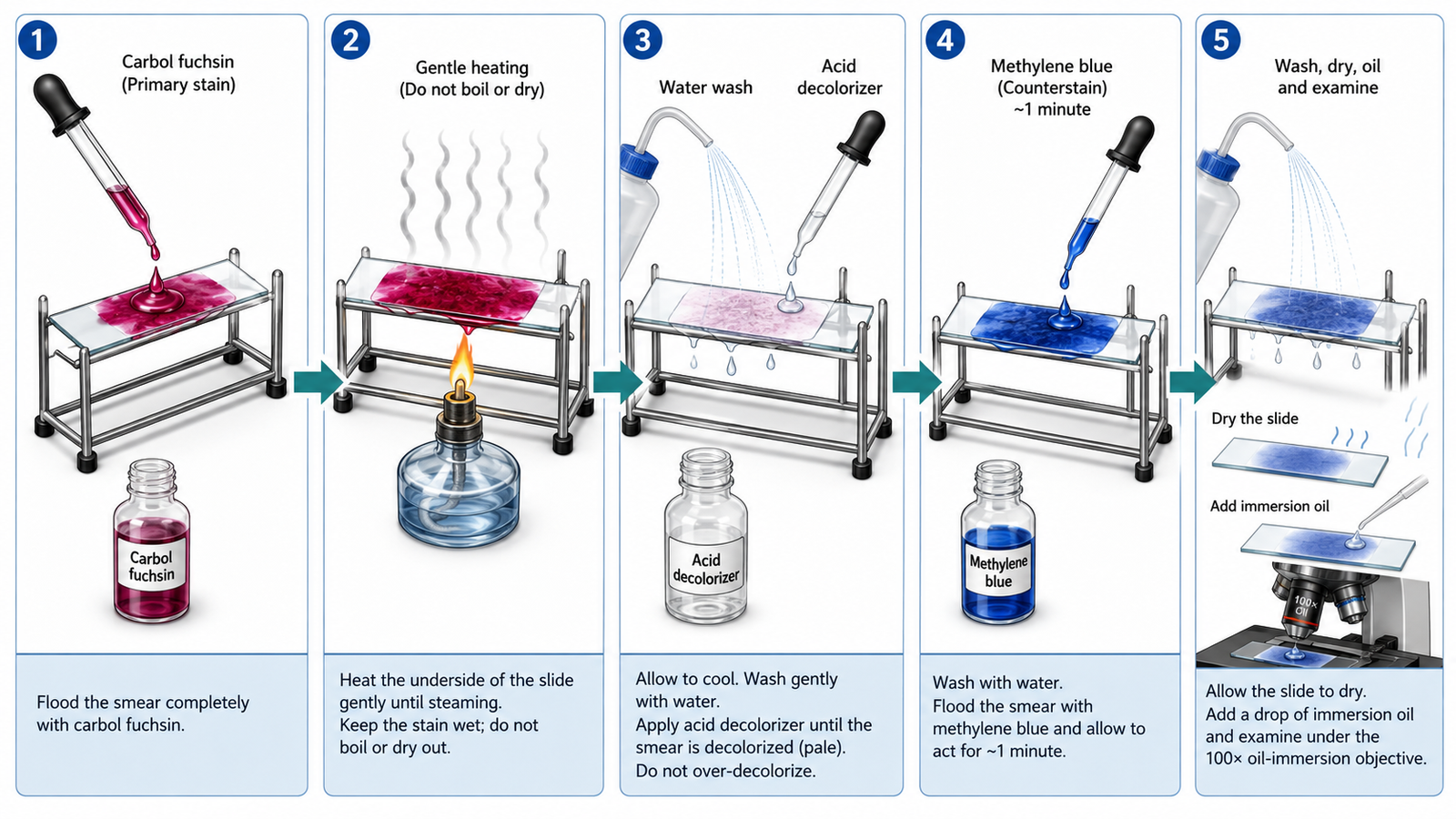
- Apply the primary stain. Flood the smear completely with carbol fuchsin.
- Heat gently. Warm the underside of the slide until the stain begins to steam; maintain the stain on the smear while heating. Do not boil or allow the stain to dry.
- Cool and wash. Allow the slide to cool, discard excess carbol fuchsin and wash gently with water.
- Decolorize. Apply the acid decolorizing agent until appropriate decolorization is achieved, then wash with water. Acid-fast organisms retain the red carbol fuchsin because of their lipid-rich, mycolic-acid-containing cell wall.
- Counterstain. Cover the smear with methylene blue for approximately 1 minute and wash gently with water.
- Dry and examine. Allow the slide to dry, add immersion oil and examine systematically using the 100× oil-immersion objective.
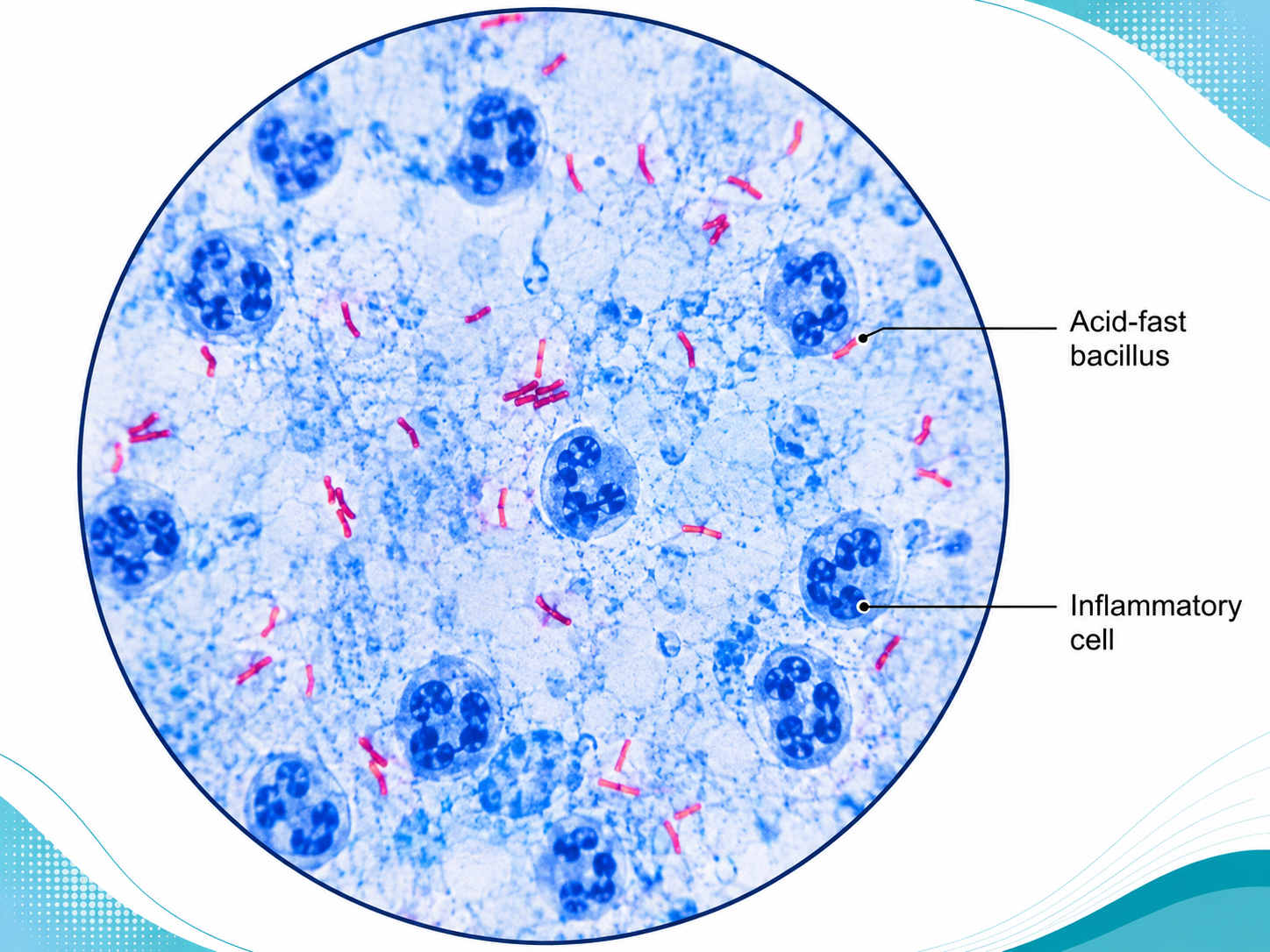
- Interpret the result. Identify bright red/pink slender bacilli against the blue counterstained background. Inflammatory cells such as pus cells appear blue; report whether AFB are seen.
🖼️ Visual Learning
Ziehl-Neelsen Staining Sequence
Microscopic Identification of AFB
🎥 Practical Video
🎥 Practical Demonstration
Preparing an Acid-Fast Stain using the Ziehl-Nielsen Method • Open Michigan / Kwame Nkrumah University of Science and Technology & University of Michigan :contentReference[oaicite:0]{index=0}
A concise laboratory demonstration showing preparation and staining of an acid-fast smear using the Ziehl-Neelsen method.
📝 Important Viva Questions
Q1. What is the principle of Ziehl-Neelsen staining?
Answer: Acid-fast bacilli retain carbol fuchsin even after acid decolorization because their cell wall is rich in waxy lipids, especially mycolic acids.
Q2. What is the primary stain used in the Ziehl-Neelsen method?
Answer: Carbol fuchsin.
Q3. Why is heat applied during classical Ziehl-Neelsen staining?
Answer: Heat facilitates penetration of carbol fuchsin through the lipid-rich, waxy cell wall of acid-fast bacilli.
Q4. What is the purpose of the acid decolorizing agent?
Answer: It removes carbol fuchsin from non-acid-fast material while acid-fast bacilli retain the primary stain.
Q5. Which counterstain is commonly used in Ziehl-Neelsen staining?
Answer: Methylene blue, which provides a blue contrasting background.
Q6. How do acid-fast bacilli appear in a positive Ziehl-Neelsen stained smear?
Answer: They appear as bright red or pink slender rods against a blue background when examined under oil immersion.
Q7. How can inflammatory cells be distinguished from AFB in the stained smear?
Answer: Inflammatory cells are much larger and counterstain blue, whereas AFB are tiny red/pink slender bacilli.
Q8. What important mistake should be avoided while heating carbol fuchsin?
Answer: Do not boil the stain or allow the smear to dry. Gentle steaming is sufficient.