
AIM OSCE / OSPE • MBBS
Intravenous Drug Administration on a Manikin
Rapid Revision • Practical Skills • Viva
🎯 Task
You are provided with a prescribed intravenous medication and a manikin with an established peripheral IV cannula. Demonstrate the standard protocol for safely preparing and administering the drug through the IV route and completing the procedure appropriately.
🔢 Stepwise Procedure / Approach
-
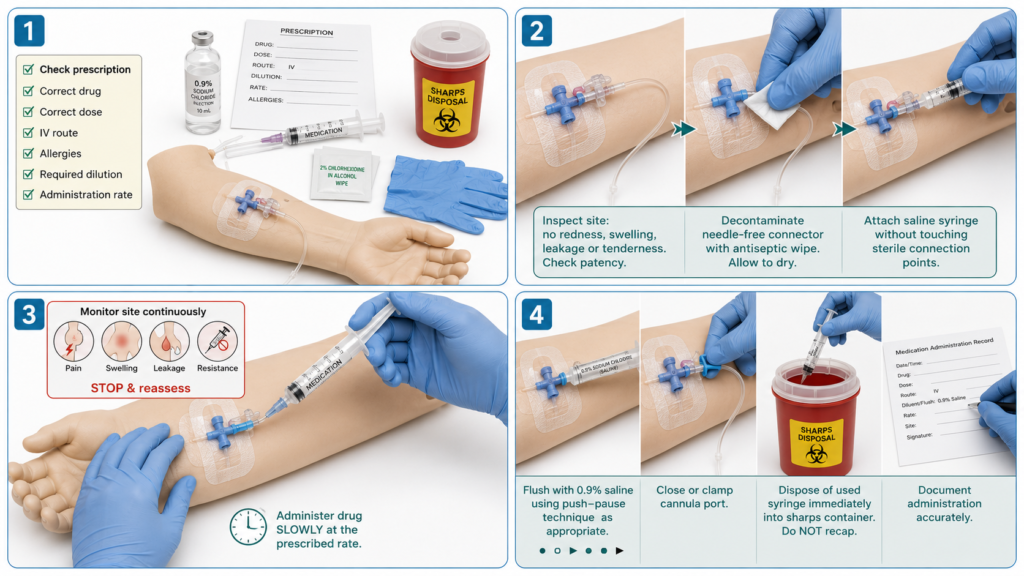
- Verify the prescription and medication.
Confirm the correct patient, drug, dose, time, IV route, indication, allergies, expiry, required dilution and recommended administration rate.
- Verify the prescription and medication.
-
- Perform hand hygiene and prepare the medication.
Gather the required equipment and prepare the drug using aseptic non-touch technique; remove air from the syringe and label it when appropriate. - Identify the patient and explain the procedure.
Confirm identity using appropriate identifiers, explain IV drug administration and obtain consent. - Inspect the IV cannula and site.
Check that the cannula is secure and look for pain, redness, swelling, leakage, infiltration or phlebitis before use. - Decontaminate the access port.
Scrub the needle-free connector with the recommended antiseptic and allow it to dry; avoid touching the disinfected connection. - Confirm cannula patency.
Where appropriate and compatible with local protocol, attach a sterile 0.9% saline flush and gently flush the cannula using a push-pause technique. Stop if there is pain, swelling or abnormal resistance. - Administer the IV medication.
Attach the medication syringe securely and inject the drug at the drug-specific recommended rate while observing the cannula site and the patient/manikin. - Flush and close the IV access.
After administration, flush the cannula with a compatible solution as required, then clamp or close the line/port correctly. - Complete the procedure safely.
Dispose of sharps immediately without recapping, discard other waste appropriately, perform hand hygiene, document the drug, dose, route and time, and monitor for adverse effects.
- Perform hand hygiene and prepare the medication.
🖼️ Visual Learning
Intravenous Drug Administration Through an Existing Peripheral Cannula
🎥 Practical Video
🎥 Practical Demonstration
NHSGGC — Introduction to Intravenous Medicine Administration
Demonstration from NHS Greater Glasgow and Clyde covering the principles and practical sequence of safe intravenous medicine administration.
▶ Watch Practical Video
📝 Important Viva Questions
Q1. What should be checked before administering an IV drug?
Answer: Confirm the patient, prescribed drug, dose, time, IV route, allergies, expiry, dilution and required rate of administration.
Q2. Why must the IV cannula site be inspected before drug administration?
Answer: To identify complications such as infiltration, extravasation, phlebitis, leakage or displacement before the drug is given.
Q3. Why is the IV access port disinfected before connecting a syringe?
Answer: To reduce microbial contamination of the intravenous system and the risk of catheter-related infection.
Q4. What findings during flushing suggest that the cannula should not be used?
Answer: Pain, swelling, leakage or unexpected resistance. Stop and reassess the cannula rather than forcing the flush.
Q5. Why are some IV drugs administered slowly?
Answer: Rapid administration can produce serious concentration-related adverse effects. The drug should therefore be given at its recommended rate.
Q6. Why may the cannula be flushed after IV medication administration?
Answer: A compatible flush helps deliver residual medication from the cannula or extension tubing and helps maintain line patency when required by protocol.
Q7. What is a major aseptic principle during IV drug administration?
Answer: Use aseptic non-touch technique and avoid touching critical parts such as syringe tips and disinfected IV connectors.
Q8. What should be documented after administering an IV drug?
Answer: Record the medication, dose, IV route, date and time of administration and any relevant observations or adverse reactions according to local policy.