
Intramuscular Drug Administration on a Manikin
Rapid Revision • Practical Skills • Viva
🎯 Task
On the provided manikin, demonstrate the safe administration of the prescribed drug by the intramuscular route. Verbalize the essential patient and medication safety checks, identify an appropriate injection site and landmark, perform the injection technique, and complete safe sharps disposal and documentation.
🩺 Stepwise Procedure / Approach
- Perform initial safety checks.
Confirm the patient, prescription, drug, dose, route, time, expiry date and allergy status; explain the procedure and obtain consent. - Prepare safely.
Perform hand hygiene, use appropriate PPE and gather the medication, syringe, suitable needles, gauze and sharps container. - Prepare the medication aseptically.
Draw up the correct prescribed dose, remove the drawing-up needle safely and attach the appropriate injection needle without contaminating it. - Select and position the injection site.
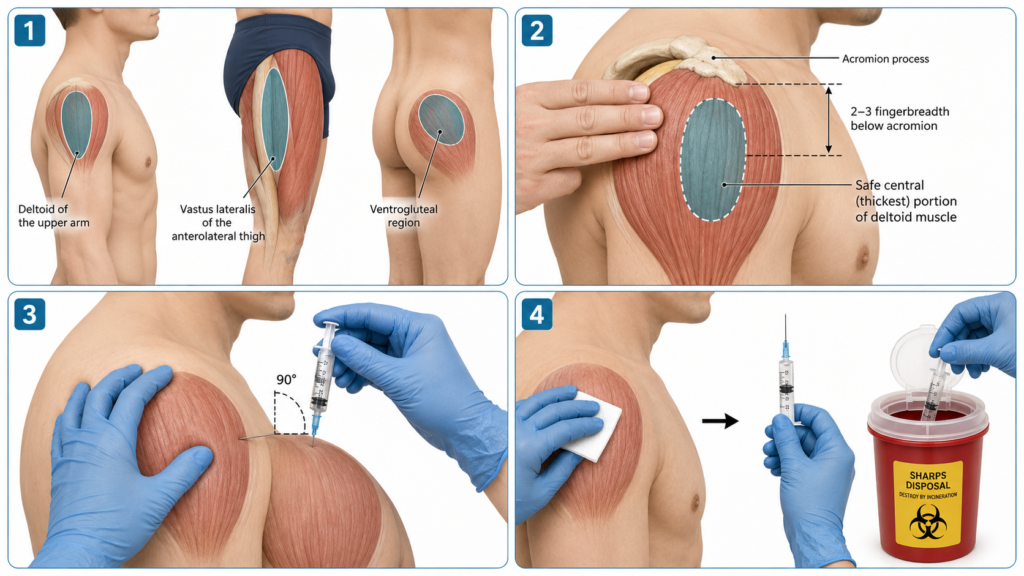
Choose an appropriate IM site such as the deltoid, vastus lateralis or ventrogluteal site; avoid bruised, inflamed, scarred or infected skin. - Identify the anatomical landmark.
For a deltoid injection, locate the acromion process and select the central, thickest part of the deltoid muscle approximately 2–3 fingerbreadths below the acromion. - Prepare the site.
Expose the area adequately and clean the skin if required by local protocol, allowing any antiseptic used to dry completely. - Insert the needle correctly.
Stabilize or displace the skin as appropriate, warn the patient, hold the syringe firmly like a dart and insert the needle into the muscle at approximately 90°. - Administer the medication.
Aspirate only when required by the specific medication or local protocol; inject the medication slowly and steadily while keeping the needle stable. - Complete the procedure safely.
Withdraw the needle smoothly, apply gentle pressure with gauze, dispose of the needle immediately into the sharps container without recapping, perform hand hygiene and document the drug, dose, route, site and time of administration.
🖼️ Visual Learning
IM Injection: Landmark and Safe Technique
🎥 Practical Video
Intramuscular (IM) Injection — OSCE Guide
Source: Geeky Medics
A focused OSCE demonstration covering equipment preparation, medication checks, selection of the injection site, needle insertion and completion of the procedure.
📝 Important Viva Questions
Q1. At what angle is an intramuscular injection usually given?
Approximately 90° to the skin. This helps the needle reach the muscle rather than remaining in subcutaneous tissue.
Q2. Name three commonly used sites for intramuscular injection.
Deltoid, vastus lateralis and ventrogluteal muscles.
Q3. How do you identify the deltoid IM injection site?
Identify the acromion process and select the central thickest part of the deltoid approximately 2–3 fingerbreadths below it.
Q4. Why should the injection site be inspected before giving an IM injection?
To avoid injecting through infected, inflamed, bruised, scarred or otherwise abnormal skin.
Q5. Is aspiration required before every intramuscular injection?
No. It is not routinely required for IM vaccination; for other medications, follow the specific drug instructions and local institutional protocol.
Q6. What is the purpose of the Z-track technique?
It displaces the skin and subcutaneous tissue so the needle track seals after withdrawal, helping reduce leakage of medication into subcutaneous tissue.
Q7. What important complications can occur after an IM injection?
Pain, bleeding or hematoma, infection, tissue injury, nerve injury, abscess formation and unintended administration into a blood vessel may occur.
Q8. What should be done with the needle immediately after the injection?
Dispose of it directly into an approved sharps container without recapping to reduce needle-stick injury.