
AIM OSCE / OSPE • FINAL YEAR MBBS
OSCE Station 01 — Cognitive Assessment: Mini-Mental State Examination (MMSE) & Dementia Family Counselling
Neuroscience Module • Medicine / Psychiatry
Rapid Revision • Clinical Skills • Practical Skills • Viva
🎯 Candidate Task
A patient is brought by a family member because of progressive forgetfulness affecting daily activities. Demonstrate a structured Mini-Mental State Examination (MMSE), interpret the supplied cognitive findings, identify important reversible causes and counsel the family regarding further assessment and care.
⚡ Model Station Answer
Assessment: “I will assess orientation, registration, attention, delayed recall, language and visuospatial ability using the 30-point MMSE.”
Interpretation: “A reduced score suggests cognitive impairment but does not independently establish dementia. I will correlate it with the history and functional decline.”
Reversible causes: “I will assess for depression, delirium, medication effects, hypothyroidism and vitamin B12 deficiency.”
Family counselling: “I will explain the findings sensitively, discuss safety and daily support, arrange further assessment and follow-up, and address caregiver concerns.”
🔎 How to Perform / Approach
- Introduce and prepare: Confirm identity, explain the assessment, obtain consent and ensure appropriate hearing, vision, language and a quiet environment.
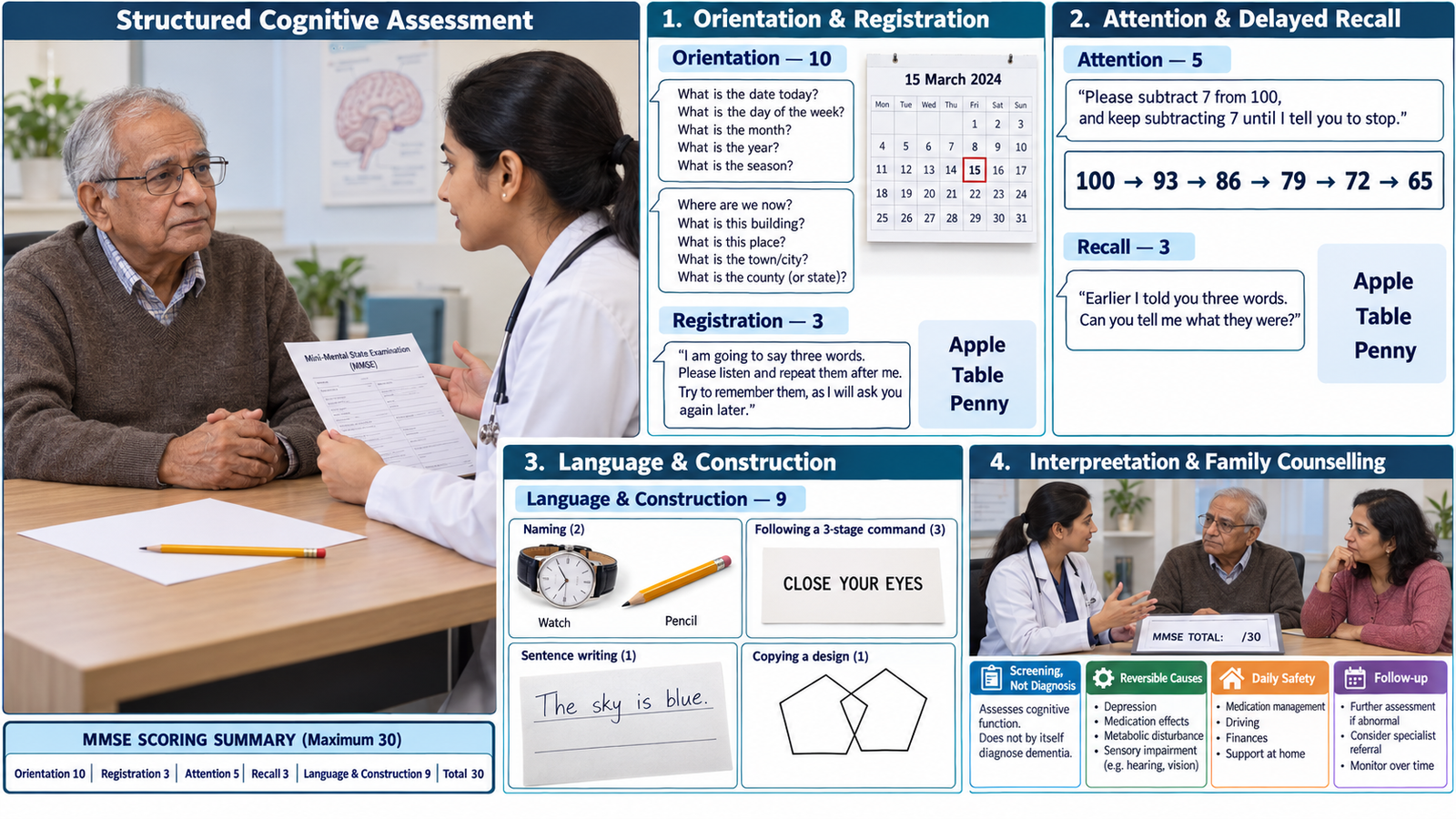
- Assess orientation (10 marks): Ask five questions about time (year, season, date, day and month) and five about place (country, region, town, building and floor).
- Test registration, attention and recall (11 marks): Ask the patient to repeat three unrelated words (3), subtract 7 serially from 100 for five responses (5), then recall the same three words after a delay (3).
- Assess language and construction (9 marks): Test object naming (2), sentence repetition (1), a three-stage command (3), reading and obeying a written command (1), writing a meaningful sentence (1) and copying intersecting pentagons (1).
- Score and interpret: Calculate the total out of 30. Interpret according to the validated test version, education, language and clinical context; assess whether cognitive impairment affects daily functioning.
- Identify reversible causes: Review medication use, mood, acute confusion and relevant medical conditions. Consider CBC, thyroid function, vitamin B12 and metabolic investigations where appropriate.
- Counsel the family: Explain possible causes and the need for diagnostic assessment. Discuss reminders, medication supervision, home safety, preservation of independence, caregiver support, treatment options and follow-up. Check understanding and invite questions.
🖼️ Visual Learning
Mini-Mental State Examination — Cognitive Domains, Scoring & Family Counselling
📝 Important Viva Questions
Q1. What is the maximum MMSE score, and which domains are assessed?
Answer: 30 marks. It assesses orientation, registration, attention/calculation, delayed recall, language and visuospatial construction.
Q2. Can an MMSE score alone diagnose dementia?
Answer: No. Diagnosis requires cognitive assessment together with clinical history, functional decline and exclusion of alternative causes.
Q3. Name three potentially reversible causes of cognitive impairment.
Answer: Hypothyroidism, vitamin B12 deficiency and depression.
Q4. How can delirium be distinguished from dementia?
Answer: Delirium typically develops acutely with fluctuating attention and awareness; dementia usually causes persistent, progressive cognitive decline.
Q5. What are the most important counselling points for a family caring for a patient with dementia?
Answer: Explain the condition, encourage structured routines and safe independence, supervise medications when necessary, arrange follow-up and provide caregiver support.