
AIM OSCE / OSPE • FINAL YEAR MBBS
OSCE Station 05 — Childhood Epilepsy: Assessment, Prescription & Parent Counselling
Neuroscience Module • Pediatrics
Rapid Revision • Clinical Skills • Practical Skills • Viva
🎯 Candidate Task
A child is brought to the pediatric clinic by a parent because of recurrent episodes of abnormal movements or brief unresponsiveness. Take a focused seizure history, describe the relevant age-appropriate neurological examination, identify the seizure type, select appropriate investigations and antiseizure treatment, and counsel the parent regarding medication, seizure first aid and follow-up.
⚡ Model Station Answer
History: “I will ask the parent about seizure onset, duration, awareness, movements, fever, postictal recovery, developmental history and previous episodes.”
Assessment: “I will perform an age-appropriate neurological examination and differentiate tonic-clonic seizures from brief absence episodes.”
Investigations: “I will assess glucose and relevant metabolic causes, arrange EEG and consider MRI brain when clinically indicated.”
Treatment: “I will select an age- and weight-appropriate antiseizure medication according to seizure classification, then write a complete, safe prescription.”
Parent counselling: “I will explain adherence, seizure first aid, safety precautions, emergency warning signs and the importance of follow-up.”
🔎 How to Perform / Approach
- Introduce and obtain a focused history: Confirm the child’s identity and obtain parental consent. Ask about seizure onset, duration, frequency, awareness, stiffening, jerking, staring, eye deviation, postictal confusion, fever, injuries and triggers. Request an eyewitness account or video when available.
- Assess background and development: Ask about birth history, developmental milestones, previous febrile seizures, head injury, CNS infections, family history, school performance and current medication. Distinguish recurrent unprovoked seizures from acute symptomatic events.
- Perform age-appropriate neurological examination: Assess consciousness, behaviour, development, cranial nerves, muscle tone, power, reflexes, coordination and gait where appropriate. Look for focal neurological deficits or developmental abnormalities.
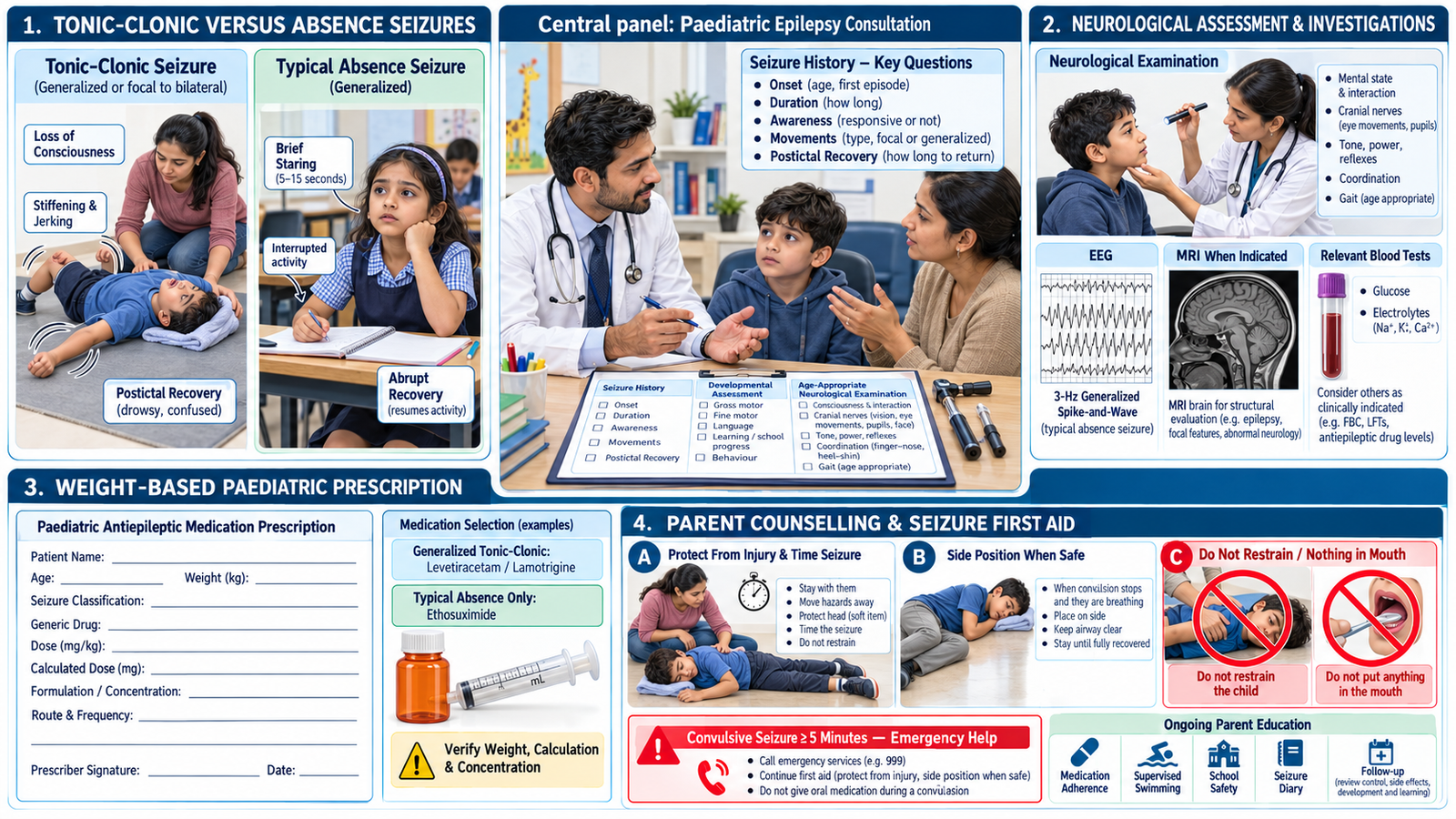
- Classify seizures and select investigations: Tonic-clonic seizures involve sustained stiffening and rhythmic jerking, usually with loss of consciousness and postictal recovery. Typical absence seizures cause brief staring with abrupt recovery. Check glucose and relevant electrolytes; arrange EEG for classification and consider MRI for focal findings, developmental concerns or suspected structural pathology.
- Select and write an appropriate prescription: Levetiracetam or lamotrigine may be considered for generalized tonic-clonic epilepsy; ethosuximide is first-line for typical absence seizures occurring alone. Document the child’s age, actual weight, diagnosis, generic drug, calculated dose, formulation, route, frequency, instructions and prescriber details. Verify current pediatric dosing before prescribing.
- Explain medication and seizure first aid: Advise parents to administer medication consistently, measure oral liquids accurately and never stop treatment abruptly. During a convulsion, protect the child from injury, time the seizure, place the child on the side when safe, and avoid restraining or putting anything in the mouth.
- Provide safety advice and follow-up: Explain supervised bathing and swimming, school communication, adequate sleep and seizure records. Seek emergency help for a convulsive seizure lasting 5 minutes or longer, repeated seizures without recovery, breathing difficulty or serious injury. Arrange pediatric follow-up and check parental understanding.
🖼️ Visual Learning
Childhood Epilepsy — Seizure Assessment, Pediatric Prescription & Parent Counselling
📝 Important Viva Questions
Q1. How do typical absence seizures differ from generalized tonic-clonic seizures in children?
Answer: Absence seizures cause brief staring and interruption of activity with abrupt recovery. Tonic-clonic seizures cause loss of consciousness with generalized stiffening and jerking, usually followed by postictal confusion.
Q2. What EEG pattern is characteristic of typical childhood absence epilepsy?
Answer: Generalized, synchronous, approximately 3-Hz spike-and-wave discharges, often provoked by hyperventilation.
Q3. Which antiseizure medications are appropriate for childhood generalized tonic-clonic and typical absence epilepsy?
Answer: Levetiracetam or lamotrigine may be used for generalized tonic-clonic epilepsy. Ethosuximide is first-line for typical absence seizures occurring alone.
Q4. What must be checked before prescribing an antiseizure medication to a child?
Answer: Verify seizure type, age, measured weight, calculated dose, formulation concentration, route, frequency, contraindications and relevant organ function.
Q5. What first-aid instructions should parents follow during a child’s convulsive seizure?
Answer: Protect the child from injury, time the seizure, position on the side when safe and never restrain or place objects in the mouth. Seek emergency help if convulsions last 5 minutes or longer or recur without recovery.