
AIM OSCE / OSPE • FINAL YEAR MBBS
OSCE Station 06 — Headache & Migraine: Clinical Assessment, Red Flags & Counselling
Neuroscience Module • Medicine / Family Medicine / Pediatrics
Rapid Revision • Clinical Skills • Practical Skills • Viva
🎯 Candidate Task
A patient presents to the primary healthcare clinic with recurrent headaches affecting daily activities. Take a focused headache history, describe the relevant neurological examination, identify possible warning signs, and explain your diagnostic approach, initial management and preventive counselling, including important considerations in children.
⚡ Model Station Answer
Assessment: “I will establish headache onset, duration, site, severity, associated symptoms, triggers and functional impact.”
Clinical recognition: “Recurrent moderate-to-severe headache with nausea, photophobia or phonophobia, often aggravated by activity, suggests migraine.”
Red flags: “I will assess for thunderclap onset, fever with meningism, focal neurological deficits, altered consciousness and progressive headache.”
Investigations and management: “Typical migraine with a normal examination usually requires no routine imaging; concerning features require targeted investigation or urgent referral. Treatment includes suitable acute medication and preventive strategies.”
Counselling: “I will advise regular sleep, hydration, meals, trigger identification, a headache diary and follow-up.”
🔎 How to Perform / Approach
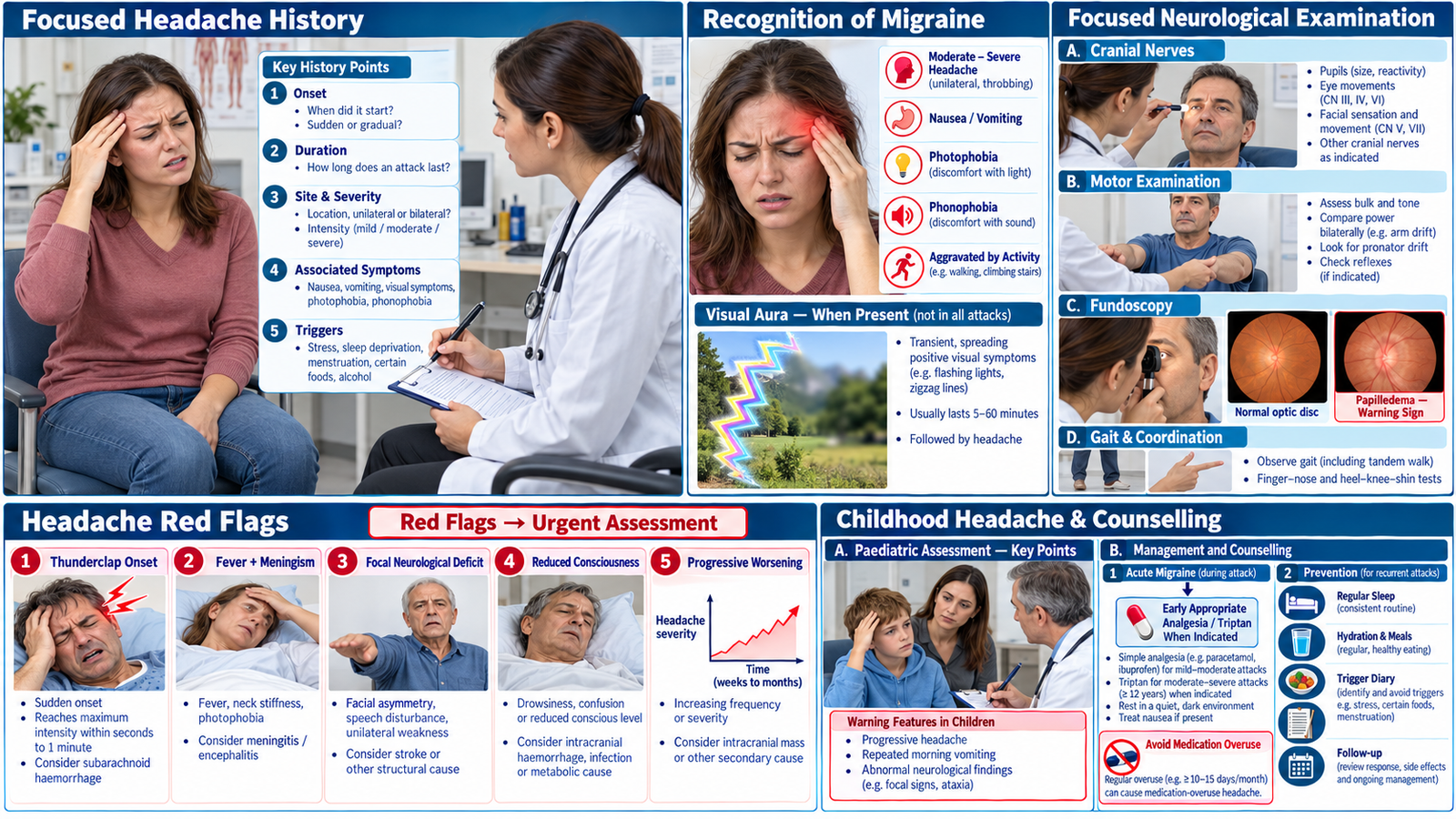
- Introduce and take a focused history: Confirm identity, obtain consent and ask about onset, location, character, severity, duration, frequency, progression, triggers and effect on daily activities. Review previous episodes and analgesic use.
- Identify characteristic migraine features: Ask about pulsating or unilateral pain, nausea, vomiting, photophobia, phonophobia, activity-related worsening and possible aura. Explore family history, sleep disturbance, menstrual association and common triggers.
- Screen for important red flags: Ask about sudden maximal-intensity headache, fever, neck stiffness, new neurological deficits, seizures, altered consciousness, head trauma, progressive worsening, cancer or immunosuppression. In children, note early-morning vomiting, abnormal neurological findings, progressive symptoms or developmental/behavioural changes.
- Perform focused examination: Assess vital signs, blood pressure, consciousness, neck stiffness, cranial nerves, visual function, limb power, sensation, reflexes, coordination and gait. Perform fundoscopy for papilledema when indicated and feasible.
- Formulate diagnosis and investigation plan: Recognize typical migraine clinically and distinguish it from other headache patterns. Routine neuroimaging is generally unnecessary for typical migraine with a normal examination and no red flags. Select urgent CT, MRI or other investigations according to suspected secondary causes.
- Outline appropriate management: For uncomplicated migraine, recommend early acute treatment with a suitable analgesic or NSAID, and a triptan when appropriate, with an antiemetic if needed. Consider preventive treatment for frequent or disabling attacks. Use age-appropriate medication in children and refer concerning presentations promptly.
- Counsel and safety-net: Encourage regular sleep, hydration, meals, physical activity, stress management, headache diary and avoidance of identified triggers. Explain medication-overuse headache, arrange follow-up and advise urgent review for sudden severe headache or new neurological symptoms.
🖼️ Visual Learning
Headache & Migraine — Focused Assessment, Neurological Red Flags & Counselling
📝 Important Viva Questions
Q1. What clinical features support the diagnosis of migraine?
Answer: Recurrent moderate-to-severe headache, often unilateral and pulsating, aggravated by activity and associated with nausea, photophobia or phonophobia.
Q2. Name four important headache red flags requiring urgent assessment.
Answer: Thunderclap onset, fever with meningism, new focal neurological deficit and altered consciousness.
Q3. Is neuroimaging routinely required for a patient with typical migraine and a normal neurological examination?
Answer: No. Routine imaging is usually unnecessary unless the history or examination suggests a secondary cause.
Q4. What are the initial treatment and prevention principles for migraine?
Answer: Use appropriate early acute treatment, such as an NSAID or triptan when indicated. Encourage regular sleep, hydration, meals, trigger management and preventive therapy for frequent disabling attacks.
Q5. Which headache features in a child suggest the need for further investigation?
Answer: Progressive headache, repeated early-morning vomiting, abnormal neurological findings, altered consciousness or other signs suggesting raised intracranial pressure or a secondary cause.