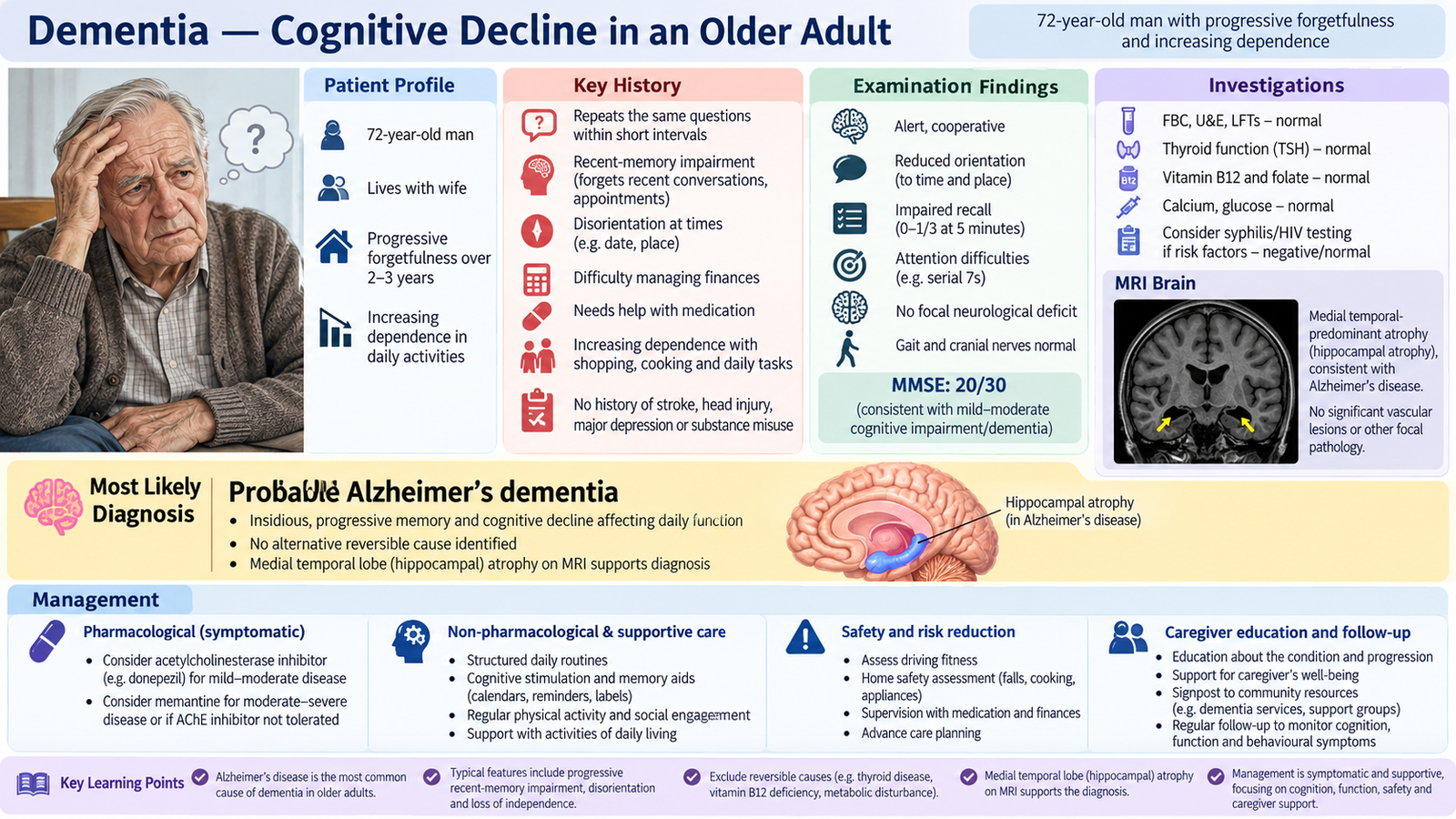
Dementia — Cognitive Decline in an Older Adult
A structured, patient-centred approach to progressive memory impairment, cognitive assessment, diagnostic reasoning, management and long-term family care.
01. Long Case Title
Long Case 01 — Evaluation of an Older Adult with Progressive Cognitive Decline
Related AIM Topic: Dementia, Cognitive Decline & Huntington’s Disease
02. Patient Scenario
A 72-year-old retired schoolteacher is brought to the medical outpatient department by his daughter because of gradually worsening forgetfulness over the past two years.
He frequently misplaces household items, repeats questions and has recently become unable to manage his medications and household finances independently.
His daughter is concerned about his increasing dependence and asks whether this is simply part of normal ageing.
03. Student Task
The student is expected to:
- Obtain a comprehensive, clinically relevant history of progressive cognitive decline, including collateral history from a family member.
- Assess memory, orientation, cognition and functional impairment.
- Perform a relevant general and neurological examination.
- Demonstrate and interpret the Mini-Mental State Examination (MMSE).
- Differentiate important reversible and irreversible causes of cognitive impairment.
- Select and interpret appropriate investigations.
- Formulate the most likely diagnosis and discuss undergraduate management principles.
- Counsel the patient and family regarding long-term care, safety and follow-up.
04. Relevant History
A. History of Presenting Illness
The daughter describes an insidious onset of forgetfulness two years ago, initially involving recent conversations and appointments. The memory problems have progressively worsened. The patient now repeats questions, misplaces objects and occasionally becomes disoriented in unfamiliar surroundings.
He was previously independent in handling household finances but now requires supervision for bills and medications. His basic self-care, including eating, dressing and bathing, remains largely preserved.
| History Clue | Clinical Significance |
|---|---|
| Progressive recent-memory impairment | Suggests an evolving neurodegenerative cognitive disorder. |
| Repeated questions and forgotten conversations | Suggest impaired retention of newly learned information. |
| Difficulty managing finances and medication | Demonstrates loss of independence in instrumental activities of daily living. |
| Gradual rather than sudden onset | Favours neurodegeneration over an acute cerebrovascular event or delirium. |
| No prominent fluctuation in consciousness | Makes delirium less likely. |
| No major depressive syndrome | Makes depression-related cognitive impairment less likely. |
B. Associated Cognitive and Behavioural Symptoms
- Memory: Significant difficulty remembering recent events and conversations.
- Orientation: Occasionally confused about the date and unfamiliar locations.
- Language: Mild word-finding difficulty without severe speech disturbance.
- Executive function: Difficulty organizing financial and medication-related tasks.
- Behaviour: Mild frustration about increasing dependence, but no major aggression or disinhibition.
- Sleep: No marked alteration in the sleep-wake cycle.
C. Important Negative History
- No sudden onset or stepwise deterioration.
- No previous major stroke or transient focal neurological episodes.
- No recurrent visual hallucinations or pronounced fluctuations in alertness.
- No significant tremor, rigidity or unexplained falls.
- No fever, acute confusion, seizures or recent head injury.
Clinical reasoning: These findings help distinguish neurodegenerative dementia from vascular, Lewy body and acute causes of cognitive disturbance.
D. Past Medical and Medication History
He has hypertension for ten years, reasonably controlled with treatment. There is no known major psychiatric illness, thyroid disease or vitamin B12 deficiency. A medication review reveals no regular sedative or strongly anticholinergic drug use.
E. Family and Social History
He lives with his wife and receives regular assistance from his daughter. There is no known family history of early-onset dementia. He previously managed personal and household responsibilities independently and does not misuse alcohol.
F. Functional History
The student should establish whether the patient can independently manage shopping, transport, finances, medicines, cooking, dressing, bathing and feeding. In this patient, complex activities are significantly affected while basic self-care is relatively preserved.
Progressive cognitive impairment accompanied by loss of independent daily functioning is more significant than isolated forgetfulness. Collateral history is essential because insight may be reduced.
05. Physical Examination
A. General Examination
The patient is conscious, comfortable, cooperative and appropriately dressed. There is no fever, pallor, dehydration or obvious malnutrition.
Vital signs: Blood pressure 138/82 mmHg, pulse 76/min and regular, respiratory rate 16/min, and temperature 36.8°C.
B. Neurological Examination
- Conscious and alert, but partly disoriented to time.
- No focal cranial nerve abnormality.
- Normal limb tone, power and reflexes.
- No spontaneous parkinsonism, tremor or involuntary movements.
- Gait is stable without significant ataxia.
- No focal sensory or motor neurological deficit.
C. Cognitive Examination — MMSE
The Mini-Mental State Examination assesses orientation, registration, attention and calculation, recall, language and visuospatial construction.
| Domain | Maximum | Patient Score |
|---|---|---|
| Orientation to time and place | 10 | 7 |
| Registration | 3 | 3 |
| Attention and calculation | 5 | 3 |
| Delayed recall | 3 | 0 |
| Language and visuospatial construction | 9 | 7 |
| TOTAL | 30 | 20 |
Interpretation: An MMSE score of 20/30 indicates clinically significant cognitive impairment in this context. Impaired delayed recall is especially prominent.
MMSE is a cognitive screening instrument, not a stand-alone diagnostic test. Interpretation must account for age, educational attainment, language, vision, hearing and premorbid functioning. The degree of functional dependence must be assessed separately.
06. Clinical Problem Representation
A 72-year-old man presents with two years of gradual, progressive episodic-memory impairment, disorientation and declining ability to perform complex daily activities. Cognitive assessment reveals deficits in recall, orientation and attention, without prominent mood disturbance, delirium or focal neurological findings.
Progressive cognitive decline associated with functional impairment, suggesting a dementia syndrome, with Alzheimer’s disease as the leading underlying cause.
07. Differential Diagnosis
| Differential | Supporting Features | Features Against |
|---|---|---|
| Alzheimer’s disease | Insidious onset, progressive memory loss and gradual loss of independence. | No major contradictory feature. |
| Vascular dementia | Older age and hypertension. | No stepwise deterioration, focal deficits or major stroke history. |
| Dementia with Lewy bodies | Progressive cognitive impairment in an older adult. | No recurrent visual hallucinations, spontaneous parkinsonism or marked cognitive fluctuations. |
| Depression-related cognitive impairment | Memory complaints can occur with late-life depression. | No prominent depressive syndrome and a steadily progressive course. |
| Potentially reversible cognitive impairment | Thyroid disease, B12 deficiency, medication effects and metabolic disturbances are important to exclude. | No supporting history or examination findings so far. |
Additional important consideration: Delirium must be actively excluded, particularly if cognition changes acutely or fluctuates. It may also develop superimposed on pre-existing dementia.
08. Investigations and Interpretation
The purpose of investigations is to identify treatable contributors, assess comorbidities and exclude alternative structural or vascular causes of cognitive decline.
| Investigation | Why Requested | Representative Result and Interpretation |
|---|---|---|
| Complete blood count | Exclude significant anaemia and possible systemic illness. | Hb 13.5 g/dL, normal indices: no significant anaemia. |
| Thyroid function | Exclude hypothyroidism as a treatable contributor. | TSH within reference range: hypothyroidism unlikely. |
| Serum vitamin B12 | Identify a potentially treatable nutritional deficiency. | Within reference range: clinically significant B12 deficiency unlikely. |
| Renal function and electrolytes | Identify renal or electrolyte disturbances affecting cognition. | Normal creatinine and electrolytes: no major metabolic explanation. |
| Liver function and serum calcium | Exclude relevant metabolic contributors. | No significant abnormality detected. |
| Blood glucose / HbA1c | Assess diabetes and vascular risk. | No uncontrolled hyperglycaemia. |
| MRI brain | Assess atrophy, vascular disease, hydrocephalus and structural pathology. | Mild generalized atrophy with medial temporal predominance; no mass, hydrocephalus or major vascular lesion. |
| Cognitive and functional assessment | Determine cognitive deficits and effect on independence. | MMSE 20/30 with impairment of instrumental daily activities, supporting a dementia syndrome. |
The combination of progressive memory-predominant decline, functional impairment, absence of an important reversible metabolic cause and supportive structural imaging favours Alzheimer’s disease. Medial temporal atrophy supports the clinical impression but is not diagnostic by itself.
09. Final Diagnosis
A gradually progressive, memory-predominant cognitive disorder with impaired instrumental activities of daily living and no evident alternative cause on initial assessment.
The diagnostic formulation rests on the clinical history, informant account, objective cognitive deficits, functional impairment and evaluation for potentially reversible or alternative causes.
10. Management
A. Immediate Priorities
- Communicate the clinical findings sensitively to the patient and family.
- Assess current safety concerns, medication errors and ability to live independently.
- Evaluate decision-making capacity for specific decisions rather than assuming global incapacity.
- Review medications that may worsen cognition, particularly sedatives and anticholinergic drugs.
B. Supportive and Non-Pharmacological Care
- Establish a predictable daily routine and familiar environment.
- Use calendars, written reminders and supervised medication organizers.
- Encourage suitable physical exercise, social interaction and cognitively engaging activities.
- Optimize hearing, vision, sleep and nutrition.
- Provide occupational therapy and functional support where available.
C. Specific Pharmacological Treatment
Cholinesterase inhibitors: Donepezil may be considered in appropriate patients with mild-to-moderate Alzheimer’s dementia after clinical assessment. Rivastigmine and galantamine are alternatives in suitable circumstances.
Memantine: May be considered in moderate-to-severe Alzheimer’s dementia, depending on clinical circumstances and specialist guidance.
These treatments aim to improve or temporarily stabilize symptoms and functioning in some patients. They do not cure Alzheimer’s disease.
Before prescribing a cholinesterase inhibitor, assess the pulse, relevant cardiac history, medication interactions and risk of bradycardia or syncope. Monitor gastrointestinal adverse effects, weight, tolerability and clinical benefit.
D. Treatment of Comorbidities
Optimize hypertension and other vascular risk factors. Identify and manage concurrent depression, sleep disturbance, nutritional problems or sensory impairment because these may worsen cognitive functioning.
E. Specialist Referral
Arrange referral to an appropriate neurology, geriatric medicine, psychiatry or memory assessment service when available for diagnostic support, treatment initiation or complex behavioural and functional problems.
F. Monitoring
- Reassess cognition and functional abilities over time.
- Monitor adverse effects and treatment benefit.
- Review falls, wandering, nutrition and medication adherence.
- Assess caregiver stress and changing support requirements.
G. Prevention of Complications
Reduce fall hazards, supervise medications, assess driving safety, prevent nutritional neglect and establish a plan to manage wandering or becoming lost.
H. Follow-Up
Plan regular reviews, often every few months initially or according to clinical need, with earlier assessment for new symptoms, medication intolerance or a change in safety or care requirements.
11. Complications and Red Flags
Important Complications
- Progressive loss of independence in daily activities.
- Medication errors and difficulty managing chronic disease.
- Falls, wandering and accidental injury.
- Malnutrition and dehydration in more advanced stages.
- Behavioural and psychological symptoms, including agitation or depression.
- Caregiver stress, exhaustion and social difficulties.
- Sudden deterioration in cognition or awareness.
- Fever associated with acute confusion.
- New focal weakness, speech disturbance or other stroke symptoms.
- New seizures or significantly reduced consciousness.
- Severe agitation creating immediate risk to the patient or others.
Acute deterioration should not automatically be attributed to progression of dementia. Assess for delirium, infection, stroke, medication toxicity or another acute illness.
12. Patient Counselling and Follow-Up
Explain the Condition
Explain in understandable language that the patient has progressive difficulty with memory and other thinking functions that now interfere with everyday independence. Alzheimer’s disease is the most likely underlying cause based on the present assessment.
Treatment Expectations
Explain that medication may help some symptoms or temporarily stabilize functioning, but currently available symptomatic treatments do not cure Alzheimer’s disease. Encourage adherence and reporting of adverse effects.
Daily Living and Safety
- Maintain familiar routines and a calm environment.
- Provide appropriate supervision for medicines and finances.
- Assess driving and independent travel safety.
- Use simple reminders and clear communication.
- Encourage safe physical activity and social contact.
Respect, Capacity and Family Participation
The patient should remain involved in care decisions as far as possible. Discuss information with family members according to the patient’s wishes and capacity, preserving dignity, privacy and autonomy.
Caregiver Support and Planning
Discuss increasing care needs, respite support, caregiver wellbeing and future arrangements for finances, medical decisions and living circumstances. Encourage early planning while the patient can still participate meaningfully.
Prognosis and Follow-Up
Explain that the condition is usually progressive, although the rate varies. Arrange periodic review of cognition, daily functioning, behavioural symptoms, medication tolerability and family support. Sudden changes require earlier medical assessment.
13. Long Case Presentation to the Examiner
“I have examined a 72-year-old retired schoolteacher who presents with a two-year history of gradually progressive memory impairment, repeated questioning and increasing dependence in complex daily activities, especially managing finances and medication. Collateral history confirms progression, while there is no sudden onset, major depressive syndrome, fluctuating consciousness or history strongly suggestive of stroke.”
“On examination, he is alert and cooperative, with impaired orientation, delayed recall and attention. His MMSE score is 20/30. There are no focal neurological signs or spontaneous parkinsonism. Relevant laboratory investigations do not identify an important reversible metabolic cause, and MRI demonstrates medial temporal-predominant atrophy without significant alternative structural pathology. My provisional diagnosis is probable Alzheimer’s dementia. I would focus on appropriate symptomatic treatment, functional support, safety assessment and family-centred long-term management.”
14. Examiner Discussion / Viva Preparation
Q1. How do you differentiate dementia from normal age-related forgetfulness?
Answer: Dementia involves acquired, persistent cognitive decline that interferes with independent daily functioning. Normal ageing may cause occasional forgetfulness without substantial loss of everyday abilities.
Q2. Why is collateral history particularly important in suspected dementia?
Answer: Patients may have reduced insight into cognitive problems. Family members help establish onset, progression, baseline functioning, behavioural changes and the impact on everyday independence.
Q3. How would you interpret an MMSE score of 20/30 in this patient?
Answer: It supports clinically significant cognitive impairment when considered with the progressive history and functional decline. The result alone cannot diagnose Alzheimer’s disease or definitively establish dementia severity.
Q4. Which potentially reversible causes of cognitive impairment should be considered?
Answer: Delirium, depression, medication effects, hypothyroidism, vitamin B12 deficiency and metabolic disturbances are important considerations. Other investigations depend on clinical findings.
Q5. How can vascular dementia be distinguished from Alzheimer’s dementia?
Answer: Vascular dementia may be associated with cerebrovascular events, stepwise deterioration, focal neurological deficits and relevant vascular imaging abnormalities. Alzheimer’s disease more commonly produces insidious, progressive episodic-memory impairment, although mixed pathology is possible.
Q6. What is the purpose of MRI brain in this patient?
Answer: MRI helps assess vascular pathology, structural lesions, hydrocephalus and patterns of brain atrophy. Medial temporal atrophy supports but does not independently establish an Alzheimer’s diagnosis.
Q7. What are the main principles of pharmacological management?
Answer: Cholinesterase inhibitors such as donepezil may be considered in appropriate patients. Memantine may be used in suitable moderate-to-severe disease. Treatment requires assessment of contraindications, tolerability, clinical benefit and continuing care needs.
Q8. What should be emphasized when counselling the family?
Answer: Explain the progressive nature of the illness, realistic treatment expectations, medication supervision, home and travel safety, preservation of dignity, caregiver support, future planning and regular follow-up.
15. ⭐ AIM Long Case — High-Yield Review
- Progressive cognitive decline plus functional impairment suggests dementia rather than simple age-related forgetfulness.
- Collateral history is essential to establish progression and functional loss.
- Alzheimer’s disease commonly presents with gradually progressive episodic-memory impairment.
- Delirium and depression must be considered before attributing all cognitive symptoms to a neurodegenerative disorder.
- MMSE assesses several cognitive domains but is not independently diagnostic.
- Functional assessment is necessary to establish the clinical impact of cognitive decline.
- Reversible contributors include thyroid dysfunction, vitamin B12 deficiency, metabolic disturbances and medication effects.
- MRI brain helps evaluate alternative structural and vascular causes; an atrophy pattern is supportive rather than conclusive.
- Cholinesterase inhibitors may provide symptomatic benefit in selected patients and require adverse-effect monitoring.
- Family counselling and safety planning are central components of long-term management.
- Sudden deterioration suggests possible delirium or another acute illness and requires prompt reassessment.
- Examiner priority: Present cognitive impairment together with its functional consequences, diagnostic reasoning and patient-centred management.