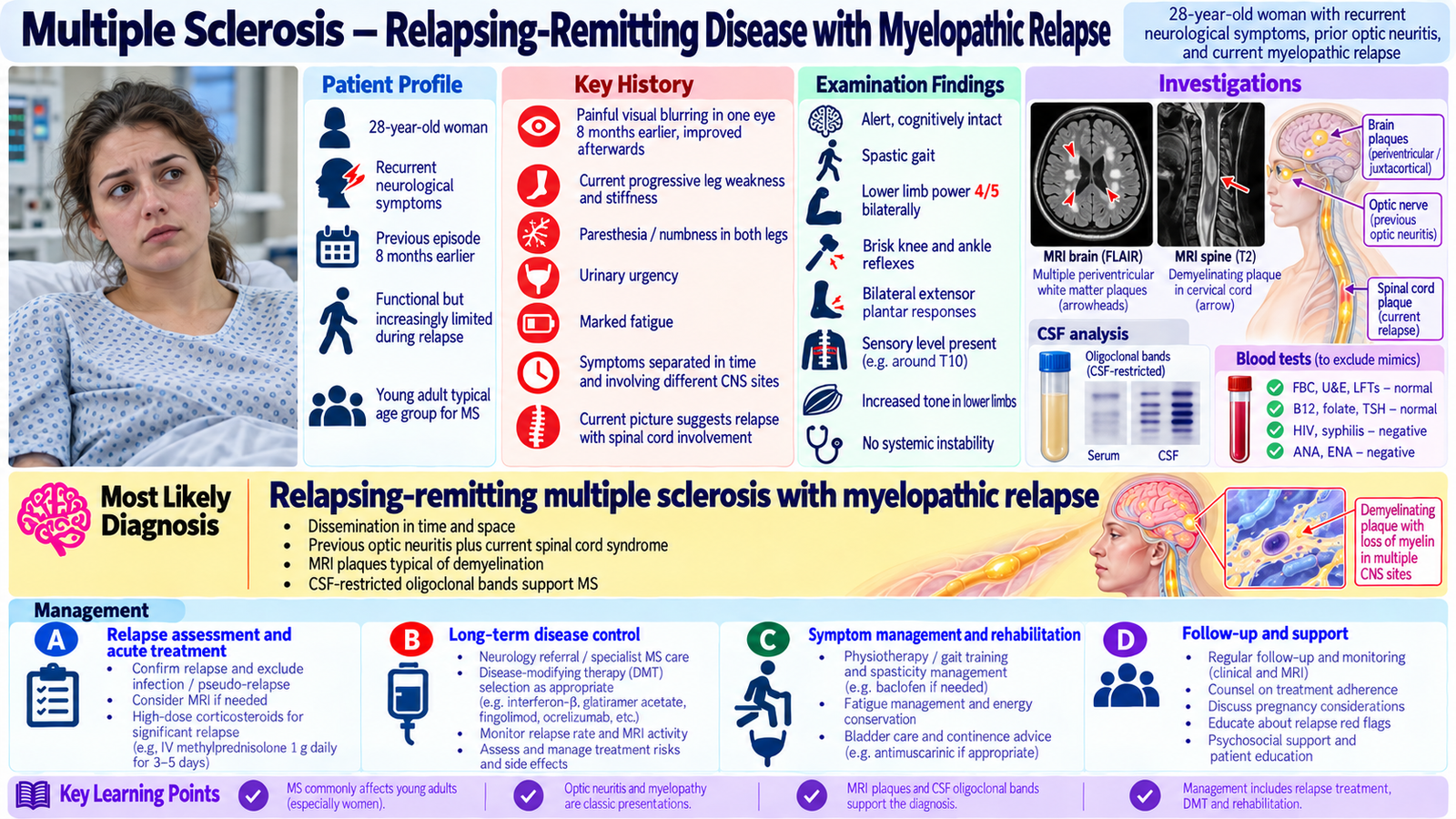
Multiple Sclerosis — A Young Adult with Recurrent Neurological Symptoms
Neuroscience Module | Related AIM Topic 9: Lower Limb Weakness, Multiple Sclerosis & Syringomyelia
From focused history and neurological localization to investigation, management, rehabilitation and long-term counselling.
2. Patient Scenario
A 28-year-old woman presents to the medical outpatient department with weakness and stiffness of both legs for the past 10 days, associated with difficulty walking. She recalls a previous episode of blurred vision in one eye that improved several months earlier. She has been referred for a detailed neurological assessment.
Clinical approach: Do not announce the diagnosis at the start. Clarify the chronology of neurological episodes and localize the deficits first.
3. Student Task
As a Final Year MBBS student, you should:
- Take a focused history of recurrent neurological symptoms and their effect on daily life.
- Perform and interpret an appropriate neurological examination, especially of the lower limbs.
- Localize the neurological dysfunction and construct a clinical problem representation.
- Formulate and prioritize differential diagnoses for lower limb weakness.
- Select and interpret investigations for suspected demyelinating disease.
- Discuss acute treatment, long-term management, rehabilitation and patient counselling.
4. Relevant History
Presenting illness and clinical significance
- Current episode: Gradually increasing bilateral leg stiffness, heaviness and difficulty climbing stairs over 10 days; symptoms persist throughout the day. Significance: Suggests a central neurological process rather than brief transient weakness.
- Sensory complaints: Tingling and reduced sensation in both legs with a band-like sensation around the lower trunk. Significance: Raises suspicion of a spinal cord lesion.
- Bladder symptoms: New urinary urgency without dysuria or fever. Significance: May indicate involvement of central pathways controlling bladder function.
- Previous visual episode: Eight months ago, she developed painful blurring of vision in the right eye over two days; it improved gradually over three weeks. Significance: Suggestive of a previous optic neuritis episode at a different anatomical site.
- Between episodes: She returned close to her normal activities after the visual problem. Significance: A history of separate episodes with recovery supports a relapsing clinical pattern.
- Fatigue and function: Fatigue becomes more troublesome with heat; she now needs support on stairs and has missed work. Significance: Establishes functional burden and rehabilitation needs; heat sensitivity alone is not proof of a new relapse.
Relevant negative history and possible mimics
- No fever, recent systemic illness or painful urination: look for infection that might worsen pre-existing neurological symptoms.
- No significant back trauma, severe back pain or rapidly progressive sphincter loss: makes some compressive causes less likely, but does not exclude them.
- No progressive symptoms starting in early childhood, family history of similar progressive weakness or consistent peripheral sensory loss: reduces suspicion of some hereditary or peripheral nerve disorders.
- No known vitamin B12 deficiency or relevant nutritional restriction: important because metabolic myelopathy can mimic demyelinating disease.
Past, drug, family and social history
She has not previously received disease-modifying treatment. Ask about earlier unnoticed episodes of diplopia, imbalance, numbness or weakness; previous MRI or neurological consultations; medications and supplements; family history; smoking; occupation; living arrangements; mobility and falls; mood; support systems; and pregnancy intentions. These details influence diagnosis, treatment choice, safety and follow-up.
5. Physical Examination
Examine respectfully with consent, appropriate exposure and support during standing or walking. The following are representative findings in this patient.
| Area | Expected finding | Clinical interpretation |
|---|---|---|
| General and vitals | Alert, afebrile, stable; no systemic illness | No immediate evidence of infection or physiological instability |
| Gait | Slow, stiff gait; difficulty with tandem walking | Pyramidal dysfunction, possibly with impaired balance |
| Lower limb tone and power | Increased tone bilaterally; power approximately 4/5, worse in hip flexion | Upper motor neuron pattern |
| Reflexes and plantar responses | Brisk knee and ankle reflexes; bilateral extensor plantar responses | Corticospinal tract involvement |
| Sensation | Reduced pinprick sensation below the lower thoracic region; mild impairment of vibration in feet | Supports a spinal cord localization |
| Cranial nerves and upper limbs | Right-sided red desaturation compared with left; upper limb strength preserved | Possible residual optic pathway involvement with separate cord deficit |
Localization: Spastic paraparesis with a sensory level and bladder urgency favors a spinal cord (myelopathic) lesion. A prior episode suggesting optic neuritis points to another CNS location. Findings are not explained by a single peripheral nerve lesion.
Assess severity: Document independent mobility, fall risk, bladder retention or incontinence and any new upper limb, brainstem or visual deficits.
6. Clinical Problem Representation
A 28-year-old woman has a 10-day episode of spastic paraparesis, lower trunk/leg sensory disturbance and urinary urgency, with upper motor neuron signs and a sensory level on examination. Eight months previously she had a self-limited episode of painful monocular visual loss. She is afebrile and has no clear history of trauma or systemic infection.
Main clinical problem: Recurrent neurological deficits affecting anatomically distinct parts of the central nervous system, currently presenting as a probable inflammatory myelopathy.
7. Differential Diagnosis
- Multiple sclerosis: Most likely because of separate episodes involving the optic pathway and spinal cord, with interval improvement. Requires investigation and exclusion of better explanations.
- Other inflammatory demyelinating disease (e.g., NMOSD): Can cause optic neuritis and myelitis; consider especially when optic nerve or cord involvement is unusually severe or extensive.
- Compressive spinal cord lesion: Explains spastic paraparesis and sensory level; the previous visual episode is not readily explained by a single spinal lesion. Cord compression must be excluded promptly.
- Vitamin B12 deficiency-related myelopathy: May produce gait impairment and posterior column signs, but the episodic optic/cord history is less typical.
- Infective or other inflammatory myelitis: May cause an acute/subacute spinal syndrome; fever, systemic features, exposures and MRI/CSF findings guide distinction.
8. Investigations and Interpretation
The aim is to detect CNS demyelination in characteristic locations, establish dissemination across time and space where applicable, and exclude important mimics. A diagnosis should never be based on MRI appearances alone without clinical correlation.
| Test | Why requested | Representative result and meaning |
|---|---|---|
| MRI brain with contrast when appropriate | Identify characteristic CNS plaques and activity | Multiple T2/FLAIR hyperintense lesions in periventricular and juxtacortical regions; some enhance while others do not. Supports lesions in typical locations and different activity stages. |
| MRI cervical/thoracic spinal cord | Localize current myelopathy and exclude compression | Short-segment focal T2 hyperintense thoracic cord lesion without compression. Supports inflammatory demyelination concordant with the clinical findings. |
| CSF analysis | Provide supportive evidence and assess alternatives when needed | CSF-restricted oligoclonal bands are detected; this supports intrathecal immune activity but is not, alone, specific for MS. |
| Visual pathway assessment | Clarify preceding visual episode | Ophthalmic assessment and, if indicated, visual evoked potentials may provide supporting evidence of prior optic pathway dysfunction. |
| Basic screening tests | Exclude common mimics/infection and inform treatment | CBC, inflammatory markers, serum B12, electrolytes and glucose guided by clinical features; urine assessment if urinary infection suspected. Results do not identify another cause. |
| Targeted alternative-diagnosis testing | Investigate atypical/severe optic neuritis or myelitis | Serum AQP4-IgG (and MOG-IgG where clinically indicated) may be requested by specialists to evaluate alternative demyelinating disorders. |
9. Final Diagnosis
Relapsing-remitting multiple sclerosis, currently presenting with a spinal cord relapse causing spastic paraparesis, sensory disturbance and bladder urgency.
The earlier probable optic neuritis, current myelopathic episode and compatible MRI/CSF findings support the diagnosis. Functional severity is reflected by impaired gait, although the patient remains clinically stable.
10. Management
A. Immediate priorities
Assess mobility, falls, bladder function and progression; check for infection or other triggers of symptom worsening. Urgently exclude spinal compression if clinical findings suggest it. Obtain neurology review; admit when weakness, mobility loss or bladder dysfunction is significant.
B. Treat a functionally significant relapse
After clinical assessment and exclusion of infection/pseudo-relapse, a short course of high-dose methylprednisolone may be used under specialist supervision to hasten recovery. Explain that steroids shorten relapse-related disability but are not a long-term cure or substitute for disease-modifying therapy. Monitor relevant adverse effects such as hyperglycemia, sleep disturbance and mood change.
C. Long-term disease control
Refer to an MS specialist team to initiate an appropriate disease-modifying therapy (DMT), selected according to disease activity, safety screening, other illnesses and pregnancy plans. DMTs reduce future relapses and new lesion activity; the selected agent requires individualized monitoring. Do not start or switch DMT without specialist assessment.
D. Symptom control and rehabilitation
- Physiotherapy: Strengthening, stretching, gait and balance work to preserve mobility and limit falls.
- Occupational therapy: Energy conservation, work/home adaptations and assistance with activities of daily living.
- Spasticity: Stretching and specialist-guided medication if needed; check that treatment does not worsen useful muscle tone or walking.
- Bladder urgency: Assess for infection and incomplete emptying; consider bladder training and specialist input.
- Fatigue, mood and sleep: Identify contributing factors, support pacing and consider psychological services where indicated.
E. Monitoring and follow-up
Document neurological function and walking ability, review relapse history and medication adherence/adverse effects, arrange periodic MRI as guided by the treating team, and reassess rehabilitation goals and social participation.
11. Complications and Red Flags
Possible complications: Recurrent relapses, persistent weakness or gait disability, spasticity and painful spasms, falls, bladder dysfunction and urinary infections, fatigue, mood problems and reduced occupational participation.
- Rapidly progressive weakness, inability to stand/walk or new severe visual loss.
- New urinary retention, severe sphincter disturbance or sensory symptoms suggesting acute cord compression.
- Fever, confusion or other evidence of serious infection with neurological deterioration.
Not every symptom fluctuation represents a relapse. Heat or infection can temporarily worsen previous deficits; new or worsening neurological symptoms lasting over 24 hours in the absence of fever/infection require assessment for a true relapse.
12. Patient Counselling and Follow-Up
- Explain the condition: MS is a chronic immune-mediated disease affecting the brain, spinal cord and optic nerves. Symptoms and recovery vary between people.
- Set realistic expectations: Treatments can reduce relapses and disability risk, while rehabilitation improves independence; long-term follow-up remains necessary even when feeling well.
- Support healthy routines: Encourage regular appropriate exercise, adequate sleep, smoking cessation if relevant, balanced nutrition, avoidance of overheating where it aggravates symptoms and pacing for fatigue.
- Discuss medication safety: Do not stop DMT without medical advice; attend scheduled blood tests, imaging and clinic visits. Report suspected drug adverse effects promptly.
- Safety and function: Discuss safe mobility, fall prevention, work adjustments, coping strategies and mental health support.
- Pregnancy planning: Ask proactively about pregnancy intentions because some DMTs need adjustment before conception; coordinate with neurology and obstetric services.
- Family involvement: With the patient’s permission, involve trusted family members in understanding support needs while respecting privacy and autonomy.
- When to return: Seek assessment for new persistent weakness, sensory loss, visual changes or worsening bladder function.
13. Long Case Presentation to the Examiner
“I examined a 28-year-old woman presenting with 10 days of progressive bilateral lower limb weakness and stiffness, sensory disturbance and urinary urgency. Eight months earlier, she had an episode of painful right monocular visual loss that improved over several weeks. On examination, she is afebrile and alert, with spastic paraparesis, exaggerated lower limb reflexes, extensor plantar responses, a lower thoracic sensory level and mild residual right optic pathway dysfunction.”
“These findings suggest a current spinal cord lesion with a previous anatomically separate optic pathway episode. My leading diagnosis is relapsing-remitting multiple sclerosis, while important alternatives include another inflammatory demyelinating disorder and spinal cord compression. I would arrange MRI of the brain and spinal cord, perform relevant screening tests, consider CSF assessment and involve neurology for relapse management, disease-modifying treatment and rehabilitation.”
14. Examiner Discussion / Viva Preparation
Q1. Which examination findings indicate an upper motor neuron lesion?
Increased tone, brisk deep tendon reflexes, extensor plantar responses and spastic gait.
Q2. Where would you localize the current lesion?
To the spinal cord because of bilateral pyramidal weakness, a sensory level and bladder symptoms.
Q3. What makes multiple sclerosis more likely than a single compressive lesion?
Two separate neurological episodes involving different CNS regions: previous likely optic neuritis and current myelopathy. Imaging must still exclude compression.
Q4. What MRI findings support multiple sclerosis?
Characteristic focal demyelinating lesions in typical CNS locations, such as periventricular, juxtacortical and spinal cord regions; enhancing and non-enhancing lesions may indicate different stages of activity.
Q5. What is the clinical significance of CSF oligoclonal bands?
They support intrathecal immune activity and can contribute to diagnostic assessment, but are not specific to MS on their own.
Q6. How would you treat her current disabling episode?
First assess for infection or other mimics, then consider a short course of high-dose methylprednisolone under specialist supervision, plus mobility and symptom support.
Q7. What is the difference between relapse treatment and disease-modifying therapy?
Corticosteroids mainly hasten recovery from an acute relapse; DMT is intended to reduce future relapses and disease activity.
Q8. Which counselling advice is especially relevant for long-term follow-up?
Medication adherence, recognition of new persistent neurological symptoms, exercise and fatigue management, fall prevention, scheduled follow-up and pregnancy planning where appropriate.
15. AIM Long Case — High-Yield Review
- Ask about separate neurological attacks and recovery between them.
- Painful monocular visual loss may indicate optic neuritis.
- Spastic paraparesis, brisk reflexes and extensor plantar responses imply UMN dysfunction.
- A sensory level with bladder symptoms supports spinal cord localization.
- Consider MS when deficits involve different CNS sites at different times.
- MRI brain and spinal cord provides essential anatomical evidence and excludes compression.
- CSF-restricted oligoclonal bands are supportive, not individually diagnostic.
- Exclude important mimics, especially compression and alternative inflammatory disease.
- Assess infection/pseudo-relapse before treating a suspected relapse.
- Steroids may hasten recovery from a disabling relapse; DMT targets future disease activity.
- Rehabilitation and bladder, fatigue, mood and mobility care matter alongside medication.
- Examination pitfall: do not label all lower limb weakness as MS without localization and differential diagnosis.