
Anxiety and Depression in Primary Care — An Adult with Persistent Low Mood and Worry
Neuroscience Module | Related AIM Topic 2: Psychiatric, Behavioral & Substance Use Disorders
A patient-centred primary-care consultation: history, screening, safety, clinical formulation, management, referral and follow-up.
2. Patient Scenario
A 32-year-old married schoolteacher attends a family medicine clinic because of persistent tiredness, poor sleep, frequent worry and reduced interest in daily activities for approximately eight weeks. Her symptoms are affecting her work and relationships. She asks whether something serious is wrong with her health.
At first contact: Invite her account without labelling the diagnosis. Offer privacy and explain confidentiality and its safety limits.
3. Student Task
The student should:
- Establish a therapeutic rapport and obtain a focused psychiatric, medical and psychosocial history.
- Assess depressive and anxiety symptoms, their duration, severity and functional impact.
- Conduct a direct, sensitive risk assessment for suicide, self-harm, abuse, psychosis and mania.
- Perform focused general and mental state examinations.
- Use screening tools appropriately and formulate a prioritized differential.
- Plan selective investigations, initial primary-care treatment, referral and safety-netting.
- Present the case concisely and agree a practical follow-up plan with the patient.
4. Relevant History
History obtained: She describes almost daily low mood, loss of enjoyment in teaching and family activities, early waking, reduced appetite, impaired concentration, low energy and feelings of worthlessness for eight weeks. She worries excessively about finances and her family, finds it difficult to control the worry, and experiences muscle tension and restlessness. Symptoms worsen after workplace stress and reduced sleep.
| History clue | Patient finding | Clinical significance |
|---|---|---|
| Mood and pleasure | Low mood and anhedonia most days for eight weeks | Supports a depressive episode rather than a brief response to stress. |
| Biological and cognitive symptoms | Early waking, low energy, reduced appetite, impaired concentration, guilt | Contribute to syndrome severity and work impairment. |
| Anxiety symptoms | Persistent difficult-to-control worry, restlessness and muscle tension | Establishes clinically significant anxiety; eight weeks is insufficient to diagnose DSM-style generalized anxiety disorder requiring six months. |
| Function | Missed classes and withdrawn from usual activities; still independently self-caring | Significant functional impairment informs severity and treatment choice. |
| Suicide and self-harm | Feels hopeless at times but denies thoughts of death, self-harm, plan or intent; no previous attempts | Immediate risk is not identified on current assessment, but risk can change and must be reviewed. |
| Mania / hypomania / psychosis | No past periods of elevated or irritable mood with reduced need for sleep and increased energy; no hallucinations or fixed delusions | Helps distinguish bipolar or psychotic disorders before prescribing antidepressants. |
| Stressors and supports | Financial worries, heavy workload; supportive spouse | Identifies triggers, protective factors and collaborative management opportunities. |
| Substance / medicine / physical illness | No alcohol or recreational drug use; no stimulants or corticosteroids; no known thyroid disease | Checks for substance-, medication- or illness-related symptoms. |
| Previous psychiatric / family history | No prior psychiatric admission; a first-degree relative previously treated for depression | Adds vulnerability context without establishing diagnosis. |
Consultation approach: Explore trauma, domestic violence, reproductive or pregnancy considerations and culturally relevant concerns privately when appropriate; ask permission before involving family. Clarify duration and details rather than treating screening results as a diagnosis.
5. Physical Examination
Focused general examination: Alert, cooperative and appropriately dressed. BP 118/76 mmHg, pulse 84/min, temperature 36.8°C; no tremor, goitre, pallor or focal neurological abnormality. These normal findings do not exclude medical causes but reduce suspicion of an acute systemic illness.
Mental state examination:
- Appearance and behaviour: Tired appearance, reduced spontaneous activity, appropriate eye contact; cooperative.
- Speech: Soft and slightly slowed but coherent.
- Mood and affect: Subjectively “sad and worried”; constricted but reactive affect.
- Thought: Ruminations about work and family, self-critical ideas; no delusions or formal thought disorder.
- Perception: No hallucinations reported.
- Cognition: Fully oriented; attention mildly reduced in conversation.
- Insight and judgment: Recognizes symptoms are impairing her life; willing to consider help.
Interpretation: The examination supports an affective disorder without evident psychosis, delirium or immediate behavioural disturbance. The mental state assessment complements, rather than replaces, direct safety questions.
6. Clinical Problem Representation
A 32-year-old schoolteacher has eight weeks of persistent low mood and anhedonia with sleep, appetite, concentration and energy changes, excessive worry and significant occupational impairment. She has no elicited history of mania or psychosis and denies current suicidal thoughts, plan or intent. Her presentation is most consistent with a clinically significant depressive episode accompanied by anxiety symptoms.
Main clinical problem: Depressive symptoms with anxious distress affecting daily function in a primary-care setting, requiring structured risk assessment and stepped, collaborative management.
7. Differential Diagnosis
| Differential | Why considered | Feature against / distinction |
|---|---|---|
| Major depressive episode with prominent anxiety symptoms | Low mood, loss of interest, biological symptoms and functional deterioration for over two weeks | Best explains the dominant clinical picture; confirm diagnostic criteria and rule out bipolar disorder. |
| Adjustment disorder with mixed anxiety and depressed mood | Symptoms are temporally associated with occupational and financial stressors | The prominent depressive syndrome may meet criteria for a depressive episode rather than adjustment disorder. |
| Generalized anxiety disorder | Persistent worry, restlessness, tension and poor sleep | Only eight weeks reported; formal GAD duration criteria may not yet be met. |
| Bipolar depressive episode | Depressive symptoms may be the first recognized presentation of bipolar disorder | No reported past mania/hypomania, but carefully screen before antidepressant initiation. |
| Medical / medication-related mood symptoms | Thyroid disease, anemia, substances and certain drugs may produce overlapping symptoms | Current history and examination do not strongly suggest these; targeted tests are guided by context. |
8. Investigations and Interpretation
Clinical diagnosis is primarily based on interview and assessment. Laboratory tests are targeted to plausible physical contributors and are not routine diagnostic tests for depression.
| Assessment / test | Why requested | Representative result → meaning |
|---|---|---|
| PHQ-9 | Quantify depressive symptom burden and track response | Score 16/27 → moderately severe depressive symptom range, requiring clinical correlation, impairment assessment and item-9 safety follow-up. |
| GAD-7 | Describe anxiety symptom burden and monitor change | Score 13/21 → moderate anxiety symptom range, not by itself a diagnosis of generalized anxiety disorder. |
| Direct suicide-risk interview | Determine thoughts, plans, intent, access to means, past attempts and protective factors | No current ideation, plan or intent reported; document individual formulation, not a score-based “low-risk” label. |
| Focused screening for bipolar disorder / psychosis | Identify features altering treatment and referral priorities | No convincing mania/hypomania or psychotic symptoms elicited; ask again if new signs appear. |
| CBC, if clinically indicated | Look for anemia if fatigue, menstrual history or examination warrants | Hemoglobin 12.8 g/dL → significant anemia less likely. |
| TSH, if clinically indicated | Evaluate thyroid disease if clinical features suggest it | TSH within local reference interval → thyroid dysfunction less likely. |
| Additional tests only when indicated | Pregnancy testing, metabolic studies or medication/substance evaluation based on history | No blanket psychiatric laboratory panel is necessary in an otherwise uncomplicated presentation. |
Interpretation principle: PHQ-9 and GAD-7 are screening/severity tools; they supplement but never replace the diagnostic interview, assessment of function or direct questioning about suicide and psychosis.
9. Final Diagnosis
Most likely diagnosis: A current major depressive episode of clinically significant severity, with prominent coexisting anxiety symptoms, presenting in primary care.
Current clinical formulation: No evidence elicited of psychosis or mania and no current suicidal ideation, plan or intent; occupational impairment is substantial. Definitive severity and formal coding depend on full clinical assessment. A separate generalized anxiety disorder diagnosis should not be assumed from eight weeks of worry.
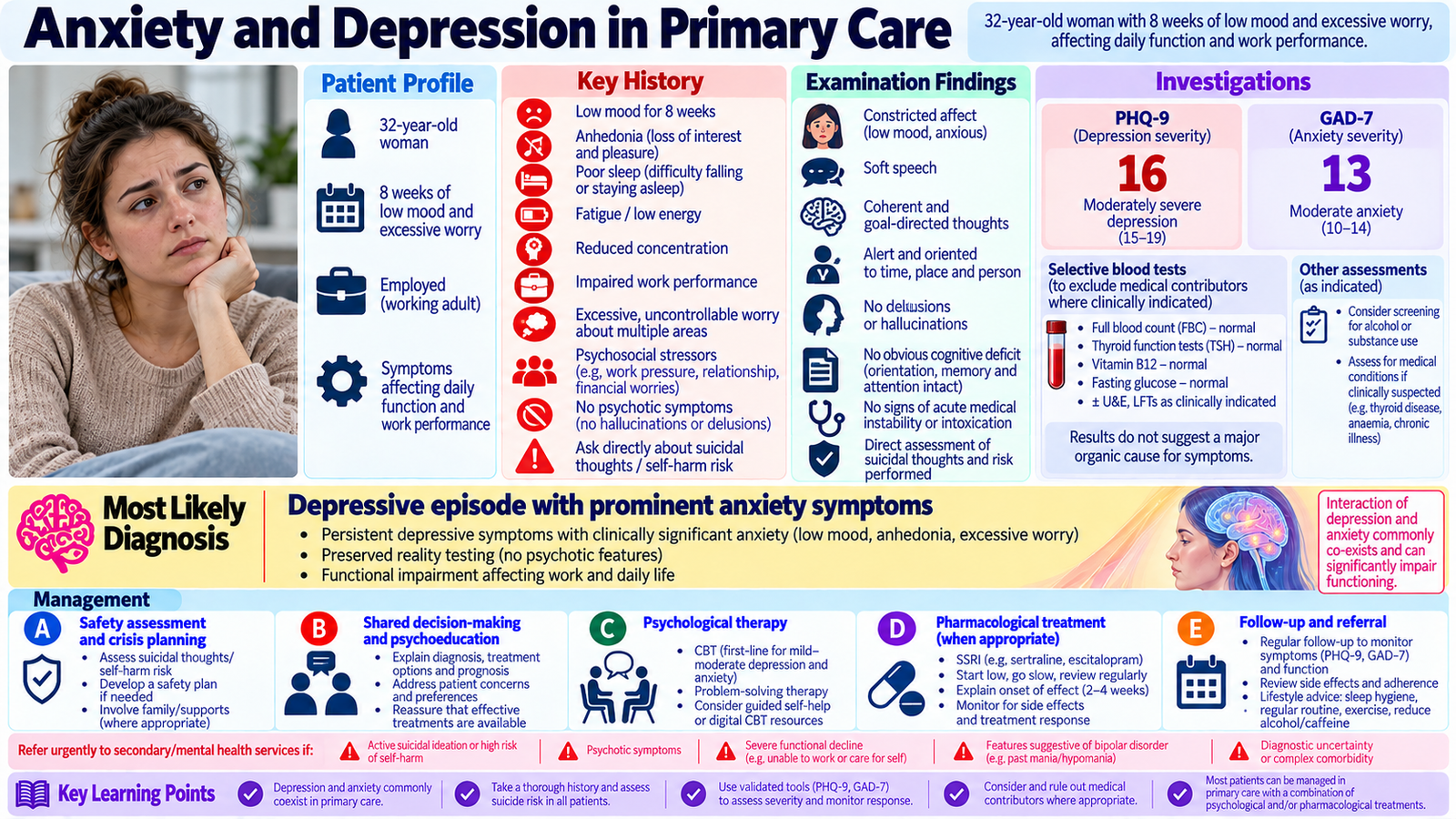
10. Management
A. Immediate priorities and safety
- Establish privacy and rapport; confirm whether there is current suicidal ideation, intent, planning, past attempts, inability to self-care, abuse or severe psychotic symptoms.
- For imminent suicide risk or severe deterioration, arrange urgent same-day emergency/mental health assessment and a safe supervised transfer.
- Identify patient priorities, work difficulties, financial stressors and available support.
B. Collaborative first-line care in primary care
- Explain the working diagnosis using non-stigmatizing language and address fears about physical illness.
- Offer evidence-based talking therapy, such as cognitive behavioural therapy (CBT), behavioural activation or structured psychological intervention.
- Because symptoms are persistent with substantial impairment, discuss antidepressant medication alongside psychotherapy through shared decision-making; an SSRI is a common first-line medicine when appropriate.
- Before prescribing: review past mania/hypomania, pregnancy plans, other medicines, medical conditions, possible interactions and patient preference.
- Agree achievable sleep routines, graded activity, supportive social contact and manageable daily goals; these support but do not replace indicated treatment.
C. Monitoring and follow-up
- Review relatively soon after treatment initiation—earlier when age, clinical risk, tolerability or deterioration warrants—to reassess safety, adherence and adverse effects.
- Explain that improvement from antidepressants may take several weeks; monitor for early agitation, worsening mood or emerging suicidal thoughts, particularly after starting or changing treatment.
- Review symptom and functional change using clinical interview and, if useful, repeat PHQ-9/GAD-7; reassess diagnosis if improvement is inadequate.
- Continue effective treatment for an appropriate continuation period after remission and plan gradual discontinuation with a clinician when suitable.
D. Referral and escalation
- Refer urgently for suicide risk requiring emergency care, psychosis, mania, severe self-neglect or inability to remain safe.
- Seek specialist review for suspected bipolar disorder, diagnostic uncertainty, recurrent or severe illness, poor response to adequate initial treatment or complex comorbidity.
Why this matters: Primary care can safely manage many depressive and anxiety presentations when risk is assessed, the treatment choice is individualized and follow-up is reliable.
11. Complications and Red Flags
Possible consequences: Persistent occupational and relationship dysfunction, social withdrawal, sleep disturbance, reduced self-care, substance misuse and recurrence of illness.
⚠️ Urgent safety concerns
- Current suicidal intent, plan, preparatory acts or inability to agree a safe immediate plan.
- Psychotic depression, command hallucinations or severe agitation.
- New manic symptoms, marked disinhibition or reduced need for sleep with increased energy.
- Severe self-neglect, inability to eat or drink, or major functional collapse.
- Abuse or threat from others requiring immediate safeguarding action.
Act on clinical findings; do not rely on questionnaire cutoffs to decide safety or discharge.
12. Patient Counselling and Follow-Up
Discuss the diagnosis in a respectful, understandable way and invite questions about stigma, medication dependence, work and family responsibilities.
- Explanation: Depression is a treatable clinical condition; worry and physical symptoms may accompany it. Recovery and relapse risk vary.
- Treatment choice: Explain options, expected benefit, common early adverse effects of SSRIs, the importance of adherence and why treatment should not be stopped abruptly.
- Practical supports: Agree sleep and activity routines, problem-solving around work pressures and involvement of a trusted relative only with patient consent unless safety requires otherwise.
- Safety plan: Identify warning signs, trusted contacts and where to obtain urgent help if suicidal thoughts or major deterioration arise.
- Follow-up: Book and document a specific review, with earlier contact for worsening symptoms or medication concerns; monitor function as well as scores.
Communication principle: Validate suffering without promising instant recovery or dismissing symptoms as “just stress.”
13. Long Case Presentation
“I assessed a 32-year-old schoolteacher presenting with an eight-week history of pervasive low mood, loss of enjoyment, poor sleep, reduced appetite, impaired concentration and fatigue, accompanied by excessive worry, restlessness and muscle tension. The symptoms have significantly affected her occupational and social functioning. Workplace and financial stressors are present, with family support available.”
“On mental state examination, she appeared tired with constricted affect and coherent, self-critical thinking. She was oriented, had no elicited psychotic features and reported no previous manic episodes. She denied current suicidal thoughts, intent or plan, though safety requires ongoing review. My working diagnosis is a depressive episode with prominent anxiety symptoms. I would use symptom scales to establish a baseline, consider targeted medical investigations, agree psychotherapy and possible SSRI treatment according to preference and clinical assessment, and arrange planned follow-up with appropriate safety-netting.”
14. Examiner Discussion / Viva Preparation
Q1. 1. Which features support a depressive episode?
Persistent low mood and anhedonia together with sleep, appetite, concentration and energy changes for over two weeks, producing significant impairment.
Q2. 2. Why is a GAD diagnosis not automatic in this case?
Clinically important worry has been present for eight weeks; the usual diagnostic duration criterion for generalized anxiety disorder is at least six months.
Q3. 3. Why ask about mania before starting an antidepressant?
Unrecognized bipolar disorder can change management and carries risk of mood switching with antidepressant treatment.
Q4. 4. Are PHQ-9 and GAD-7 diagnostic tests?
No. They estimate symptom burden and assist monitoring; diagnosis requires a clinical interview and functional assessment.
Q5. 5. What are the essential components of a suicide risk assessment?
Ask directly about suicidal thoughts, intent, plans, means, previous attempts, acute stressors, protective factors and ability to remain safe; reassess as circumstances change.
Q6. 6. When should this patient be referred urgently?
With imminent suicide risk, severe self-neglect, mania, psychosis or marked inability to maintain safety.
Q7. 7. What are appropriate first-line treatments?
Evidence-based psychotherapy and, when indicated after shared decision-making, an antidepressant such as an SSRI, with monitoring and follow-up.
Q8. 8. Why is follow-up important after starting treatment?
To review safety, tolerability, adherence, symptom and functional response and revise the plan if deterioration or inadequate improvement occurs.
15. AIM Long Case — High-Yield Review
- Explore low mood, anhedonia, duration, associated symptoms and functional impairment systematically.
- Excessive worry may coexist with depression; do not equate a positive GAD-7 with formal GAD.
- Ask directly about suicide, past self-harm, intent, planning and protective factors.
- Screen for mania/hypomania and psychosis before deciding on routine primary-care treatment.
- A focused mental state examination interprets appearance, speech, mood, thought, perception, cognition and insight.
- PHQ-9 and GAD-7 help quantify symptoms but do not independently establish diagnoses.
- Rule out plausible medical or medication-related contributors using selective assessment and tests.
- Psychotherapy and shared-decision antidepressant treatment are important options for clinically significant depression.
- Do not use antidepressants without considering bipolar history, safety and follow-up.
- Urgent referral is indicated for imminent risk, mania, psychosis or profound self-neglect.
- Monitor function and safety, not symptom scores alone.
- A safe long case ends with patient-centred counselling, written safety advice and an agreed review plan.