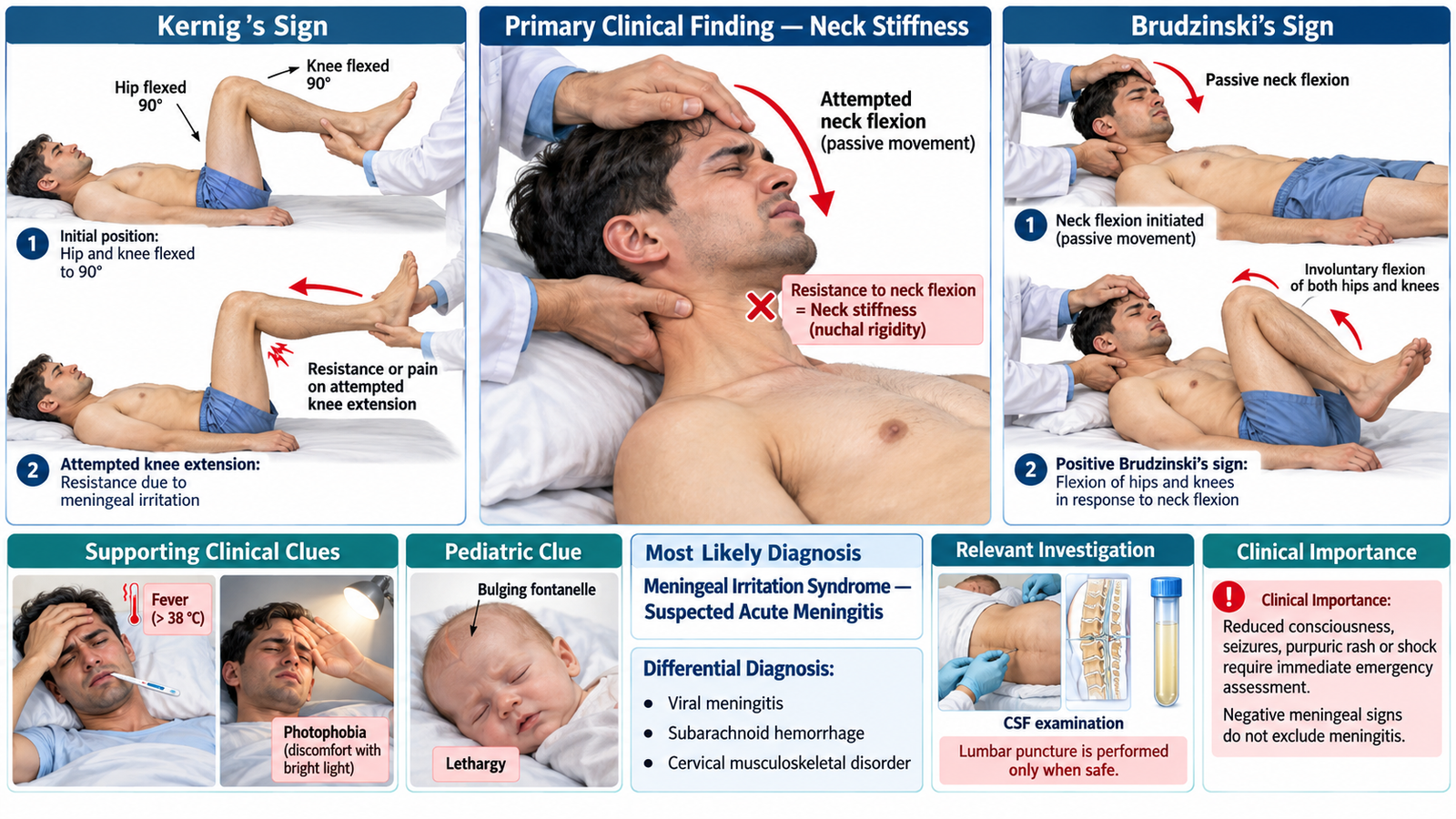
Meningeal Irritation — Clinical Signs
Neuroscience Module | Medicine & Pediatrics
Focused bedside assessment of neck stiffness, Kernig’s sign, Brudzinski’s sign and neurological warning signs in a patient with suspected meningitis.
1. Patient / Clinical Setting
A 22-year-old male university student is admitted to the emergency department with fever, severe headache and repeated vomiting for the previous 24 hours. He reports neck pain and difficulty bending his head forward.
Clinical setting: The patient is conscious, cooperative and currently hemodynamically stable. A focused examination is requested to identify evidence of meningeal irritation and assess important neurological warning signs.
2. Student Task
Examine this patient for clinical evidence of meningeal irritation. Demonstrate and interpret the relevant meningeal signs, identify neurological warning signs and present your findings and clinical impression to the examiner.
3. Focused Examination Approach
Introduce yourself, obtain consent and explain the examination. Ensure the patient is comfortable and avoid forceful neck movements. Assess consciousness and clinical stability before attempting provocative meningeal tests.
A. Initial Observation and General Assessment
- General appearance: Observe whether the patient looks acutely ill, uncomfortable or unusually drowsy.
- Vital signs: Assess temperature, pulse, blood pressure, respiratory rate and oxygen saturation.
- Consciousness: Assess orientation, responsiveness and Glasgow Coma Scale (GCS) where appropriate.
- Photophobia: Ask whether bright light worsens headache or causes discomfort.
- Skin examination: Look for petechiae, purpura or a non-blanching rash that may suggest meningococcal infection.
Clinical importance: Fever, headache and neck stiffness raise suspicion of meningitis. Altered consciousness or a non-blanching rash may indicate severe infection requiring immediate escalation.
B. Examination for Neck Stiffness
- Position the patient comfortably in the supine position.
- Support the head gently with both hands.
- Assess passive flexion of the neck by carefully bringing the chin toward the chest.
- Observe resistance, discomfort or limitation during forward flexion.
- Stop if the movement causes significant pain or the patient resists.
Positive finding: Involuntary resistance or marked limitation of passive neck flexion due to meningeal irritation.
Interpretation: Neck stiffness supports meningeal irritation but is not specific for meningitis. Cervical musculoskeletal disorders and other causes of neck pain must be considered.
C. Kernig’s Sign
Examination technique:
- Keep the patient lying supine.
- Flex one hip and knee to approximately 90 degrees.
- Maintain the hip in flexion while gently attempting to extend the knee.
- Observe for pain or resistance during knee extension.
- Compare the response on both sides if tolerated.
Positive Kernig’s sign: Pain or resistance that limits knee extension while the hip remains flexed.
Interpretation: Stretching inflamed meninges or related neural structures may produce discomfort and reflex resistance.
Important distinction: Hamstring tightness, sciatica or musculoskeletal pathology may also limit knee extension. Interpret the sign in the clinical context.
D. Brudzinski’s Sign
Examination technique:
- Position the patient supine with both lower limbs initially relaxed.
- Gently flex the patient’s neck forward.
- Observe both hips and knees during the movement.
- Stop the maneuver if the patient develops marked discomfort.
Positive Brudzinski’s sign: Involuntary flexion of the hips and knees during passive neck flexion.
Interpretation: This response is consistent with meningeal irritation, although it is not sufficiently sensitive to exclude meningitis when absent.
E. Focused Neurological Examination
Assess important neurological functions to detect complications or alternative diagnoses.
- Consciousness: Reassess alertness, orientation and GCS.
- Pupils: Examine size, symmetry and reaction to light.
- Cranial nerves: Look for obvious ocular movement abnormalities or cranial nerve palsies.
- Motor system: Assess gross limb movement, power and symmetry.
- Focal neurological deficits: Look for unilateral weakness or other lateralizing signs.
- Seizures: Identify any observed or recently reported seizure activity.
Interpretation: Altered consciousness, seizures or focal neurological deficits suggest complicated CNS infection or an alternative intracranial disorder and require urgent evaluation.
F. Recognition of Meningitis in Children
Classical meningeal signs may be absent or difficult to demonstrate in infants and young children.
- Infants: Look for poor feeding, lethargy, irritability, abnormal temperature, seizures or a bulging fontanelle.
- Young children: Assess fever, vomiting, altered behavior, reduced activity and neck discomfort.
- Older children: Headache, photophobia and neck stiffness may become more recognizable.
Clinical importance: A child with suspected meningitis requires age-appropriate assessment. The absence of Kernig’s or Brudzinski’s sign does not exclude serious CNS infection.
G. Examination Safety
- Avoid forceful neck flexion in patients with severe pain, suspected cervical injury or unstable neurological status.
- Do not repeatedly provoke meningeal signs when clinical suspicion is already high.
- Prioritize urgent medical assessment in patients with shock, reduced consciousness, seizures or rapidly deteriorating neurological findings.
4. Important Clinical Findings
Positive Findings
| Clinical Finding | Clinical Interpretation |
|---|---|
| Temperature 39°C | Supports an acute febrile illness, including possible CNS infection. |
| Marked resistance to passive neck flexion | Demonstrates nuchal rigidity. |
| Pain and resistance during knee extension with the hip flexed | Positive Kernig’s sign, supporting meningeal irritation. |
| Involuntary hip and knee flexion during neck flexion | Positive Brudzinski’s sign. |
| Photophobia and severe headache | Additional clinical features supporting meningeal irritation. |
Important Relevant Negative Findings
- GCS 15/15: No current impairment of consciousness.
- No focal limb weakness: No obvious focal motor deficit on examination.
- No observed seizure activity: No seizure during the current assessment.
- No petechial or purpuric rash: No visible non-blanching skin lesions, although meningococcal infection remains possible.
- No obvious cranial nerve palsy: No cranial nerve abnormality identified on the focused examination.
Normal consciousness and absence of focal signs do not establish that meningitis is uncomplicated or exclude serious intracranial disease.
5. Presentation of Findings
“I examined a 22-year-old gentleman presenting with fever, severe headache and vomiting. He is conscious, oriented and has a GCS of 15/15. Examination demonstrates marked neck stiffness with positive Kernig’s and Brudzinski’s signs. Photophobia is present. There are no obvious focal neurological deficits, seizures or non-blanching skin lesions on examination. These findings are consistent with a meningeal irritation syndrome, and acute meningitis is my leading clinical suspicion. Urgent investigation and medical management are required.”
6. Most Likely Diagnosis
Meningeal Irritation Syndrome — Suspected Acute Meningitis
The combination of fever, severe headache, neck stiffness and supportive meningeal signs raises strong clinical suspicion of acute meningitis. Bacterial meningitis is an urgent possibility that must be considered, but the examination alone cannot distinguish bacterial, viral or other causes. CSF assessment and relevant microbiological investigations are needed when safe and appropriate.
7. Differential Diagnosis
| Important Differential | Distinguishing Clinical Clue |
|---|---|
| Viral meningitis | May produce the same meningeal signs; patients are often less systemically ill, but CSF testing is needed for differentiation. |
| Subarachnoid hemorrhage | Sudden thunderclap headache, often reaching maximum intensity within seconds to minutes, with possible neck stiffness. |
| Cervical musculoskeletal disorder | Localized neck pain and painful movement without the characteristic systemic features of meningitis. |
8. Relevant Investigations
Investigations should confirm meningitis, identify its cause and recognize complications without delaying urgent treatment.
- Lumbar puncture with CSF analysis: When safe, assess opening pressure where appropriate, cell count and differential, glucose with paired blood glucose, protein, Gram stain, culture and relevant molecular testing. Bacterial meningitis commonly causes neutrophilic pleocytosis, increased protein and reduced CSF glucose.
- Blood cultures: Obtain promptly, preferably before antimicrobial therapy if this does not delay treatment; they may identify the causative organism.
- Complete blood count and inflammatory markers: May support evidence of systemic inflammation but cannot independently confirm or exclude meningitis.
- CT brain before lumbar puncture, when indicated: Consider when there are focal neurological signs, markedly impaired consciousness or other features raising concern about intracranial complications. CT is not routinely required before every lumbar puncture.
9. Management Discussion
- Arrange immediate medical assessment and hospital-based care for suspected acute meningitis.
- Obtain appropriate cultures and CSF studies promptly when safe, without delaying treatment.
- Initiate urgent empiric intravenous antibiotics for suspected bacterial meningitis, following local protocols; administer adjunctive corticosteroids when indicated.
- Provide supportive care, including appropriate fluids, fever control and monitoring of consciousness and vital signs.
- Apply appropriate infection-control precautions and assess the need for public health notification and close-contact prophylaxis if meningococcal disease is suspected.
10. Red Flags / Serious Complications
- Reduced consciousness or rapidly falling GCS.
- Seizures or new focal neurological deficits.
- Non-blanching purpuric rash or signs of septic shock.
- Severe deterioration with features suggesting raised intracranial pressure.
- In infants, bulging fontanelle, marked lethargy or poor responsiveness.
Any neurological deterioration, shock or suspected bacterial meningitis requires immediate emergency escalation.
11. Examiner Viva Preparation
Q1. What is nuchal rigidity?
Answer: Involuntary resistance to passive neck flexion due to irritation of the meninges or related structures. It is an important but nonspecific clinical sign.
Q2. How do you demonstrate Kernig’s sign?
Answer: With the patient supine, flex the hip and knee to approximately 90 degrees, then gently extend the knee while keeping the hip flexed. Pain or resistance limiting extension constitutes a positive sign.
Q3. What is a positive Brudzinski’s sign?
Answer: Involuntary flexion of the hips and knees occurring during passive forward flexion of the patient’s neck.
Q4. Can negative Kernig’s and Brudzinski’s signs exclude meningitis?
Answer: No. Both signs have limited sensitivity. Meningitis may be present despite their absence, particularly in infants, older adults or early disease.
Q5. What are important clinical features of meningitis in infants?
Answer: Poor feeding, irritability, lethargy, abnormal temperature, seizures, reduced responsiveness and sometimes a bulging fontanelle. Classical neck stiffness may be absent.
Q6. What CSF findings typically support bacterial meningitis?
Answer: Increased white cell count with neutrophilic predominance, elevated protein and reduced CSF glucose relative to blood glucose. Microbiological testing helps identify the organism.
Q7. What is the immediate priority when bacterial meningitis is strongly suspected?
Answer: Urgent hospital assessment and prompt empiric intravenous antimicrobial treatment. Blood cultures and lumbar puncture should be obtained when appropriate but must not delay antibiotics.
12. AIM Short Case High-Yield Review
- Core examination: Assess consciousness, neck stiffness, Kernig’s sign, Brudzinski’s sign and focal neurological abnormalities.
- Neck stiffness: Resistance to passive forward flexion of the neck.
- Kernig’s sign: Pain or resistance on knee extension with the hip flexed.
- Brudzinski’s sign: Involuntary hip and knee flexion during neck flexion.
- Clinical interpretation: Positive meningeal signs support but do not confirm meningitis.
- Important limitation: Absence of meningeal signs cannot exclude meningitis.
- Pediatric clue: Infants may present with poor feeding, irritability, lethargy, seizures or a bulging fontanelle.
- Key investigation: CSF examination when clinically safe, supported by blood cultures and relevant tests.
- Critical safety: Suspected bacterial meningitis requires prompt treatment without waiting for imaging or lumbar puncture.
- Common examination mistake: Forcibly flexing the neck or relying on Kernig’s and Brudzinski’s signs alone to establish or exclude meningitis.
13. AIM Short Case Clinical Visual