
πŸ©ΈπŸ”¬ AIM OSPE/OSCE Lab β€” Blood & Immunology-II Module | 3rd Year MBBS
About Course

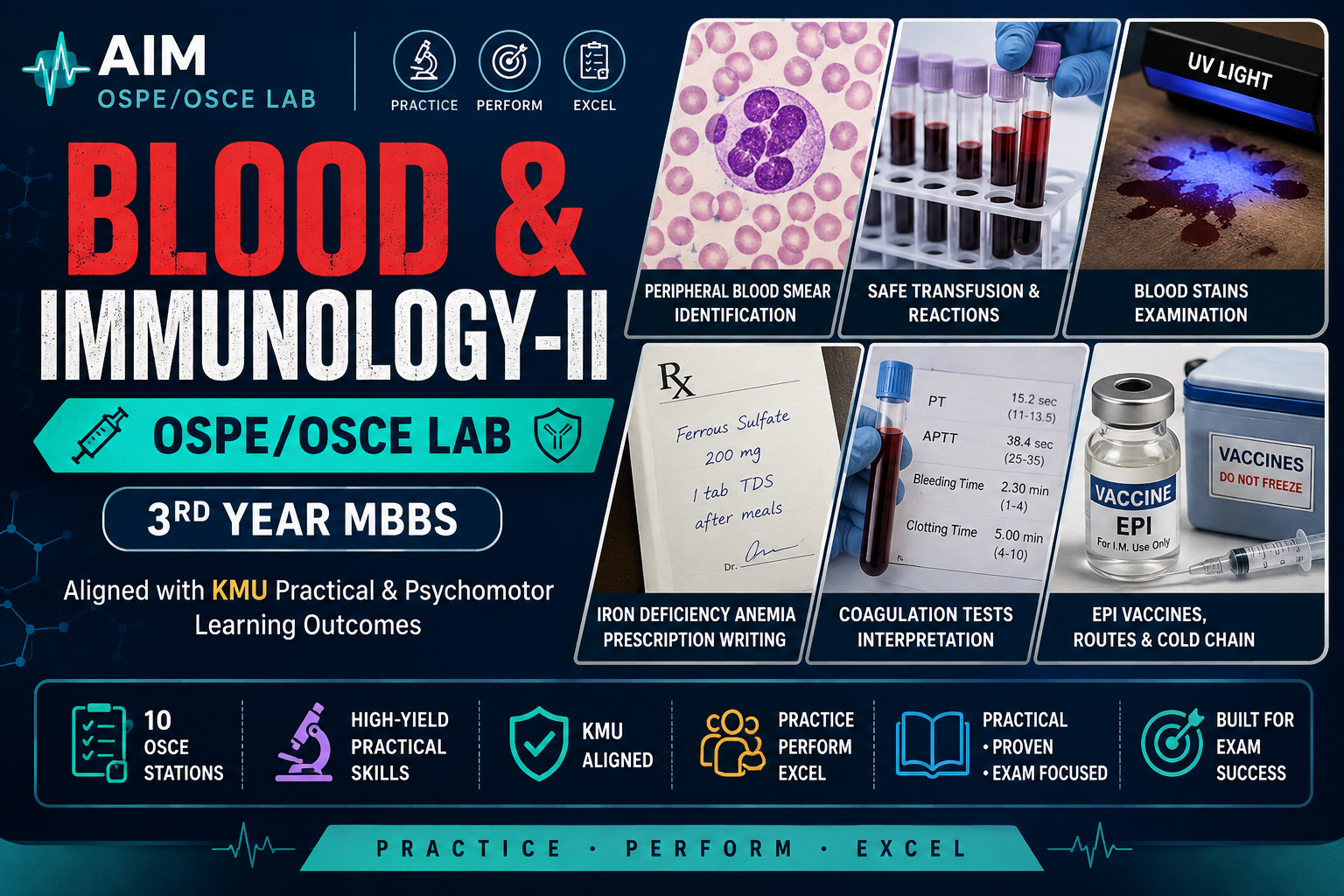
AIM Blood & Immunology-II OSPE/OSCE Lab is a practical, exam-focused course designed for 3rd Year MBBS students to master the essential Pathology, Pharmacology, Forensic Medicine, Community Medicine and transfusion-related practical skills included in the KMU Blood & Immunology-II module.

Students will practice 10 high-yield OSPE/OSCE-style stations covering normal and abnormal peripheral blood smears, RBC morphology and anemia identification, iron-deficiency anemia prescription writing, safe blood transfusion and transfusion reactions, WBC identification, forensic examination of blood and blood stains, EPI vaccination and cold-chain principles, and interpretation of coagulation testsβ€”aligned with the KMU practical and psychomotor learning outcomes.

Show More

Course Content

πŸ”¬ Station 1 β€” Identification of Normal Blood Cells on Peripheral Smear
Learning Outcomes Identify normal RBCs, WBCs and platelets on a provided peripheral blood smear/image. Differentiate the major blood-cell lineages using their morphological features.

πŸ”΄ Station 2 β€” Abnormal RBC Morphology & Identification of Anemia
Learning Outcomes Differentiate normal from abnormal red blood cells on a peripheral smear. Identify common abnormal RBC shapes. Suggest the likely type of anemia from the provided RBC morphology.

πŸ’Š Station 3 β€” Prescription Writing for Iron-Deficiency Anemia
Learning Outcomes Write an appropriate prescription for a patient at risk of developing iron-deficiency anemia. Select an appropriate iron preparation and provide clear instructions for its use.

🩸 Station 4 β€” Safe Blood Transfusion & Recognition of Transfusion Reactions
Learning Outcomes Demonstrate the essential safety checks required before blood transfusion. Identify common transfusion reactions from a supplied clinical scenario. Describe the appropriate immediate response when a transfusion reaction is suspected.

βšͺ Station 5 β€” Identification of White Blood Cells on Peripheral Smear
Learning Outcomes Identify the major types of white blood cells on a provided peripheral smear. Differentiate neutrophils, eosinophils, basophils, lymphocytes and monocytes using morphology. Recognize a smear demonstrating leukocytosis.

πŸ”¬ Station 6 β€” Microscopic Examination of Human and Animal Blood
Learning Outcomes Perform/interpret microscopic examination of provided human and animal blood specimens or images. Differentiate human from animal blood using the supplied microscopic features.

πŸ”¦ Station 7 β€” Examination of Blood Stains Under Ultraviolet Light
Learning Outcomes Demonstrate the correct approach to examination of a suspected blood stain using ultraviolet light. Recognize findings suggestive of a blood stain on the supplied material.

🩸 Station 8 β€” Identification of Blood-Stain Patterns
Learning Outcomes Identify different blood-stain patterns from supplied specimens/images. Differentiate the presented patterns on the basis of their gross appearance.

πŸ’‰ Station 9 β€” EPI Vaccination, Route & Cold-Chain Assessment
Learning Outcomes Identify vaccines included in the Pakistan EPI schedule from provided material. Identify the appropriate route of administration of selected vaccines. Demonstrate/describe correct vaccine storage and maintenance of the cold chain. Recognize important contraindications to vaccination.

πŸ§ͺ Station 10 β€” Interpretation of Coagulation Tests
Learning Outcomes Interpret PT and APTT from provided laboratory results. Interpret bleeding time and clotting time. Use the pattern of abnormalities to identify the likely defect in hemostasis.

Want to receive push notifications for all major on-site activities?

βœ•
Scroll to Top
πŸ’¬ WhatsApp Support