
AIM OSCE / OSPE • MBBS
🩸 Station 8 — Identification of Blood-Stain Patterns
Rapid Revision • Visual Recognition • Viva
🎯 Task
CANDIDATE TASK
Examine the supplied blood-stain specimens/images. Identify the demonstrated blood-stain patterns and differentiate them using their important gross visual features.
⚡ Model Station Answer
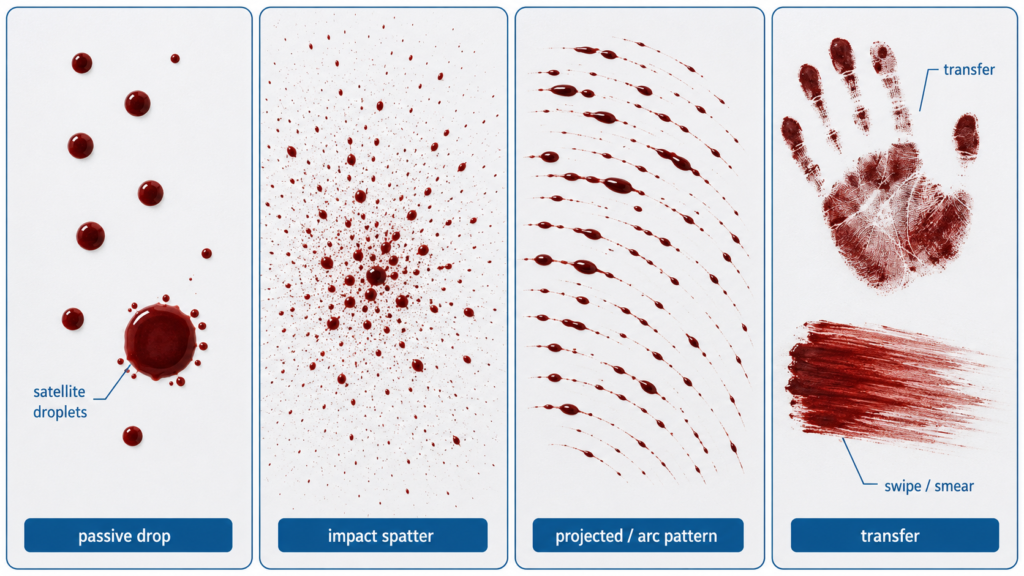
Passive drops: Usually discrete rounded stains; satellite droplets may be present.
Impact spatter: Multiple smaller droplets dispersed around an area, often with a radiating appearance.
Projected / arterial pattern: Larger stains occurring in linear, wave-like or repeated arc patterns.
Transfer pattern: Blood is deposited by contact with a blood-bearing surface, producing an impression, swipe or smear.
🔎 Stepwise Procedure / Approach
- Observe the entire stain distribution before focusing on individual droplets.
- Assess stain size — note whether the pattern consists mainly of large drops, small droplets or a mixed distribution.
- Assess shape — look for round, oval, elongated, irregular or smeared stains.
- Look for associated features such as satellite droplets, radiating dispersion, arcs, repeated waves or contact impressions.
- Assess arrangement — determine whether stains are isolated, clustered, projected in a direction or transferred across a surface.
- Correlate the gross appearance with the most likely pattern category.
- State the identification clearly and mention the strongest distinguishing gross feature supporting it.
🖼️ Visual Learning
VISUAL 1
Common Blood-Stain Patterns — Gross Comparison
🎥 Practical Video
How bloodstain pattern analysis works
Source: The Royal Institution
A concise forensic demonstration showing how the appearance and distribution of blood stains can be examined to recognize different bloodstain patterns
📝 Important Viva Questions
Q1. What is a blood-stain pattern?
Answer: It is the recognizable size, shape and distribution of blood stains produced when blood is deposited on a surface.
Q2. What is the typical gross appearance of a passive blood drop falling approximately vertically onto a smooth surface?
Answer: It is usually predominantly round, and small satellite droplets may occur around a larger parent stain.
Q3. What gross feature suggests impact spatter?
Answer: Multiple smaller droplets distributed or radiating away from an area are characteristic of an impact-associated spatter pattern.
Q4. How may projected or arterial-type blood staining appear?
Answer: It may form directional linear, wave-like or repeated arc-shaped stains produced by blood projected under pressure.
Q5. What is a transfer blood-stain pattern?
Answer: It is produced when a blood-bearing surface contacts another surface and leaves an impression, swipe or smear.
Q6. Which gross features should you assess before identifying a blood-stain pattern?
Answer: Assess the size, shape, distribution, directionality, satellite droplets, arcs and evidence of contact or smearing.
Q7. Why should a blood-stain pattern not be interpreted from one isolated feature alone?
Answer: Pattern identification depends on the overall combination of stain morphology and distribution; a single feature may be non-specific.