
๐Ÿงช๐Ÿ”ฌ AIM OSPE/OSCE Lab โ€” Infection & Inflammation Module | 3rd Year MBBS
About Course

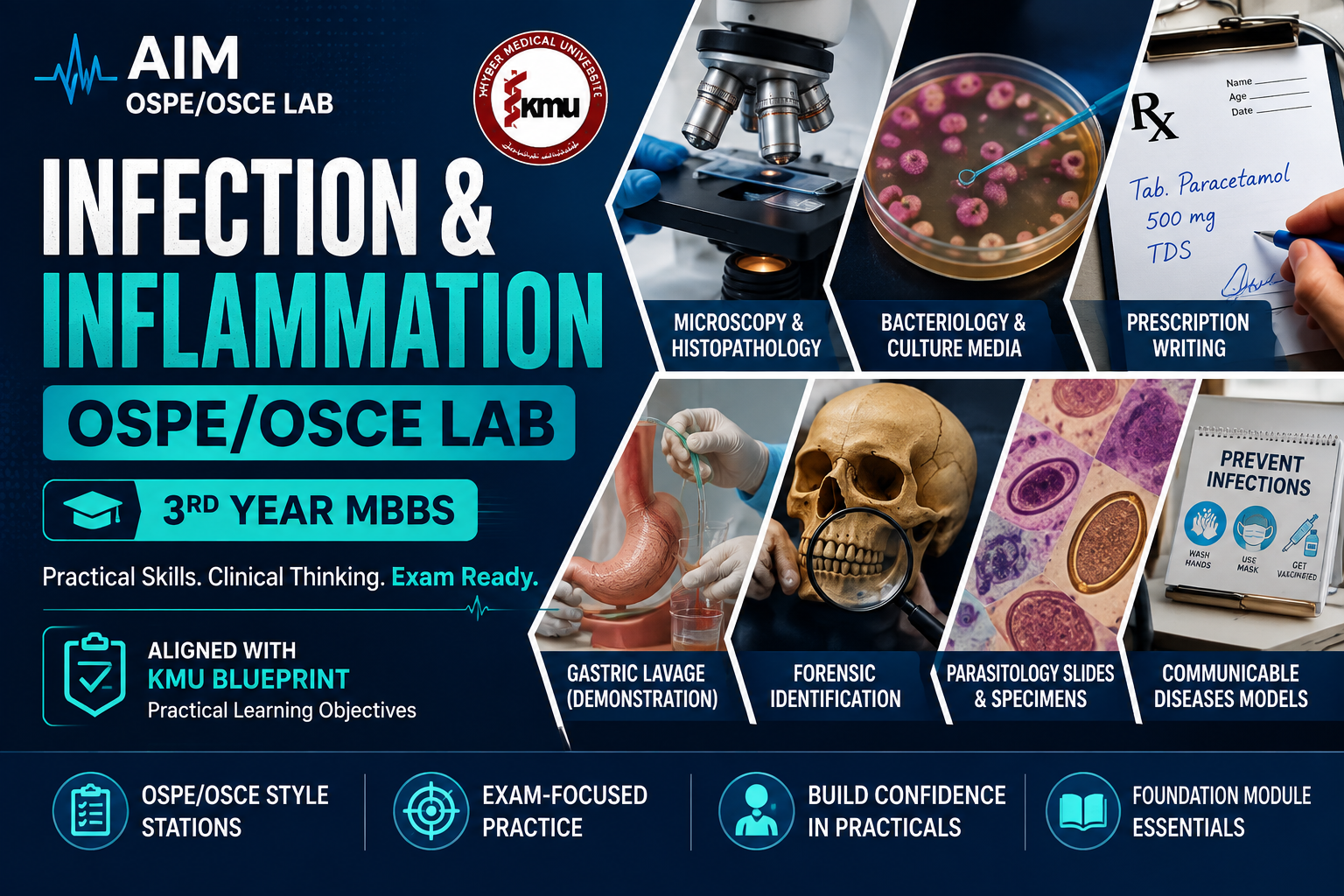
AIM Infection & Inflammation OSPE/OSCE Lab is a practical, exam-focused course designed to help 3rd Year MBBS students master the essential pathology, microbiology, pharmacology, forensic medicine, and community medicine practical skills included in the KMU Infection & Inflammation Module.

Students will practice OSPE/OSCE-style stations covering inflammatory cells and histopathology, bacterial diagnostic tests and culture media, prescription writing, gastric lavage, forensic identification, parasitology slides and specimens, and communicable-disease modelsโ€”aligned with the practical learning objectives specified in the KMU blueprint.

Course Content

๐Ÿ”ฌ Station 1 โ€” Microscopic Identification of Acute Inflammation
Learning Outcomes Identify inflammatory cells on a provided microscopic slide. Identify the histopathological changes of acute appendicitis. Relate the demonstrated microscopic findings to acute inflammation.

๐Ÿ”ฌ Station 2 โ€” Microscopic Identification of Chronic and Granulomatous Inflammation
Learning Outcomes Identify the morphological changes of chronic inflammation in a provided specimen/slide. Identify the characteristic cells and their arrangement in a granuloma. Distinguish the demonstrated chronic inflammatory pattern from acute inflammation when asked.

๐Ÿ”ฌ Station 3 โ€” Identification of Granulation Tissue
Learning Outcomes Identify granulation tissue on a provided histopathology slide/image. Identify its characteristic microscopic features. Distinguish granulation tissue from granulomatous inflammation when asked.

๐Ÿงช Station 4 โ€” Performance and Interpretation of Bacterial Biochemical Tests
Learning Outcomes Perform the bacterial biochemical test provided at the station using the appropriate technique. Observe and interpret the test result. Report the test as positive or negative based on the demonstrated reaction.

๐Ÿงซ Station 5 โ€” Identification of Culture Media and Hemolysis on Blood Agar
Learning Outcomes Identify the provided microbiological culture medium. Recognize blood agar, mannitol salt agar, chocolate medium or Cary-Blair transport medium when presented. Identify the demonstrated pattern of hemolysis on blood agar.

๐Ÿš‘ Station 6 โ€” Demonstration of Gastric Lavage
Learning Outcomes Demonstrate the sequence of steps involved in gastric lavage using the provided model/manikin and equipment. Demonstrate safe handling and appropriate procedural sequence. State the essential precaution(s) relevant to the procedure when asked.

๐Ÿ’Š Station 7 โ€” Prescription Writing for Common Infectious Diseases Acute Tonsillitis / Malaria
Learning Outcomes Construct a complete prescription for the supplied infectious-disease scenario. Select appropriate medication with dose, route, frequency and duration. Demonstrate essential principles of safe and rational prescription writing.

๐Ÿฆด๐Ÿ” Station 8 โ€” Forensic Personal Identification: Bone or Hair/Fibre
Learning Outcomes Determine human sex from a provided bone or identify human hair microscopically, according to the station material. Identify the relevant distinguishing characteristics supporting the conclusion. Differentiate human hair from fibre when that specimen is provided.

๐Ÿฆ  Station 9 โ€” Laboratory Identification of Common Parasites
Learning Outcomes Identify the supplied parasite/specimen from a laboratory slide or specimen. Recognize the characteristic diagnostic form demonstrated. State the identifying feature supporting the diagnosis.

๐ŸŒ Station 10 โ€” Identification of Communicable Disease Models and Prevention
Learning Outcomes Identify the communicable disease represented by the provided model. Identify the important signs/features demonstrated by the model. State the major complication(s) and relevant preventive measures.

Want to receive push notifications for all major on-site activities?

โœ•
Scroll to Top
๐Ÿ’ฌ WhatsApp Support