
Course Content
🔬 Station 1 — Microscopic Identification of Acute Inflammation
Learning Outcomes Identify inflammatory cells on a provided microscopic slide. Identify the histopathological changes of acute appendicitis. Relate the demonstrated microscopic findings to acute inflammation.
0/1
🔬 Station 2 — Microscopic Identification of Chronic and Granulomatous Inflammation
Learning Outcomes Identify the morphological changes of chronic inflammation in a provided specimen/slide. Identify the characteristic cells and their arrangement in a granuloma. Distinguish the demonstrated chronic inflammatory pattern from acute inflammation when asked.
0/1
🔬 Station 3 — Identification of Granulation Tissue
Learning Outcomes Identify granulation tissue on a provided histopathology slide/image. Identify its characteristic microscopic features. Distinguish granulation tissue from granulomatous inflammation when asked.
0/1
🧪 Station 4 — Performance and Interpretation of Bacterial Biochemical Tests
Learning Outcomes Perform the bacterial biochemical test provided at the station using the appropriate technique. Observe and interpret the test result. Report the test as positive or negative based on the demonstrated reaction.
0/1
🧫 Station 5 — Identification of Culture Media and Hemolysis on Blood Agar
Learning Outcomes Identify the provided microbiological culture medium. Recognize blood agar, mannitol salt agar, chocolate medium or Cary-Blair transport medium when presented. Identify the demonstrated pattern of hemolysis on blood agar.
0/1
🚑 Station 6 — Demonstration of Gastric Lavage
Learning Outcomes Demonstrate the sequence of steps involved in gastric lavage using the provided model/manikin and equipment. Demonstrate safe handling and appropriate procedural sequence. State the essential precaution(s) relevant to the procedure when asked.
0/1
💊 Station 7 — Prescription Writing for Common Infectious Diseases Acute Tonsillitis / Malaria
Learning Outcomes Construct a complete prescription for the supplied infectious-disease scenario. Select appropriate medication with dose, route, frequency and duration. Demonstrate essential principles of safe and rational prescription writing.
0/1
🦴🔍 Station 8 — Forensic Personal Identification: Bone or Hair/Fibre
Learning Outcomes Determine human sex from a provided bone or identify human hair microscopically, according to the station material. Identify the relevant distinguishing characteristics supporting the conclusion. Differentiate human hair from fibre when that specimen is provided.
0/1
🦠 Station 9 — Laboratory Identification of Common Parasites
Learning Outcomes Identify the supplied parasite/specimen from a laboratory slide or specimen. Recognize the characteristic diagnostic form demonstrated. State the identifying feature supporting the diagnosis.
0/1
🌍 Station 10 — Identification of Communicable Disease Models and Prevention
Learning Outcomes Identify the communicable disease represented by the provided model. Identify the important signs/features demonstrated by the model. State the major complication(s) and relevant preventive measures.
0/1
🧪🔬 AIM OSPE/OSCE Lab — Infection & Inflammation Module | 3rd Year MBBS
AIM OSCE / OSPE • MBBS

💊 Station 7 — Prescription Writing for Common Infectious Diseases

Acute Tonsillitis / Malaria • Rapid Revision • Practical Skills • Viva

🎯 Task

CANDIDATE TASK

You are provided with an adult clinical scenario of either acute tonsillitis requiring antimicrobial treatment or confirmed uncomplicated malaria. Write a complete and rational prescription, including the appropriate medicine, dose, route, frequency, duration and essential prescribing information.

⚡ Model Station Answer

First: I will confirm the indication, patient identity, age/weight, allergy status, pregnancy where relevant, current medicines and important contraindications.
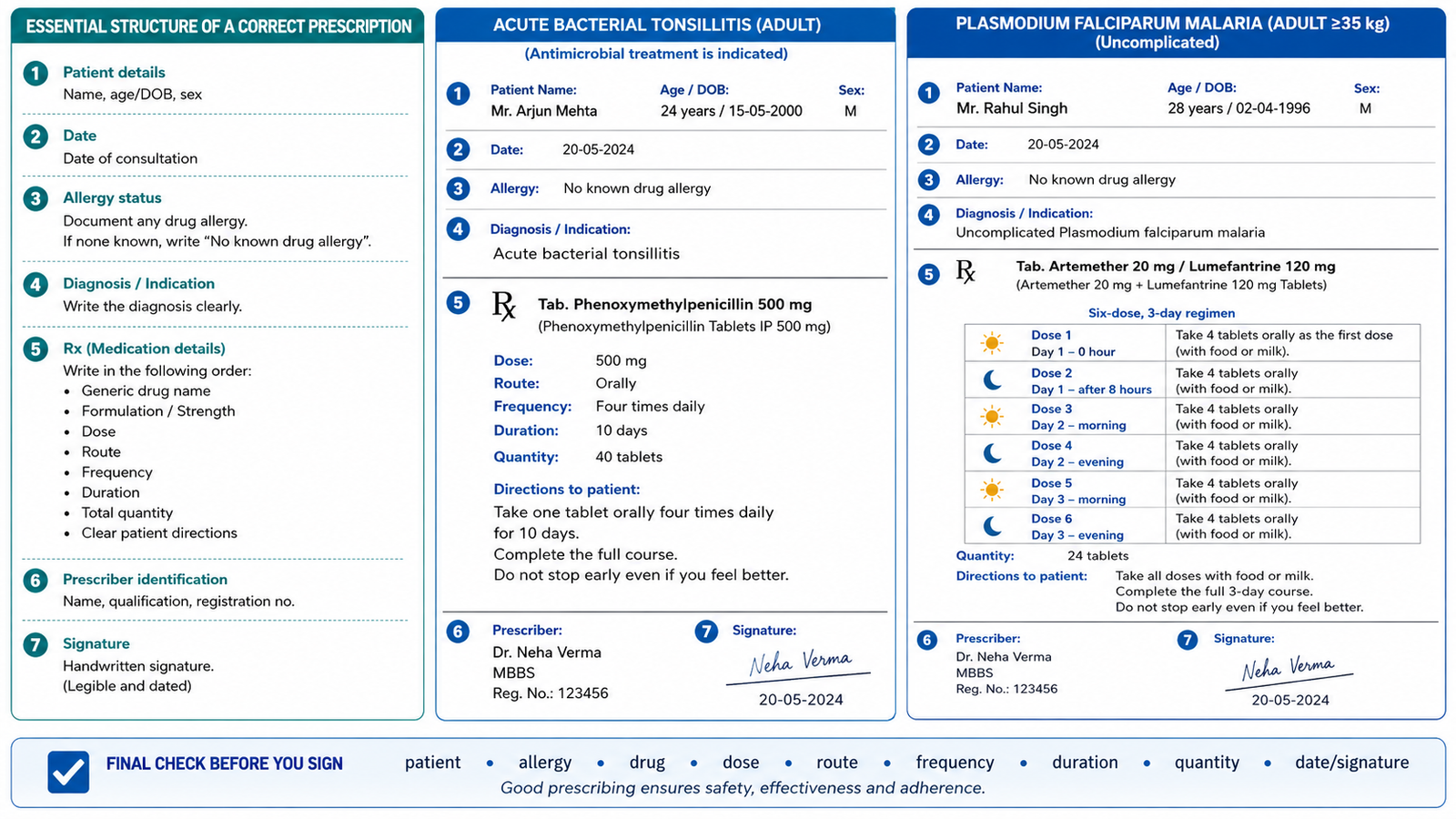
Acute bacterial tonsillitis: when antibiotic treatment is clinically indicated, an adult example is phenoxymethylpenicillin 500 mg orally four times daily for 10 days; dispense 40 tablets.
Uncomplicated falciparum malaria, body weight ≥35 kg: artemether 20 mg/lumefantrine 120 mg — four tablets orally per dose; first dose now, second after 8 hours, then four tablets twice daily for the next 2 days; total 24 tablets.
Finally: I will write clear patient instructions and total quantity, check the prescription for errors, then add the date, prescriber details and signature.
Exam safety: Do not prescribe an antibiotic automatically for every sore throat. For malaria, confirm that the case is uncomplicated and follow the species, body weight, patient factors and treatment protocol supplied in the scenario.

🔎 Stepwise Procedure / Approach

Review the clinical scenario. Confirm the diagnosis or treatment indication and identify whether antimicrobial therapy is actually required.

Check patient factors. Confirm name, age/date of birth, weight when relevant, drug allergies, pregnancy status, major comorbidities and important concurrent medicines.

Select the appropriate medicine. Choose a rational first-line agent according to the diagnosis, organism/species, severity and supplied or local treatment protocol.

Write the drug clearly. Prefer the generic name and include formulation and strength where required.

Complete the regimen. State the exact dose, route, frequency and duration. For weight-based treatment, verify the correct weight category before prescribing.

Add dispensing and patient instructions. State the total quantity and provide clear directions for administration without ambiguous abbreviations.

Complete the prescription. Add the date, relevant prescriber identification and signature.

Perform a final safety check. Recheck the patient, drug, dose, route, frequency, duration, quantity, allergies, interactions and contraindications before submission.

🖼️ Visual Learning

VISUAL 1

Complete Infectious-Disease Prescription Writing
 

🎥 Practical Video

Pharmacology: How to Write and Understand Prescriptions
Source: Kendall Wyatt MD

A practical prescribing demonstration reviewing the essential components of a medication prescription and how drug orders should be written and interpreted safely.


▶ Watch Practical Video


📝 Important Viva Questions

Q1. What are the essential medication details that should appear in a prescription?
Answer: The drug name, formulation/strength where relevant, dose, route, frequency, duration or quantity, and clear directions for use.
Q2. Why should generic drug names usually be used?
Answer: Generic prescribing reduces confusion between brands, supports rational prescribing and allows clear identification of the active medicine.
Q3. Should every patient with acute tonsillitis receive an antibiotic?
Answer: No. Most acute sore throats are self-limiting and often viral; antibiotics should be used only when clinical assessment indicates a meaningful likelihood of bacterial infection or the patient is at increased risk of complications.
Q4. What is a suitable first-line oral antibiotic example for an adult with acute bacterial tonsillitis when antibiotic treatment is indicated?
Answer: Phenoxymethylpenicillin is a suitable first-line option; an adult regimen is 500 mg orally four times daily, with the course selected according to the applicable guideline.
Q5. What is the standard artemether-lumefantrine regimen for uncomplicated falciparum malaria in a patient weighing at least 35 kg?
Answer: Four tablets of 20 mg/120 mg per dose: first dose immediately, second dose after 8 hours, then four tablets twice daily for the following 2 days — six doses and 24 tablets in total.
Q6. Why is body weight important when prescribing artemether-lumefantrine?
Answer: The number of tablets given per dose is weight-based, so incorrect weight classification can cause underdosing or overdosing.
Q7. What common prescription-writing errors should you check before handing the prescription to the examiner?
Answer: Check for missing patient details, allergy status, wrong drug or dose, omitted route/frequency/duration, unclear abbreviations, incorrect quantity, interactions or contraindications, and missing date or signature.
Scroll to Top
💬 WhatsApp Support