
AIM OSCE / OSPE • MBBS
🌍 Station 10 — Identification of Communicable Disease Models and Prevention
Rapid Revision • Identify • Recognize Features • Complications • Prevention
🎯 Task
Candidate Task
Examine the provided communicable-disease model. Identify the disease, state the important features demonstrated, mention one major complication, and state the relevant preventive measures.
⚡ Model Station Answer
Use only the line corresponding to the model shown in your examination.
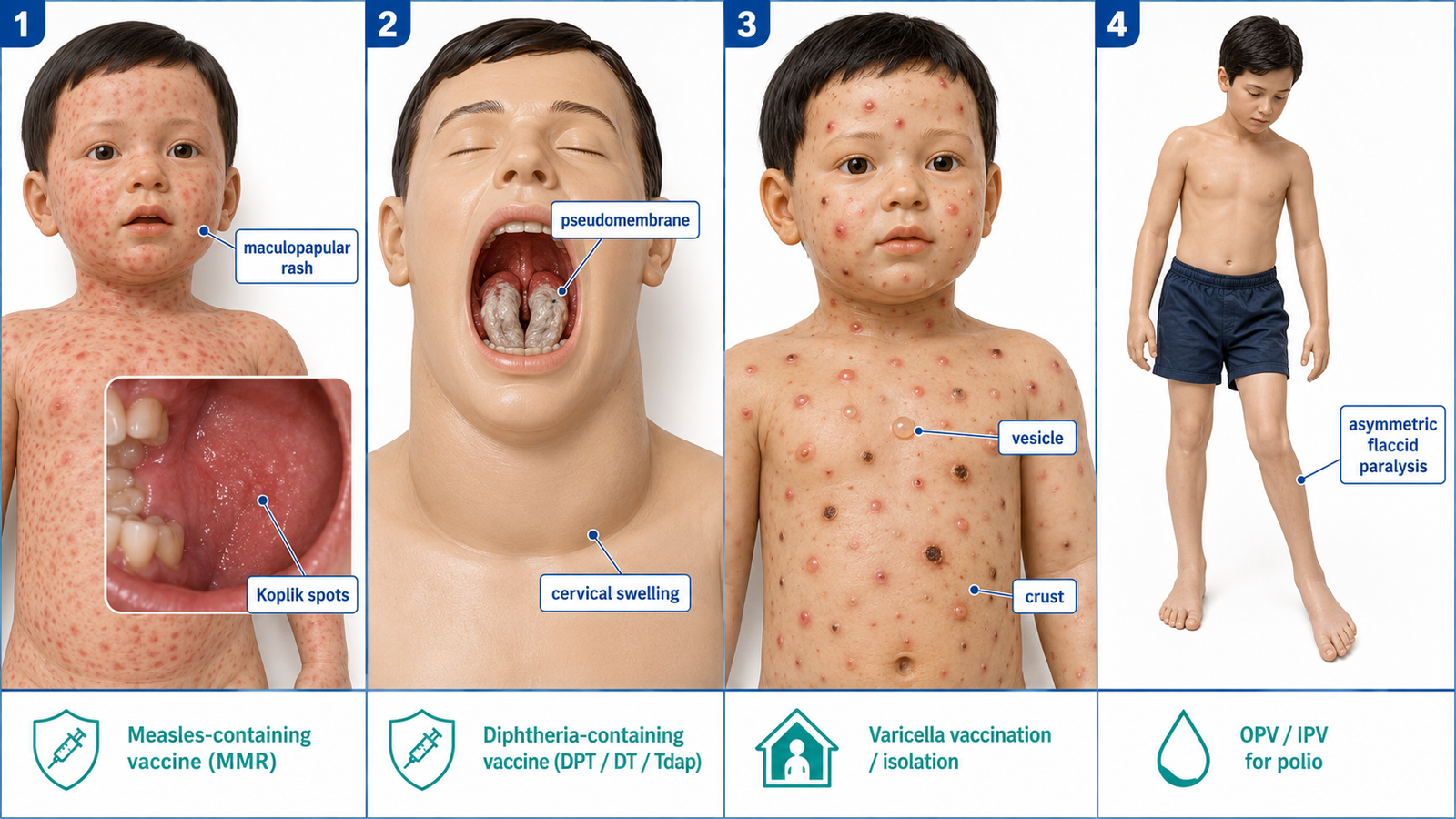
Measles: Fever with a generalized maculopapular rash and characteristic Koplik spots. A major complication is pneumonia or encephalitis. Prevention is primarily by measles-containing vaccination.
Diphtheria: An adherent gray-white pharyngeal pseudomembrane, sometimes with cervical swelling or “bull neck.” Major complications include airway obstruction and myocarditis. Prevention is by diphtheria-containing vaccination.
Chickenpox: A generalized pruritic vesicular eruption with lesions in different stages, including vesicles and crusts. Important complications include secondary bacterial infection, pneumonia and encephalitis. Prevention includes vaccination and appropriate isolation of infectious cases.
Poliomyelitis: The characteristic severe manifestation is acute asymmetric flaccid paralysis. Respiratory muscle involvement is an important complication. Prevention is through polio immunization with OPV/IPV and interruption of fecal-oral transmission.
Exam technique: Identify the disease first, then immediately give 2 distinguishing features → 1 major complication → prevention.
🔎 Stepwise Procedure / Approach
Observe the entire model first. Note the body region involved and the dominant abnormality.
-
- Identify the type of lesion or sign. Look for rash, vesicles, membrane formation, paralysis, swelling or another characteristic feature.
- Look for the hallmark clue. Examples include Koplik spots, an adherent pharyngeal pseudomembrane, crops of vesicles or asymmetric flaccid weakness.
- State the disease clearly. Give one specific identification rather than a long differential diagnosis.
- Describe 2 important visible features. Mention only findings actually demonstrated by the model.
- State a major complication. Choose a common or serious complication relevant to the identified disease.
- State the main preventive measure. Prioritize specific vaccination when applicable, then add appropriate transmission-control measures if required.
🖼️ Visual Learning
VISUAL 1
Recognition of Common Communicable Disease Models
📝 Important Viva Questions
Q1. What is the most useful examination approach when shown a communicable-disease model?
Answer: Identify the dominant clinical feature, recognize the disease, state the characteristic findings, and then mention its important complication and prevention.
Q2. What is the characteristic oral lesion of measles?
Answer: Koplik spots—small whitish lesions on an erythematous buccal mucosa, classically appearing before the generalized rash.
Q3. What is the characteristic local lesion of faucial diphtheria?
Answer: A thick, gray-white, firmly adherent pseudomembrane over the tonsillopharyngeal mucosa.
Q4. Which serious systemic complication is associated with diphtheria?
Answer: Myocarditis is a major systemic complication; neurological complications may also occur.
Q5. What feature helps distinguish chickenpox on inspection?
Answer: Lesions are typically present in different stages simultaneously, such as papules, vesicles and crusts.
Q6. What type of paralysis is classically associated with paralytic poliomyelitis?
Answer: Acute asymmetric flaccid paralysis, caused by involvement of lower motor neurons.
Q7. What is the most important general principle for prevention of vaccine-preventable communicable diseases?
Answer: Achieving appropriate immunization coverage is the main specific preventive measure, supported by early case detection and relevant measures to interrupt transmission.