
🚑 Station 6 — Demonstration of Gastric Lavage
🎯 Task
Using the provided manikin and equipment, demonstrate the correct sequence of gastric lavage. Maintain procedural safety throughout and state the essential precautions when asked by the examiner.
⚡ Model Station Answer
Preparation: I would first confirm that gastric lavage is specifically indicated, check for contraindications and ensure that the airway is protected.
Position: I would place the patient in the left lateral, head-down position, with suction and resuscitation equipment immediately available.
Technique: After inserting an appropriately sized lubricated gastric tube and confirming gastric placement, I would aspirate the stomach contents, then instill and withdraw measured aliquots of lavage fluid repeatedly.
Completion: I would monitor the patient throughout, stop if complications occur, remove the tube safely when lavage is complete and document the procedure.
🔎 Stepwise Procedure / Approach
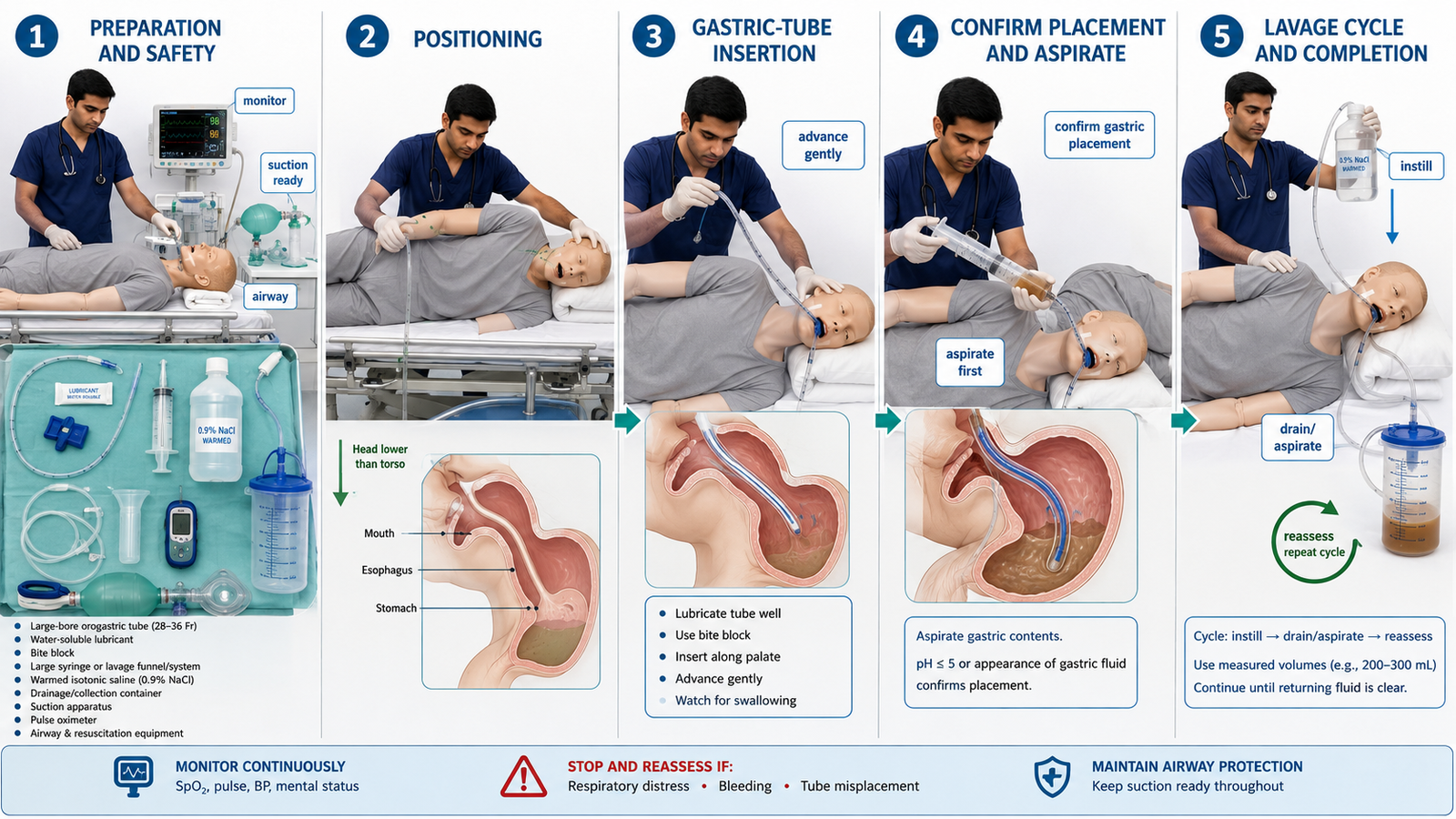
Confirm indication and exclude contraindications. Review the ingested substance, timing, airway status and risk of aspiration or gastrointestinal injury.
- Prepare and protect the patient. Explain the procedure, obtain cooperation where possible, perform hand hygiene, wear appropriate PPE and ensure monitoring, suction and resuscitation equipment are ready.
- Position correctly. Place the patient in the left lateral decubitus position with the head lower than the torso where appropriate, to reduce aspiration risk and facilitate gastric drainage.
- Prepare and insert the gastric tube. Use an appropriately sized, well-lubricated gastric/orogastric tube; insert gently without force. A bite block may be used when appropriate.
- Confirm gastric placement before lavage. Aspirate gastric contents and confirm that the tube is in the stomach according to the local clinical protocol. Do not instill fluid if placement is uncertain.
- Aspirate the initial gastric contents. Collect the initial aspirate where clinically required before starting irrigation.
- Perform the lavage cycle. Introduce a measured aliquot of warmed isotonic lavage fluid, commonly about 200–300 mL at a time in an adult, then lower/aspirate the system to recover the fluid and gastric contents. Avoid excessive pressure or volume.
- Repeat while monitoring. Continue the instillation-and-drainage cycle as clinically directed while observing airway, breathing, oxygenation, pulse and the character and volume of the return.
- Complete safely. Stop if airway compromise, respiratory distress, bleeding or other complication occurs. When finished, remove the tube carefully if appropriate, reassess the patient and document fluid used, return obtained and patient response.
🖼️ Visual Learning
Safe Gastric Lavage — Position, Tube Placement and Lavage Cycle
🎥 Practical Video
Demonstrates gastric-tube placement and the practical lavage sequence, helping you visualize the positioning, insertion and washout steps expected in a skills station.