
AIM OSPE/OSCE Lab — MSK-II Module | 3rd Year MBBS
About Course

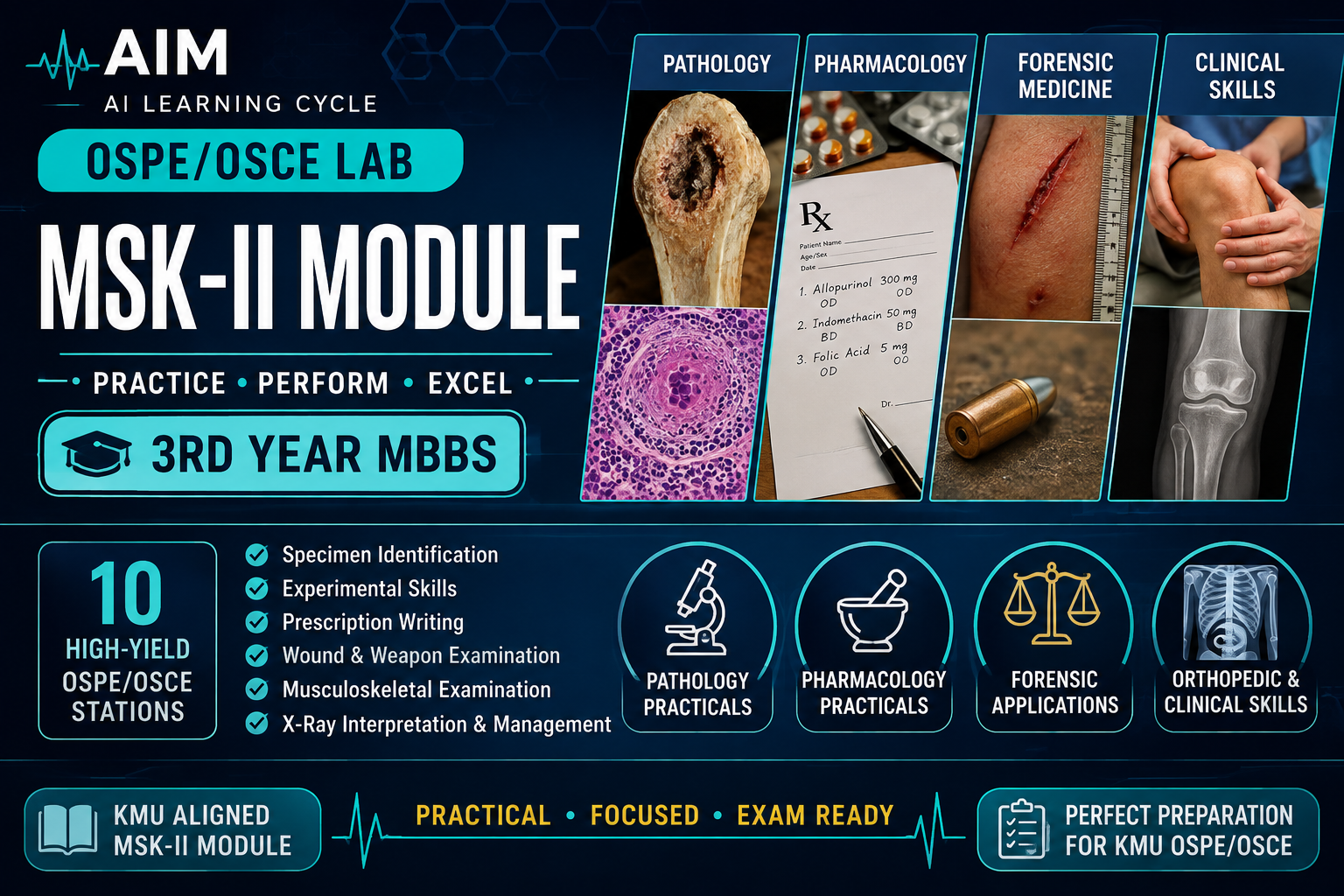
AIM MSK-II OSPE/OSCE Lab is a practical, exam-focused course designed for 3rd Year MBBS students to master the essential Pathology, Pharmacology, Forensic Medicine, Orthopedics, and clinical MSK skills included in the KMU MSK-II module.

Students will practice 10 high-yield KMU-aligned OSPE/OSCE stations covering gross and microscopic specimen identification, ASO latex agglutination, prescription writing, wound and weapon examination, firearm injury interpretation, focused musculoskeletal examination, fracture/dislocation X-ray interpretation, and initial limb management.

Each station is kept focused, practical, and exam-oriented, helping students develop the skills required to identify, perform, interpret, prescribe, document, and demonstrate confidently in KMU professional OSPE/OSCE examinations.

Show More

Course Content

🔬 Station 1 — Identification of Tuberculous Osteomyelitis
Learning Outcomes Identify tuberculous osteomyelitis from a provided gross specimen or histopathology image/slide. Identify the key gross and microscopic morphological features supporting the diagnosis. Differentiate the lesion from common pyogenic osteomyelitis when provided with relevant findings.

🔬 Station 2 — Identification of Common Bone Tumours
Learning Outcomes Identify the provided bone tumour from a gross specimen, image or histopathology slide. Identify the key morphological features supporting the diagnosis. Differentiate osteosarcoma, osteoclastoma and chondrosarcoma using characteristic morphological findings.

🧪 Station 3 — ASO Test by Latex Agglutination
Learning Outcomes Prepare the specimen and reagents required for the ASO latex agglutination test. Demonstrate the correct steps of the latex agglutination technique. Interpret visible agglutination and report the test as positive or negative.

🔬 Station 4 — Identification of Squamous Cell Carcinoma and Basal Cell Carcinoma of Skin
Learning Outcomes Identify SCC or BCC from a provided gross specimen/image or histopathology slide. Identify the important morphological features supporting the diagnosis. Differentiate squamous cell carcinoma from basal cell carcinoma on morphological grounds.

💊 Station 5 — Prescription Writing for Gout and Rheumatoid Arthritis
Learning Outcomes Write a complete and rational prescription for a patient with gout or rheumatoid arthritis based on the supplied clinical scenario. Select an appropriate drug, dose, route, frequency and duration. Demonstrate the essential components of safe prescription writing.

💊 Station 6 — Prescription Writing for Common Dermatological Disorders
Learning Outcomes Write an appropriate prescription for a supplied case of scabies or psoriasis. Select the appropriate preparation, route, dose/frequency and duration. Include essential patient instructions relevant to safe and effective treatment.

⚖️ Station 7 — Identification of Mechanical Wounds and Causative Weapon
Learning Outcomes Identify the type of mechanical wound from a provided model, image or injury photograph. Recognize abrasion, bruise, laceration, incised wound or stab wound from its characteristic features. Identify the probable causative weapon/mechanism and relevant medico-legal significance.

🔫 Station 8 — Examination of Firearm Injury and Identification of Bullet/Ammunition
Learning Outcomes Identify a firearm entry or exit wound from the provided image/model and describe its important features. Interpret features relevant to the probable range or mechanism of firing when demonstrated. Identify a supplied bullet/ammunition specimen and document the important medico-legal findings.

🩺 Station 9 — Focused Musculoskeletal History and Examination
Learning Outcomes Obtain a focused history relevant to a common musculoskeletal complaint. Perform an appropriate focused general and musculoskeletal examination. Present the relevant positive and negative findings in an organized manner.

🦴 Station 10 — X-Ray Interpretation of Fracture/Dislocation and Initial Limb Management
Learning Outcomes Identify a fracture or dislocation on a provided X-ray. Describe the site, type, displacement and/or angulation of the injury systematically. Demonstrate or describe appropriate immediate immobilization and initial management of the injured limb.

Want to receive push notifications for all major on-site activities?

Scroll to Top
💬 WhatsApp Support