
Course Content
🔬 Station 1 — Identification of Tuberculous Osteomyelitis
Learning Outcomes Identify tuberculous osteomyelitis from a provided gross specimen or histopathology image/slide. Identify the key gross and microscopic morphological features supporting the diagnosis. Differentiate the lesion from common pyogenic osteomyelitis when provided with relevant findings.
0/1
🔬 Station 2 — Identification of Common Bone Tumours
Learning Outcomes Identify the provided bone tumour from a gross specimen, image or histopathology slide. Identify the key morphological features supporting the diagnosis. Differentiate osteosarcoma, osteoclastoma and chondrosarcoma using characteristic morphological findings.
0/1
🧪 Station 3 — ASO Test by Latex Agglutination
Learning Outcomes Prepare the specimen and reagents required for the ASO latex agglutination test. Demonstrate the correct steps of the latex agglutination technique. Interpret visible agglutination and report the test as positive or negative.
0/1
🔬 Station 4 — Identification of Squamous Cell Carcinoma and Basal Cell Carcinoma of Skin
Learning Outcomes Identify SCC or BCC from a provided gross specimen/image or histopathology slide. Identify the important morphological features supporting the diagnosis. Differentiate squamous cell carcinoma from basal cell carcinoma on morphological grounds.
0/1
💊 Station 5 — Prescription Writing for Gout and Rheumatoid Arthritis
Learning Outcomes Write a complete and rational prescription for a patient with gout or rheumatoid arthritis based on the supplied clinical scenario. Select an appropriate drug, dose, route, frequency and duration. Demonstrate the essential components of safe prescription writing.
0/1
💊 Station 6 — Prescription Writing for Common Dermatological Disorders
Learning Outcomes Write an appropriate prescription for a supplied case of scabies or psoriasis. Select the appropriate preparation, route, dose/frequency and duration. Include essential patient instructions relevant to safe and effective treatment.
0/1
⚖️ Station 7 — Identification of Mechanical Wounds and Causative Weapon
Learning Outcomes Identify the type of mechanical wound from a provided model, image or injury photograph. Recognize abrasion, bruise, laceration, incised wound or stab wound from its characteristic features. Identify the probable causative weapon/mechanism and relevant medico-legal significance.
0/1
🔫 Station 8 — Examination of Firearm Injury and Identification of Bullet/Ammunition
Learning Outcomes Identify a firearm entry or exit wound from the provided image/model and describe its important features. Interpret features relevant to the probable range or mechanism of firing when demonstrated. Identify a supplied bullet/ammunition specimen and document the important medico-legal findings.
0/1
🩺 Station 9 — Focused Musculoskeletal History and Examination
Learning Outcomes Obtain a focused history relevant to a common musculoskeletal complaint. Perform an appropriate focused general and musculoskeletal examination. Present the relevant positive and negative findings in an organized manner.
0/1
🦴 Station 10 — X-Ray Interpretation of Fracture/Dislocation and Initial Limb Management
Learning Outcomes Identify a fracture or dislocation on a provided X-ray. Describe the site, type, displacement and/or angulation of the injury systematically. Demonstrate or describe appropriate immediate immobilization and initial management of the injured limb.
0/1
AIM OSPE/OSCE Lab — MSK-II Module | 3rd Year MBBS

AIM OSCE / OSPE • MBBS

⚖️ Station 7 — Identification of Mechanical Wounds and Causative Weapon

Rapid Revision • Practical Recognition • Viva

🎯 Task

CANDIDATE TASK

You are shown an injury model, photograph or specimen. Identify the type of mechanical wound, state the characteristic features supporting your identification, and indicate the probable causative weapon or mechanism with one relevant medico-legal point.


⚡ Model Station Answer

Identification: I would classify the injury as an abrasion, bruise, laceration, incised wound or stab wound according to its morphology.
Key features: I would assess skin loss or discoloration, wound margins, tissue bridging, surrounding bruising and the relationship between wound length and depth.
Probable mechanism: Abrasions, bruises and lacerations usually indicate blunt force, while incised and stab wounds indicate sharp-force injury.
Medico-legal interpretation: The wound may suggest the probable type of weapon and direction or mechanism of force, but the exact weapon should not be identified from wound appearance alone.

🔎 Stepwise Procedure / Approach

  1. Observe systematically. Note the site, shape, dimensions and overall appearance of the injury before naming it.
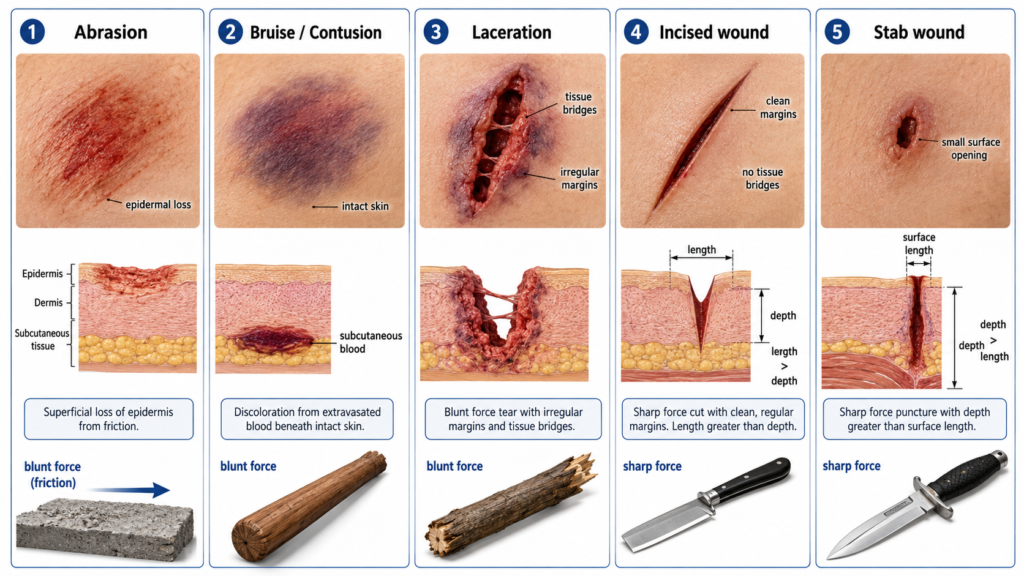
  2. Assess the skin surface. Look for superficial epidermal loss suggesting an abrasion or intact skin with subcutaneous discoloration suggesting a bruise.
  3. Examine the wound margins. Clean regular margins favor an incised wound; irregular crushed or abraded margins favor a laceration.
  4. Look inside the wound. Tissue bridges, crushed tissue and associated bruising support a laceration caused by blunt force.
  5. Compare length with depth. An incised wound is typically longer than it is deep, whereas a stab wound has a depth greater than its surface length.
  6. Infer the probable mechanism. Relate the morphology to blunt impact, friction, a sharp cutting edge or a pointed penetrating weapon.
  7. State the medico-legal relevance. Mention useful information such as possible force direction, patterned injury or probable weapon category without claiming an exact weapon unless independently established.
Exam point: Describe the visible wound first, then infer the probable weapon or mechanism. Avoid statements such as “this exact knife caused the injury” solely from wound morphology.

🖼️ Visual Learning

VISUAL 1

Mechanical Wounds — Recognition Features and Probable Weapon
🎥 Practical Video

🎥 Practical Demonstration — Weapon & Wounds: Types of Mechanical Injury

Source: Dr Med — Sakib Rahaman • YouTube

This forensic-medicine teaching demonstration reviews common wound appearances, mechanical-injury types and correlation with weapon categories, helping reinforce visual identification for practical examinations.


▶ Watch Practical Video

📝 Important Viva Questions

Q1. What is an abrasion?

Answer: An abrasion is a superficial injury involving loss of the epidermis, usually produced by friction, scraping, pressure or impact against a rough surface.

Q2. What is a bruise or contusion?

Answer: It is extravasation of blood into tissues following blunt-force trauma, usually without disruption of the overlying skin.

Q3. Which feature strongly differentiates a laceration from an incised wound?

Answer: A laceration typically has irregular crushed or bruised margins with tissue bridges; an incised wound has clean regular margins and lacks tissue bridges.

Q4. What type of force usually produces a laceration?

Answer: Lacerations are usually produced by blunt force that crushes, stretches or splits the skin and underlying tissue.

Q5. How do you distinguish an incised wound from a stab wound?

Answer: In an incised wound, the surface length is usually greater than the depth. In a stab wound, the depth of penetration is greater than the surface length.

Q6. What weapons commonly produce incised and stab wounds?

Answer: Incised wounds are produced by sharp cutting edges such as knives or razors, while stab wounds are produced by pointed penetrating weapons such as knives or daggers.

Q7. Can the exact weapon be identified from the wound alone?

Answer: Usually no. Wound morphology may indicate the probable class, dimensions or characteristics of a weapon, but identification of the exact weapon requires correlation with the weapon, circumstances and other forensic evidence.

Scroll to Top
💬 WhatsApp Support