
💊 Station 5 — Prescription Writing for Gout and Rheumatoid Arthritis
Rapid Revision • Rational Prescribing • Prescription Safety • Viva
🎯 Task
You are provided with a clinical scenario of a patient requiring treatment for gout or rheumatoid arthritis. Write a complete, rational and safe prescription, selecting an appropriate medicine with its dose, route, frequency and duration, and ensure that all essential prescription components are included.
⚡ Model Station Answer — What to say in the exam
Approach: I will first review the diagnosis, allergies, current medicines, contraindications and relevant renal, hepatic or pregnancy information before prescribing.
Prescription: I will document the patient identifiers and date, then write the medicine by generic name with the correct formulation, strength, dose, route, frequency, duration or quantity and clear patient instructions.
Completion: I will check the prescription for dosing or interaction errors and then sign it with the required prescriber details.
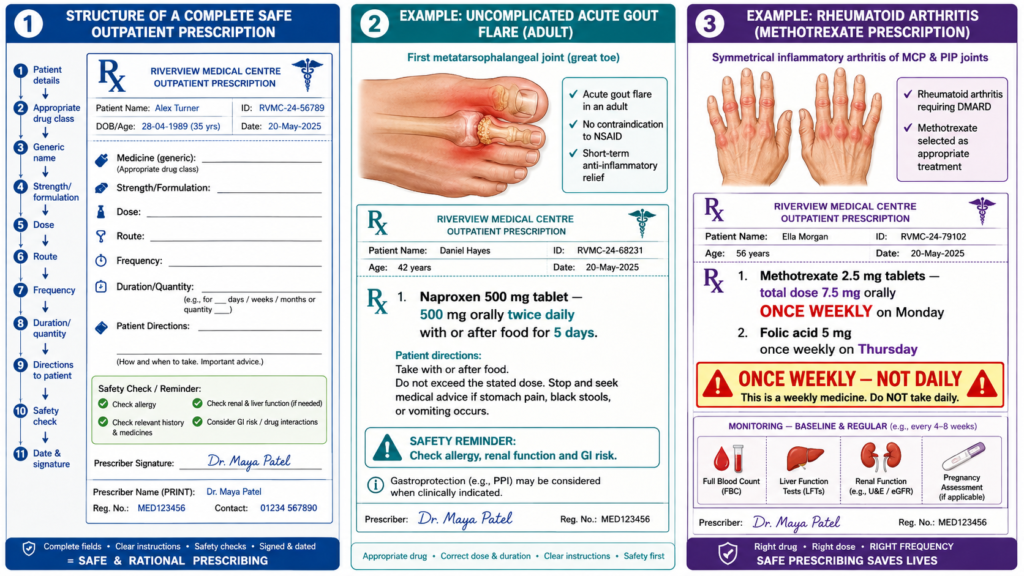
Naproxen 500 mg tablet — take 500 mg orally twice daily with or after food for 5 days, provided there is no relevant NSAID contraindication. Consider gastroprotection when clinically indicated.
Methotrexate 2.5 mg tablets — take a total dose of 7.5 mg orally ONCE WEEKLY on a clearly specified day, with appropriate monitoring. Co-prescribe folic acid 5 mg once weekly on a different day according to the treatment plan.
🔎 Stepwise Procedure / Approach
Review the clinical scenario. Confirm the diagnosis and determine whether treatment is for an acute gout flare, long-term disease control or rheumatoid arthritis.
- Check patient safety factors. Review age, allergies, pregnancy status where relevant, comorbidities, renal and hepatic function and current medicines.
- Select the appropriate medicine. Choose a rational drug according to the indication and any contraindications supplied in the scenario.
- Complete patient particulars. Write the required patient identifiers and the date clearly.
- Write the medicine completely. State the generic name, formulation and strength without unsafe abbreviations.
- Specify administration. Clearly write the dose, route, frequency and duration or quantity, with practical instructions such as relation to food when relevant.
- Add essential safety instructions. For high-risk medicines such as methotrexate, clearly specify the weekly dosing day and any required accompanying therapy or monitoring.
- Final prescription check. Recheck indication, allergies, dose, frequency, interactions and completeness, then sign and authenticate the prescription as required.
🖼️ Visual Learning
Safe Prescription Writing — Gout and Rheumatoid Arthritis
🎥 Practical Video
Demonstrates the essential parts of a prescription and the systematic method of writing a complete, clear and safe prescription for an MBBS practical/OSPE station.
📝 Important Viva Questions
Q1. What are the essential components of a complete prescription?
Answer: Patient identifiers and date, medicine name, formulation/strength, dose, route, frequency, duration or quantity, clear instructions and prescriber authentication.
Q2. Why should medicines generally be prescribed by generic name?
Answer: Generic prescribing reduces confusion between brands, supports clear communication and usually allows appropriate cost-effective dispensing.
Q3. Which drug groups may be used as first-line treatment for an acute gout flare?
Answer: Depending on patient factors, an NSAID, colchicine or a short course of corticosteroid may be selected.
Q4. What important factors should be checked before prescribing an NSAID for gout?
Answer: Check allergy, renal function, gastrointestinal ulcer or bleeding risk, cardiovascular risk, relevant comorbidities and interacting medicines.
Q5. What is the most important prescription-writing safety rule for methotrexate in rheumatoid arthritis?
Answer: Methotrexate must be prescribed once weekly on a clearly specified day, not as a daily medicine. Daily dosing can cause severe or fatal toxicity.
Q6. Why is folic acid commonly prescribed with low-dose methotrexate?
Answer: It reduces several adverse effects of methotrexate. A common regimen is folic acid 5 mg once weekly on a different day from methotrexate.
Q7. What routine monitoring is important in a patient receiving methotrexate?
Answer: Full blood count, liver function and renal function require monitoring, together with appropriate assessment for contraindications and toxicity.