
Station 1 — Sore Throat: Focused History, Examination and Initial Management
🎯 Candidate Task
A patient presents with a sore throat. Take a focused history, perform the relevant general, local throat and systemic examination, and state your initial management based on the clinical findings.
⚡ Model Station Answer
- I would take a focused history covering onset, duration, severity, fever, painful or difficult swallowing, cough, voice change, breathing difficulty and associated ear or neck symptoms.
- I would assess the patient’s general condition and vital signs, then examine the mouth, oropharynx, tonsils, uvula and cervical lymph nodes.
- I would look specifically for tonsillar enlargement, erythema or exudate and exclude important red flags such as respiratory distress, significant dehydration, trismus or features suggesting a deep neck infection.
- If this is uncomplicated acute follicular tonsillitis, initial conservative management includes adequate fluids, rest, appropriate analgesia/antipyretics and safety-net advice, with further treatment guided by clinical assessment.
🔎 How to Perform / Approach
- Introduce and confirm the patient: perform hand hygiene, introduce yourself, confirm identity and obtain consent.
- Take the focused history: ask about onset and progression of sore throat, pain, fever, odynophagia/dysphagia and effect on oral intake.
- Screen associated symptoms and red flags: ask about cough, coryza, ear symptoms, neck swelling, voice change, drooling, trismus and breathing difficulty; briefly cover relevant past, drug and allergy history.
- Assess general condition: note distress, hydration and relevant vital signs; look for respiratory difficulty or systemic illness.
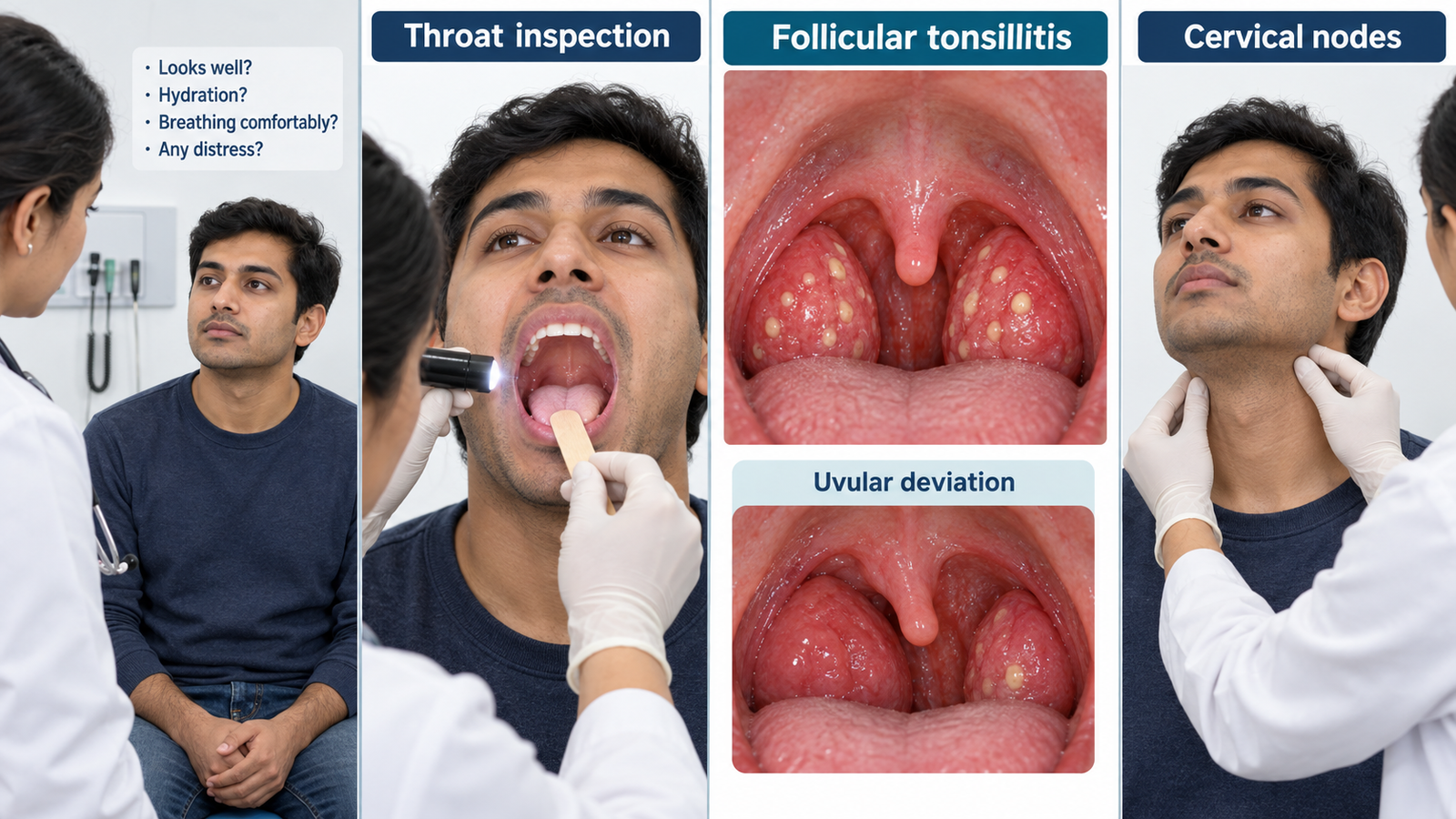
- Examine the throat systematically: with good illumination and a tongue depressor if required, inspect the oral cavity, tonsils, anterior/posterior pillars, posterior pharyngeal wall, soft palate and uvula.
- Complete relevant examination: assess cervical lymph nodes and perform focused ear, nasal, respiratory or other systemic examination when clinically indicated.
- State findings and plan: summarize the important positive and negative findings and give an appropriate conservative management and safety-net plan.
🖼️ Visual Learning
Systematic Examination of a Patient With Sore Throat
🎥 Practical Demonstration
A practical undergraduate OSCE demonstration of systematic oral cavity and oropharyngeal examination, including inspection of the tonsils and pharyngeal structures.
📝 Important Viva Questions
Answer: Tonsillar enlargement and erythema, tonsillar or follicular exudate, pharyngeal inflammation and associated tender cervical lymphadenopathy.
Answer: Respiratory difficulty, drooling or inability to swallow, marked dehydration, trismus, severe systemic illness or features suggesting a deep neck or peritonsillar infection.
Answer: Unilateral peritonsillar swelling with asymmetry and deviation of the uvula away from the affected side; trismus may also be present.
Answer: Encourage adequate oral fluids and rest, provide appropriate analgesia/antipyretics and give clear advice about deterioration or red-flag symptoms requiring reassessment.
Answer: The upper deep cervical nodes, particularly the jugulodigastric nodes, may become enlarged and tender.