
Station 15 — Neck Examination: Lymph Nodes, Neck Lump, Thyroid and Parotid
🎯 Candidate Task
Perform a systematic examination of the patient’s neck, including the cervical lymph nodes and any neck swelling. Examine the thyroid and parotid gland where appropriate and present your important findings to the examiner.
⚡ Model Station Answer
Neck: I would inspect the neck systematically and examine all major cervical lymph-node groups.
Neck lump: I would describe its site, size, surface, consistency, tenderness, mobility and relation to surrounding structures, including movement with swallowing or tongue protrusion where relevant.
Thyroid: I would assess the gland for enlargement, symmetry, nodules, consistency and movement on swallowing, followed by relevant thyroid functional signs if required.
Parotid: I would assess the swelling’s extent and consistency, overlying skin, fixation, cervical nodes, facial-nerve function and the parotid duct opening where appropriate
🔎 How to Perform / Approach
- Step 1 — Prepare and inspect.
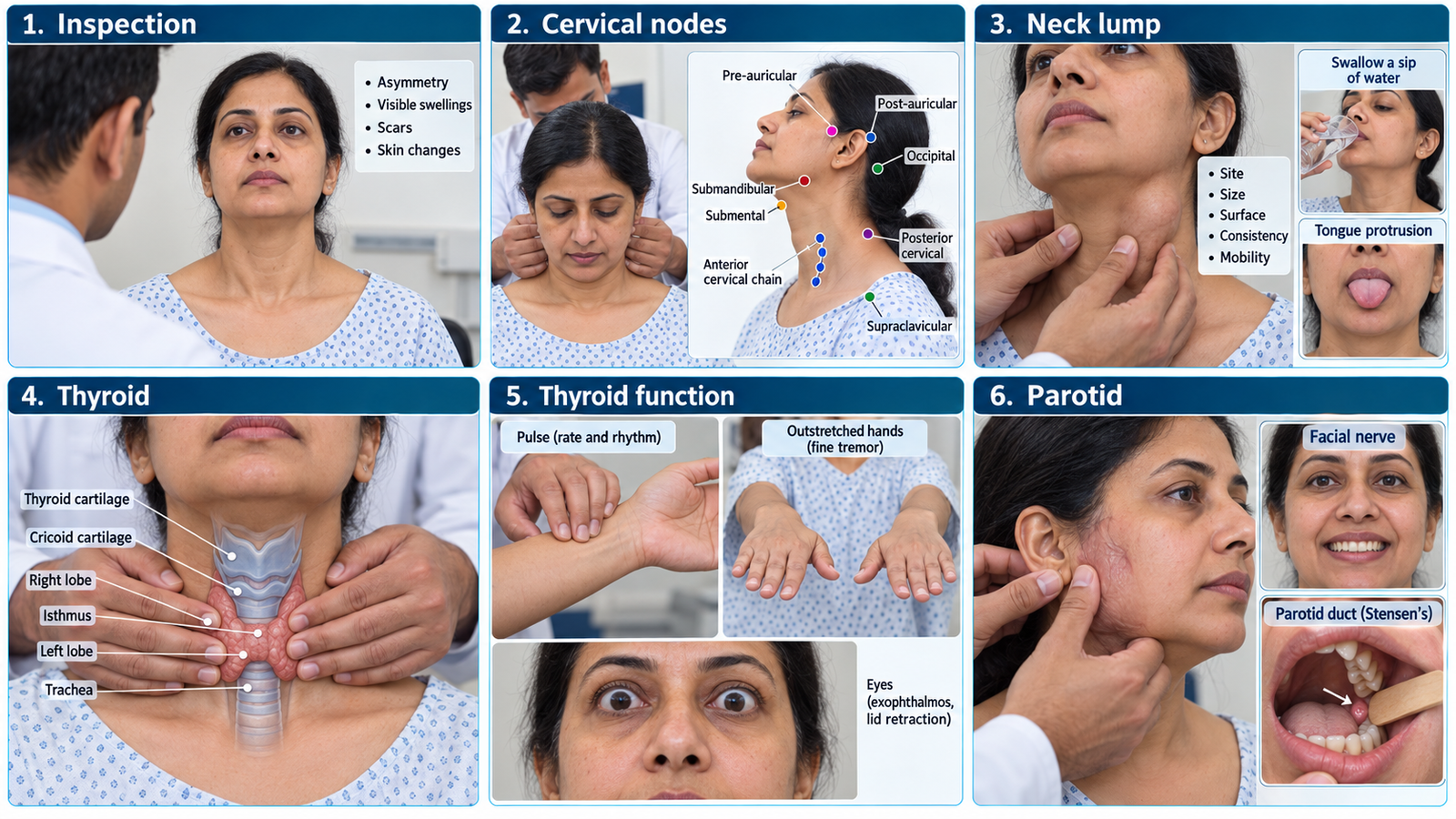
Introduce yourself, confirm identity, explain the examination, obtain consent, perform hand hygiene and expose the neck adequately. Inspect from the front and sides for asymmetry, scars, swellings and skin changes. - Step 2 — Examine the cervical lymph nodes.
From behind the seated patient, palpate systematically using the finger pads: submental, submandibular, pre-auricular, post-auricular, occipital, anterior cervical, posterior cervical and supraclavicular groups. Note size, tenderness, consistency, mobility and fixation. - Step 3 — Examine any neck lump.
Define its anatomical site and assess size, shape, surface, margins, skin, temperature, tenderness, consistency, fluctuation and mobility. Assess movement on swallowing and with tongue protrusion when relevant. - Step 4 — Examine the thyroid anatomically.
Inspect the lower anterior neck, ask the patient to swallow and observe movement. Palpate the isthmus and both lobes from behind, assessing enlargement, symmetry, nodules, consistency, tenderness and mobility; assess the trachea and cervical nodes where relevant. - Step 5 — Assess thyroid function when required.
Look for relevant peripheral signs such as pulse abnormality, tremor, warm hands, eye signs or other clinical features suggesting altered thyroid function rather than limiting assessment to the neck swelling alone. - Step 6 — Examine a parotid swelling.
Inspect the pre-auricular and retromandibular region, including the ear lobule, then palpate the swelling for size, surface, consistency, tenderness and fixation. Assess facial-nerve function, cervical lymph nodes and inspect the parotid duct opening inside the mouth where appropriate. - Step 7 — Complete the examination.
Thank the patient, perform hand hygiene and summarize the important positive and negative findings clearly to the examiner.
🖼️ Visual Learning
Systematic Neck, Cervical Node, Thyroid and Parotid Examination
🎥 Practical Demonstration
Neck Lump Examination — OSCE Demonstration
This practical demonstration shows systematic neck inspection, cervical lymph-node examination, thyroid assessment and examination of a neck lump.
📝 Important Viva Questions
1. Which major cervical lymph-node groups should be examined?
Answer: Examine the submental, submandibular, pre-auricular, post-auricular, occipital, anterior cervical, posterior cervical and supraclavicular groups systematically.
2. How should you describe a neck lump on examination?
Answer: Describe its site, size, shape, surface, consistency, tenderness, mobility or fixation and relevant associated features, including movement with swallowing or tongue protrusion.
3. Why do you ask the patient to swallow during thyroid examination?
Answer: The thyroid normally moves upward during swallowing because of its attachment to the larynx and trachea, helping identify a swelling arising from the thyroid.
4. Which simple clinical signs can help assess thyroid function?
Answer: Relevant signs include pulse rate and rhythm, hand temperature, tremor and appropriate eye signs, interpreted together with the rest of the clinical examination.
5. Why should facial-nerve function be assessed in a patient with a parotid swelling?
Answer: The facial nerve passes through the parotid gland. Facial weakness associated with a parotid mass is therefore an important clinical finding.