
AIM OSCE / OSPE • MBBS
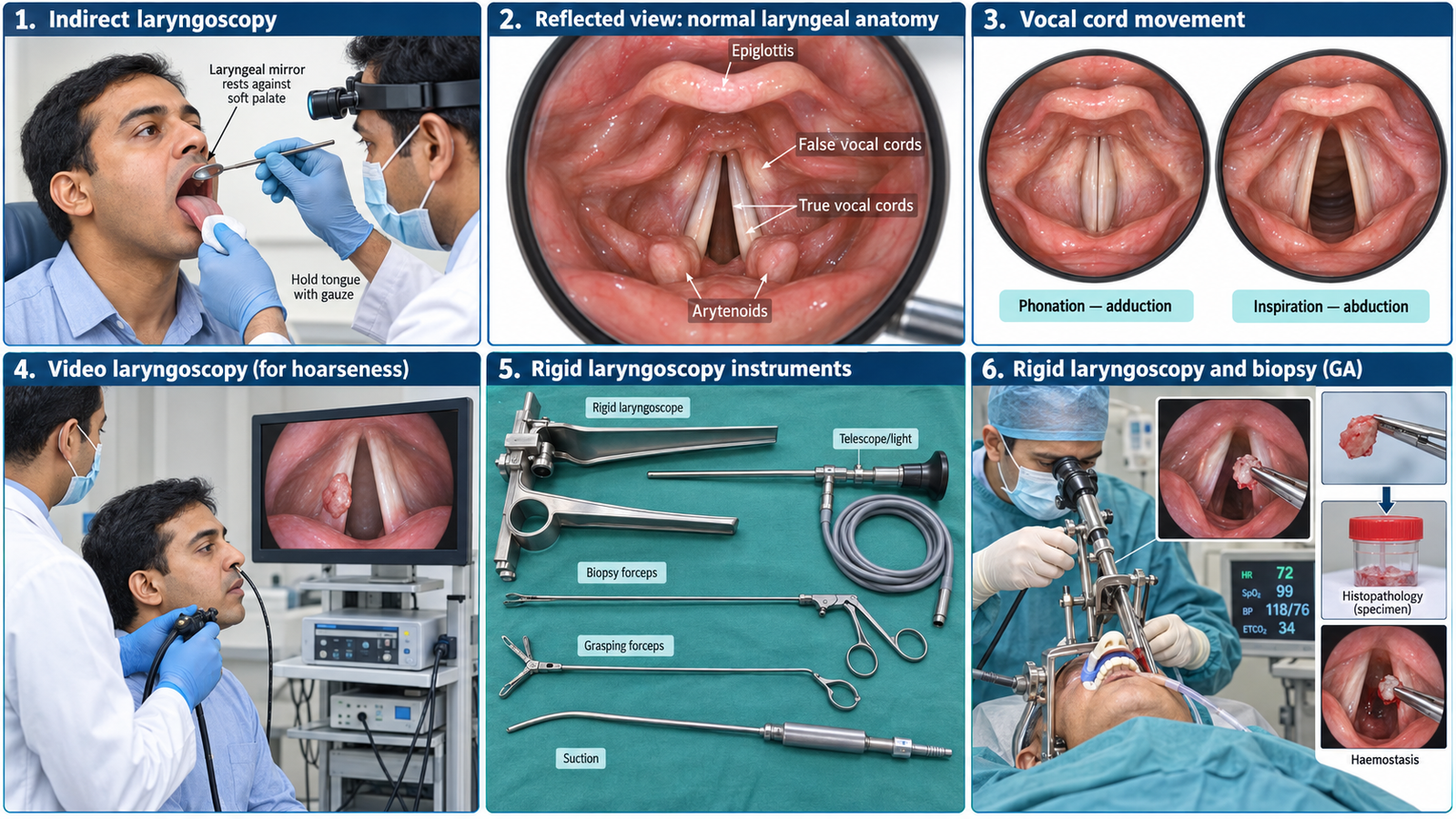
Station 6 — Laryngeal Examination: Indirect, Video and Rigid Laryngoscopy
🎯 Candidate Task
Demonstrate indirect laryngeal examination and identify the important laryngeal structures. Explain appropriate investigations for a patient with hoarseness, interpret the role of video laryngoscopy, and describe the instruments and basic steps of rigid laryngoscopy with biopsy of a laryngeal growth.
⚡ Model Station Answer
- Indirect laryngoscopy: I would examine the seated patient using a warmed laryngeal mirror while gently holding the protruded tongue with gauze and avoiding the tongue base and posterior pharyngeal wall.
- Structures: I would identify the epiglottis, valleculae, aryepiglottic folds, arytenoids, false cords, true vocal cords, pyriform fossae and assess vocal-cord movement during respiration and phonation.
- Hoarseness: Video/flexible laryngoscopy provides magnified dynamic visualization of the vocal folds and may demonstrate a lesion, inflammation or impaired cord mobility.
- Investigations: Depending on the findings I would request laryngoscopic assessment, appropriate imaging such as contrast CT of the neck for a suspicious growth, and histopathology when biopsy is obtained.
- Rigid laryngoscopy: Under general anaesthesia the larynx is exposed with a rigid laryngoscope, inspected systematically and a representative biopsy may be taken from a growth with haemostasis and correct specimen handling.
🔎 How to Perform / Approach
1
Prepare for indirect laryngoscopy. Introduce yourself, obtain consent, perform hand hygiene, seat the patient upright facing you and provide good illumination.
2
Position the tongue and mirror. Ask the patient to protrude the tongue, wrap it gently in gauze and hold it forward. Warm the laryngeal mirror and check its temperature before insertion.
3
Obtain the laryngeal view. Introduce the mirror without touching the tongue base or posterior pharyngeal wall and rest it gently against the soft palate. Adjust the angle until the larynx is visualized.
4
Inspect systematically. Identify the epiglottis, valleculae, aryepiglottic folds, arytenoids, false and true vocal cords and pyriform fossae. Ask the patient to phonate and then breathe deeply to assess vocal-cord movement.
5
Assess video laryngoscopy. Review the image/video for mucosal lesions, vocal-fold symmetry, colour, surface abnormality and movement, especially in a patient presenting with persistent hoarseness.
6
Select and request investigations. Write patient identifiers, relevant history and examination findings, the suspected clinical problem and the specific investigation required; suspicious laryngeal disease may require endoscopic assessment, imaging and biopsy for histopathology.
7
Describe rigid laryngoscopy. Under general anaesthesia with monitoring and dental protection, introduce the rigid laryngoscope under direct vision, expose the larynx and systematically inspect the supraglottis, glottis and visible subglottic region.
8
Biopsy the growth. Using appropriate long laryngeal biopsy forceps, obtain representative tissue under direct visualization, control bleeding and place the specimen in a correctly labelled histopathology container.
Exam point: During mirror examination, avoid touching the tongue base and posterior pharyngeal wall because this commonly triggers gagging. During rigid laryngoscopy, avoid forceful insertion and excessive pressure on the teeth or surrounding tissues.
🖼️ Visual Learning
VISUAL 1
Indirect, Video and Rigid Laryngeal Examination
🎥 Practical Demonstration
Examination of the Larynx and Pharynx — NEJM Videos in Clinical Medicine
Practical demonstration of laryngeal and pharyngeal examination using indirect mirror examination and flexible endoscopic visualization.
📝 Important Viva Questions
1. Why is the laryngeal mirror warmed before indirect laryngoscopy?
Warming prevents condensation and fogging on the mirror. Its temperature must be checked before insertion to avoid mucosal injury.
2. Which important structures should be identified during laryngeal examination?
The epiglottis, valleculae, aryepiglottic folds, arytenoids, false cords, true vocal cords and pyriform fossae should be assessed.
3. How do you assess vocal-cord mobility?
Observe both vocal cords during phonation and respiration. They normally adduct during phonation and abduct during inspiration.
4. What is the role of video laryngoscopy in a patient with persistent hoarseness?
It provides direct magnified visualization of the larynx and permits assessment of vocal-fold lesions, mucosal abnormalities and cord movement.
5. Why is rigid laryngoscopy useful when a laryngeal growth is suspected?
It provides detailed examination under general anaesthesia and permits a representative biopsy to be obtained for histopathological diagnosis.