
Station 5 — Hoarseness and Stridor: Focused History and Clinical Examination
🎯 Candidate Task
Take a focused history from a patient presenting with hoarseness or stridor and perform the relevant general, local ENT, systemic and neck examination. At the end, state any findings that would require further laryngeal assessment.
⚡ Model Station Answer
- I would establish the onset, duration and progression of the voice or breathing problem and ask about dysphagia, odynophagia, cough, haemoptysis, aspiration, neck swelling, weight loss and relevant smoking or occupational history.
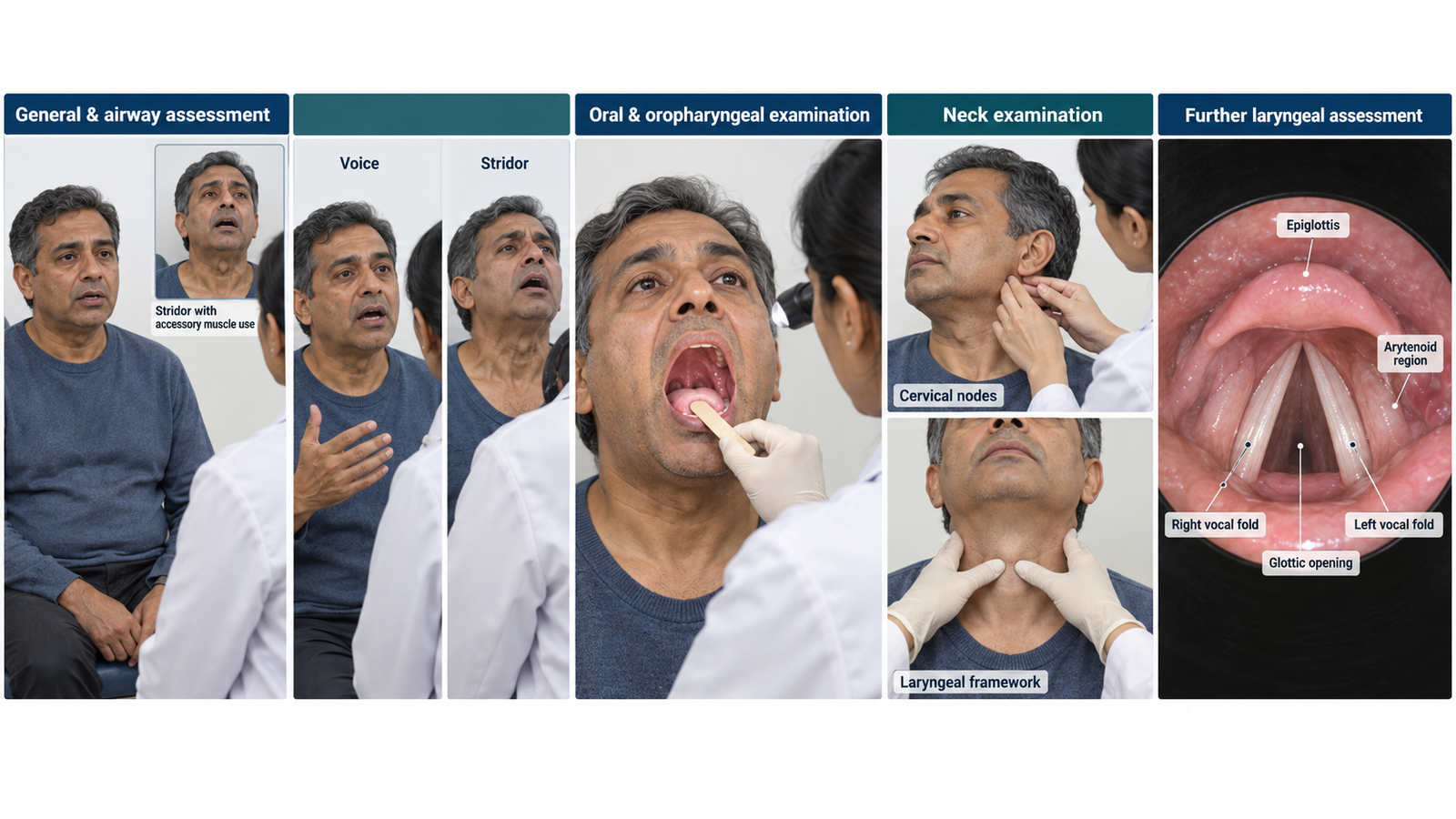
- I would assess the patient’s general condition, voice, respiratory effort and presence or character of stridor before proceeding with focused ENT and neck examination.
- I would examine the oral cavity and oropharynx, inspect and palpate the neck systematically, including cervical lymph nodes and relevant laryngeal and thyroid regions, and complete an appropriate respiratory examination.
- Persistent or progressive hoarseness, stridor, neck nodes or swelling, dysphagia, haemoptysis or other suspicious upper-airway features would prompt further laryngeal assessment.
🔎 How to Perform / Approach
Introduce and assess safety: confirm the patient, obtain consent and first observe whether there is respiratory distress or audible stridor before continuing with a routine station.
-
- Characterize the main symptom: for hoarseness ask about onset, duration, progression, voice use and variability; for stridor ask about onset, progression, triggers and whether it occurs at rest.
- Ask associated symptoms: enquire about dysphagia, odynophagia, choking or aspiration, cough, haemoptysis, throat or ear pain, fever, neck swelling and constitutional symptoms.
- Cover relevant background: ask about smoking, alcohol where relevant, occupational or vocal exposure, previous intubation or neck surgery, reflux-related symptoms, respiratory disease and relevant medication history.
- Perform general and local ENT examination: assess voice quality, respiratory effort and stridor, then inspect the mouth and oropharynx and perform other focused ENT examination where clinically indicated.
- Examine the neck systematically: inspect from the front and side, then palpate the laryngeal framework, thyroid region, any swelling and the cervical lymph-node groups, noting site, size, consistency, mobility and tenderness where relevant.
- Complete and summarize: perform a focused respiratory and other relevant systemic examination, then summarize the important findings and state whether further visualization of the larynx is required.
🖼️ Visual Learning
Clinical Examination in Hoarseness and Stridor
🎥 Practical Demonstration
Useful practical revision of systematic neck inspection, cervical lymph-node assessment and examination of neck structures relevant to this station.
📝 Important Viva Questions
Answer: Stridor is a harsh upper-airway sound produced by turbulent airflow through a narrowed airway and should prompt assessment for airway compromise.
Answer: Respiratory distress, cyanosis, marked accessory-muscle use, inability to speak normally and worsening stridor are important concerning features.
Answer: Ask especially about dysphagia, odynophagia, aspiration, haemoptysis, referred ear pain, neck swelling and constitutional symptoms.
Answer: Neck examination may identify cervical lymphadenopathy, thyroid or other neck masses and abnormalities around the laryngeal framework that may be related to the patient’s symptoms.
Answer: It is required when hoarseness is persistent or progressive or when associated findings such as stridor, neck nodes or swelling, dysphagia, haemoptysis or other suspicious upper-airway features are present.