
📖 AIM Learning Material · Foundation Module
Evidence-Based Practice, Patient Safety & Clinical Governance
How to make a well-supported clinical decision, reduce preventable harm and improve the care a service delivers.
Topic Introduction
Good care requires more than knowing a treatment. A clinician must decide whether the available evidence applies to the person in front of them, deliver care safely and recognise when a service needs to improve. Evidence-based medicine supports the individual decision. Patient-safety practices reduce the chance that care itself causes harm. Clinical governance makes teams and organisations responsible for measuring and improving quality; clinical audit is one practical way to do that. These ideas connect at the bedside and in the operating theatre. This chapter explains each process in a usable sequence, including how the safety principles taught here apply during preoperative care.
A. What Evidence-Based Medicine Means
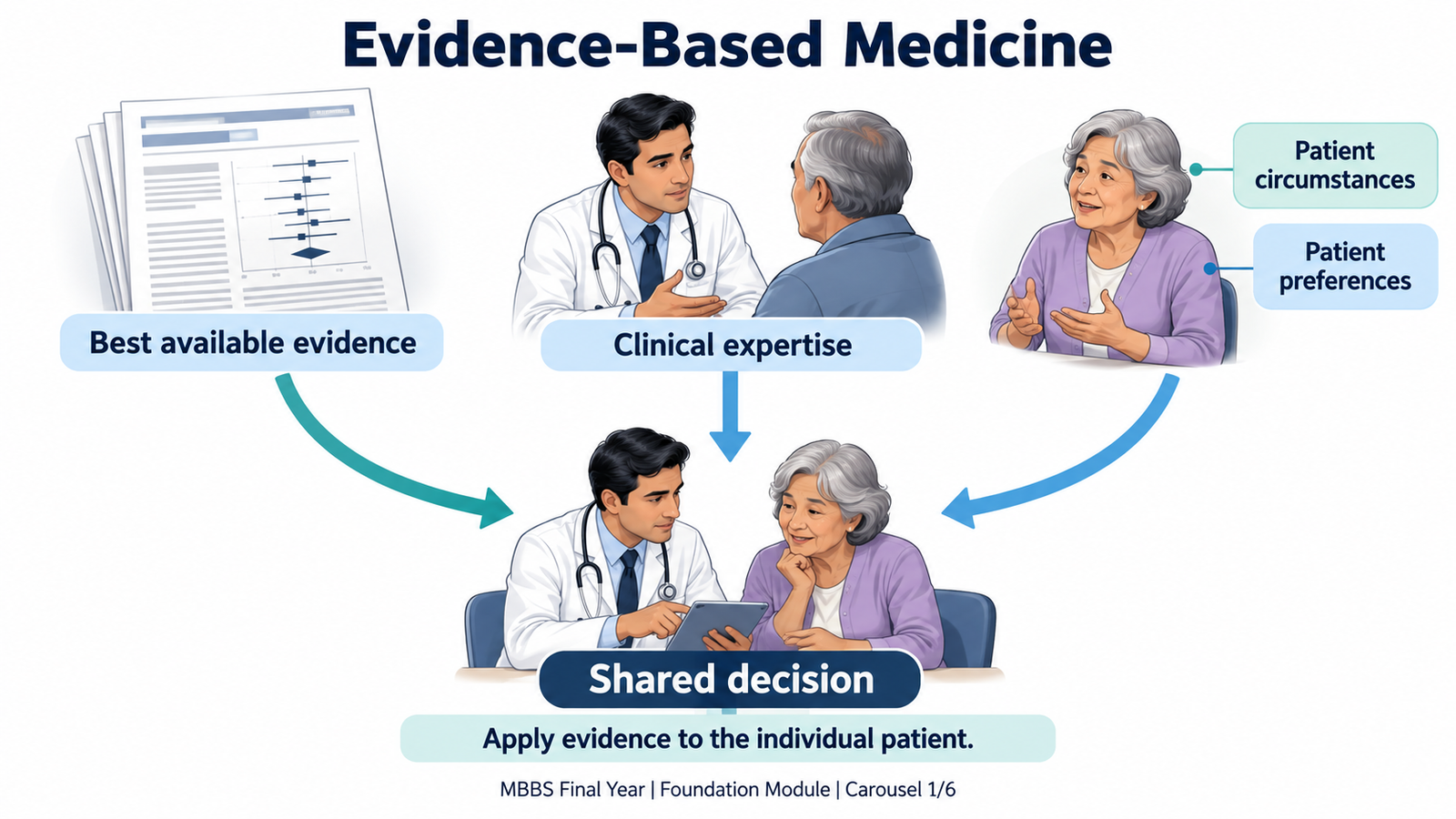
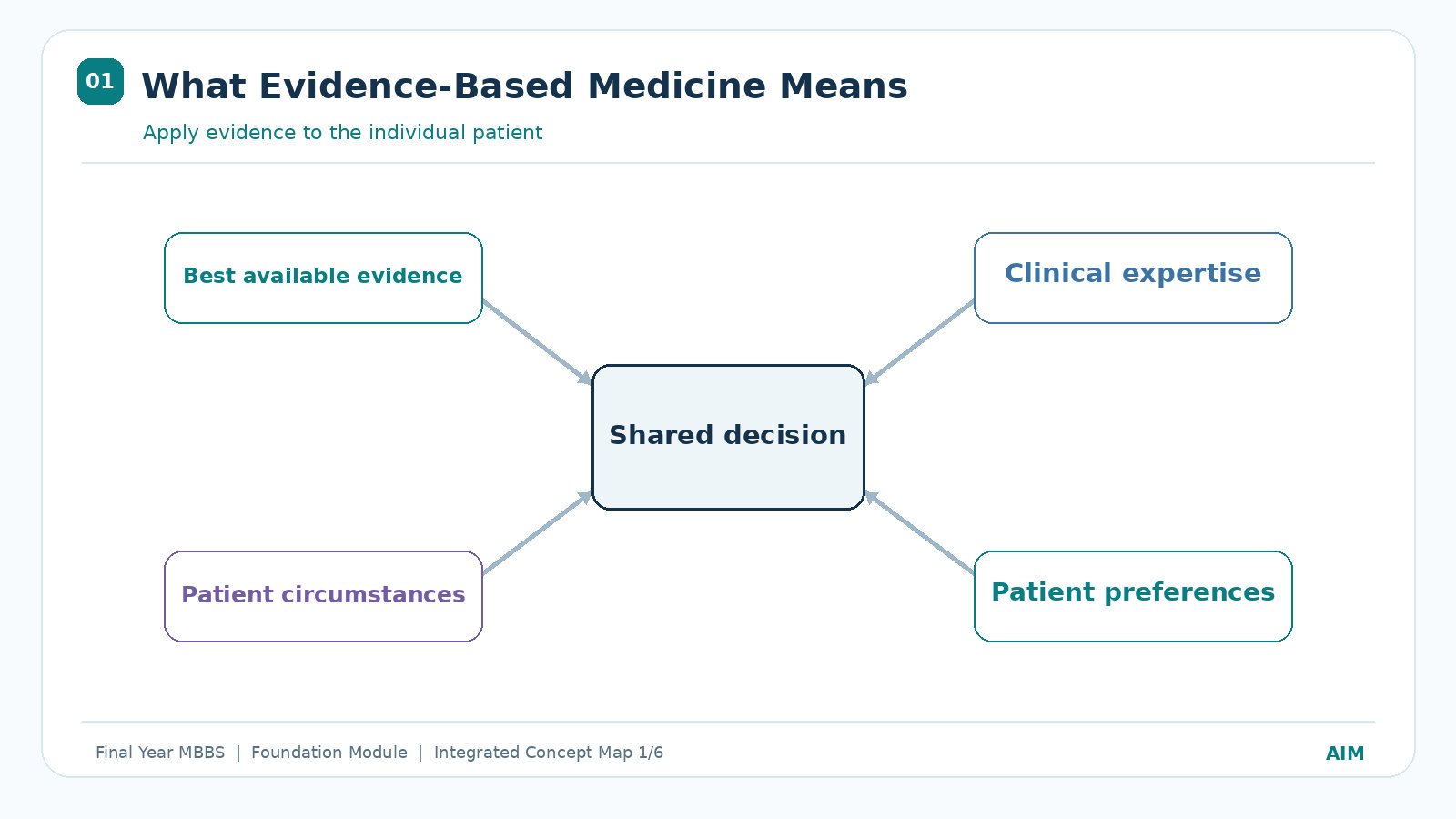
Evidence-based medicine (EBM) means using the best available research evidence together with clinical expertise and the patient’s circumstances and preferences to make a care decision. Research tells us what has happened in studied groups. Clinical judgement asks whether those findings are credible and relevant to this patient. The patient helps determine which possible benefits, harms and practical demands matter most. :contentReference[oaicite:0]{index=0} For example, evidence may support a treatment on average, but a patient’s other illnesses, possible adverse effects or priorities may change the appropriate choice. EBM therefore supports a reasoned, shared decision; it is more than following a paper or guideline automatically.
B. The Steps of Evidence-Based Practice and Levels of Evidence
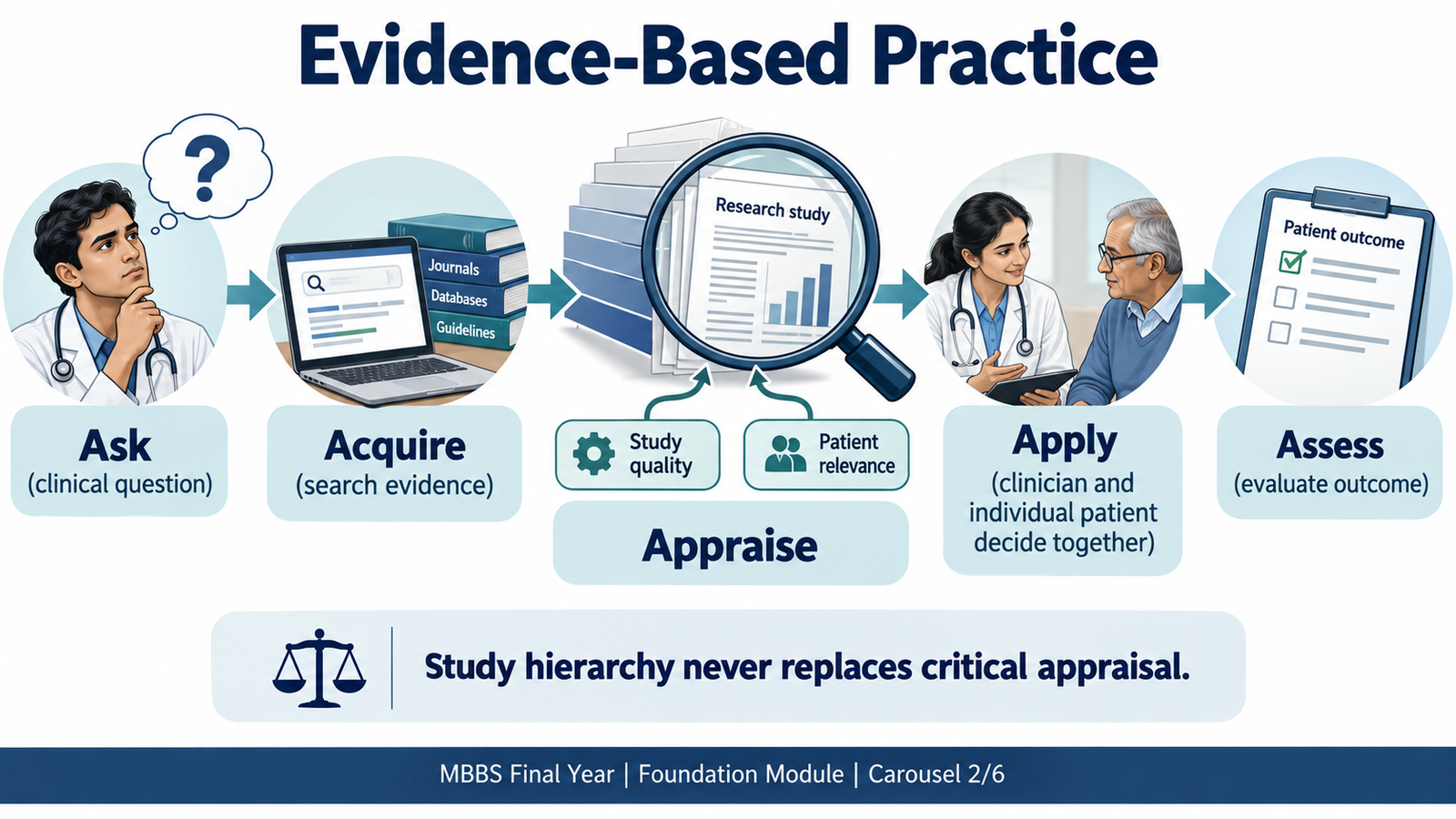
EBM begins with a clinical uncertainty, such as whether an intervention improves a patient-important outcome. A focused question makes the search manageable. For a treatment question, PICO helps specify the patient or problem, intervention, comparison and outcome.
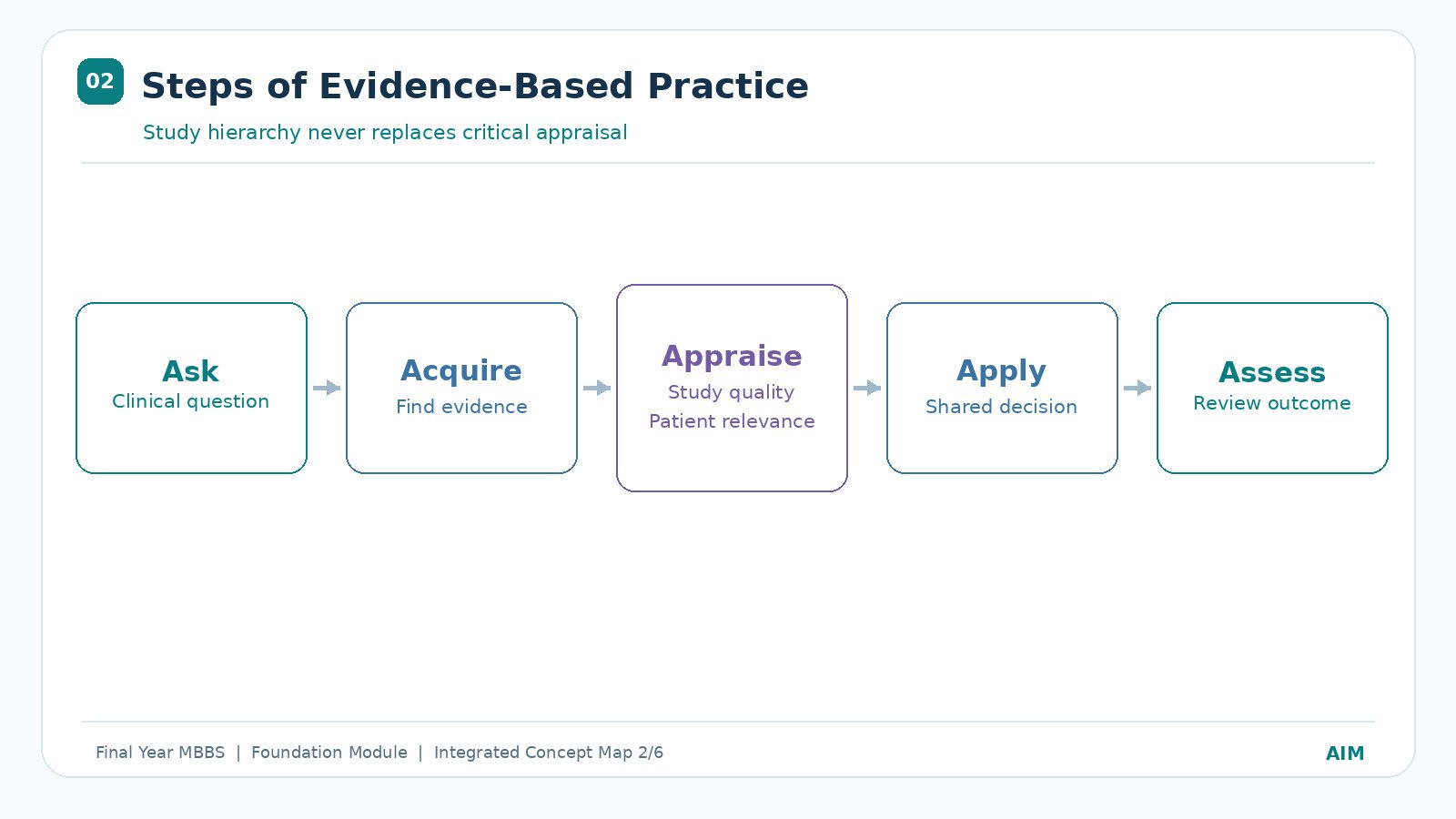
- Ask: Turn the uncertainty into a focused clinical question.
- Acquire: Find the best relevant and accessible evidence, beginning with reliable summaries where available.
- Appraise: Check whether the methods are trustworthy, what the results show and whether they are relevant to the patient.
- Apply: Combine the findings with clinical expertise and the patient’s preferences to choose a course of care.
- Assess: Review the result for the patient and consider how the decision-making process could improve next time.
These steps form a cycle: a patient’s response or a newly recognised uncertainty can lead to another question. :contentReference[oaicite:1]{index=1} Levels of evidence describe which study designs are likely to answer a particular type of question reliably. For a treatment benefit, a well-conducted systematic review of suitable randomised trials or a sound randomised trial often gives stronger evidence than an uncontrolled case series or unsupported opinion. Questions about diagnostic accuracy, prognosis or harm may call for different designs. A study’s place in a hierarchy never removes the need to appraise its quality: a poorly conducted study at a nominally high level may mislead. In appraisal, ask whether selection or measurement could have biased the result, whether the effect is large and precise enough to matter, and whether the studied patients resemble the patient receiving care. Statistical significance alone does not establish clinical importance.
C. Patient Safety and How Medical Errors Arise
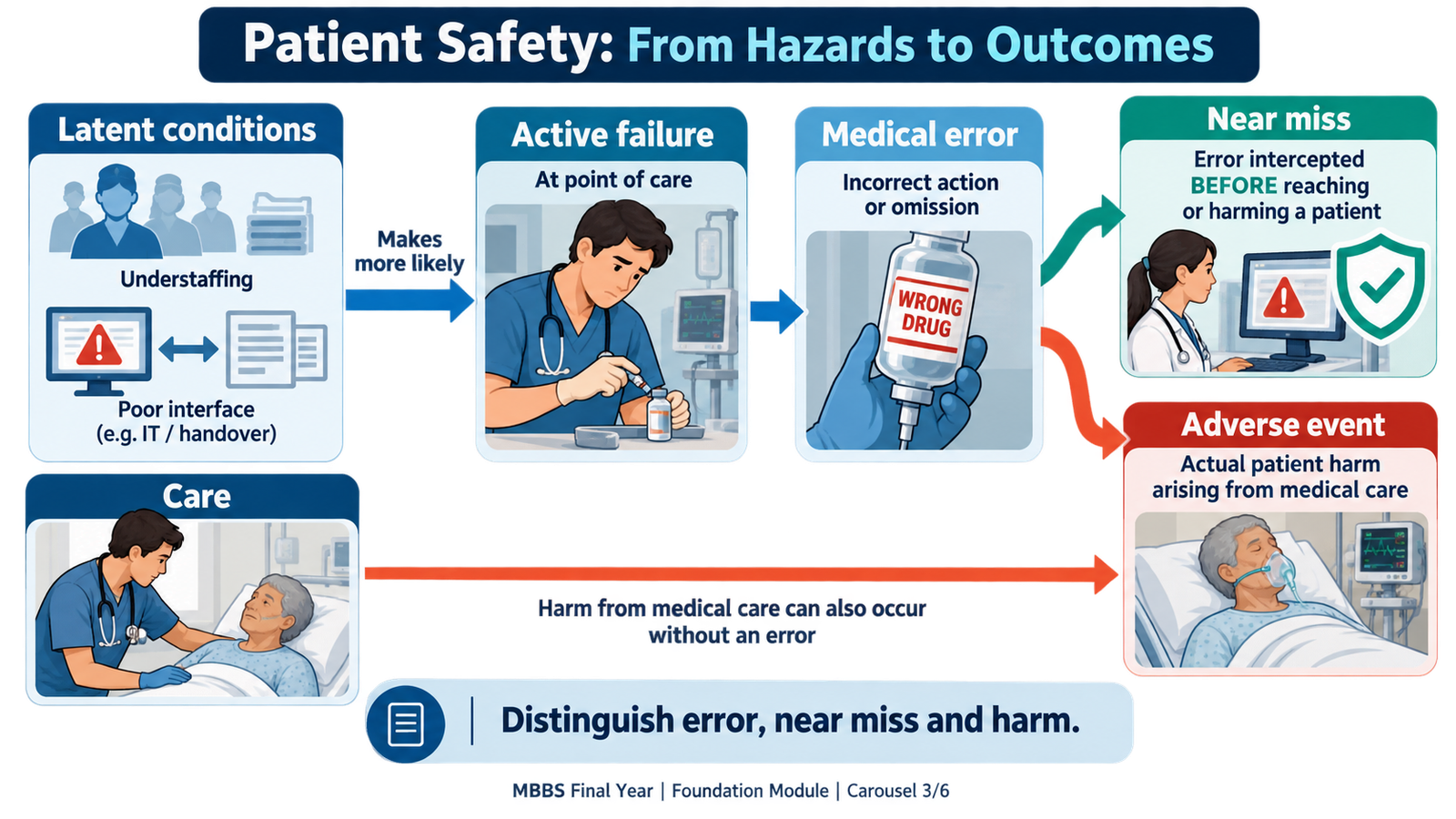
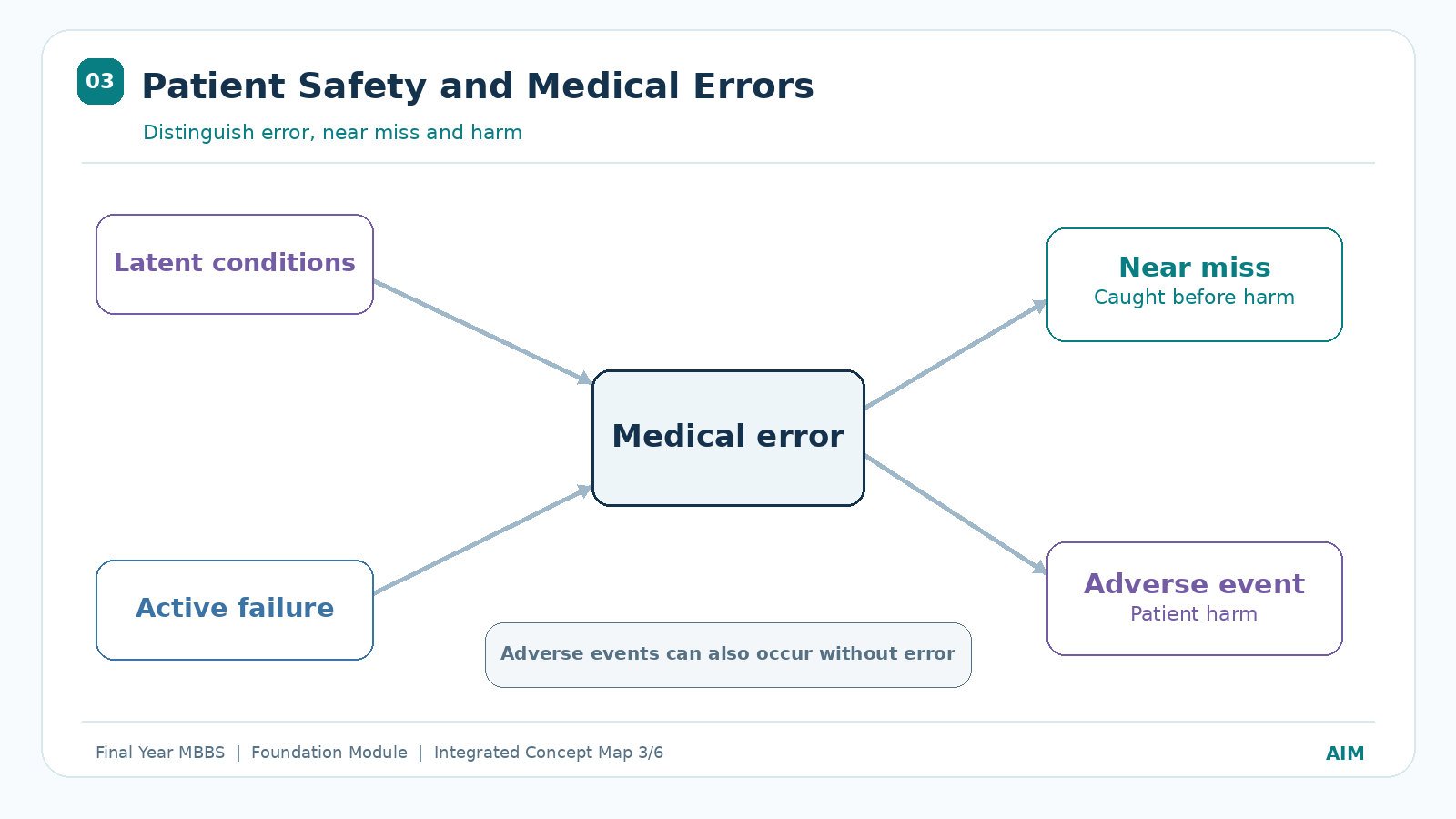
Patient safety is the work of reducing avoidable harm associated with healthcare. A medical error occurs when an intended action is not carried out as planned or the wrong plan is used. An error may be detected before it reaches a patient. An adverse event is harm associated with healthcare rather than the underlying illness; harm can occur without a preventable error. A near miss is a safety event that could have caused harm but did not. These distinctions matter because teams should learn from both harm and hazards caught in time. Errors may occur during diagnosis, prescribing or administering treatment, communication, procedures, monitoring or handover. At the individual task level, a slip is a failure while carrying out an appropriate plan; a mistake is a problem with the plan or judgement itself. The response should address the cause: an extra memory reminder alone will not correct a confusing process or an incorrect clinical assumption. An event often has both an active failure, close to the patient, and a latent condition, built into the work system. For example, selecting the wrong medicine is the visible action; look-alike packaging, poor lighting, interruptions or an unclear prescription may have made it more likely. Fatigue, workload, inadequate training, missing information and weak handovers can also contribute. A useful safety review asks what allowed the error to happen and what could prevent its recurrence.
D. Preventing Errors in Everyday and Preoperative Care
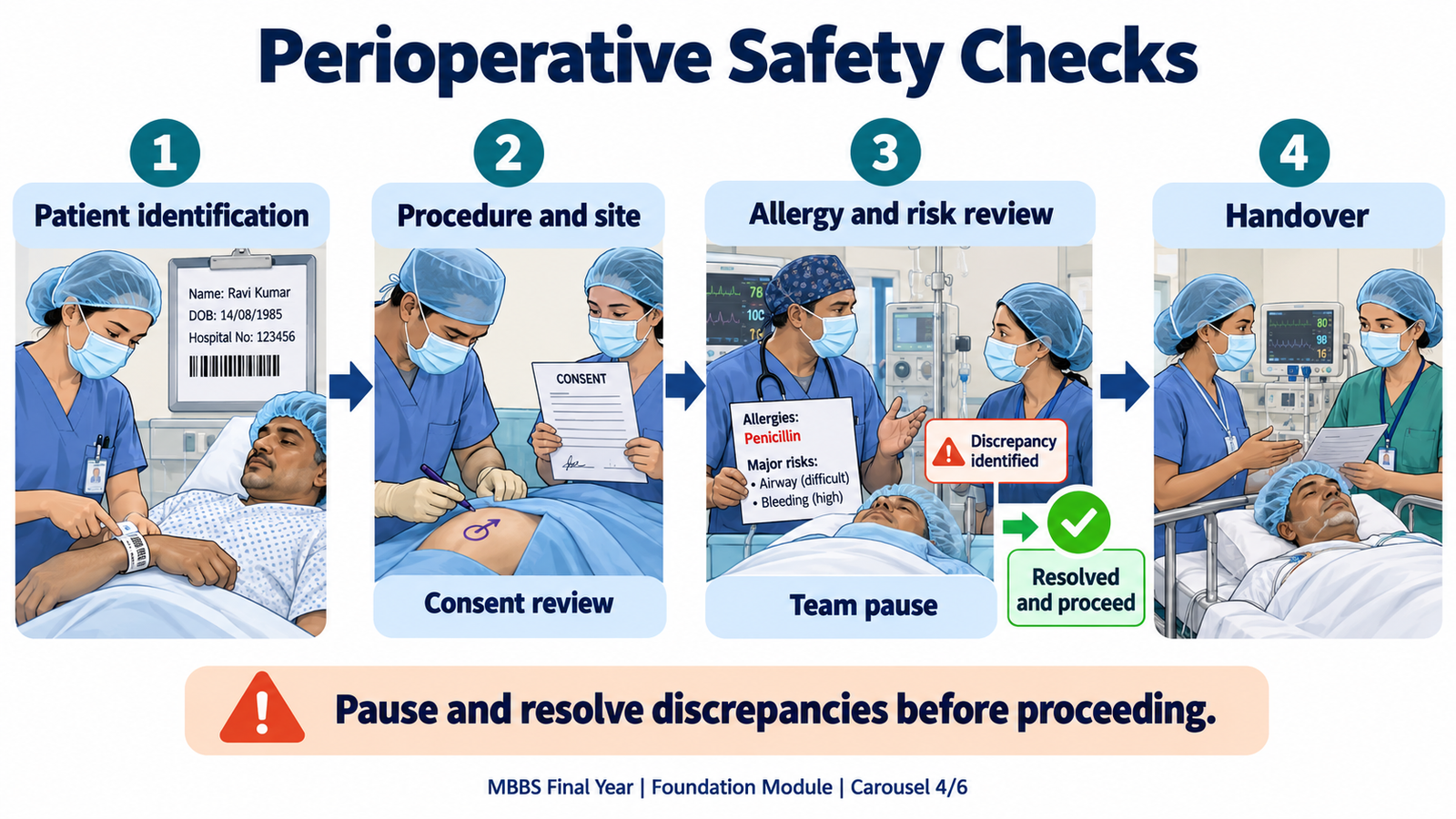
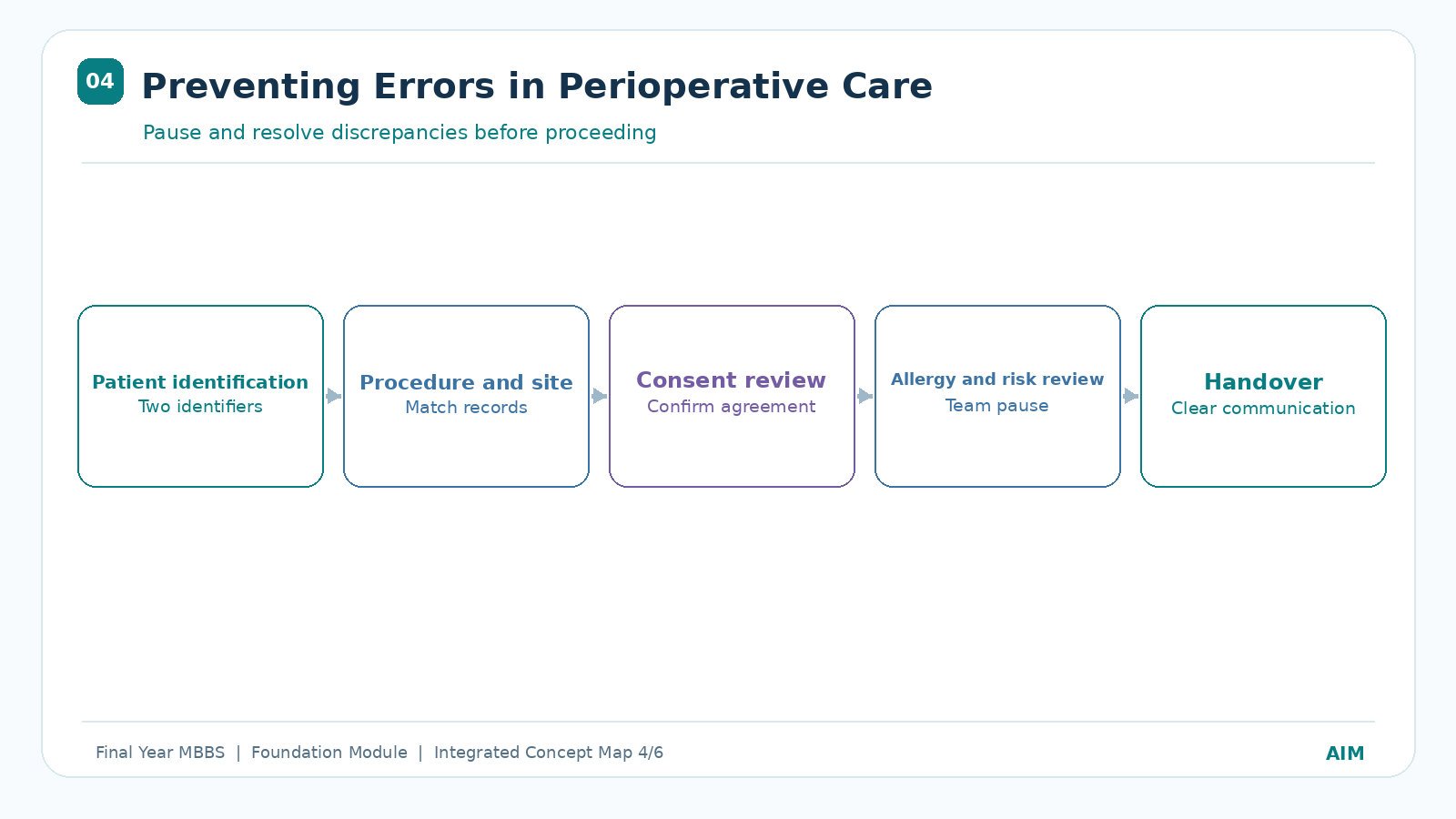
Prevention works best when reliable systems support careful clinicians. Clear patient identification, accurate documentation, medication checks, effective handovers, appropriate supervision and an environment where staff can raise concerns all reduce the opportunity for an error to reach a patient. Reporting and reviewing near misses can reveal a hazard before harm occurs. When an incident has happened, the immediate priority is the patient’s safety and appropriate escalation; the team then documents and learns from the event under its local policy. Preoperative care applies the same principles at several points. The team checks that it has the correct patient, planned procedure and site; reviews relevant consent and records; communicates allergies, anticipated difficulties and other patient-specific risks; and confirms that necessary equipment and information are available. The surgical safety checklist creates planned moments for the team to share this information. The WHO checklist uses checks before anaesthesia, before incision and before the patient leaves the operating room.A checklist supports communication; it does not replace clinical assessment or justify a rushed tick-box exercise. If an important discrepancy appears, the safe response is to pause, resolve it and escalate as needed before proceeding. Topic 3 applies these principles in its preoperative assessment and surgical-safety learning and OSCE.
E. Clinical Governance and Its Main Components
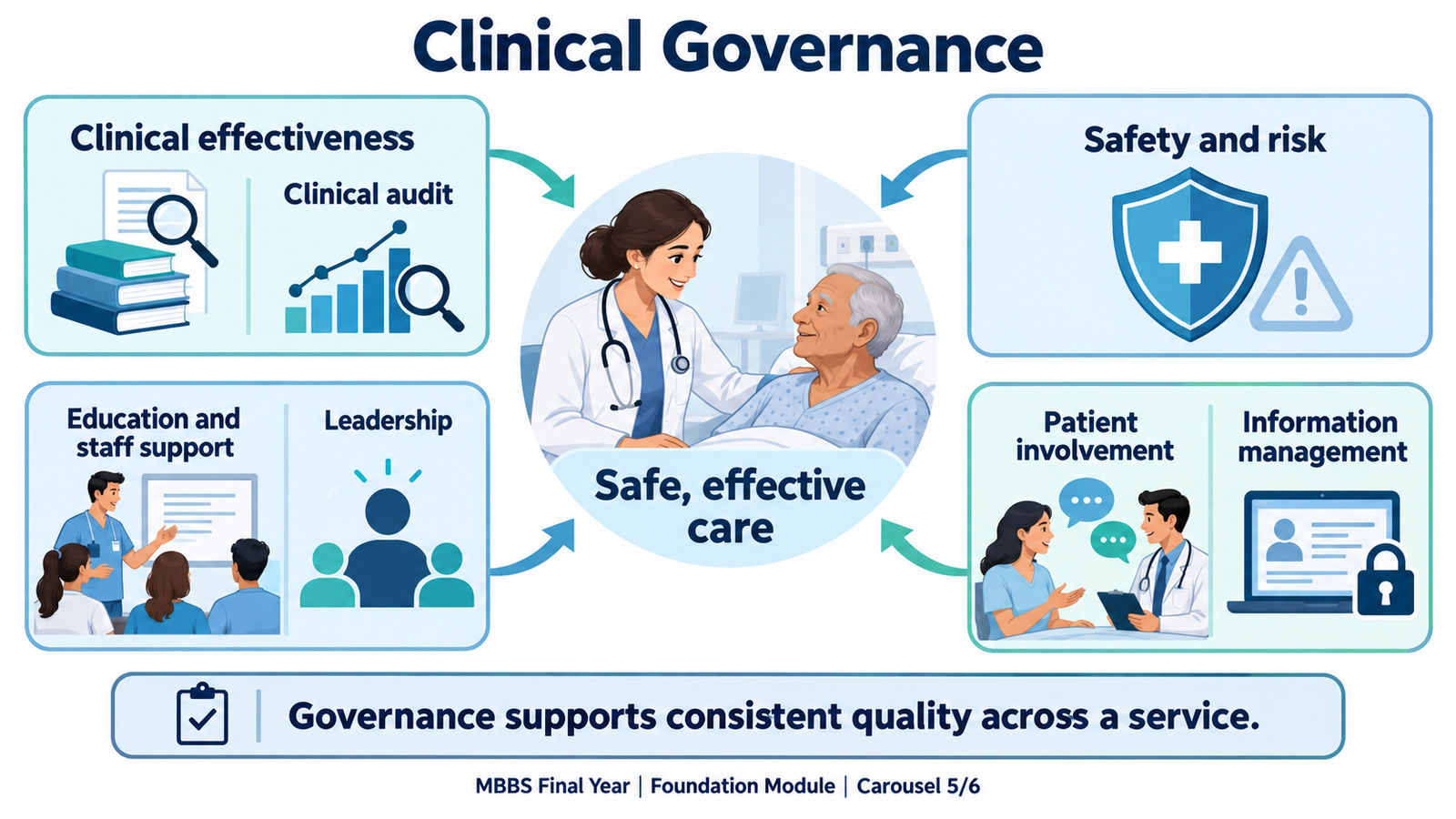
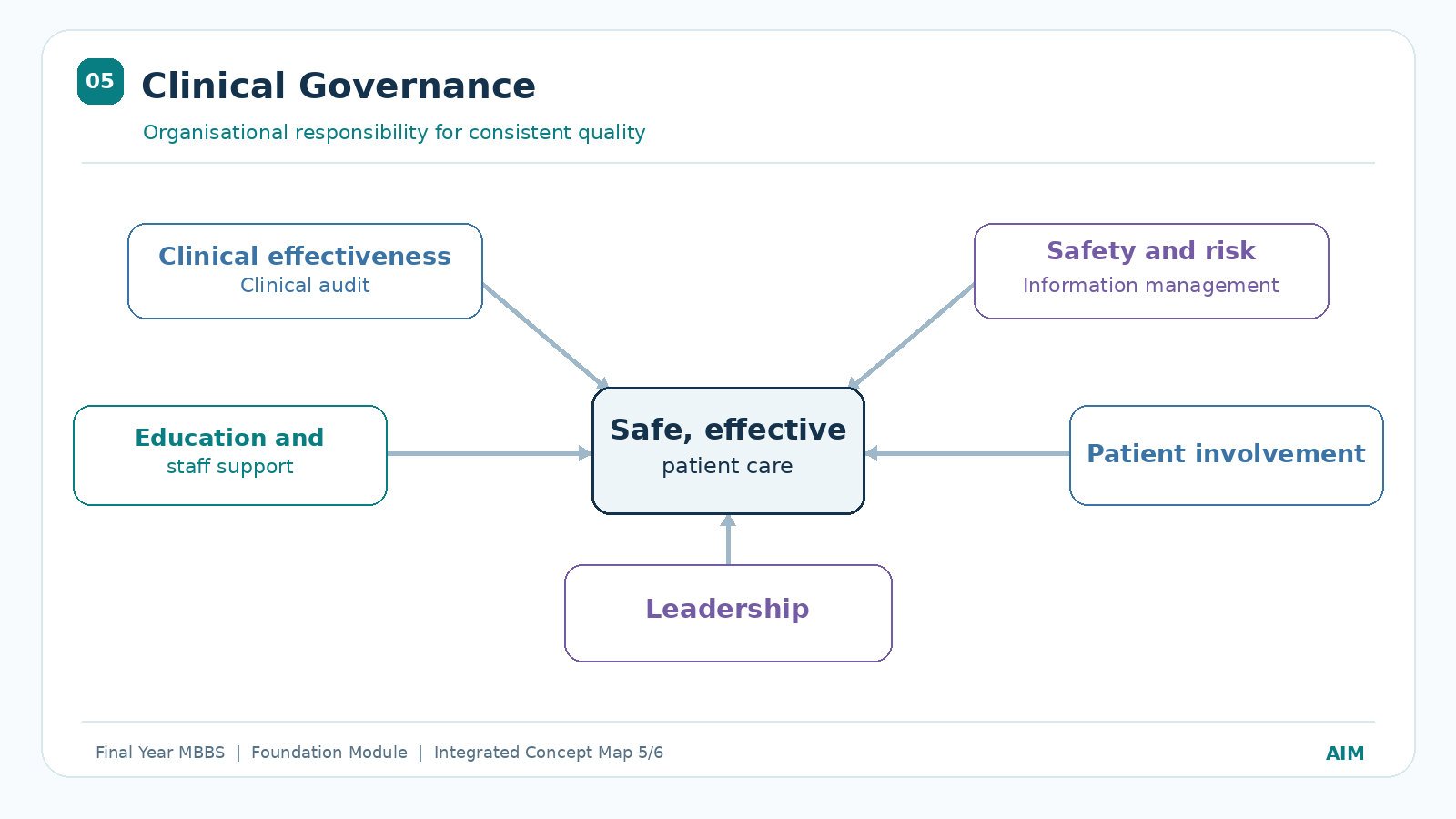
Clinical governance is the way a healthcare organisation remains accountable for maintaining and improving the quality and safety of its care. It connects individual professional practice with team learning, reliable information, leadership and organisational responsibility. A clinician may use evidence to make one good decision; governance asks whether the service can deliver good care consistently across patients. :contentReference[oaicite:6]{index=6} Its components are often taught as related areas rather than one universal numbered list:
- Clinical effectiveness: Use sound evidence and review whether care achieves intended results.
- Patient safety and risk management: Identify hazards, respond to incidents and reduce the chance of recurrence.
- Clinical audit and improvement: Compare actual practice with an agreed standard and act on gaps.
- Education, training and staff support: Maintain the knowledge, skills and working conditions needed for safe care.
- Patient and public involvement: Include patients’ experiences and priorities in service improvement.
- Information management: Keep records accurate, useful and appropriately confidential so teams can coordinate and review care.
- Leadership and accountability: Assign responsibility, support reporting and ensure agreed improvements are carried out.
These components reinforce each other. For example, an incident report may identify a handover problem; staff training and a clearer handover process address it; an audit then checks whether the revised process is being used.
F. Clinical Audit as a Cycle of Improvement
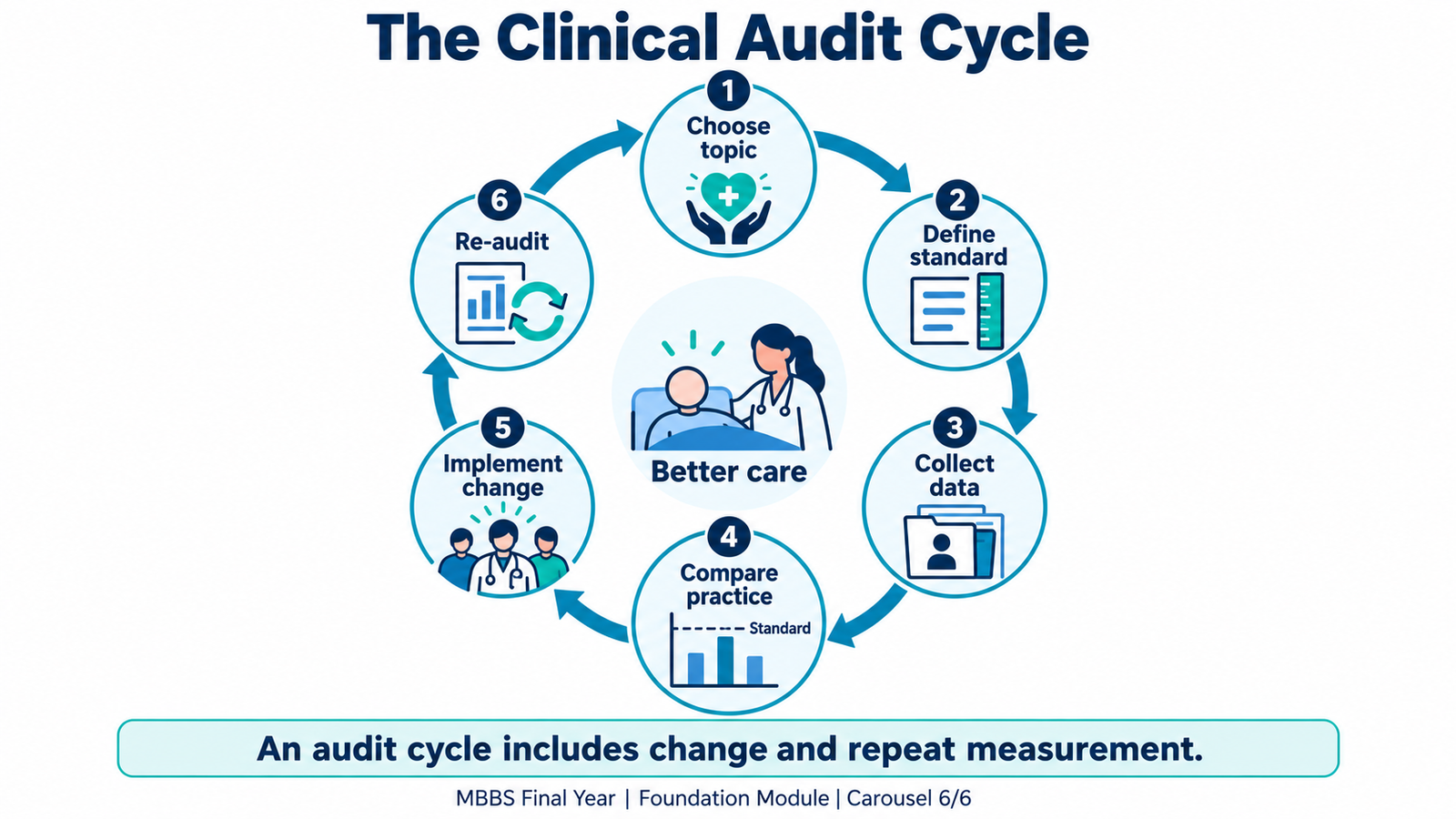
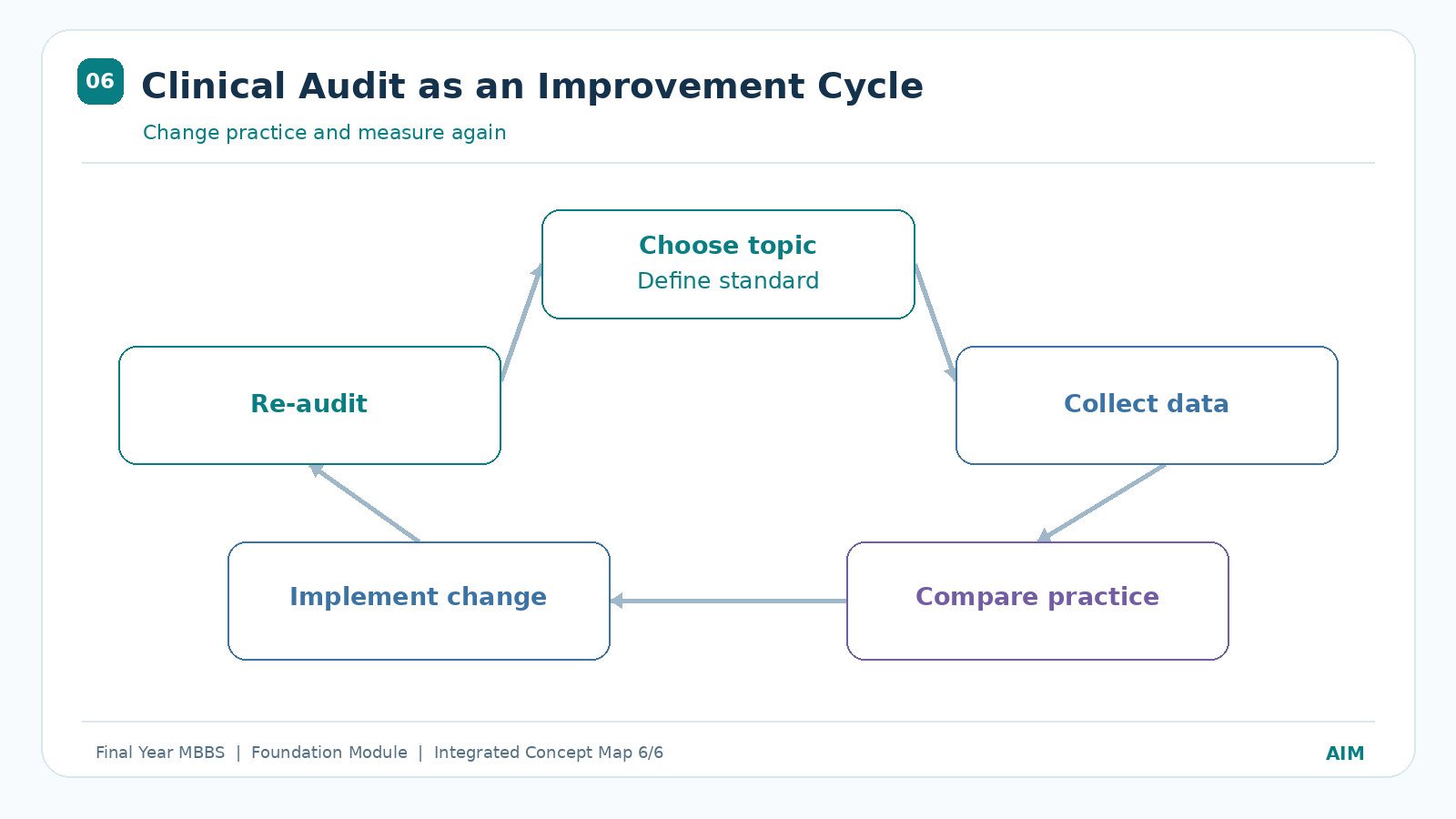
A clinical audit checks whether care being delivered meets an explicit, evidence-informed standard. It starts with a defined aspect of existing practice, measures what is happening, identifies a gap, supports a change and measures again. A first measurement alone is an incomplete audit cycle if the team never acts on the findings or checks whether practice improved. :contentReference[oaicite:7]{index=7}
- Choose the topic: Select an important aspect of care where improvement is possible, such as documentation of a specified safety check.
- Set the criterion and standard: State exactly what should happen and the agreed target against which practice will be compared. The standard should come from appropriate evidence or an accepted local policy.
- Plan and collect data: Decide which patient records or cases qualify, what information is needed, how it will be recorded and how confidentiality will be protected.
- Compare practice with the standard: Calculate how often the criterion was met and look for the reasons behind any gap.
- Implement change: Agree practical actions, responsible people and a time for review. A change might involve clearer documentation or a more reliable team process.
- Re-audit: Collect comparable data again to see whether practice improved. Continue the cycle if a significant gap remains.
Suppose a team audits whether a required preoperative safety check is documented. It first defines what counts as completed documentation and the standard expected by its service. After reviewing eligible records, the team addresses identified barriers and repeats the measurement. The comparison shows whether the change improved that part of care; it does not, on its own, prove that every surgical outcome improved.
AIM High-Yield Review
- EBM combines best available evidence, clinical expertise and the patient’s circumstances and preferences.
- The five EBM steps are Ask, Acquire, Appraise, Apply and Assess.
- PICO makes a treatment question focused and searchable.
- The useful study design depends on the clinical question; study quality and patient relevance still need appraisal.
- An error can occur without harm. An adverse event involves healthcare-associated harm. A near miss reveals a hazard caught before harm.
- Both the visible action and underlying system conditions may contribute to an error.
- Patient identification, clear communication, reliable checks and speaking up about discrepancies help prevent harm.
- Preoperative safety includes verifying the patient, procedure and site and communicating important risks across the team.
- Clinical governance makes organisations accountable for safe, effective and continuously improving care.
- Clinical audit compares actual care with an explicit standard, implements change and measures again.
▶ Clinical Audit and the Audit Cycle
Watch how a clinical team compares practice with a standard, implements change and re-audits to check for improvement.
If the video does not display, open it on YouTube.