
Topic 6. Breaking Bad News, Palliative & Geriatric Care
Foundation Module · Communicating difficult information, relieving suffering and supporting the needs of older adults.
Topic introduction
A serious diagnosis can change how a patient understands the future. Good clinical care therefore includes explaining difficult information clearly, finding out what matters to the patient and responding to distress. When an illness causes substantial suffering, palliative care adds focused relief of physical symptoms and psychological, social and spiritual concerns. Near the end of life, this care becomes particularly attentive to comfort, dignity and the patient’s wishes. Geriatric care has a wider purpose: it helps older adults maintain function and independence while managing illness and age-related vulnerabilities. These three areas meet in patient-centred practice, but they are not the same task.
A. What breaking bad news requires
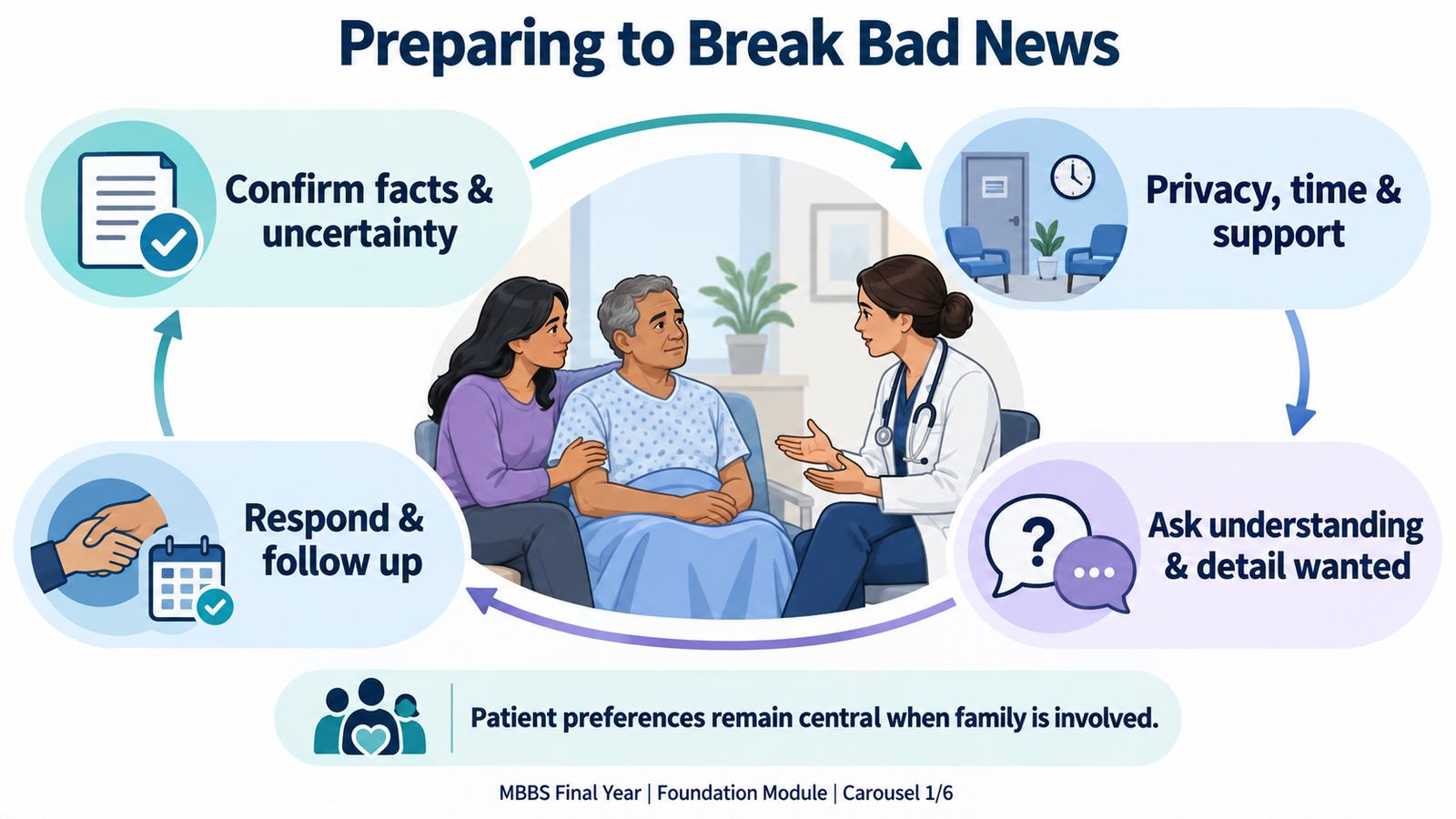
Bad news is information that seriously changes a person’s expectations about health or the future. It may concern a diagnosis, treatment failure, disability or a poor prognosis. The difficulty lies in more than delivering facts: the clinician must discover what the patient understands, communicate at a pace the patient can manage and remain available after the news is given.
Before the discussion, confirm the clinical facts and what is still uncertain. Choose a private, quiet setting with enough time and minimal interruption. Ask whom the patient wants present. Family members can provide important support, but an adult patient who can make decisions remains central to the conversation; information should be shared with relatives according to the patient’s wishes and applicable confidentiality requirements.
Use ordinary language and avoid guessing how much detail the patient wants. Some people ask for full information immediately; others prefer to receive it gradually. Notice the response as well as the words spoken: silence, disbelief or repeated questions may mean the patient needs time before further explanation.
B. Using SPIKES to counsel the patient and family
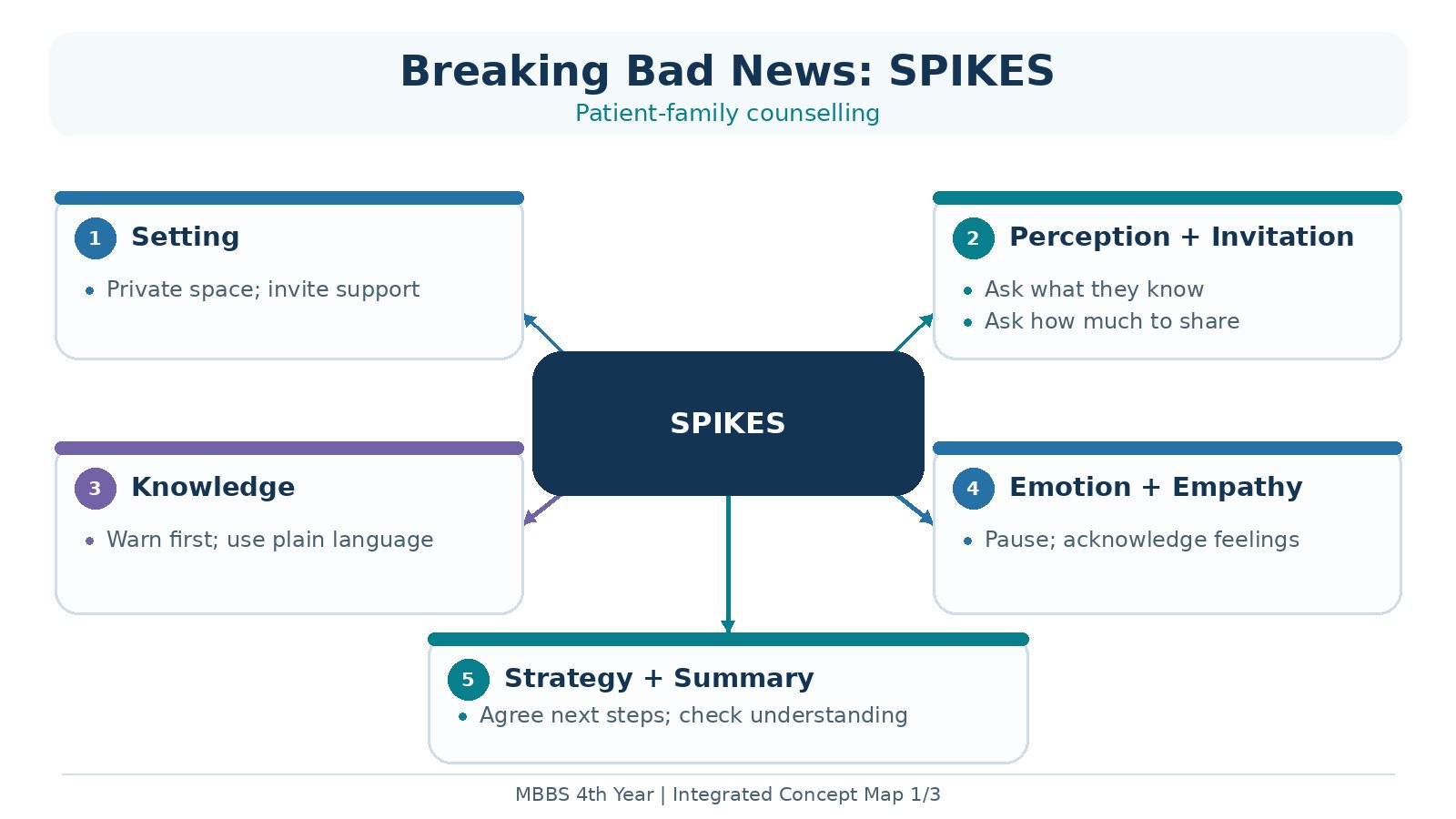
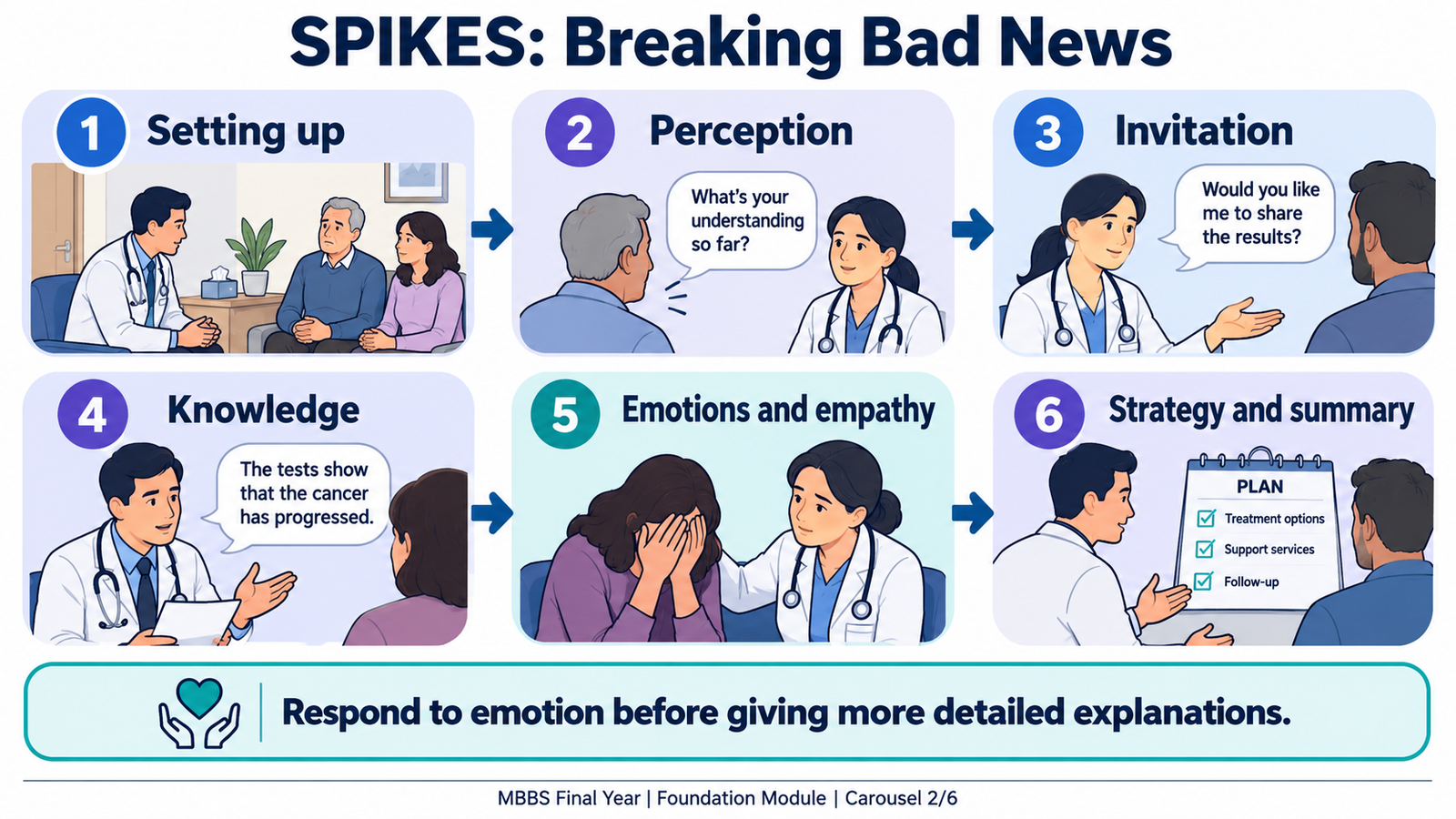
SPIKES is a six-step framework for a difficult conversation. It provides an order to remember, while allowing the clinician to adapt to the individual patient. Its purpose is to support an honest, compassionate exchange rather than a rehearsed speech.
- S — Setting up: Prepare the facts and arrange privacy, time and appropriate support. Sit where the patient can see you and reduce interruptions.
- P — Perception: Find out what the patient already understands. This reveals misconceptions and helps you start from the patient’s current understanding.
- I — Invitation: Ask how much the patient wishes to know now and whether they want family involved. Respect the answer while keeping a way open for further discussion.
- K — Knowledge: Give a brief warning that difficult information is coming. Explain the news in clear, small portions; pause and check understanding. State uncertainty honestly when the outcome is not yet known.
- E — Emotions and empathy: Recognize the response, allow silence and acknowledge the feeling. An empathetic response should come before a long discussion of investigations or treatment.
- S — Strategy and summary: Summarize what has been understood, discuss realistic next steps and agree on a plan for support and follow-up.
When counselling both patient and family, attend to the patient’s concerns as well as the family’s. Check whether they understand the immediate plan, invite questions and arrange another discussion when necessary. Avoid overwhelming detail, false reassurance and promises about prognosis that the evidence cannot support. SPIKES helps structure communication; it does not replace clinical judgment or the patient’s preferences.
C. Palliative care: when to consider it and what it addresses
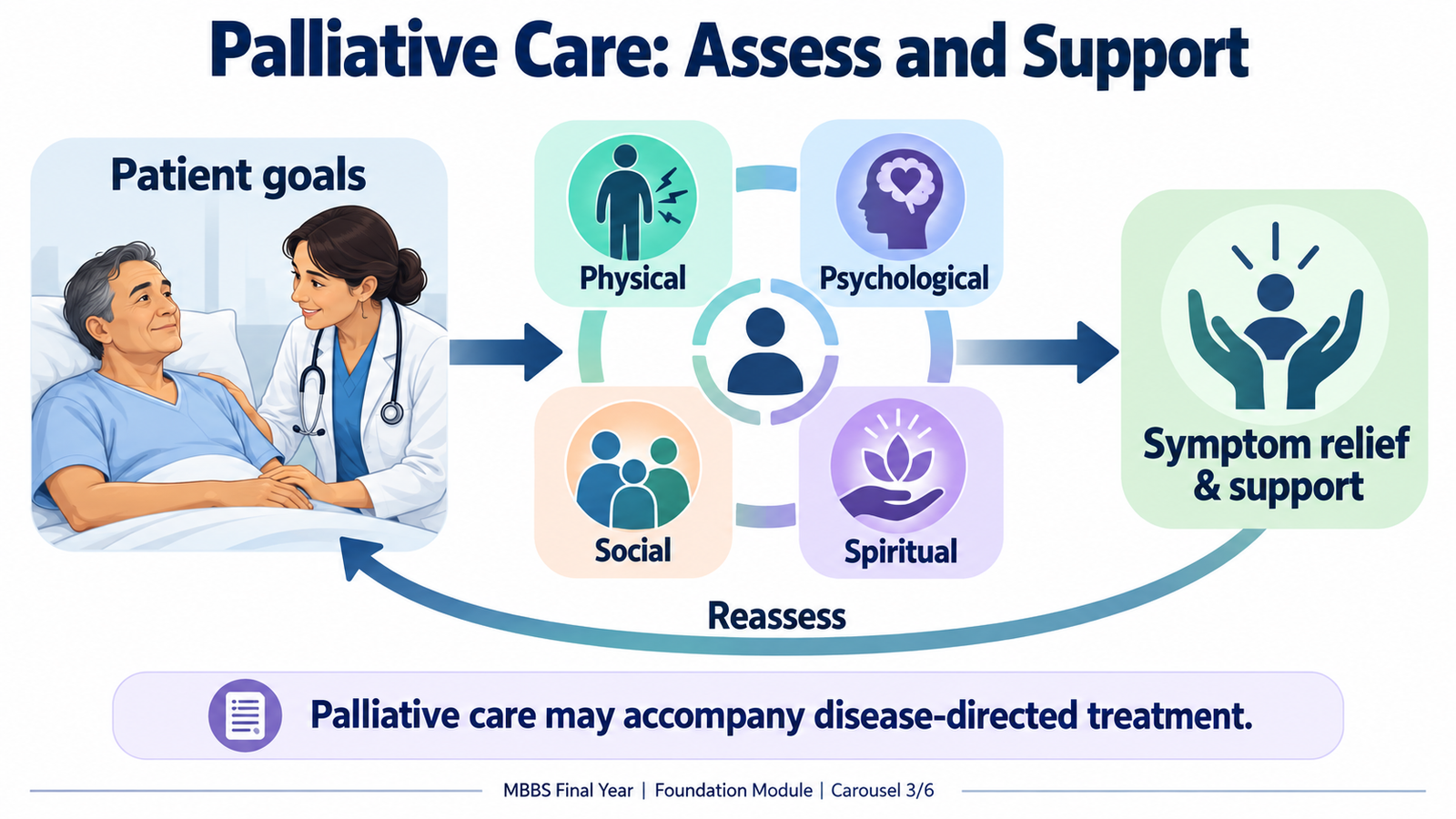
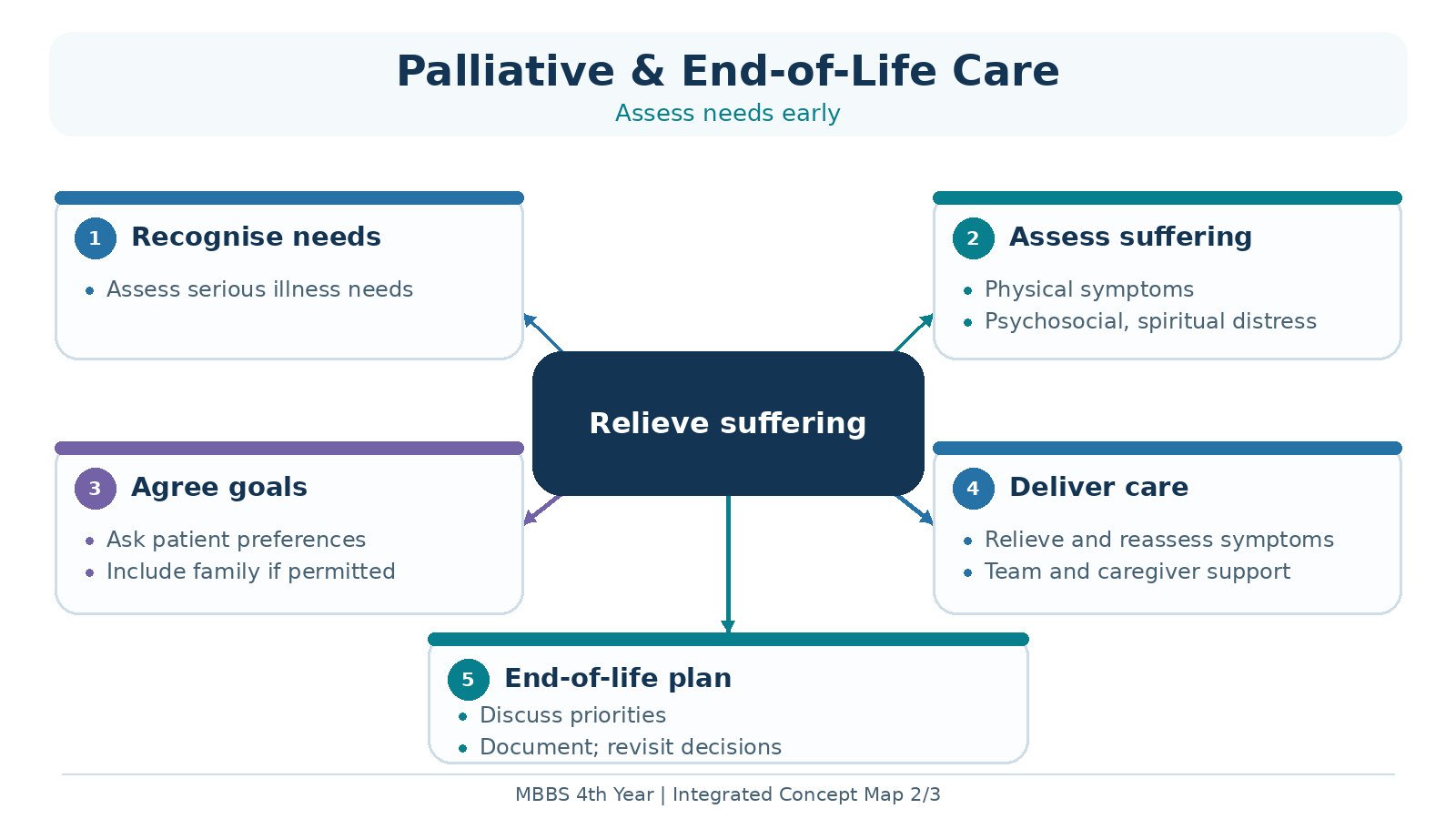
Palliative care aims to improve quality of life by preventing and relieving suffering associated with serious illness. It considers physical, psychological, social and spiritual needs, including the needs of family caregivers. A patient can receive palliative care while also receiving treatment intended to control the illness. Therefore, introducing it does not mean that treatment has stopped or that death is imminent.
The prerequisite is recognition of a need: symptoms, distress or practical difficulties that require additional attention. The team first asks what matters most to the patient, assesses the sources of suffering and identifies problems that can be treated or eased. A useful assessment includes:
- Physical concerns: pain, breathlessness, nausea, fatigue, poor sleep and other troublesome symptoms.
- Psychological concerns: fear, low mood, uncertainty and worries about loss of control.
- Social concerns: caregiving, finances, access to care and the effect of illness on family life.
- Spiritual or personal concerns: beliefs, meaning, hopes and practices the patient wishes clinicians to respect.
Care then follows an ongoing cycle: agree on goals, manage symptoms, offer appropriate support and reassess whether the plan is helping. Treat a reversible contributor when doing so fits the patient’s goals. Explain the expected benefit and burden of each intervention rather than assuming that more treatment always means better care. Nurses, physicians and other relevant professionals work with the patient and family, with specialist palliative input when needs are complex.
D. End-of-life care: recognising change and planning comfort
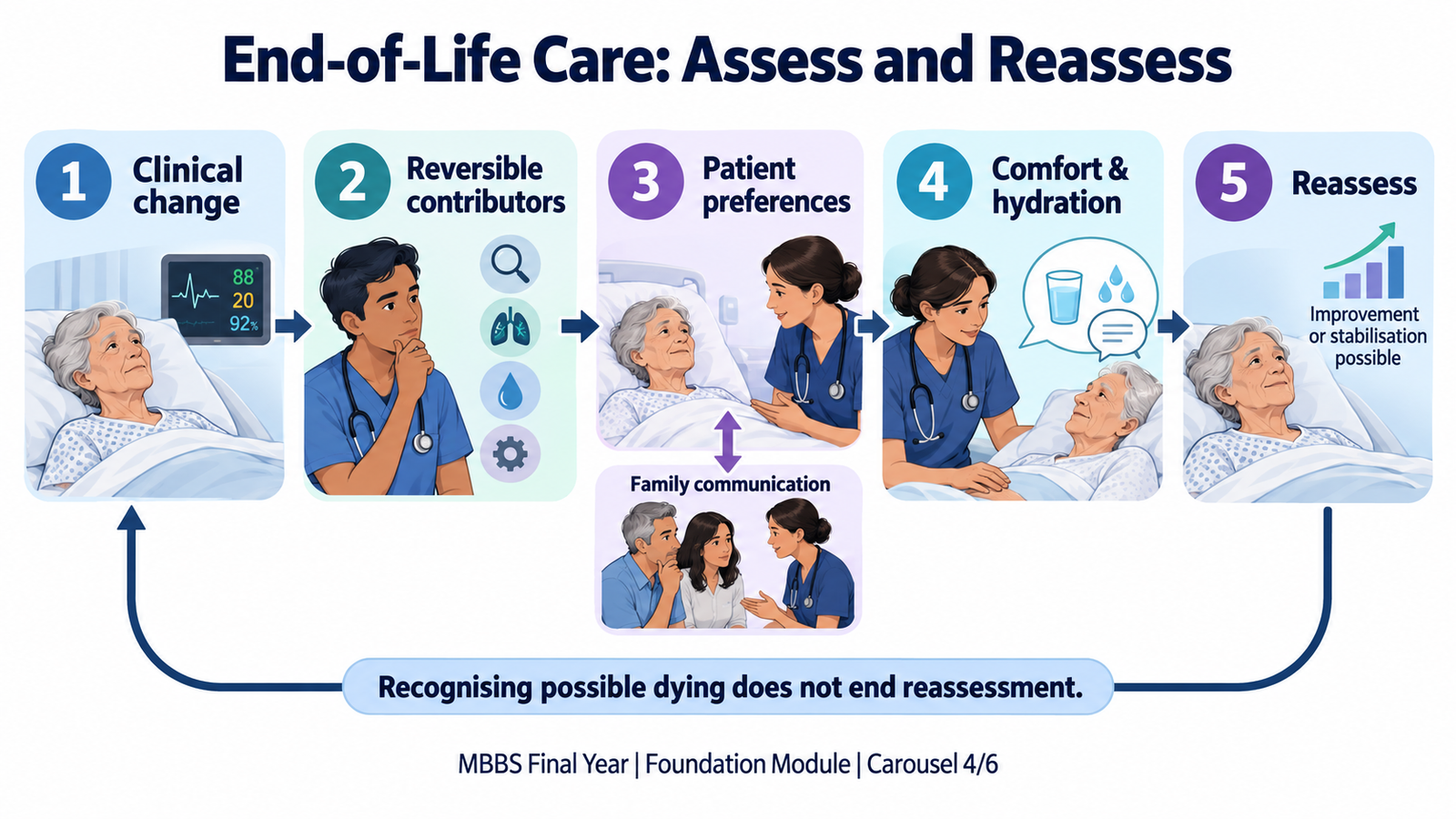
End-of-life care applies when a patient may be approaching death. Recognising this phase requires clinical assessment and repeated review, because deterioration can sometimes have a reversible cause and the timing of death is uncertain. A person may become increasingly weak, spend more time asleep, take less food and fluid or become less able to communicate. These findings should prompt careful assessment rather than an automatic assumption that every treatment should stop.
The first steps are to review the patient’s condition, discuss the likely situation sensitively and establish the patient’s goals and preferences as far as possible. Decision-making ability may change during illness. Involve the patient whenever possible, include people the patient wants involved and follow the applicable local process when the patient cannot participate. Document the agreed plan and communicate it across the care team.
Comfort care remains active care. Regularly assess pain, breathlessness, agitation, nausea, mouth discomfort and other distressing symptoms; look for manageable causes and provide proportionate relief. Attend to positioning, skin care, mouth care, privacy and family support. Offer help with drinking when safe and desired. Decisions about clinically assisted hydration require individual assessment of possible comfort, benefit and burden, with reassessment as the condition changes.
Explain to family members what changes are being observed, what remains uncertain and whom to contact if distress develops. Continue reviewing the patient: if the condition stabilises or improves, reconsider the plan. Care for a dying person is guided by comfort and dignity, with clear communication rather than abandonment.
E. Geriatric care: health, function and independence
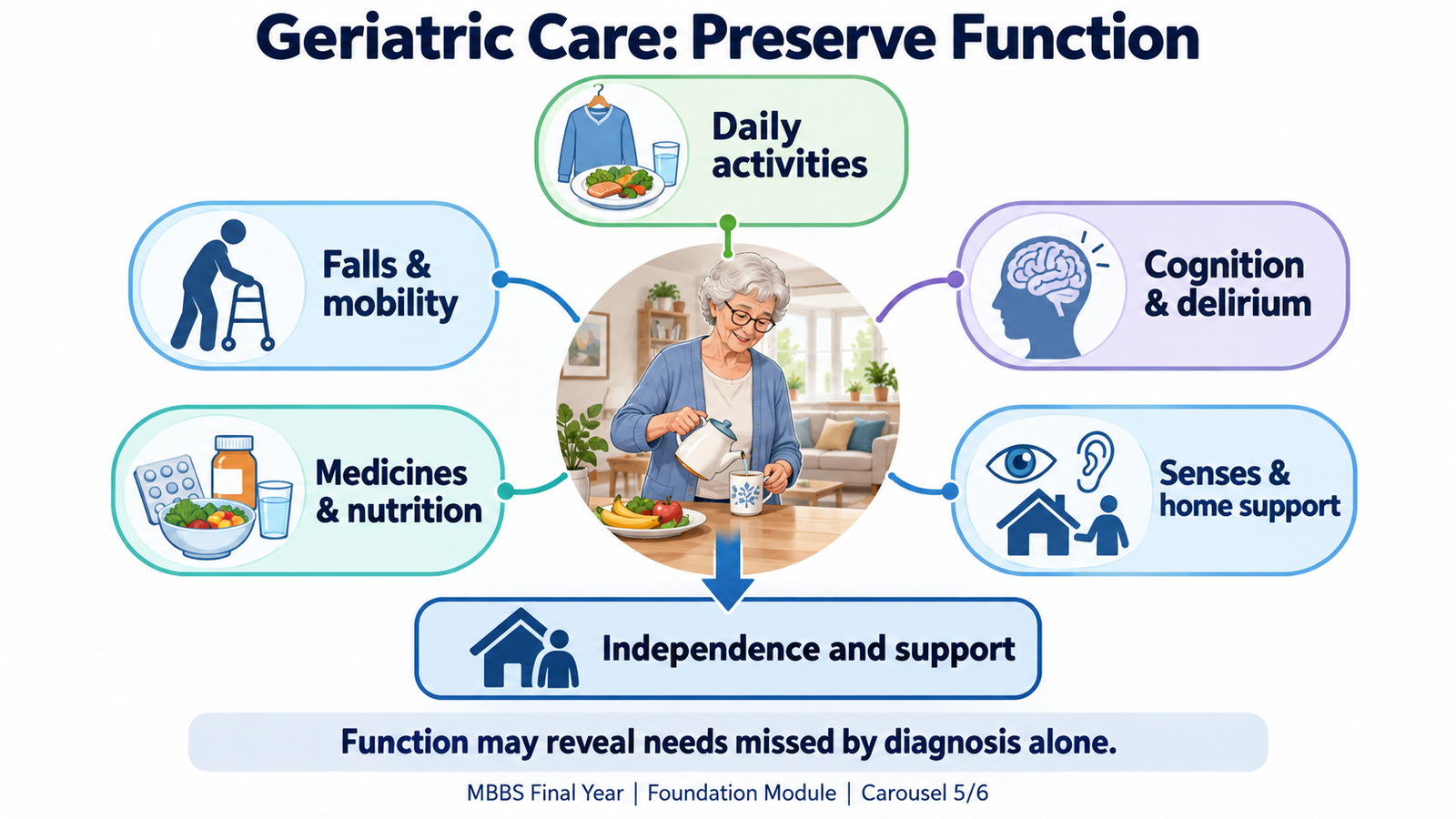
Geriatric care addresses the needs of older adults, many of whom live with several conditions at once. Its goal is not simply to treat each diagnosis separately. It is to preserve function—what the person can do in daily life—and support the priorities that make life meaningful to that person. Older age alone does not establish frailty, dependence or a need for end-of-life care.
A useful assessment asks about illness and symptoms, then looks at their effect on everyday activity. Can the person move safely, wash, dress, eat and use the toilet? Can they manage medicines, shopping and other tasks needed for independent living? Changes in these abilities can reveal a problem that a disease label alone misses. Hearing or visual impairment may also make an apparently confused patient seem unable to understand instructions.
Several problems commonly overlap in older adults:
- Falls and reduced mobility: may arise from weakness, poor balance, impaired vision, illness or medicines; a fall can further reduce confidence and independence.
- Delirium: an acute change in attention and awareness that should prompt assessment for an underlying cause. It differs from a longer-standing cognitive decline.
- Frailty: reduced reserve, so an apparently small stress such as an infection may cause a large loss of function.
- Multiple medicines: increase the chance of adverse effects, interactions and difficulty following a treatment plan; review whether each medicine still serves a useful goal.
- Nutrition, continence and social support: problems in these areas may increase dependence even when the main medical condition appears stable.
Management brings these findings together: address treatable illness, review medicines, support mobility and nutrition, reduce avoidable falls and arrange appropriate rehabilitation or help at home. Agree on goals with the older person and involve caregivers with the person’s permission. Reassess function after an acute illness, because recovery may require support beyond resolution of the original disease.
F. Choosing care that fits the person
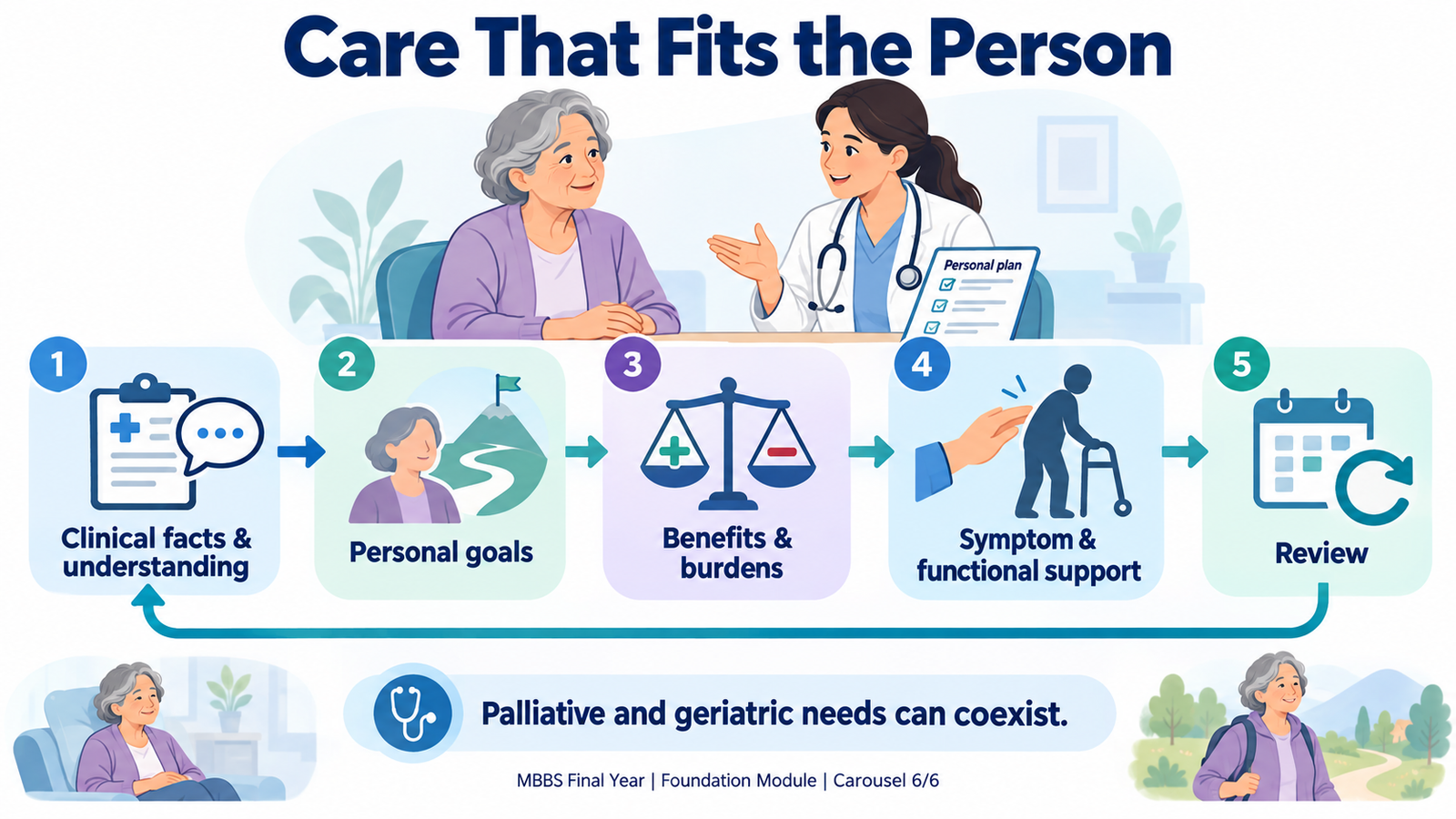
Communication, palliative care and geriatric care meet when a clinician must make a plan with a patient whose needs extend beyond a single diagnosis. Begin with the clinical facts, ask what the person understands and identify what matters most to them. Then consider both the likely benefit and the burden of proposed care. The resulting plan should be explained clearly, shared with the care team and reviewed when circumstances change.
For example, an older patient with a serious illness may need treatment for a reversible infection, assessment of mobility and medicine-related problems, relief of pain, and an honest discussion about future care. These needs can be addressed together. Palliative support may be appropriate because of distressing symptoms, while geriatric care addresses the patient’s function and independence. Neither decision, by itself, establishes that the patient is dying.
🩺 AIM Clinical Bridge
An older patient is told that a serious illness has progressed. She asks what this means for her ability to remain at home. She also has troublesome pain and has fallen twice recently. A useful discussion checks what she understands and wants to know, responds to her concern, and agrees on next steps. Pain relief addresses suffering; a falls and function assessment addresses her ability to live safely at home. Her wishes guide both parts of the plan.
Think clinically: Which concerns need attention now? Who does she want involved? When should the plan be reviewed?
AIM High-Yield Review
- SPIKES structures a difficult conversation; it is adapted to the patient rather than recited as a script.
- Ask what the patient understands and how much they want to know before giving detailed news.
- Give information clearly and in small portions; pause for the emotional response.
- Involve family according to the patient’s wishes and confidentiality requirements.
- Palliative care addresses physical, psychological, social and spiritual suffering.
- Palliative care can accompany treatment of the underlying illness.
- End-of-life care requires individual assessment, communication and repeated review.
- Comfort care includes active symptom relief and attention to dignity and family support.
- Hydration decisions near death should consider the individual patient’s comfort, benefit and burden.
- Geriatric care focuses on function and the older person’s own goals as well as diagnoses.
- Assess falls, cognition, medicines, nutrition and available support when they affect independence.
- Older age, palliative-care needs and approaching death are different concepts.
Topic 6 — Video Learning
Breaking Bad News, Palliative & Geriatric Care
1. Breaking bad news: SPIKES framework
Watch how the six SPIKES steps organise a sensitive conversation.
Video not displaying? Watch on YouTube.
2. Understanding palliative care
An introduction to palliative care from Aga Khan University Hospital, Pakistan.
Video not displaying? Watch on YouTube.
3. Comprehensive geriatric assessment
See how assessment of an older person considers function and wider care needs alongside medical conditions.
Video not displaying? Watch on YouTube.