
TOPIC 7. PEDIATRIC HISTORY, EXAMINATION, GROWTH & DEVELOPMENT
Foundation Module · Pediatrics
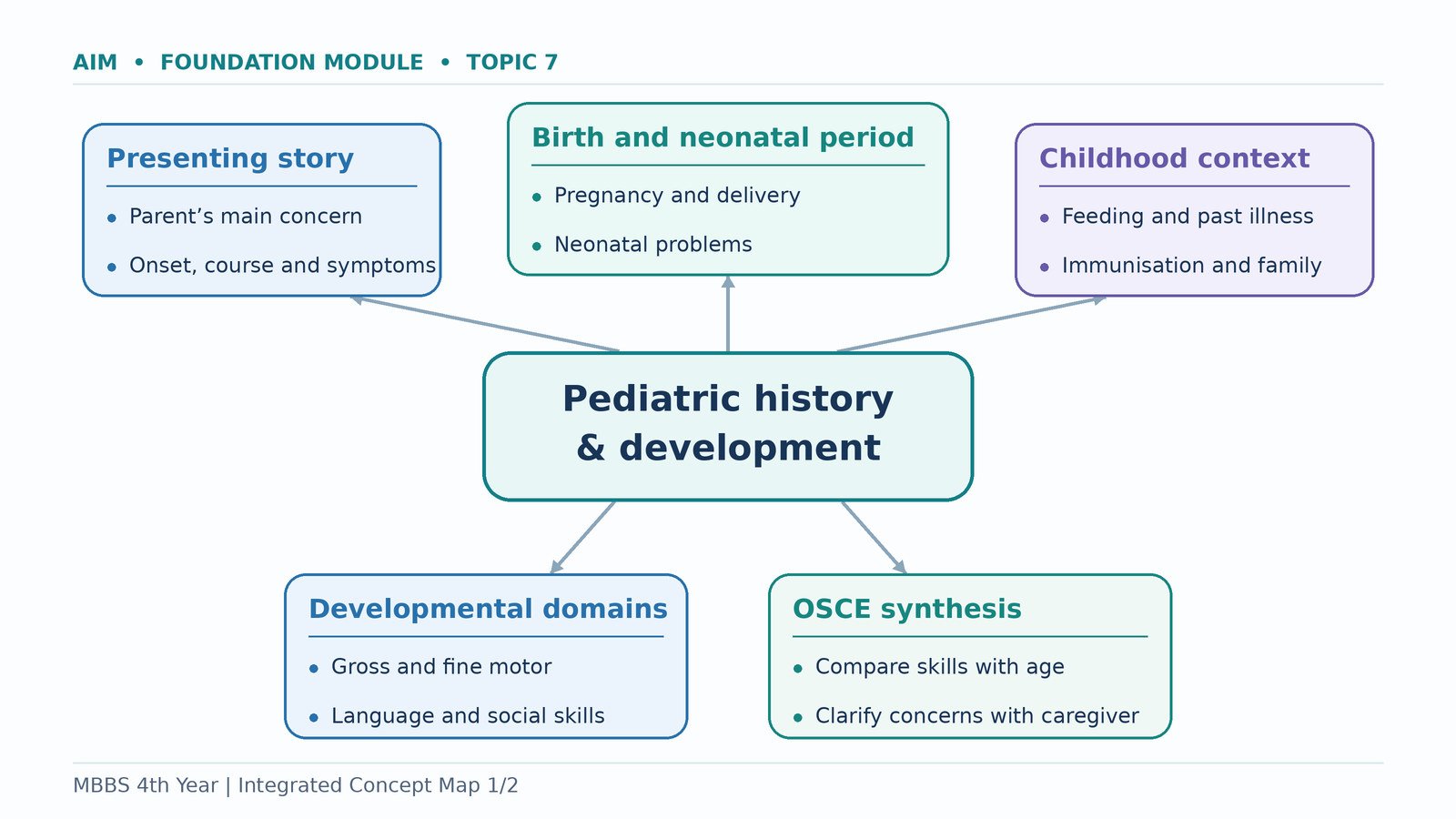
A practical approach to understanding a child through the caregiver’s history, age-appropriate examination, growth measurements and developmental abilities.
A pediatric assessment begins with the child’s age and the caregiver’s observations. The same symptom can mean different things in a newborn, an infant and a school-age child. Children may also be unable to describe their symptoms, so feeding, activity, behavior and interaction become important clinical clues. History and examination show how the child is now; growth charts show how the body has changed over time; and developmental assessment shows how abilities are emerging. These sources of information should be interpreted together. A single unusual measurement or missed milestone prompts a closer look, while an unwell child requires attention to immediate clinical safety.
A. Building a reliable history with parents and caregivers
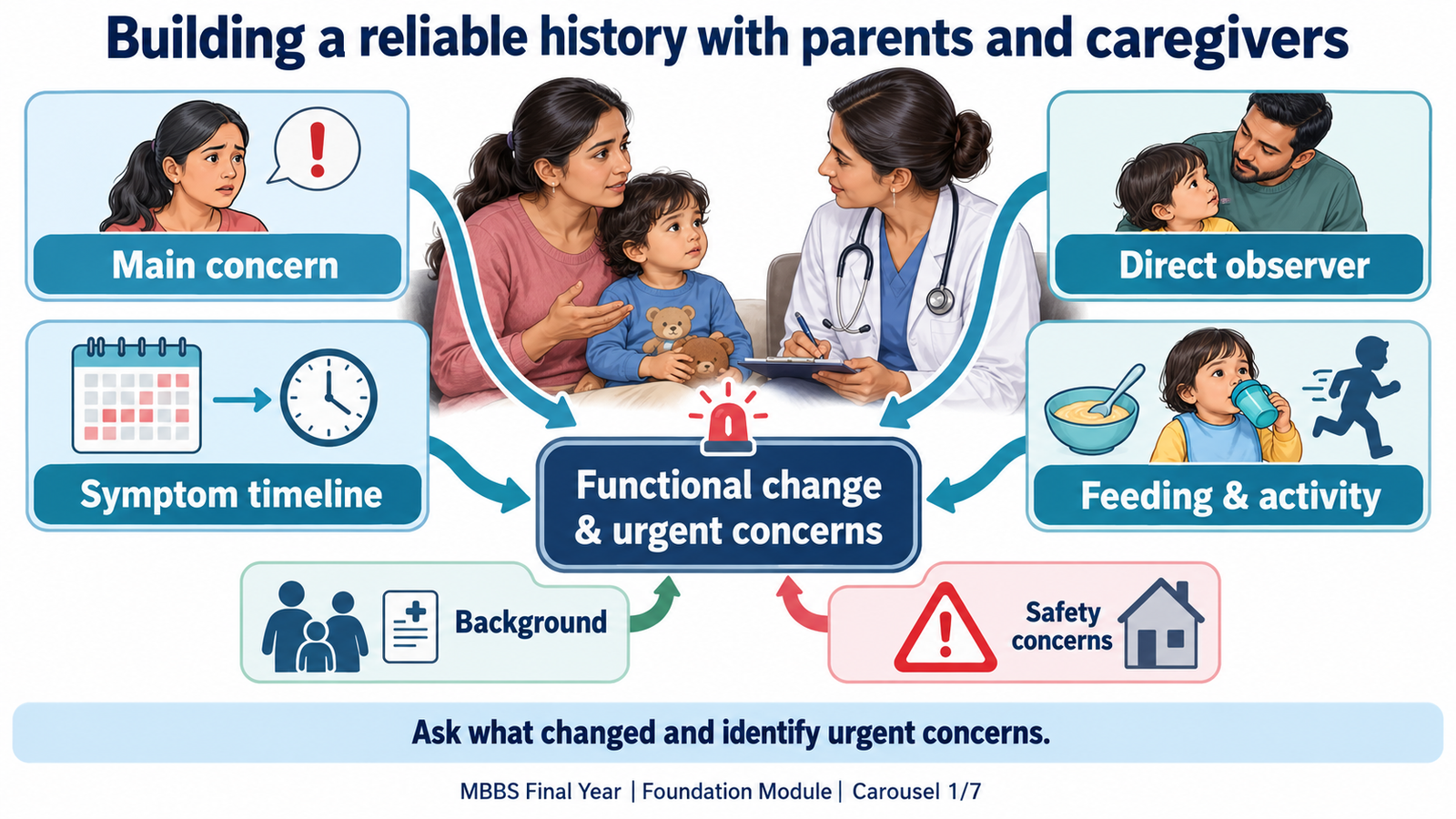
A parent or caregiver usually provides the first account, but the child should contribute whenever age and ability allow. Begin with the main concern in the caregiver’s own words, then establish when it started, how it has changed, what has already been tried and how the child is functioning. Clarify who observed an event directly, especially when several people care for the child. Listening to the caregiver’s view of what is unusual helps distinguish the child’s normal behavior from a genuine change.
The immediate history should answer three linked questions: How ill is the child? What pattern does the problem follow? How has it affected normal life? Ask about feeding or drinking, urine output, sleep, play or responsiveness, and associated symptoms. A young child who cannot describe breathlessness may instead feed poorly or become less active. A school-age child may describe symptoms directly and can be asked alongside the caregiver.
- Background that changes interpretation: birth and neonatal history, previous illnesses or admissions, medicines and allergies, immunizations, nutrition, growth and developmental progress.
- Family and environment: relevant inherited conditions, household contacts, home circumstances and caregiver concerns.
- Clinical synthesis: finish by checking the timeline and identifying any change in feeding, activity, breathing or consciousness that needs prompt assessment.
B. The neonatal history: pregnancy, birth and the first weeks
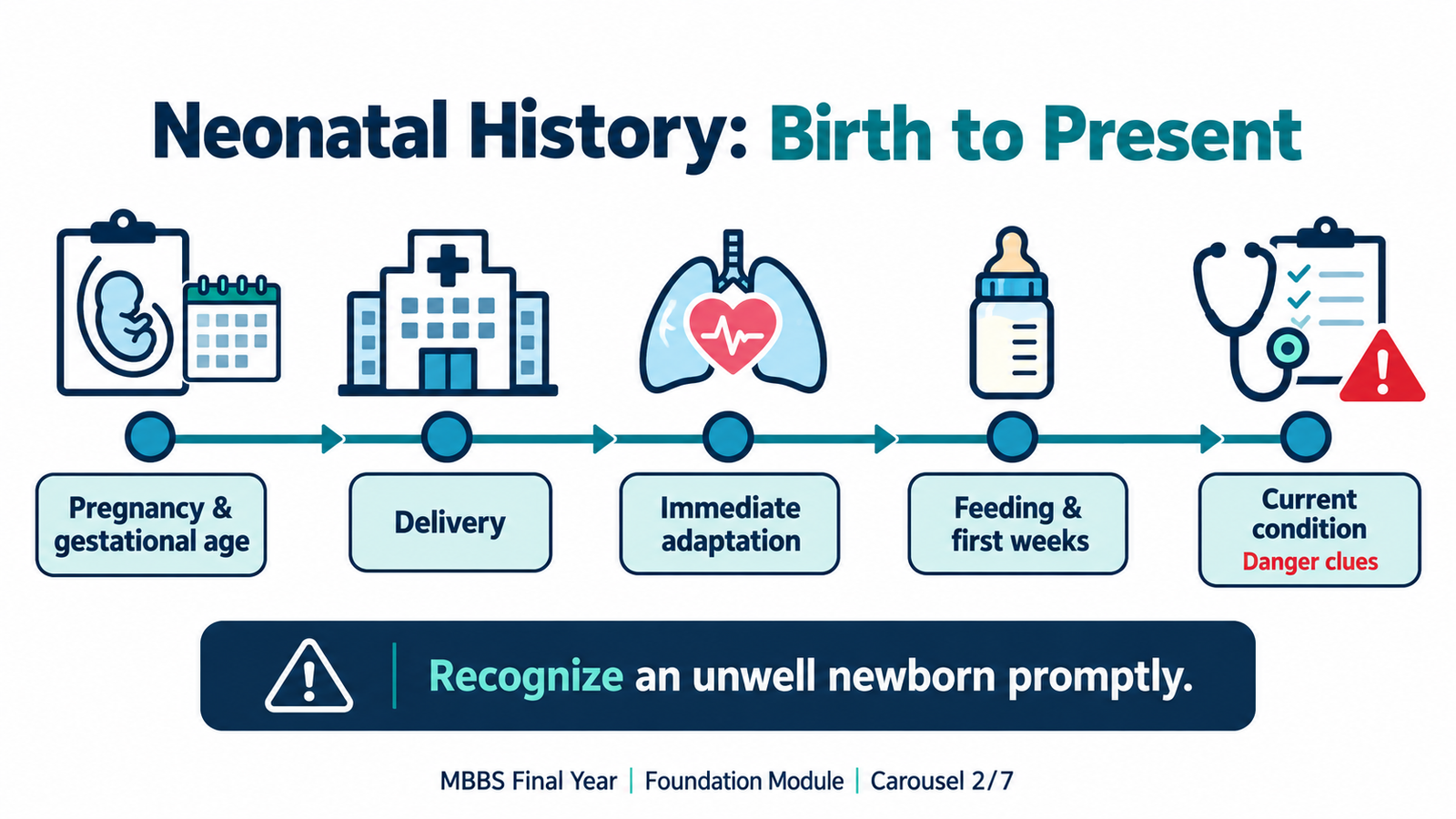
In a neonate, the present problem cannot be understood fully without the events surrounding birth. Gestational age indicates whether the baby was born preterm; pregnancy complications and maternal illness may alter the baby’s risks. The account of labor, delivery and the baby’s condition immediately afterward helps explain early breathing, feeding or neurological concerns. Ask about any need for resuscitation, nursery care or treatment, without assuming that a complicated birth explains every later symptom.
Move from birth to the baby’s current routine. Establish how feeding is going, whether the baby wakes and feeds effectively, whether wet nappies and stools have changed, and whether there has been jaundice, abnormal temperature, breathing difficulty or unusual sleepiness. Ask about birth weight and subsequent measurements when available. Poor feeding matters because it may be both a sign of illness and a cause of dehydration or inadequate weight gain.
Age changes the urgency of findings. A neonate who is difficult to wake, feeds poorly, has abnormal breathing, appears blue, or is unusually cold or hot needs prompt clinical assessment. Serious illness in a young baby may be present without an obvious fever.
C. How the history changes through infancy and childhood
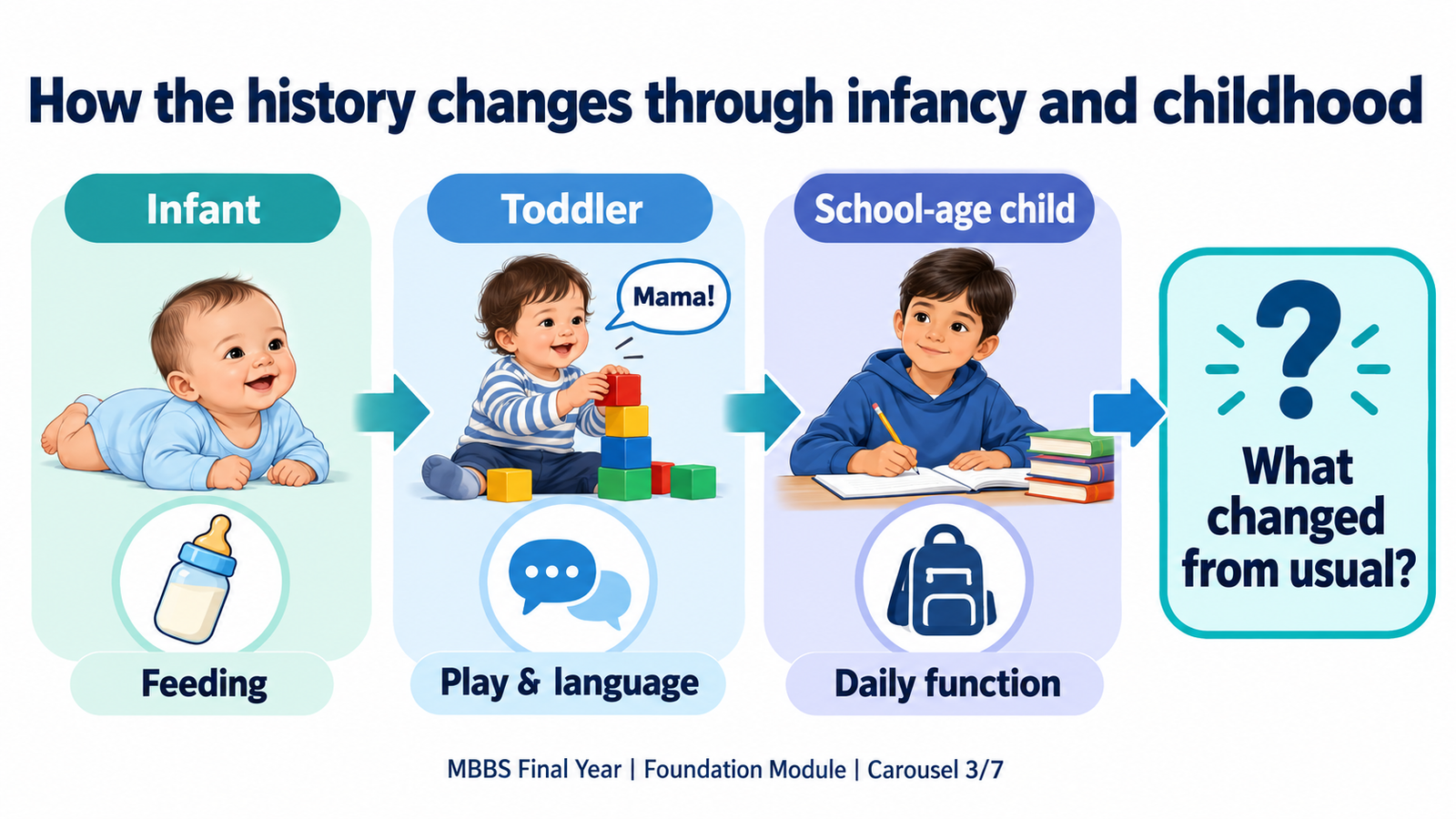
As a child grows, the history still starts with the presenting concern, but the supporting questions change. In infancy, caregivers describe feeding, movement, social response and emerging sounds. For toddlers, play, language, walking, behavior and interaction become especially informative. Older children can describe symptoms, school participation and daily activities themselves. The aim is to understand the child in their usual setting, not to recite the same list at every age.
Nutrition should be described in terms of what the child actually eats or drinks and whether this has recently changed. Ask about previous growth concerns and developmental progress. For an older child, a change in school or play may reveal a problem that is less obvious during a short consultation. Immunization information and records can be reviewed as part of the background history, while the caregiver’s immediate concern remains central.
A useful closing question is: “What can your child normally do that they are unable or unwilling to do today?” Loss of an established ability differs from never having acquired it and needs careful assessment. Parents may identify a change before it becomes obvious during examination.
D. Understanding the neonatal physical examination
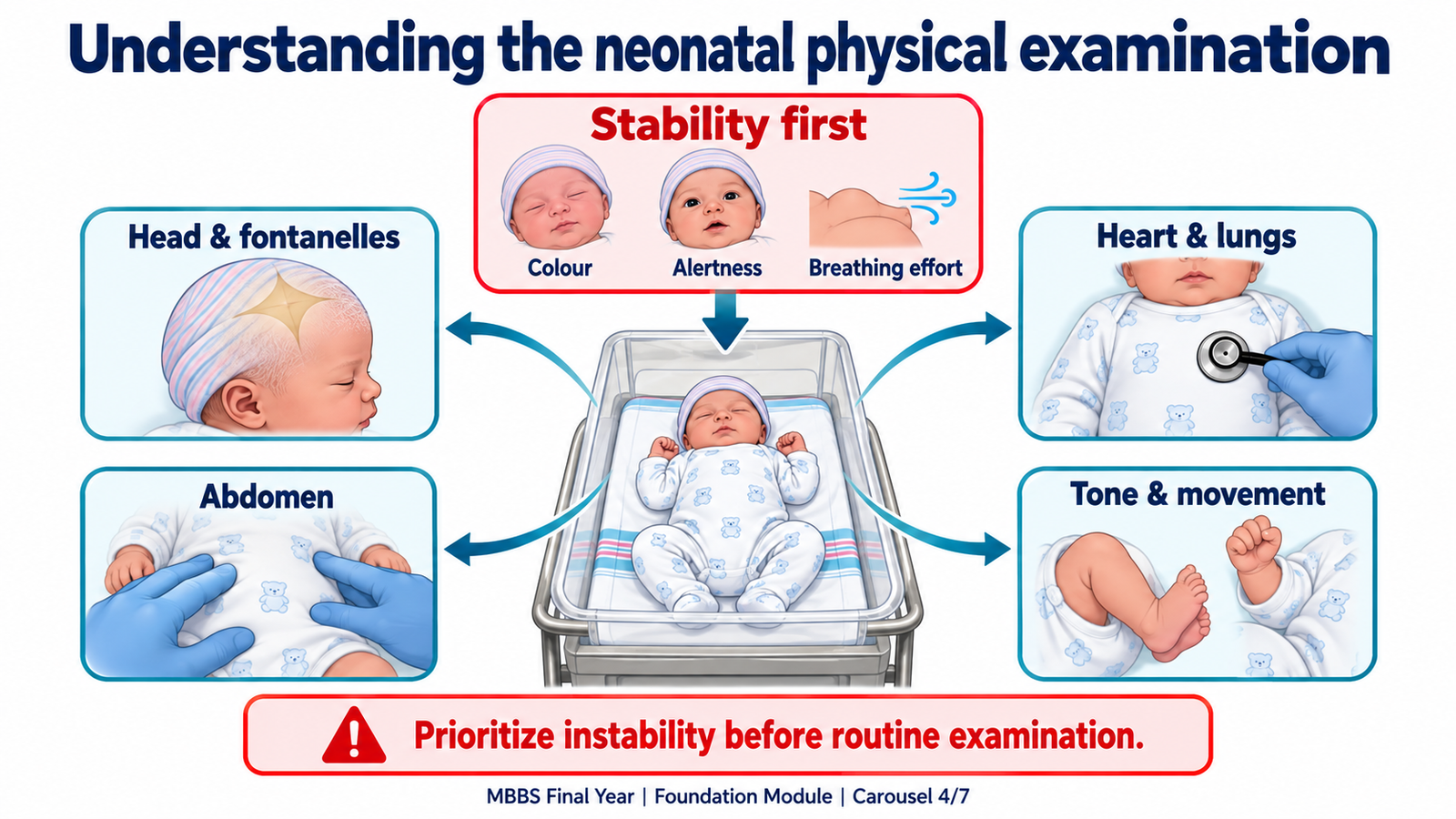
Examination of a newborn begins by observing before handling: color, posture, spontaneous movement, alertness and the work of breathing. A calm baby may also show how well they respond to the environment. The examination then relates these observations to the history. For example, poor feeding alongside lethargy is more concerning than either observation considered alone.
Assess the head and face, including head shape and fontanelles; inspect the mouth and palate; and look for obvious asymmetry or congenital differences. Examine breathing and circulation, the abdomen and umbilicus, genitalia, spine, hips, limbs, skin, tone and spontaneous movements. The purpose is to recognize normal adaptation and identify findings that need review. A heart murmur, respiratory effort, jaundice or reduced movement gains meaning from the baby’s age and overall condition.
Handle the baby gently and maintain warmth. If the baby appears unstable, urgent assessment takes priority over completing a routine examination. A complete newborn assessment includes general appearance, breathing, cardiovascular findings, head and face, abdomen, limbs and neurological behavior.

E. Examining the older infant and child
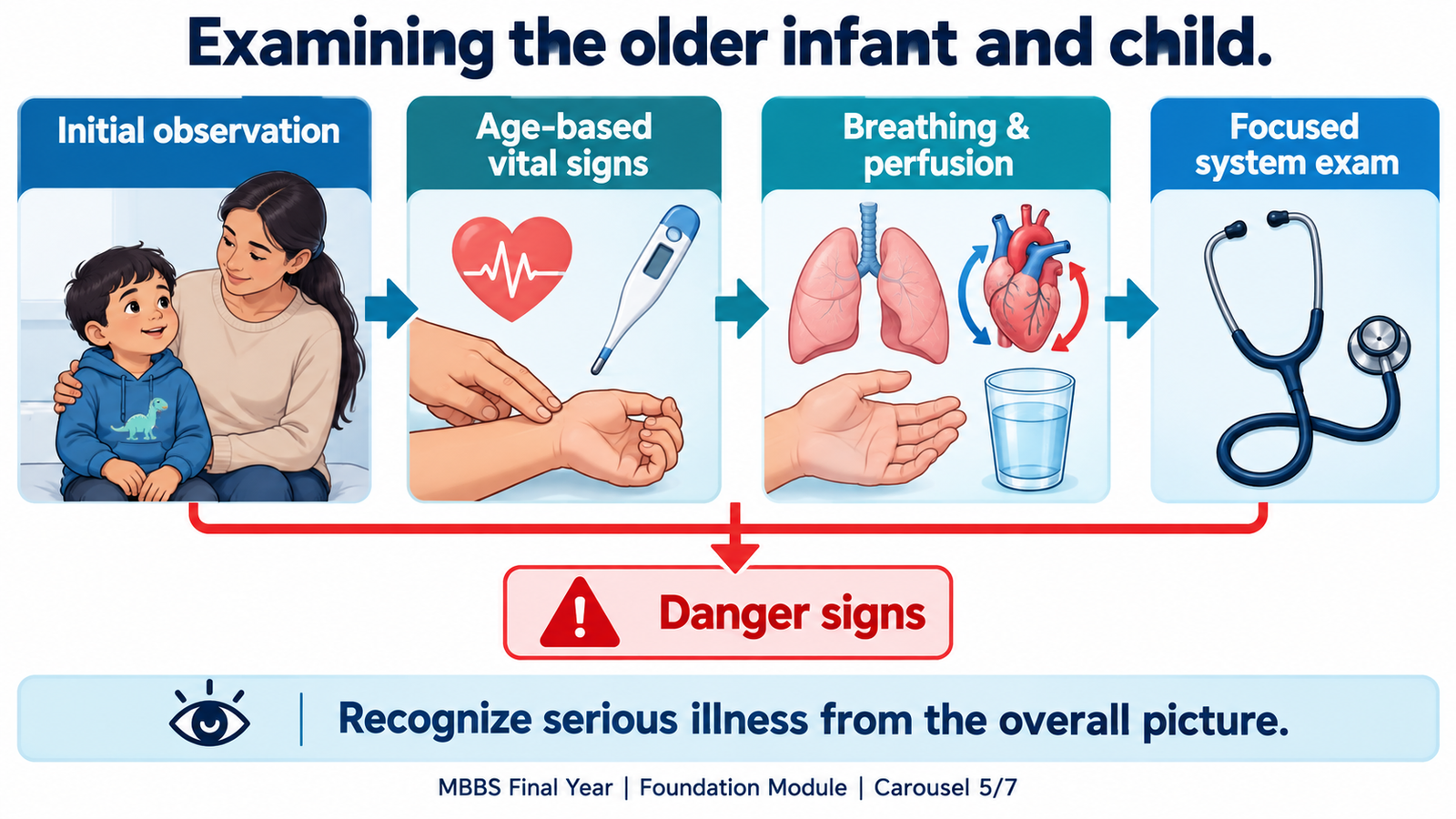
A child’s examination is adapted to age, distress and the presenting problem. Observation while the child remains with a caregiver can reveal alertness, interaction, speech, movement and respiratory effort. Less upsetting parts of the examination can often be done first. An older child should receive an explanation they can understand and opportunities to participate.
Vital signs must be interpreted in the context of age and clinical state. Then look for findings relevant to the history: hydration and perfusion when intake is poor; breathing effort and chest findings with respiratory symptoms; or abdominal tenderness and distension with abdominal complaints. A focused neurological assessment may include level of alertness, movement, tone and gait when age appropriate. No single normal finding should override a concerning overall picture.
Recognize immediate danger: markedly reduced responsiveness, severe breathing difficulty, poor circulation or a child who looks seriously unwell calls for urgent assessment and escalation. Routine growth or developmental measurements can wait until the child is safe.
F. Measuring and interpreting growth
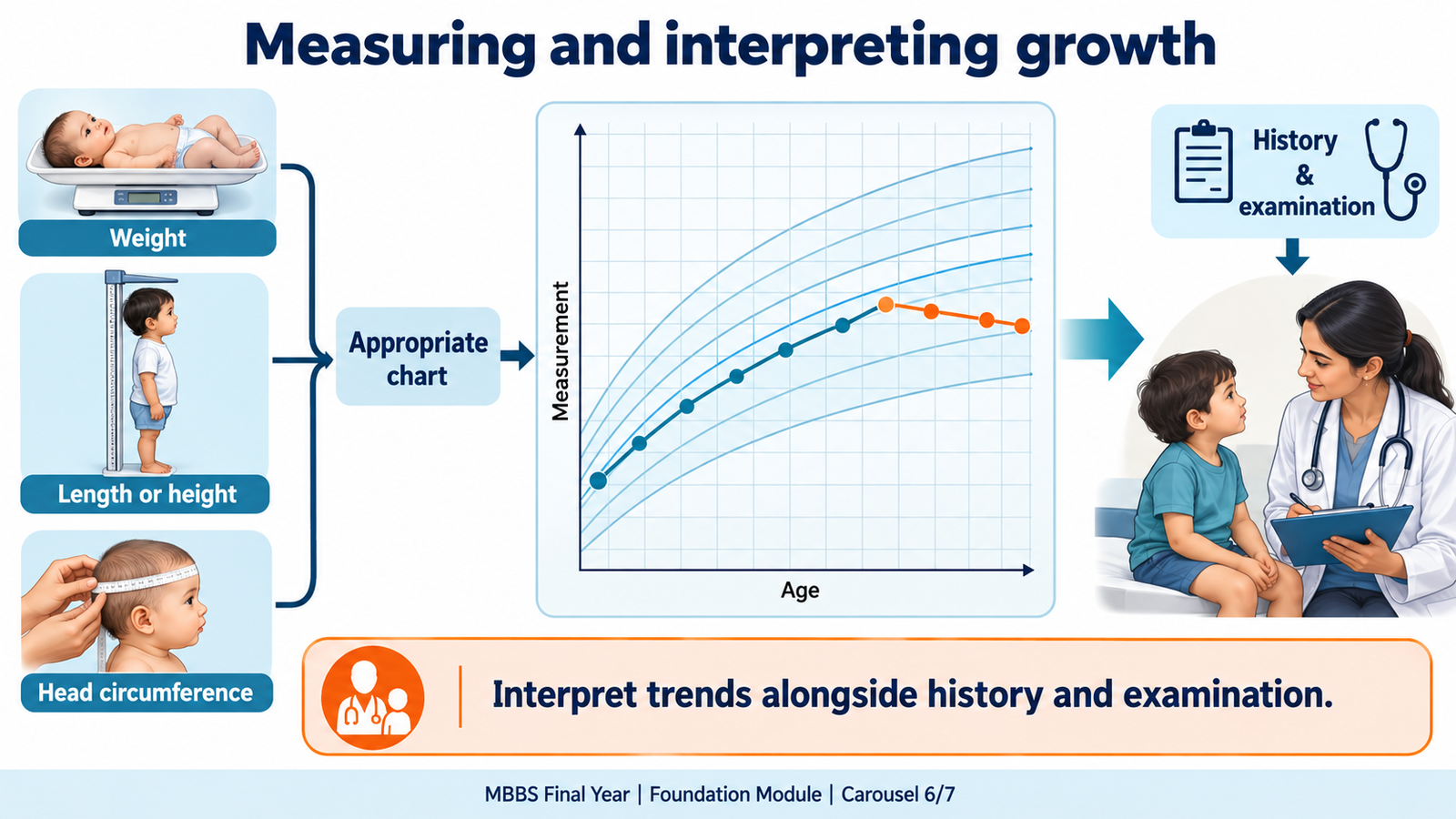
Growth assessment turns measurements into a pattern over time. Measure weight and length or height accurately; measure head circumference when appropriate, particularly in infants and young children. Recumbent length is used for a child who cannot reliably stand, while standing height is used when the child can cooperate. Record the child’s age accurately and plot measurements on an appropriate age- and sex-specific chart. A plotted point shows where the child is now; repeated points show the direction and pace of growth.
Different growth indicators answer different questions. Weight-for-age describes weight relative to age but does not distinguish a short child from a thin child. Length/height-for-age reflects linear growth over time. Weight-for-length/height relates body weight to body size. Head-circumference-for-age helps assess head growth in early childhood. WHO provides these child growth standards and charts.
Interpret the chart together with feeding, illness, family growth patterns and previous measurements. A single point may reflect normal variation or measurement error; a persistent change in trajectory deserves reassessment. An unexpectedly large or small head measurement should likewise be checked and interpreted alongside development and examination. For a preterm infant, corrected age may be needed when interpreting early growth and development.
G. Assessing development and interpreting concerns
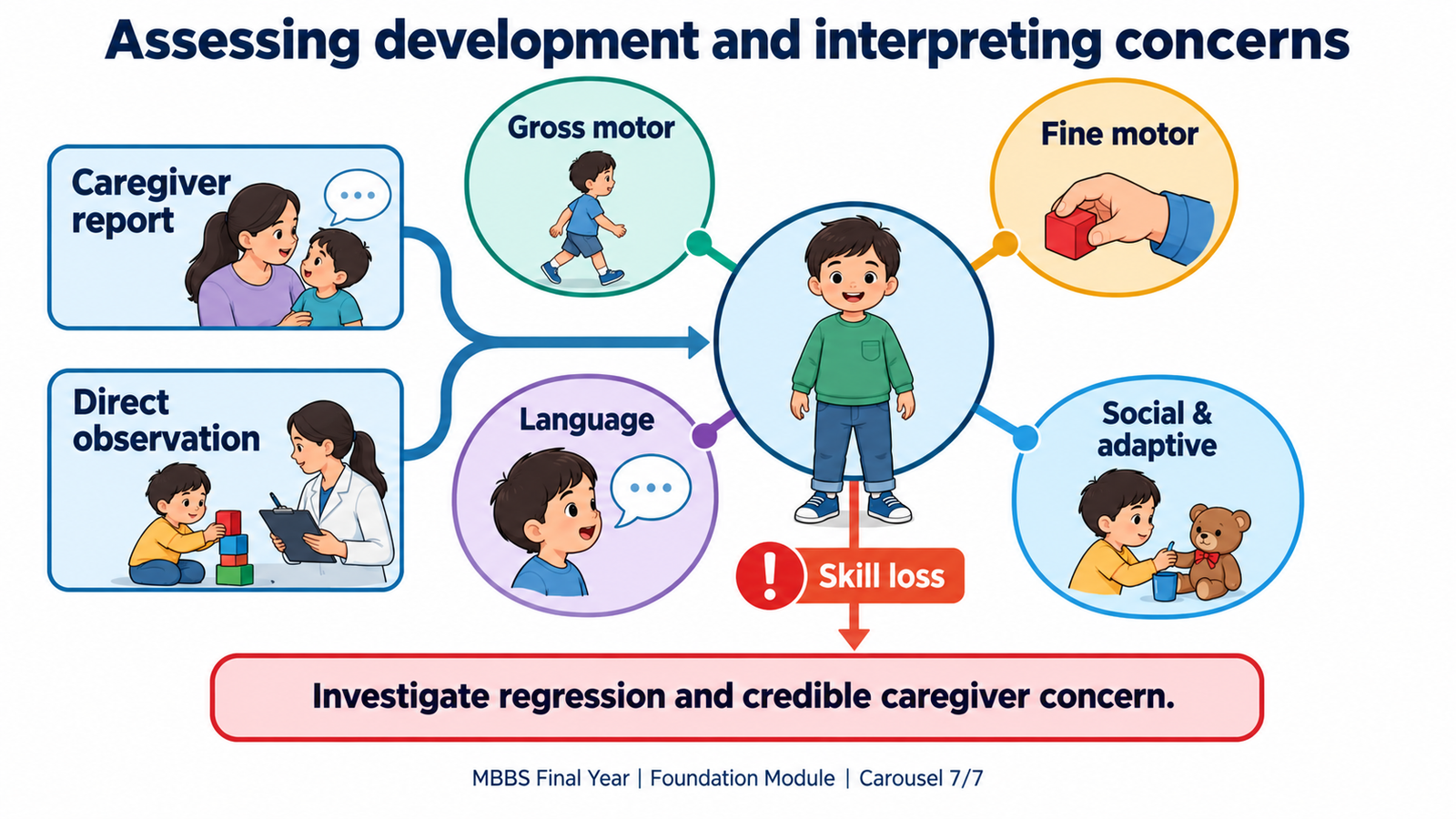
Development is the gradual acquisition of abilities. An age-appropriate assessment combines what caregivers report with what the child demonstrates through ordinary interaction and play. Consider four broad areas together: gross motor movement and posture; fine motor hand use; language and communication; and social and adaptive interaction and everyday skills. A child may progress differently across these areas, so “development is normal” should be supported by more than one observed skill.
Ask what the child can do now, when the ability first appeared and whether any established ability has been lost. Observe suitable activities for the child’s age: an infant’s response to faces and sounds and control of movement; a toddler’s play, gestures, walking and words; or an older child’s speech, coordination and interaction. Hearing or vision difficulty may affect apparent language or social performance, so these possibilities belong in the assessment rather than being assumed away.
Milestone guides help organize observation, but a checklist does not itself diagnose a developmental disorder. Developmental surveillance is the continuing process of asking, observing and reviewing progress; a standardized screening tool provides a structured assessment when indicated. If caregivers are concerned, abilities are clearly delayed, or skills have been lost, document the concern and arrange appropriate further assessment rather than offering reassurance based on one brief observation.
AIM High-Yield Review
- A pediatric history combines the caregiver’s observations with the child’s own account when possible.
- Establish the symptom timeline and its effect on feeding, activity, sleep and daily function.
- Neonatal assessment needs pregnancy, birth, immediate adaptation and current feeding history.
- Poor feeding, reduced responsiveness or abnormal breathing in a neonate requires prompt assessment.
- Ask age-specific questions: early feeding and interaction in infants; play, language and function in older children.
- Observe a child before handling them; behavior and breathing effort are examination findings.
- Interpret vital signs and physical findings in the context of age and the child’s overall condition.
- Growth assessment requires accurate measurements plotted against age and sex, preferably across repeated visits.
- Weight-for-age, height-for-age, weight-for-height and head circumference answer different growth questions.
- Developmental assessment covers gross motor, fine motor, language and social or adaptive abilities.
- Use both caregiver report and direct observation; consider hearing and vision when interpreting development.
- Loss of an established skill or a credible caregiver concern warrants further assessment.
Topic 7 video: Introduction to the Pediatric Physical Examination. If the player does not load, watch the video on Vimeo.