
This chapter follows the supplied KMU outcomes and connects family care, adherence, follow-up and psychiatric assessment. Understand the explanations first; use the High-Yield Review for revision later.
Family Care, Treatment Adherence & Initial Psychiatric Assessment
Foundation Module • Psychiatry and patient-centred care
A practical approach to helping a patient and family manage illness at home, continue agreed treatment, obtain appropriate follow-up and receive a safe first assessment after psychiatric admission.
Much of a patient’s care happens between clinical visits. A good treatment plan must therefore work in the patient’s home, fit their daily life and make clear when help is needed. This matters in both short illnesses, which may need temporary support, and long-term conditions, which need sustained care. In psychiatry, the same patient-centred approach begins at admission: the clinician must understand the patient’s symptoms, physical health, immediate safety and available support before planning care. This chapter explains these connected tasks without turning them into examination-station scripts. The central question throughout is: what can this patient and family realistically do next, and how will we know whether the plan is working?
A. Planning safe care at home
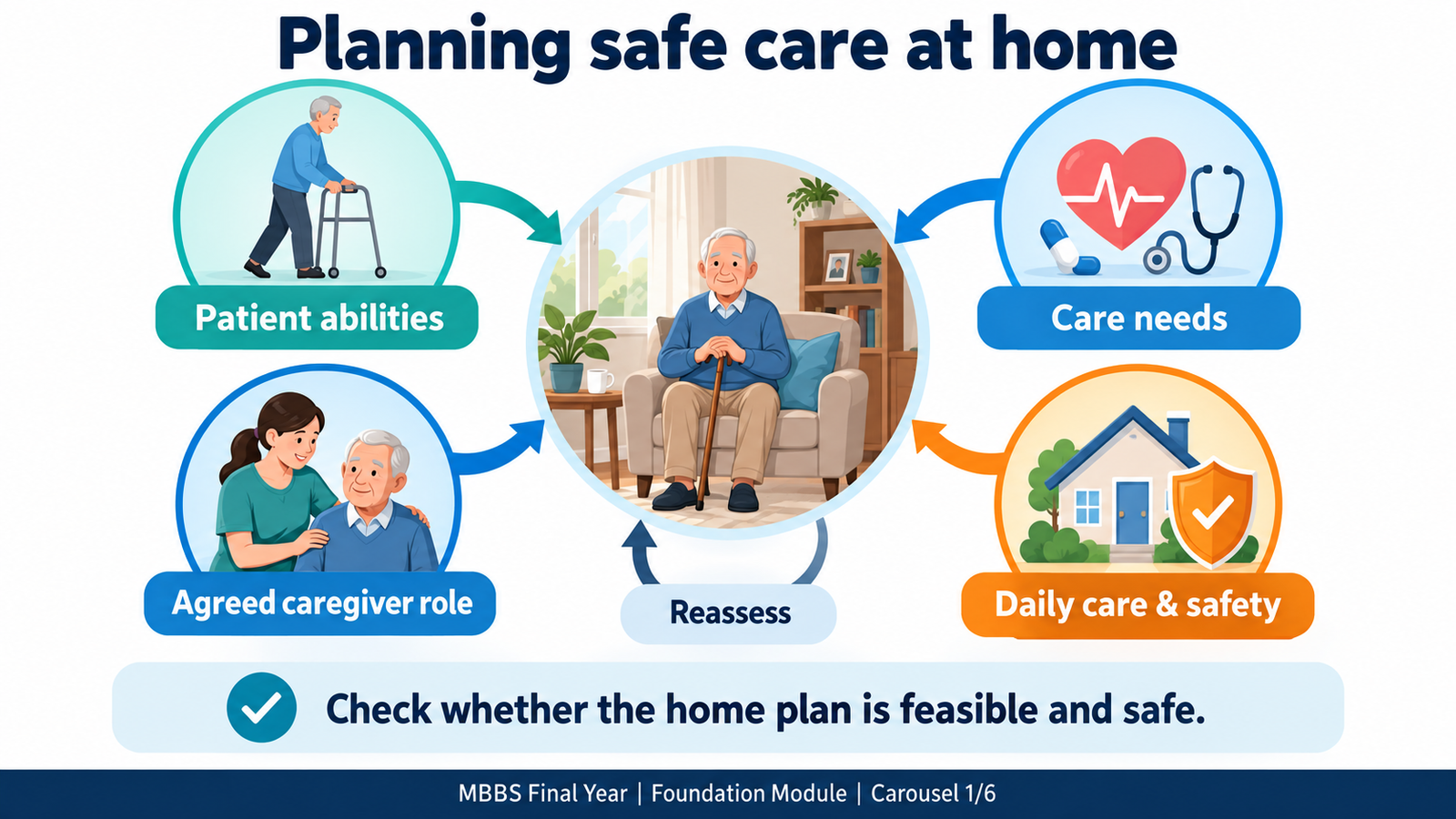
Home care means the practical and emotional support that lets a patient continue appropriate treatment and daily activities outside hospital. It starts by assessing what the patient needs and what the household can actually provide. A family member may help, but family involvement should be agreed with the patient where the patient can make that decision. Being a relative does not automatically make someone available, willing or able to provide care.
In acute illness, home support may be temporary: helping with meals, fluids, mobility, prescribed treatment and observation while the patient recovers. In chronic illness, the plan must remain workable for weeks or years. It may include regular medication, appointments, rehabilitation or psychological support, and adjustments when symptoms or family circumstances change.
A useful plan answers four linked questions:
- What can the patient do independently? Assess understanding, mobility, daily function and ability to manage treatment.
- What help is needed? Identify specific tasks, such as obtaining medicines, accompanying the patient to visits or noticing a change in behaviour.
- Who can provide that help? Agree responsibilities with the patient and any participating caregiver; consider the caregiver’s own capacity and strain.
- What would make home care unsafe? Recognize problems that require earlier review, urgent assessment or a different level of support.
For a patient with a psychiatric illness, home care may also require a predictable daily routine, supportive communication and attention to sleep, food and social functioning. The family should know that symptoms can affect motivation, concentration and insight. Difficulty following a plan should prompt assessment and support, not blame.
B. Educating and working with the family
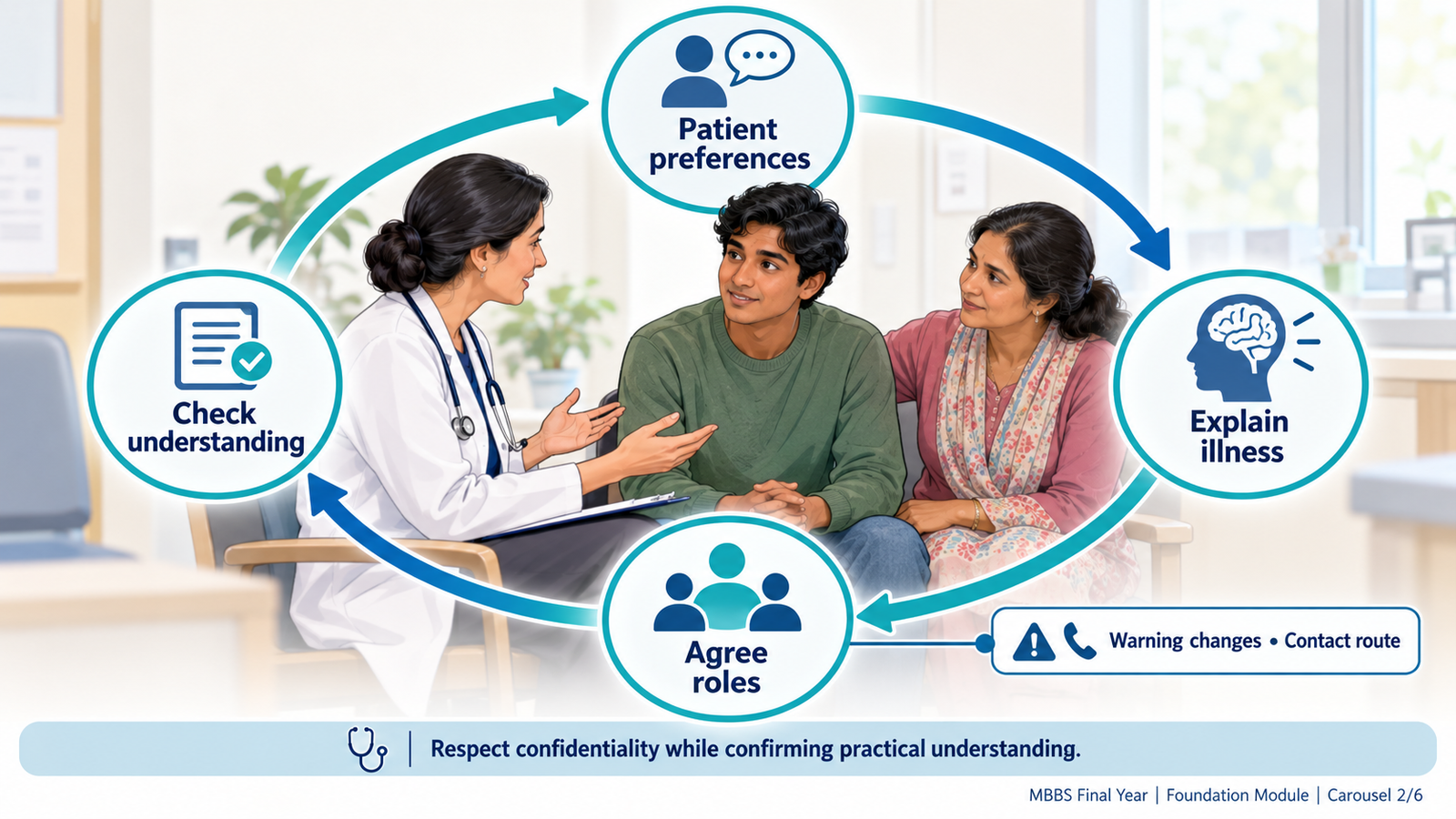
Family education turns a clinical plan into actions people can understand. First explain the illness and the purpose of treatment in ordinary language. Then discuss what recovery or ongoing control may look like, which changes should be reported and where help is available. Information should match the patient’s condition and the family’s role; giving every possible medical detail at once can obscure the instructions that matter now.
Effective counselling is a two-way conversation. Ask what the patient and family already believe, what concerns them and which parts of the plan seem difficult. Invite them to explain the agreed plan back in their own words. If an explanation has not been understood, clarify it without treating the patient or caregiver as at fault.
In psychiatric care, ask the patient what may be shared with relatives. Explain symptoms without stigmatizing language. A family member may offer useful observations about changes in sleep, behaviour or functioning, but the patient’s own account remains central. Where capacity, consent or an immediate safety concern complicates information sharing, follow applicable clinical and institutional requirements.
Education should leave the patient and participating caregiver able to identify:
- the main problem and the purpose of the agreed treatment;
- the tasks each person has agreed to undertake;
- expected progress and important treatment difficulties;
- warning changes that require earlier or urgent help;
- the next appointment and the route for seeking advice.
C. Understanding why treatment adherence is difficult
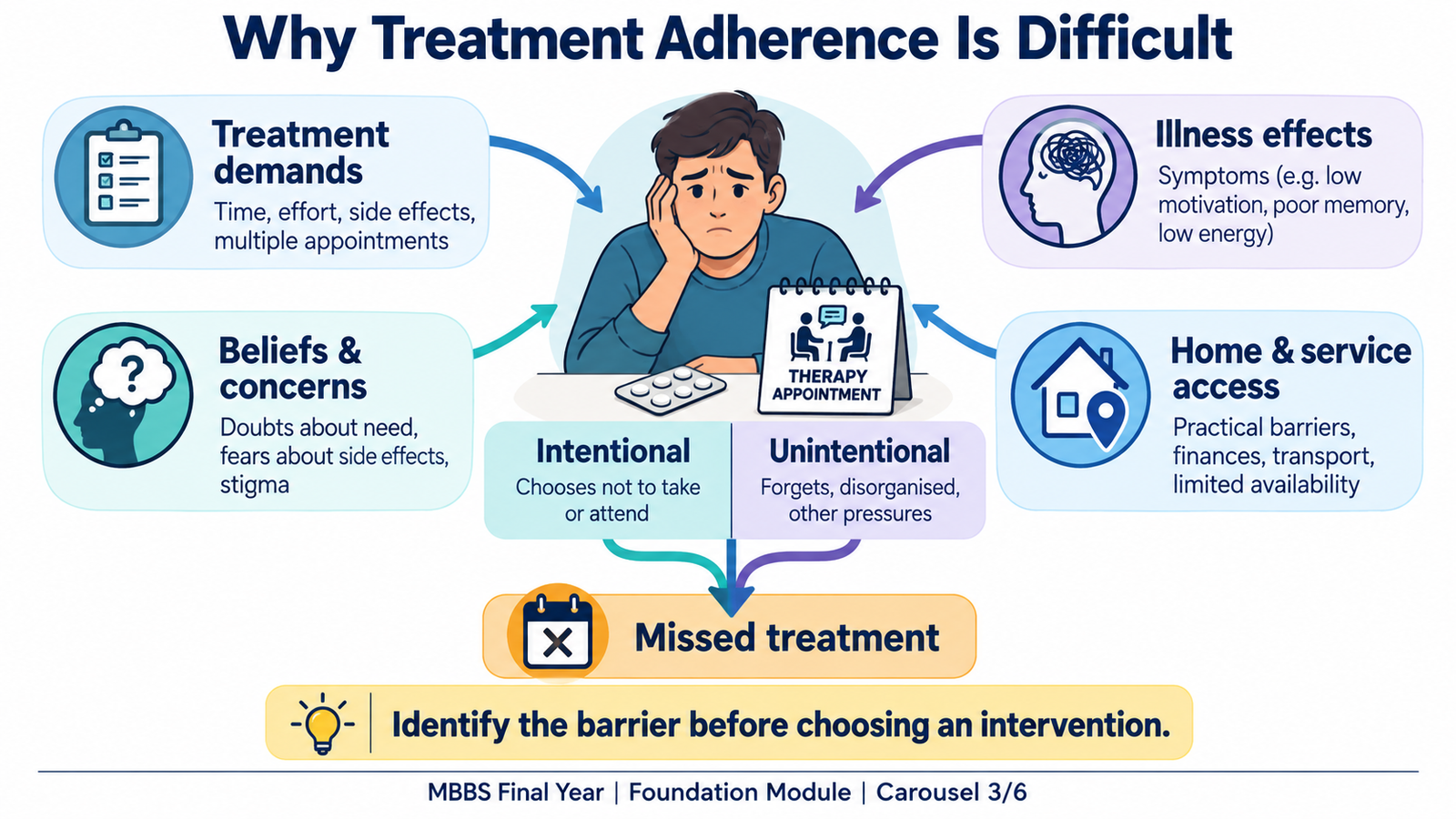
Adherence describes how closely a patient’s actions follow a treatment plan agreed with the clinician. The plan may include medicines and nonpharmacological care, such as psychological therapy, rehabilitation, sleep routines or activity changes. Adherence is not simply a measure of whether someone is “cooperative.” A person may value treatment yet be unable to follow it because the plan is costly, confusing, uncomfortable or difficult to access.
It helps to distinguish two patterns. In unintentional non-adherence, the person intends to follow the plan but encounters a practical barrier, such as forgetting, difficulty obtaining medicines or misunderstanding instructions. In intentional non-adherence, the person chooses not to follow some or all of it, perhaps because of adverse effects, fear, stigma or a belief that treatment is unnecessary. These patterns can occur together and may change over time.
Ask without judgment: “How has the treatment been going in daily life?” Follow with specific questions about missed doses or sessions, adverse effects, cost, access and the patient’s understanding of benefit. A useful assessment looks beyond the patient alone:
- Treatment: Is the regimen complicated, unpleasant or causing adverse effects?
- Condition: Do symptoms, poor concentration or reduced insight make treatment harder?
- Patient’s concerns: Does the person understand and accept the goal of treatment?
- Home and social setting: Are money, travel, work, stigma or limited support obstacles?
- Health service: Are appointments, explanations, prescriptions and follow-up accessible and coordinated?
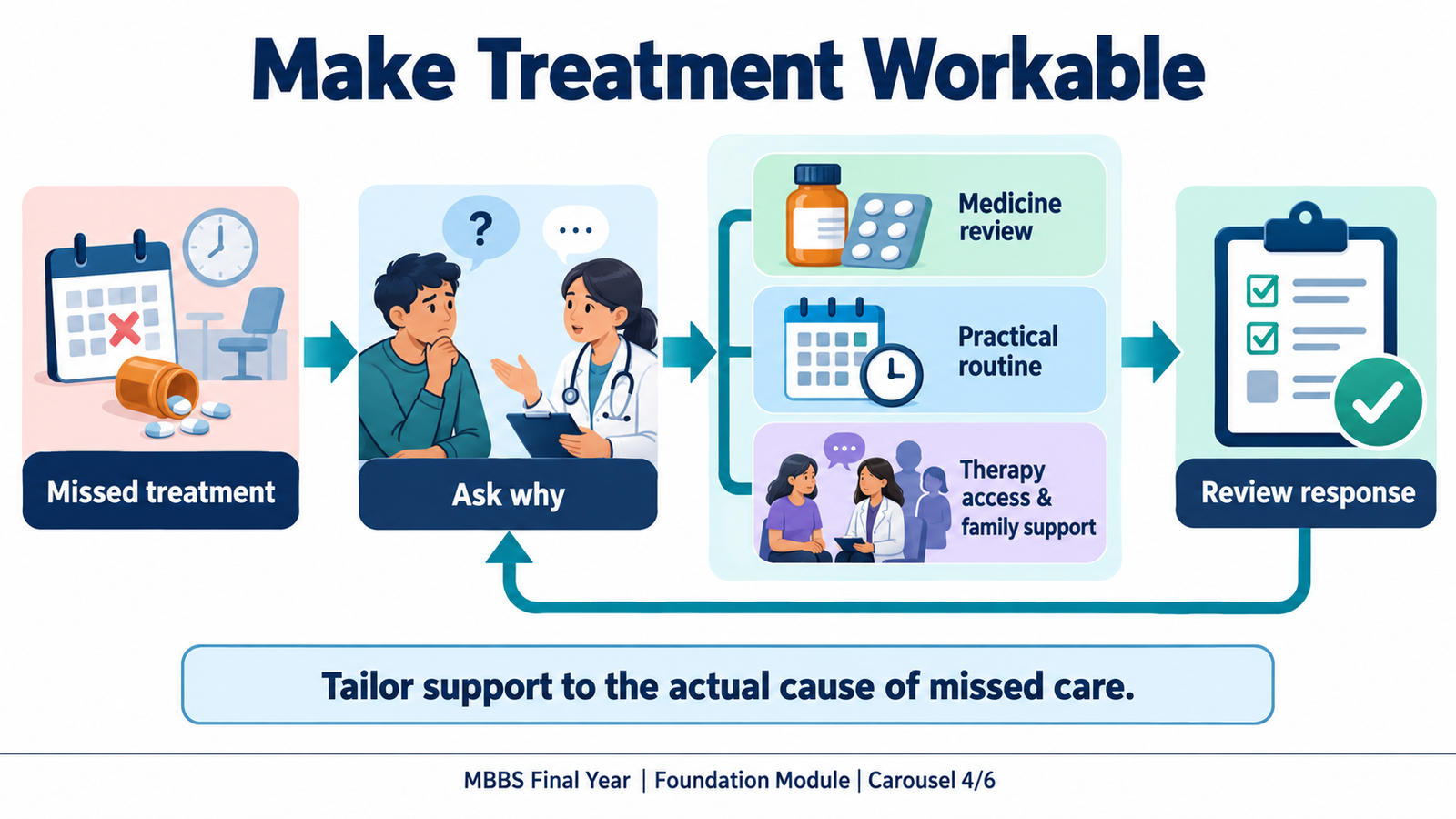
Clinical interpretation: Repeatedly missed treatment is a signal to find the obstacle and adapt the plan. Repeating instructions alone will not solve a problem caused by cost, adverse effects or access.
D. Making pharmacological and nonpharmacological care workable
Once the barrier is known, choose support that addresses it. For medicines, explain what the medicine is intended to do, how it fits the agreed plan and which troublesome effects should be reported. If a regimen is difficult, the prescriber can review whether it can be simplified or adjusted safely. A written medicine list, a routine linked to an existing daily activity, or help arranging supplies may suit some patients. The patient should know whom to contact before making changes when treatment causes problems.
Nonpharmacological care needs the same practical attention. “Attend therapy” or “change your lifestyle” is too vague to guide action. Agree on a feasible next step, such as attending a scheduled psychological therapy visit, practising an advised rehabilitation activity or establishing a regular sleep routine. Ask what might interrupt that step and how the patient could respond.
Family help can include reminders, transport and encouragement when the patient wants that support. It should not replace the patient’s participation or become coercive. At follow-up, assess both whether the plan was possible and whether it helped. Improvement may support continuing it; persistent symptoms, adverse effects or missed care call for reassessment. Patient involvement and practical changes to the regimen are established approaches to supporting adherence. :contentReference[oaicite:1]{index=1}
🩺 AIM Clinical Bridge
A patient recovering from a psychiatric admission says the prescribed treatment is helpful but has missed follow-up visits because travelling to hospital is expensive. A relative is willing to help collect medicines, while the patient would prefer routine reviews closer to home.
Think clinically: What is the main barrier to continuing care? Which parts of the plan could be arranged locally? What changes would still require urgent assessment?
E. Follow-up that prevents avoidable tertiary-care visits
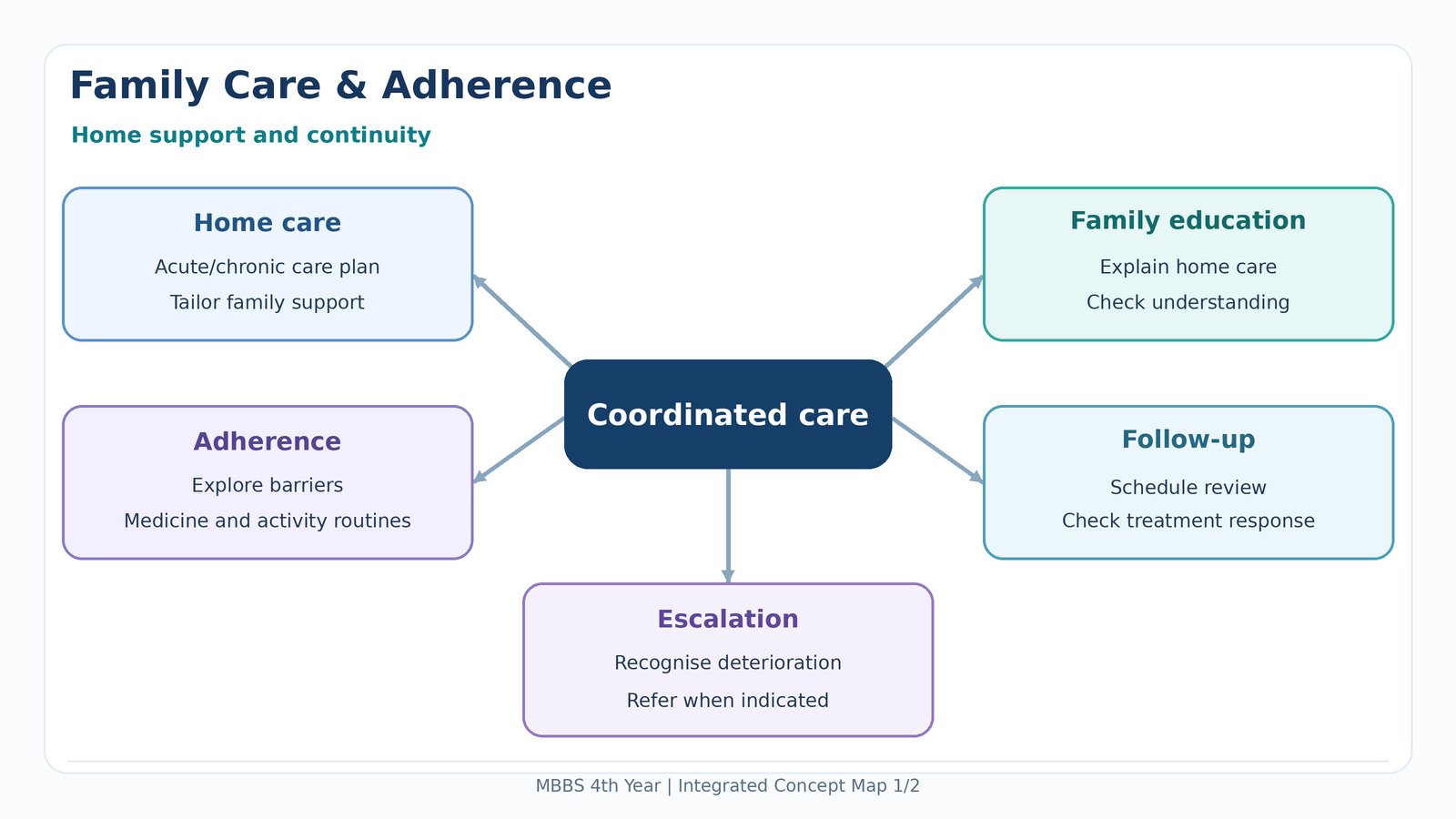
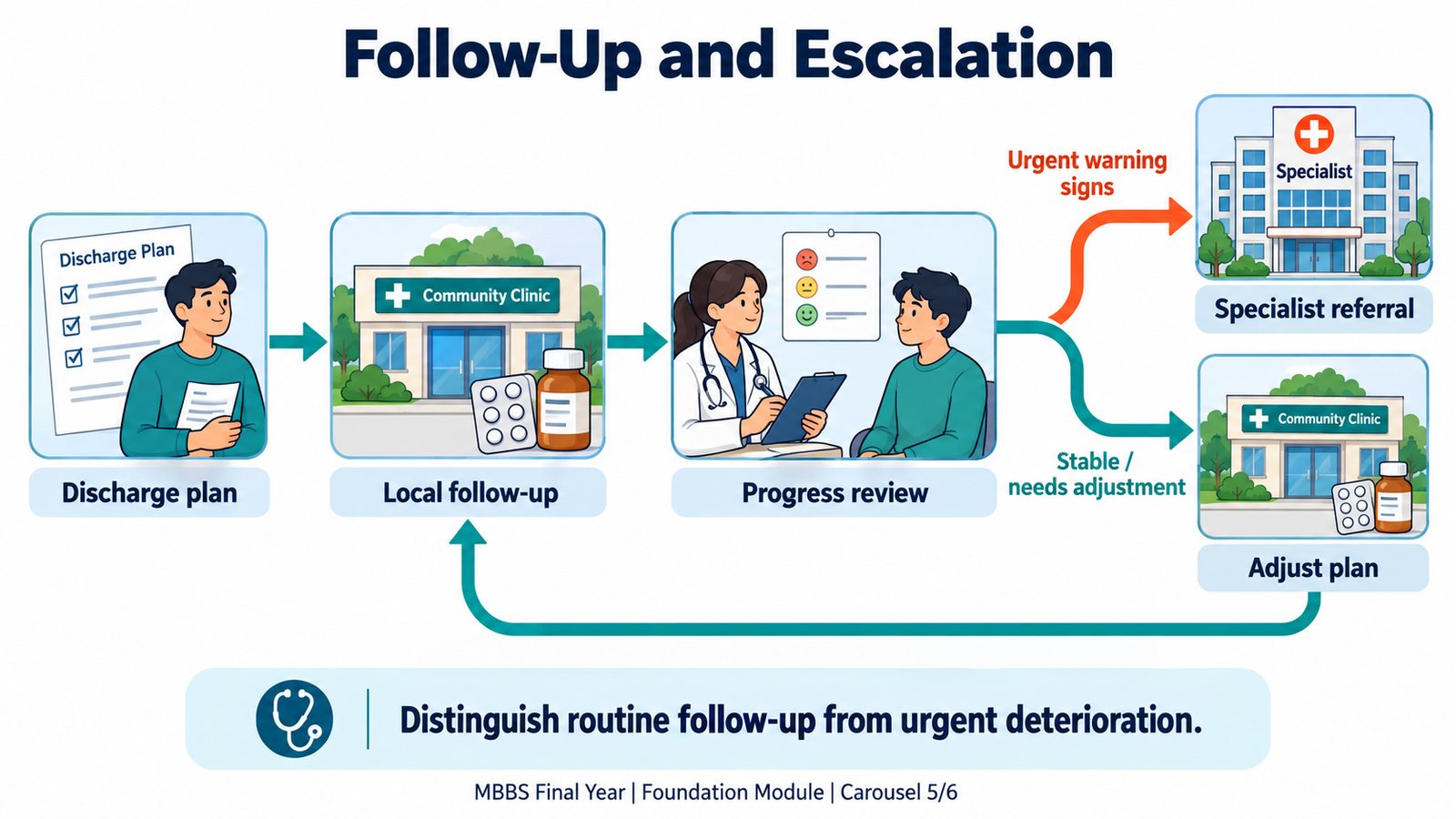
Follow-up is part of treatment, not an optional final instruction. Before discharge or the end of a consultation, decide what needs review, when it needs review and which service can provide it safely. A stable patient may be monitored through an appropriate local or primary-care service, with specialist input for problems that need it. The aim is continuity of care and timely escalation, rather than repeatedly sending the patient to a tertiary hospital for routine needs.
A clear follow-up plan identifies:
- the next review location and an agreed appointment or method of arranging one;
- who will review symptoms, daily functioning, adherence and treatment difficulties;
- how medicines and other treatment will remain available until review;
- which findings mean the plan should be changed or specialist advice sought;
- how the patient or caregiver can obtain help between appointments.
At review, compare the patient’s current state with the earlier assessment. Improving symptoms and function suggest the plan may be working. New symptoms, worsening function, adverse effects or repeated missed treatment require a fresh assessment of illness and barriers. Communication between hospital and community clinicians helps prevent gaps in care after discharge. :contentReference[oaicite:2]{index=2}
Urgent escalation: A patient who expresses current intent to harm themselves or others, has marked confusion, cannot meet basic needs safely, or has an acute medical problem needs prompt clinical assessment. A routine appointment is not an adequate response to immediate danger.
F. Initial psychiatric assessment after admission
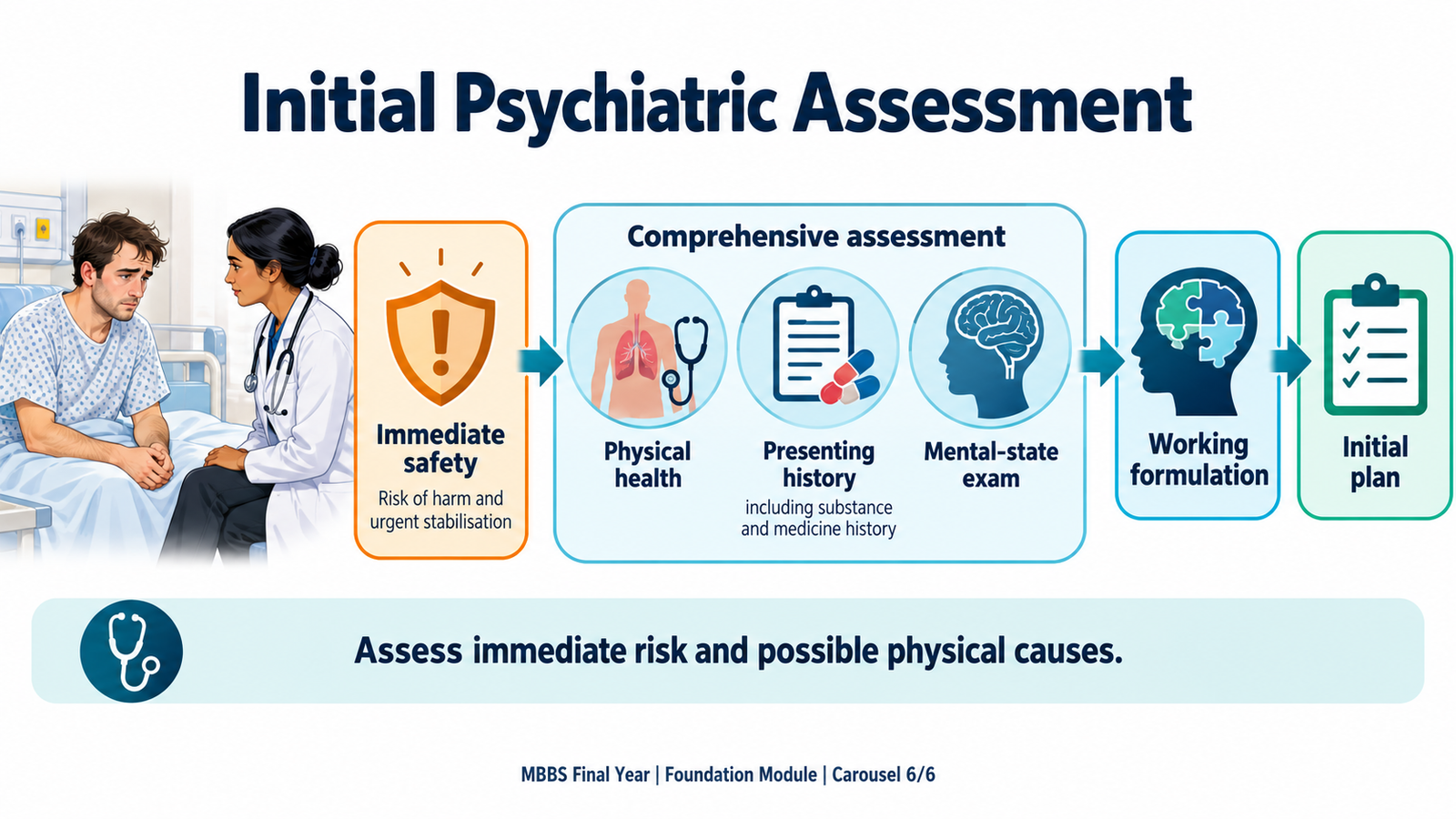
The first assessment of an admitted patient has two purposes: identify any immediate danger and understand the problem well enough to begin a safe, individual care plan. A psychiatric symptom is not automatically evidence of a primary psychiatric disorder. A change in behaviour or thinking may also relate to physical illness, a medicine or substance use, so mental and physical health must be considered together.
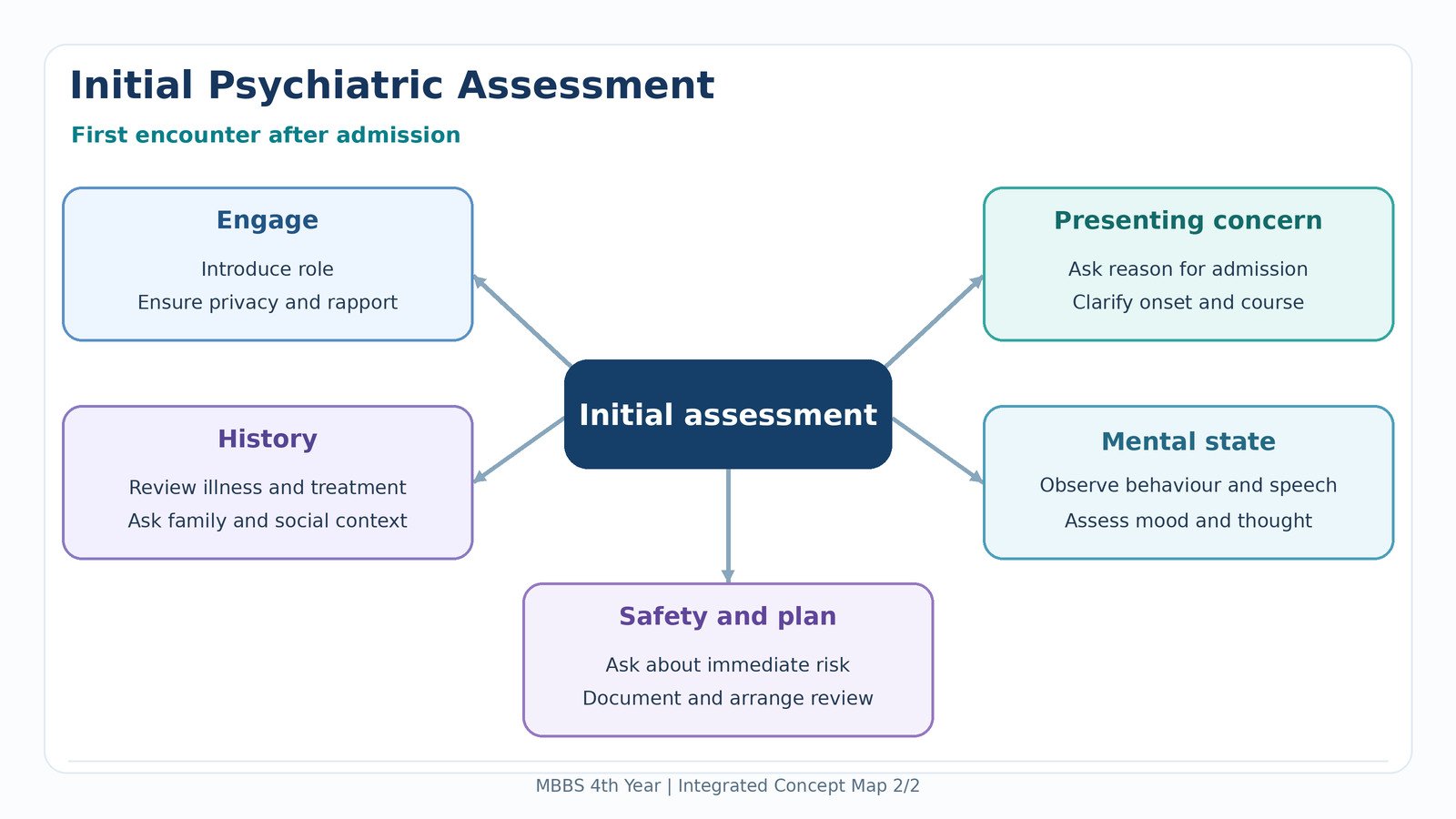
Begin with the reason for admission and the patient’s own account. Establish when the change began, how it has progressed, what preceded it and how it affects sleep, relationships, self-care and usual activities. Ask about previous episodes and treatment, current medicines, alcohol or other substances, relevant physical illness and available supports. With appropriate attention to consent and confidentiality, information from relatives or staff can clarify the time course when the patient cannot give a complete account.
The mental-state examination describes what is observed and reported now; it is distinct from the history of how the problem developed. Its main domains are appearance and behaviour; speech; mood and observed affect; the form and content of thought; perception; cognition and orientation; and insight and judgment. For example, a patient’s report of hearing a voice is a perceptual symptom, while a fixed false belief concerns thought content. Document what was found rather than using a diagnostic label as a substitute for description.
Physical assessment should address vital signs, consciousness and relevant examination findings. Further investigations depend on the presentation: an acutely confused or medically unwell patient needs assessment for a physical cause, while tests should otherwise answer a clinical question rather than be ordered as an automatic battery.
Assess safety directly and respectfully. Ask about thoughts of self-harm or suicide, any intent or plan, recent acts, risk to others, vulnerability and ability to care for basic needs. Consider immediate protective factors and available support, but do not let their presence dismiss a serious concern. The findings guide observation, urgent treatment and specialist involvement. Asking about self-harm during initial assessment is supported by WHO guidance for relevant mental health presentations.
The initial assessment ends with a working formulation: a brief explanation of the presenting problem, possible contributing factors, immediate risks and what remains uncertain. This guides the first management steps and what must be reassessed. It is acceptable for a final diagnosis to remain open while information is gathered.
AIM High-Yield Review
- Home care begins with the patient’s abilities, needs, available support and safety.
- Acute illness may need temporary help; chronic illness needs a plan that remains workable over time.
- Family participation should reflect the patient’s wishes and the caregiver’s actual capacity.
- Family education should explain the problem, agreed tasks, warning changes and how to seek help.
- Adherence applies to both medicines and nonpharmacological treatment.
- Unintentional non-adherence reflects a barrier to carrying out treatment; intentional non-adherence may reflect concerns or disagreement. Explore either without blame.
- Match adherence support to the cause: information alone cannot remove cost, access or adverse-effect barriers.
- A follow-up plan specifies where and how progress, treatment and difficulties will be reviewed.
- Appropriate local follow-up can prevent avoidable tertiary-care visits; deterioration still requires escalation.
- The first psychiatric assessment combines the history, current mental state, physical assessment and immediate safety assessment.
- The mental-state examination describes the patient’s current presentation; it does not replace the history.
- ⭐ Acute confusion or physical illness must not be assumed to be a primary psychiatric disorder.
- ⭐ Current self-harm intent, serious risk to others or inability to remain safe requires prompt assessment and an immediate safety plan.
- A working formulation links the findings and risks to the initial care plan, even when the diagnosis is still uncertain.
Initial Psychiatric Assessment: Mental-State Examination
Watch how a clinician assesses a patient’s current mental state. As you watch, identify observations about behaviour, speech, mood, thought, perception, cognition and risk.
If the video does not play in the LMS, open it on YouTube.