
Course Content
💊 Station 1 — Prescription Writing for Myocardial Infarction
Learning Outcome Construct an appropriate prescription for a patient with myocardial infarction.
0/1
🩺 Station 2 — Prescription Writing for Hypertension
Learning Outcome Construct an appropriate prescription for a patient with hypertension.
0/1
❤️ Station 3 — Prescription Writing for Congestive Cardiac Failure
Construct an appropriate prescription for a patient with congestive cardiac failure.
0/1
🧪 Station 4 — Estimation of Total Cholesterol
Demonstrate the procedure for estimation of total cholesterol.
0/1
🔬 Station 5 — Identification of Hemangioma
Identify the morphological changes occurring in hemangioma from a provided specimen/image.
0/1
☠️ Station 6 — Identification of Digitalis as a Cardiac Toxin
Identify digitalis as a cardiogenic toxin from the provided specimen/material.
0/1
☠️ Station 7 — Identification of Cannabis as a Cardiac Toxin
Identify cannabis as a cardiogenic toxin from the provided specimen/material.
0/1
☠️ Station 8 — Identification of Heroin as a Cardiac Toxin
Identify heroin as a cardiogenic toxin from the provided specimen/material.
0/1
🤝 Station 9 — Obtaining Informed Consent Before an Invasive Procedure
Obtain informed consent from a patient before an invasive procedure using appropriate professional communication.
0/1
🗣️ Station 10 — Patient Counselling Skills in a Cardiovascular Clinical Scenario
Demonstrate appropriate counselling skills during a structured cardiovascular patient interaction.
0/1
❤️🩺 AIM OSPE/OSCE Lab — CVS-II Module | 3rd Year MBBS

AIM OSCE / OSPE • MBBS

🧪 Station 4 — Estimation of Total Cholesterol

Rapid Revision • Laboratory Practical • Viva

🎯 Task

CANDIDATE TASK

You are provided with a serum sample, cholesterol reagent kit, standard and colorimeter/spectrophotometer. Demonstrate how you would estimate the total cholesterol concentration of the given sample and state how the result is calculated.

⚡ Model Station Answer

What to say in the exam

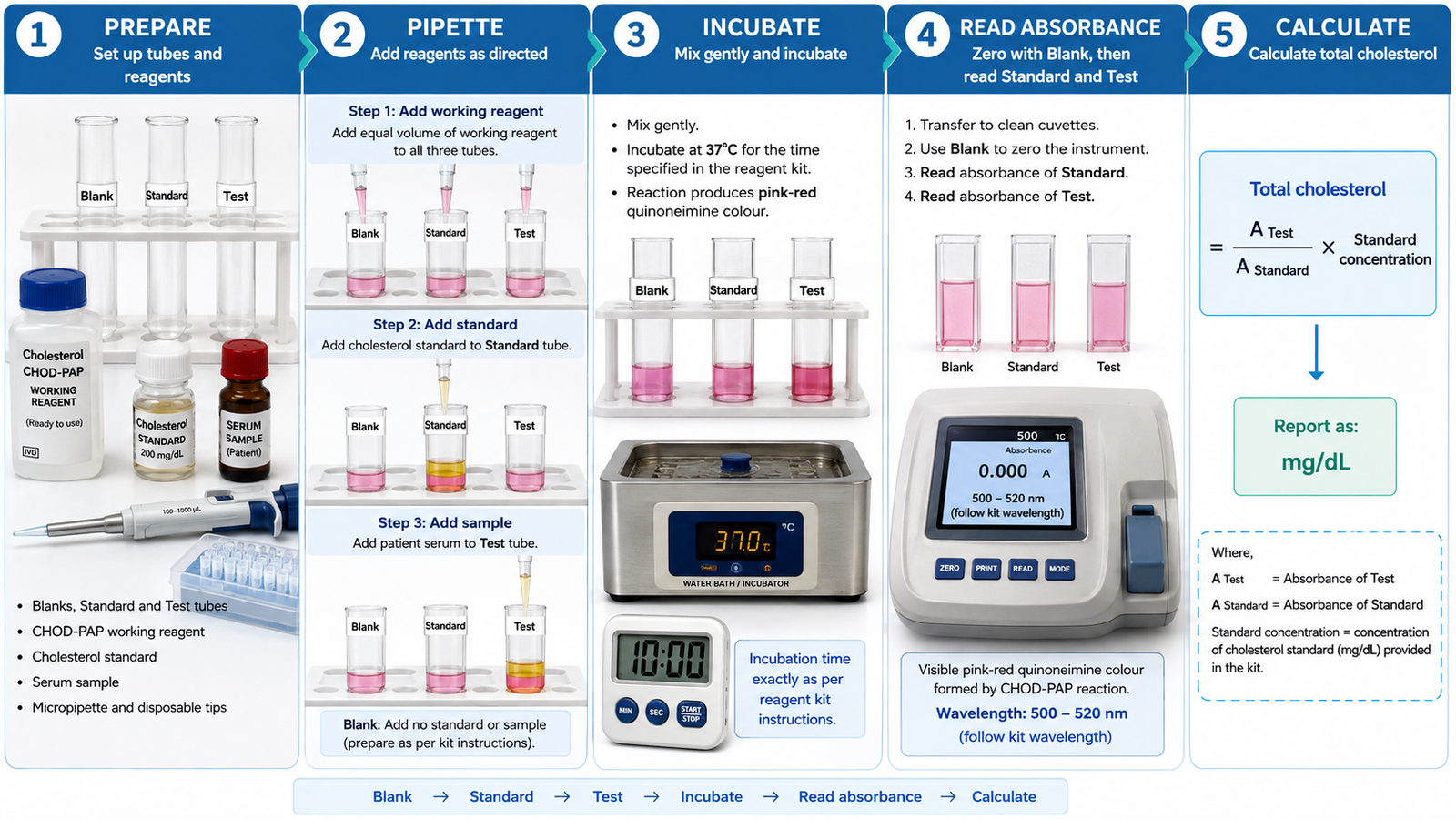
Technique: I will label three tubes as Blank, Standard and Test and add the cholesterol working reagent according to the kit protocol.

I will add the cholesterol standard to the Standard tube and the patient’s serum to the Test tube, mix and incubate for the specified time and temperature.

Reading: I will measure the absorbance of the Standard and Test against the Blank at the wavelength specified for the CHOD-PAP reagent.

Result: Total cholesterol = Absorbance of Test ÷ Absorbance of Standard × concentration of Standard, reported in mg/dL.

🔎 Stepwise Procedure / Approach

  1. Prepare the workstation. Wear appropriate laboratory protection and arrange clean tubes, micropipette/tips, serum, cholesterol standard, working reagent and colorimeter/spectrophotometer.
  2. Label three tubes: Blank (B), Standard (S) and Test (T).
  3. Add cholesterol working reagent to all three tubes in the volume specified by the reagent kit.
  4. Prepare the reactions. Add blank solution as specified to B, cholesterol standard to S and the patient’s serum to T using accurate micropipetting and separate clean tips.
  5. Mix and incubate all tubes for the manufacturer-specified time and temperature so that the coloured reaction develops.
  6. Measure absorbance. Set the recommended wavelength, zero the instrument with the Blank and record the absorbance of the Standard and Test.
  7. Calculate and report: (Absorbance Test ÷ Absorbance Standard) × Standard concentration. Record the result in mg/dL and dispose of laboratory material safely.
Exam note: Exact reagent volumes, incubation time and reading wavelength may vary between commercial CHOD-PAP kits. Follow the protocol supplied at the station rather than assuming a different kit’s values.

🖼️ Visual Learning

VISUAL 1

Total Cholesterol Estimation — CHOD-PAP Practical Sequence
🎥 Practical Video

🎥 Estimation of Serum Total Cholesterol by Enzymatic (CHOD-POD) Method

Source: Biochemistry Basics by Dr Amit

Demonstrates the practical sequence for enzymatic serum total-cholesterol estimation, including preparation of Blank, Standard and Test, absorbance measurement, calculation and viva-oriented discussion.


▶ Watch Practical Video

📝 Important Viva Questions

Q1. What is the commonly used enzymatic method for estimation of total cholesterol?

Answer: The CHOD-PAP/CHOD-POD enzymatic colorimetric method using cholesterol esterase, cholesterol oxidase and peroxidase.
Q2. What is the principle of the CHOD-PAP method?

Answer: Cholesterol esters are hydrolysed and cholesterol is oxidized to generate hydrogen peroxide. In the presence of peroxidase, a coloured quinoneimine compound is formed whose intensity is proportional to the cholesterol concentration.
Q3. Why is a reagent Blank used?

Answer: The Blank corrects for absorbance produced by the reagent and solvent so that the measured absorbance represents the reaction involving cholesterol.
Q4. Why is a cholesterol Standard required?

Answer: It contains a known cholesterol concentration and provides the reference absorbance used to calculate the concentration in the patient’s sample.
Q5. How is serum total cholesterol calculated?

Answer: Total cholesterol = Absorbance of Test ÷ Absorbance of Standard × concentration of the Standard.
Q6. Which specimen is commonly used for this test?

Answer: Serum is commonly used. Suitable plasma may also be accepted depending on the reagent manufacturer’s instructions.
Q7. Name common practical errors that may alter the result.

Answer: Inaccurate pipetting, wrong tube identification, incorrect incubation, contaminated cuvettes, incorrect wavelength and failure to zero the instrument properly can produce erroneous results.

Scroll to Top
💬 WhatsApp Support