
AIM OSCE / OSPE • MBBS
☠️ Station 6 — Identification of Digitalis as a Cardiac Toxin
Rapid Revision • Visual Recognition • Viva
🎯 Task
CANDIDATE TASK
Examine the provided plant specimen/material carefully. Identify the poison and state its toxicological nature.
Examine the provided plant specimen/material carefully. Identify the poison and state its toxicological nature.
⚡ Model Station Answer
What to say in the exam
Identification: The specimen is Digitalis (foxglove).
Nature: It is a cardiac glycoside / cardiogenic poison.
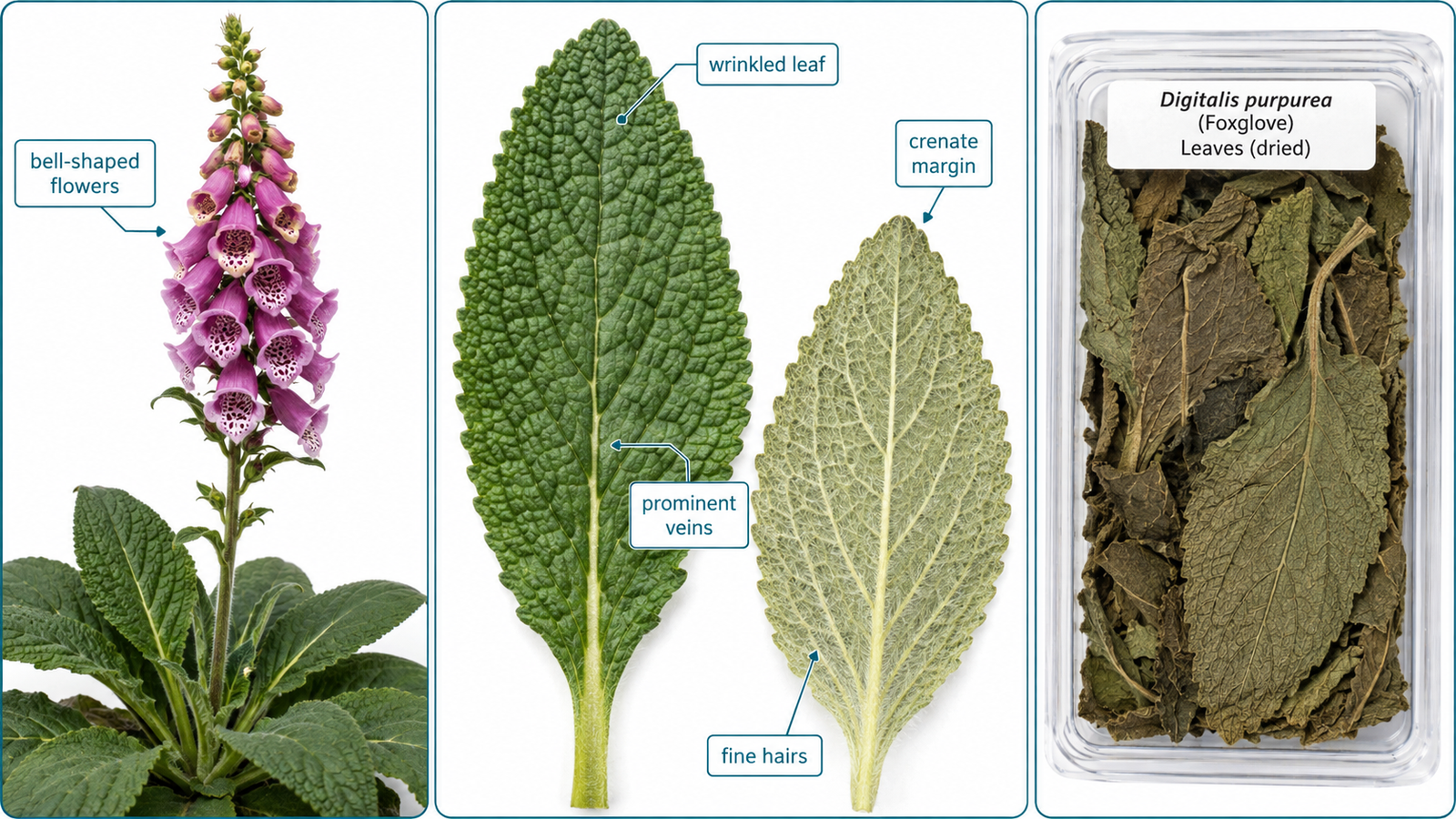
Key recognition features: Digitalis leaves are characteristically wrinkled, prominently veined and usually hairy, with a crenate margin; the foxglove plant has characteristic tubular, bell-shaped flowers.
Toxic principle: Cardiac glycosides such as digitoxin and digoxin.
🔎 Stepwise Procedure / Approach
- Observe the material systematically without tasting or unnecessarily handling an unknown toxic specimen.
- If leaves are provided, assess their shape, colour and surface.
- Look for a characteristically wrinkled leaf surface with prominent venation.
- Examine the margin for a crenate or bluntly toothed appearance.
- Look for fine pubescence, particularly on the lower leaf surface.
- If the whole plant is shown, recognize the tall flowering spike with tubular, bell-shaped foxglove flowers.
- Correlate the characteristic plant and leaf features and identify the specimen as Digitalis.
- State that Digitalis contains cardiac glycosides and is therefore a cardiogenic poison.
“`
Exam point: Identification should be based on visible specimen features. Never taste an unknown plant or toxic material during a practical examination.
🖼️ Visual Learning
VISUAL 1
Digitalis — Practical Specimen Recognition
🎥 Practical Video
🎥 Practical Demonstration
DIGITALIS | Cardiac Glycoside | Herbal Medicinal Plant | Pharmacognosy | Morphology & Microscopy
Source: PHARMAROCKS — The Way of Success
Demonstrates Digitalis plant and leaf morphology together with practical identifying features, helping reinforce specimen recognition for a spotter station.
📝 Important Viva Questions
Q1. What is Digitalis?
Answer: Digitalis is foxglove, a plant containing potent cardiac glycosides and capable of producing cardiotoxic poisoning.
Q2. What are the important toxic principles of Digitalis?
Answer: Cardiac glycosides, particularly digitoxin and digoxin-related glycosides.
Q3. What visible features help identify a Digitalis leaf?
Answer: A wrinkled surface, prominent venation, crenate margin and fine pubescence are useful recognition features.
Q4. Why is Digitalis classified as a cardiac poison?
Answer: Its cardiac glycosides interfere with cardiac electrical activity and contractility and can produce dangerous arrhythmias.
Q5. What is the principal cellular target of digitalis glycosides?
Answer: They inhibit the myocardial Na⁺/K⁺-ATPase.
Q6. What important manifestations may occur in Digitalis toxicity?
Answer: Nausea, vomiting, visual disturbance, bradycardia, conduction abnormalities and various potentially serious cardiac arrhythmias may occur.
Q7. What is the specific antidotal treatment for severe digoxin or Digitalis glycoside toxicity?
Answer: Digoxin-specific antibody fragments (digoxin immune Fab) are used in severe or life-threatening toxicity.