
Course Content
💊 Station 1 — Prescription Writing for Myocardial Infarction
Learning Outcome Construct an appropriate prescription for a patient with myocardial infarction.
0/1
🩺 Station 2 — Prescription Writing for Hypertension
Learning Outcome Construct an appropriate prescription for a patient with hypertension.
0/1
❤️ Station 3 — Prescription Writing for Congestive Cardiac Failure
Construct an appropriate prescription for a patient with congestive cardiac failure.
0/1
🧪 Station 4 — Estimation of Total Cholesterol
Demonstrate the procedure for estimation of total cholesterol.
0/1
🔬 Station 5 — Identification of Hemangioma
Identify the morphological changes occurring in hemangioma from a provided specimen/image.
0/1
☠️ Station 6 — Identification of Digitalis as a Cardiac Toxin
Identify digitalis as a cardiogenic toxin from the provided specimen/material.
0/1
☠️ Station 7 — Identification of Cannabis as a Cardiac Toxin
Identify cannabis as a cardiogenic toxin from the provided specimen/material.
0/1
☠️ Station 8 — Identification of Heroin as a Cardiac Toxin
Identify heroin as a cardiogenic toxin from the provided specimen/material.
0/1
🤝 Station 9 — Obtaining Informed Consent Before an Invasive Procedure
Obtain informed consent from a patient before an invasive procedure using appropriate professional communication.
0/1
🗣️ Station 10 — Patient Counselling Skills in a Cardiovascular Clinical Scenario
Demonstrate appropriate counselling skills during a structured cardiovascular patient interaction.
0/1
❤️🩺 AIM OSPE/OSCE Lab — CVS-II Module | 3rd Year MBBS

AIM OSCE / OSPE • MBBS

❤️ Station 3 — Prescription Writing for Congestive Cardiac Failure

Rapid Revision • Practical Skills • Viva

🎯 Task

Candidate Task

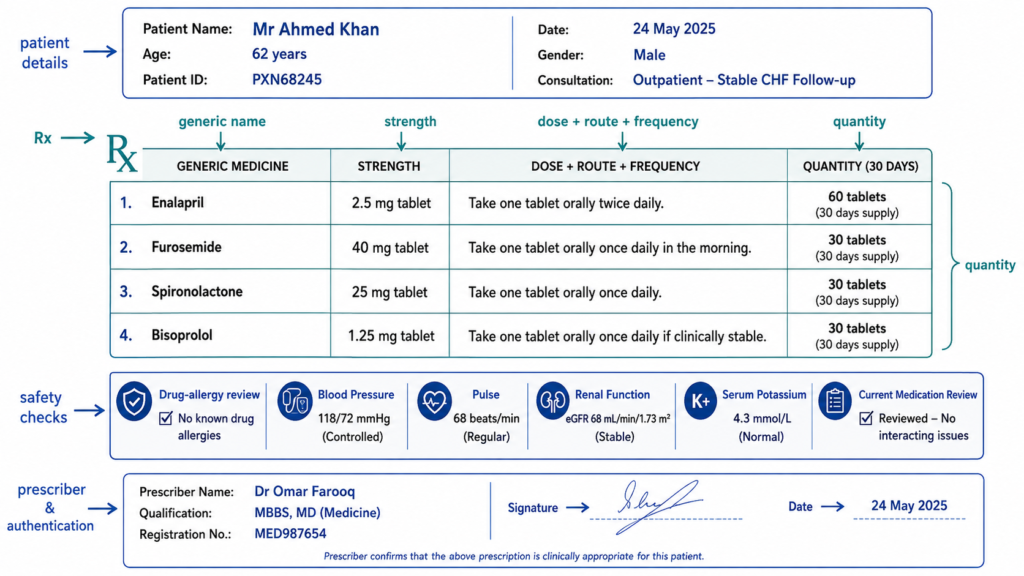
A 62-year-old patient with stable symptomatic congestive cardiac failure has peripheral edema. Relevant clinical assessment, renal function and serum electrolytes have been provided and there are no stated drug allergies. Write an appropriate outpatient prescription for this patient.

⚡ Model Station Answer

What to write in the exam
Name: Mr Ahmed Khan
Age: 62 years   |  
Date: ____ / ____ / ______
Tab. Enalapril 2.5 mg
Take one tablet orally twice daily.
Tab. Furosemide 40 mg
Take one tablet orally once daily in the morning.
Tab. Spironolactone 25 mg
Take one tablet orally once daily.
Tab. Bisoprolol 1.25 mg
Take one tablet orally once daily if clinically stable.
Exam point: A safe prescription clearly states the patient details, date, generic medicine, dosage form, strength, dose, route, frequency, quantity and prescriber authentication.

🔎 Stepwise Procedure / Approach

    1. Review the scenario. Confirm the indication, clinical stability, current medicines and drug allergies.
    2. Check prescribing safety. Review blood pressure, pulse, renal function and serum potassium where relevant.
    3. Write patient details. Record the patient’s name, age and date clearly.
    4. Write the Rx. Use generic medicine names and specify the dosage form and strength.
    5. Write complete directions. State the dose, route and frequency clearly without ambiguous abbreviations.
    6. Specify quantity. State the intended duration or total quantity to be dispensed.
    7. Recheck the prescription. Look for contraindications, interactions, duplication, inappropriate doses or omitted information.
    8. Authenticate. Sign, date and provide the required prescriber identification or registration details.

🖼️ Visual Learning

VISUAL 1

Correct Prescription Writing for Congestive Cardiac Failure


🎥 Practical Video

🎥 Practical Demonstration — How to Write a Prescription
Source: Pharmacology Tutorials

A short practical demonstration of the essential components of a prescription, including patient particulars, medicine details, directions, date, signature and prescriber identification.


▶ Watch Practical Video

📝 Important Viva Questions

Q1. What are the essential parts of a correctly written prescription?

Answer: Patient details, date, Rx, generic medicine name, dosage form, strength, dose, route, frequency, quantity and prescriber authentication.

Q2. Why should generic medicine names preferably be used?

Answer: Generic names reduce ambiguity and allow clear identification of the active medicine irrespective of brand.

Q3. What is the role of furosemide in congestive cardiac failure?

Answer: Furosemide is a loop diuretic used mainly to relieve fluid overload and symptoms of congestion.

Q4. What should be monitored when prescribing an ACE inhibitor such as enalapril?

Answer: Blood pressure, renal function and serum potassium should be assessed and monitored.

Q5. What important laboratory parameters should be checked with spironolactone?

Answer: Serum potassium and renal function are important because spironolactone can cause hyperkalemia.

Q6. When is initiation or up-titration of a beta-blocker appropriate in heart failure?

Answer: It should generally be started or increased when the patient is clinically stable rather than during significant acute decompensation.

Q7. What is a common OSCE error in prescription writing?

Answer: Common errors include omitting the strength, route, frequency, quantity, date or signature, and using unclear abbreviations.

Scroll to Top
💬 WhatsApp Support